
What Are Tires Made of: Rubber, Steel, and Chemistry
This post contains affiliate links. As an Amazon Associate, we earn from qualifying purchases.
Modern tires are made from over 200 ingredients blended into a composite of rubber, fabric, steel, and chemicals. These materials are assembled into a radial tire with nine main parts, inner liner, carcass ply, sidewall, steel belts, and tread, each formulated for a specific job: airtightness, strength, flexibility, or grip.
The exact percentage of those 200-plus ingredients in the answer to what are tires made of varies by the type of tire being built. A high-performance summer tire uses a different rubber compound and filler mix than a long-wearing highway tire, which is why they feel and wear so differently on the road. The goal is always the same: balance traction, durability, fuel efficiency, and cost in a product that must handle thousands of miles of heat, pressure, and weather.
What follows is a breakdown of the five material groups in every tire, how they’re assembled, and what that recipe means for wet braking, tread life, and rolling resistance. By the end, you’ll be able to read a tire’s sidewall and spec sheet with a clearer sense of what you’re actually buying.
Key Takeaways
- A standard tire carcass contains about 1,400 textile cords, each capable of resisting 33 pounds of force.
- The tread compound is a precise mix of rubber, fillers like carbon black or silica, and chemical agents that directly trade off wet grip against rolling resistance.
- Steel belts under the tread provide a rigid base and determine much of the tire’s strength, while the bead made of steel wires anchors the tire to the wheel.
- Tires lose 1 to 2 psi per month under normal conditions, and pressure should be checked with an accurate gauge when the tires are cold (parked 3+ hours).
- The Uniform Tire Quality Grading (UTQG) treadwear number is a comparative rating; a grade of 200 should wear twice as long as the control tire graded 100.
The Core Recipe: Rubber, Reinforcement, and Fillers
Every tire starts with five groups of raw materials. Michelin notes over 200 ingredients go into a tire, with their percentages shifting based on the tire’s intended use. This isn’t a single recipe for what are tires made of. It’s a menu where the chef, the tire engineer, selects ingredients to hit specific performance targets.
First, you need the rubber. Natural rubber is the main component of the tread layers, prized for its elasticity and heat resistance. Synthetic rubber, derived from petroleum, forms part of the treads for cars, vans, and 4x4s. It offers more consistent properties and is essential for hitting performance goals that natural rubber alone can’t achieve. The choice between them, and their blend, is one of the first decisions in tire manufacturing.
Next comes the skeleton. Textile reinforcement cords, usually polyester or nylon, form the carcass ply. This is the layer above the inner liner that gives the tire its shape and resists inflation pressure. A standard tire carcass contains about 1,400 of these cords, and each one can resist a force of 33 pounds. Then there’s steel. Very fine, high-tensile steel cords are bonded into rubber to create the belts under the tread and the beads that grip the rim.
The reinforcing fillers, carbon black and silica, are not inert powder. They form a chemical bond with the rubber polymer chains. This reinforcement is what allows a soft, grippy compound to survive thousands of miles of abrasion without dissolving into dust.
Finally, the fillers and chemicals. Carbon black is a reinforcing agent that improves durability and is the primary reason tires are black. Silica is another key filler, often used to improve wet traction and reduce rolling resistance in modern compounds. Then there are numerous chemical agents, antioxidants, antiozonants, vulcanizing agents like sulfur, added for unique properties such as low rolling resistance or ultra-high grip.
From Raw Soup to Shaped Assembly
The manufacturing process transforms these raw materials into a cohesive, durable product. It’s a mix of automated precision and skilled handwork, designed to reproduce the same tire performance whether it’s built in the United States, Europe, or Asia.
The process begins with compounding and mixing. Raw natural and synthetic rubber are combined with fillers, chemicals, and oils in massive mixers called Banbury mixers. This creates various rubber compounds, a firmer one for the sidewall, a tougher one for the inner liner, and a specialized one for the tread. These different compounds exist because, as the USTMA notes, rubber compounding is a complex science to produce compounds with specific characteristics for their location and function in the tire.
Next, component preparation. The textile cords are coated with rubber to form the carcass ply. Steel wires are bundled, coated, and woven into belts. The bead wires are shaped and covered. All these components are then assembled on a tire-building machine. The inner liner goes on first, followed by the carcass plies, the sidewalls, the beads, and the steel belts. At this stage, the tire is a soft, unvulcanized “green tire.”
The final step is vulcanization. The green tire is placed into a heated mold under pressure. The heat triggers the vulcanization process, where sulfur forms cross-links between the rubber polymer chains. This process changes the soft, sticky compound into the resilient, elastic material we know. The mold also imparts the tread pattern and sidewall markings onto the tire. After curing and a final quality inspection, the tire is complete.
| Tire Component | Primary Materials | Key Function |
|---|---|---|
| Tread | Natural/Synthetic Rubber, Carbon Black/Silica, Chemical Agents | Provides traction, wear resistance, and heat dissipation. |
| Steel Belts | High-Tensile Steel Cords, Rubber | Stabilizes tread, improves strength, and resists punctures. |
| Carcass Ply | Textile Cords (Polyester/Nylon), Rubber | Forms the tire’s shape and contains inflation pressure. |
| Sidewall | Rubber Compounds, Antioxidants | Protects tire sides from curb damage and flexes to absorb shocks. |
| Inner Liner | Synthetic Rubber (Butyl) | Provides an airtight seal to hold inflation pressure. |
| Bead | Steel Wires, Rubber | Anchors the tire securely to the wheel rim. |
The Performance Chemistry Inside Your Tread
The tread compound is where the tire’s personality is defined. It’s a precise, and often proprietary, recipe where tiny adjustments change how the tire grips, wears, and rolls.
The fundamental trade-off is between grip and efficiency. A 2010 NHTSA study on tire dynamic mechanical properties made this clear. It found that increasing the “tan δ at 0 °C” measure of the tread compound correlates to improved wet traction. Conversely, lowering “tan δ at 60° C” correlates to improved rolling resistance. In plain terms, a compound formulated to be extra sticky when wet will typically create more friction as it rolls, hurting fuel economy. Most tread compounds fit this linear trade-off.
Where this goes sideways: Choosing a tire based solely on its treadwear warranty number. The UTQG treadwear grade is a comparative rating tested under controlled government conditions, not a real-world mileage promise. A grade of 200 should wear twice as long as the control tire (grade 100), but the test doesn’t account for your alignment, driving style, or road surfaces.
Manufacturers break this trade-off by using advanced, and more costly, materials. This is where silica shines. Silica filler, when combined with a special coupling agent, can improve wet grip without a corresponding penalty in rolling resistance. It’s a key ingredient in many premium “low rolling resistance” tires that also boast good wet weather performance. The study noted that for tires not following the typical trade-off, manufacturers employed techniques like varying filler level, polymer type, or using precipitated silica, which may have increased the tire’s manufacturing costs.
This chemistry also dictates a tire’s limitations. For example, NHTSA’s Pneumatic Tire report and other sources state that summer tires are not designed to operate in temperatures below freezing, or on snow and ice. Their compound is formulated for warm, dry, or wet pavement and becomes hard and ineffective in the cold. The wrong compound for the conditions is a safety issue, not just a performance one.
How Materials Dictate Tire Types and Failures
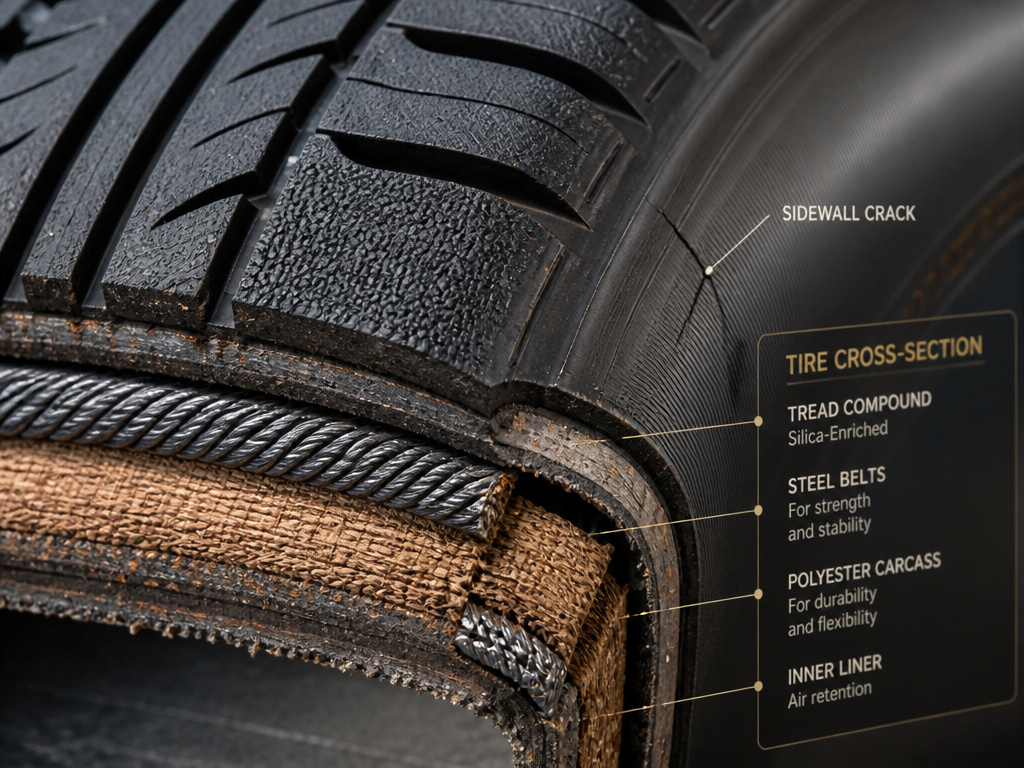
You don’t choose a high-performance tire over a grand-touring tire based on tread pattern alone. The material composition is the real differentiator, and it leads directly to the wear patterns and failures you see in the real world.
It will wear quickly because the sticky rubber abrades away faster. It may also develop “graining”, a rough, textured surface on the tread blocks from extreme heat and lateral forces. An all-season commuting tire uses a harder, more durable compound. It might last much longer, but it will rarely feel as planted in the corners. Its failure mode is often age-related cracking in the sidewall or tread before the rubber actually wears out.
The internal materials face their own stresses. The carcass ply of textile cords can be damaged by impact with a pothole or curb, leading to a bulge in the sidewall. This is a broken cord, and the tire must be replaced. The steel belts can separate from the surrounding rubber if the tire is run severely underinflated, generating excessive heat. You might feel this as a vibration before seeing any external sign.
| Tire Type | Tread Compound Focus | Reinforcement Focus | Common Failure Mode |
|---|---|---|---|
| Ultra-High Performance Summer | Maximum dry/wet grip (High silica, soft rubber) | Stiff sidewalls for response | Rapid tread wear, heat-induced graining |
| Grand Touring All-Season | Longevity, comfort, low noise (Harder rubber, balanced fillers) | Standard belts, comfort-oriented casing | Age-related cracking, wear to wear bars |
| All-Terrain (Light Truck) | Cut/chip resistance, off-road traction | Robust, multiple ply ratings, thick sidewalls | Chunking of tread blocks, sidewall punctures |
| Eco-Focused Low Rolling Resistance | Silica-rich for efficiency, moderate grip | Lightweight materials | Can be more susceptible to even wear issues if underinflated |
Research into dandelion rubber (Taraxagum) and recycled carbon black aims to reduce the environmental impact of the over 200 ingredients without sacrificing performance. This isn’t just marketing; it’s a re-engineering of the core recipe.
Standards, Aging, and the Reality of “200+ Ingredients”
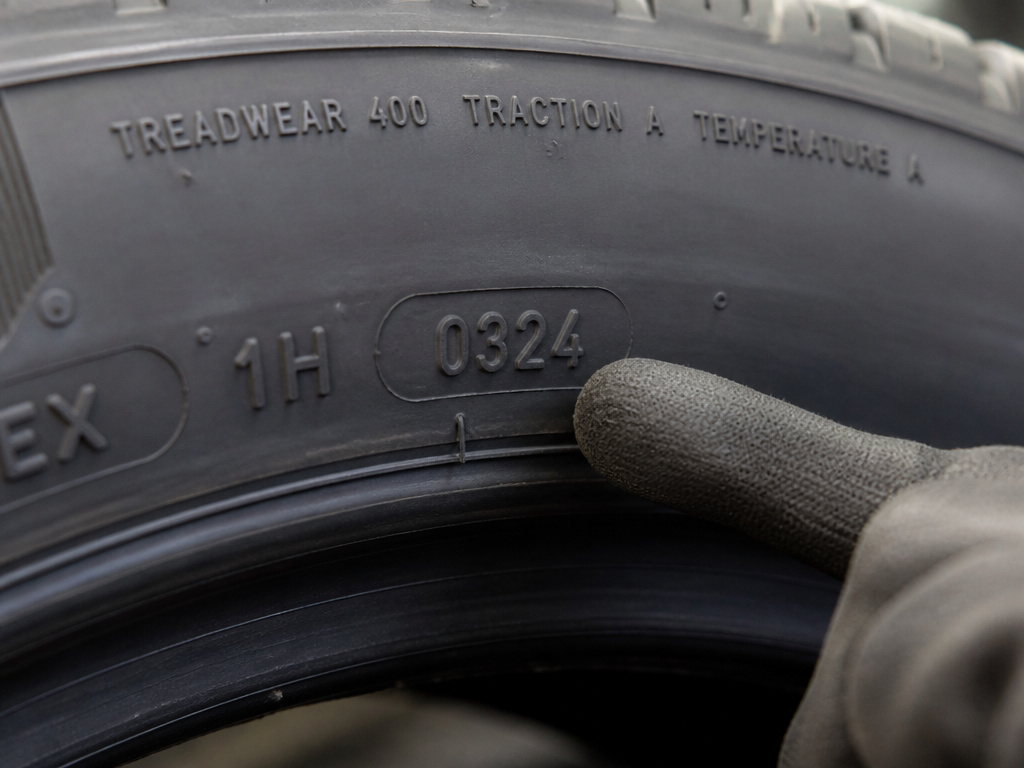
The tire on your car isn’t just a bundle of materials; it’s a regulated safety component.
The TIN itself is a material truth. The last four digits indicate the week and year of manufacture (e.g., “0324” is the third week of 2024). This matters because the rubber compounds age. Antioxidants and antiozonants in the compound slow degradation, but they don’t stop it.
Common mistake: Storing tires in a brightly lit, well-ventilated garage. The USTMA’s care guide specifies tires should be stored away from ozone-generating sources (like electric motors) and in an area with minimal air circulation. Ozone and constant airflow accelerate the oxidation that makes rubber brittle.
The “200+ ingredients” figure from Michelin is a useful shorthand for complexity, but the percentage of each varies. A tire’s exact composition is a trade secret. What’s public is the outcome: the UTQG grades for treadwear, traction, and temperature on the sidewall. These are the result of standardized tests that, while imperfect, allow for comparison. They are the closest thing you have to a verified report card on how those hundreds of ingredients performed in the lab.
What are tires made of that is sustainable?
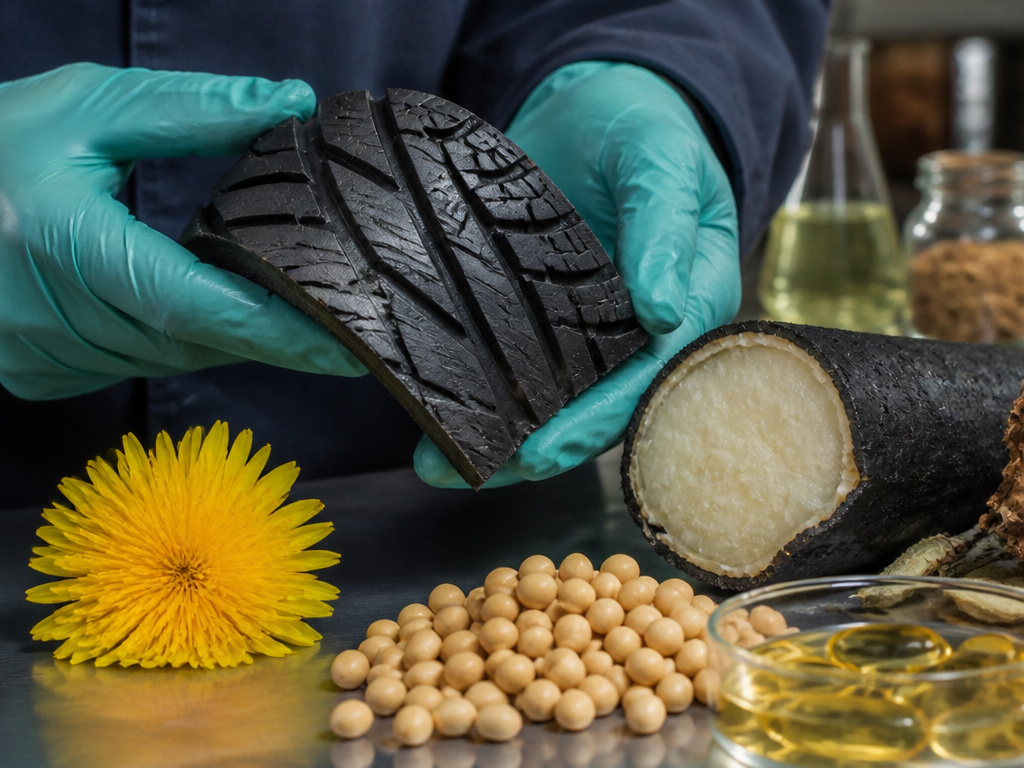
While the core recipe for a tire involves over 200 ingredients, the search for sustainable and alternative materials is a major focus for the industry. This includes research into sources of natural rubber beyond the traditional rubber tree, such as rubber derived from dandelions. The aim is to find materials that can reduce the environmental footprint of tire production without compromising performance. The exact percentage of any new material used would vary according to the type of tire being manufactured, just as traditional recipes do. The ultimate goal remains to balance critical factors like traction, durability, and rolling resistance in a product built to last.
Frequently Asked Questions
What brand of tires should I stay away from?
This is the wrong question. A brand’s lowest-tier budget tire might be a poor choice for performance, but their flagship model could be excellent. Instead of avoiding brands, avoid specific tires that perform poorly in independent tests for wet braking, wear, or rolling resistance. Look at test results, not the name on the sidewall.
Should tires last longer than 30,000 miles?
Many should, but it’s not a guarantee. The UTQG treadwear grade gives a clue. A tire graded 300 should, in theory, last three times as long as the 100-grade control tire under test conditions. Real-world mileage depends on your car’s alignment, driving style, road surfaces, and maintenance (especially inflation pressure). A tire that is underinflated can wear out significantly faster.
What tires are 100% made in the USA?
Very few, if any, tires are 100% made in the USA from raw materials to finished product. Global supply chains mean materials like natural rubber, synthetic rubber, and carbon black are sourced worldwide. A tire might be assembled in a U.S. Factory from both domestic and imported components. Look for the “DOT” code that includes a two-digit plant identifier to see where it was manufactured.
What ingredients in tires are hazardous?
During the vulcanization process, some chemical agents can be hazardous. However, in a finished, cured tire, these compounds are chemically locked into the stable rubber matrix. The primary environmental concern is improper disposal, as tires in landfills can leach certain chemicals.
The Bottom Line
A tire is a sophisticated composite material engineered around trade-offs. The over 200 ingredients are carefully selected to balance grip against longevity, and fuel efficiency against cost.
For your next tire purchase, move past the marketing. Look at the UTQG traction grade (AA is best) as a indicator of wet stopping power. Understand that a higher treadwear number suggests longer life, but only under the specific test conditions. Most importantly, match the tire’s material purpose to your driving reality. A high-silica, grand-touring compound is the right daily driver choice for far more people than an ultra-soft performance rubber.
Check the date code on the sidewall. Measure the tread depth. And remember that the best tire for you is the one whose material recipe aligns with the roads you actually drive, not the one with the most impressive ingredient count on paper.
