
Why the Tire Pressure Light Is ON When Tires Are Full?
This post contains affiliate links. As an Amazon Associate, we earn from qualifying purchases.
Your tire pressure monitoring system (TPMS) light is on because the system thinks at least one tire is 25% or more below the recommended cold pressure, even if your gauge reads fine. The five most common reasons are temperature drops, a slow leak you just masked, a failed sensor battery, a system that needs a reset after tire rotation, or a TPMS malfunction signaled by a blinking light.
That 25% threshold is the federal rule. The system isn’t a precise gauge; it’s a blunt warning that only triggers when pressure is seriously low. So when the light stays on with “full” tires, the system is working as designed, it’s just reacting to data that doesn’t match what you see. This explains why the tire pressure light is on when tires are full.
What follows is a step-by-step guide to diagnose the exact cause. This guide explains how to interpret the light’s behavior, including the common why the tire pressure light is on when tires are full scenario, why your manual gauge and the car’s computer can disagree, and what it costs to fix a dead sensor versus resetting a confused system.
Key Takeaways
- The TPMS light triggers at 25% underinflation, not when pressure is merely low. A tire at the recommended pressure needs to drop to 25% below that pressure to turn the light on solid.
- A blinking TPMS light for one minute followed by a solid light indicates a system malfunction, not low pressure. A solid light alone means the system detects low pressure.
- Tire pressure changes about 1 psi for every 10°F temperature swing according to General Motors, while the NHTSA cites a figure of approximately 0.8 psi per 10°F. A significant temperature drop can cause enough pressure loss to trigger the warning if the pressure was near the threshold.
- According to General Motors, TPMS sensor batteries are designed to last 10 years or 150,000 miles. Failure is not an “if” but a “when” for older vehicles.
- After inflating tires, you may need to drive for the system to recognize the corrected pressure. The NHTSA states driving above 16 mph may be needed, while General Motors notes driving above 20 mph for 2 minutes can restore correct values after a battery disconnect.
The #1 Reason: Temperature Changes
You filled your tires to 35 psi on a warm afternoon. The next chilly morning, the light is on. Your gauge reads 32 psi. The tires aren’t flat, so what gives?
The system uses the cold inflation pressure printed on your door jamb sticker as its benchmark. “Cold” means the vehicle has been parked for three or more hours, or driven less than one mile. The pressure in a cold tire changes with the ambient temperature outside. According to a General Motors technical bulletin, tire pressure changes about 1 psi for every 10°F of temperature change. The NHTSA cites a similar figure of 0.8 psi per 10°F.
A tire inflated to 35 psi at 70°F will read roughly 31 psi when the outside temperature drops to 30°F. That’s a 4-psi loss. If your system’s warning threshold is set at 26 psi (25% below 35 psi), you’re now only 5 psi away from the light turning on. A slightly underfilled tire or one with minor natural leakage can easily cross that line overnight.
This is why the light often turns off after you’ve driven awhile. Friction heats the tires, raising the pressure back above the warning threshold. It doesn’t mean the problem fixed itself; it means the tire is now warm. You still need to add air when the tires are cold to get back to the placard’s specified pressure.
A Slow Leak You Just Masked
This is the most dangerous cause. You see the light, check the pressure, find one tire at 28 psi, and fill it back to 35 psi. The light stays on. You assume it’s a glitch and drive off.
The light stays on because the system is still reading the sensor in that tire, which may not have updated yet, or because the pressure is still hovering near the threshold. More critically, you’ve just treated the symptom, not the cause. A tire that loses 7 psi didn’t do so because of the weather alone. It has a slow leak, a tiny nail, a corroded valve stem, or a poor seal between the tire and wheel.
Where this goes sideways: Ignoring a slow leak because the tire “holds air” after a fill. That leak will continue, causing ongoing pressure loss. You might not notice until the pressure is critically low during a high-speed drive, causing the tire to overheat and potentially fail.
The fix is simple and required: mix soapy water in a spray bottle and thoroughly wet the suspect tire’s tread, sidewall, and especially the valve stem. Spray the suspect tire thoroughly with soapy water and look for tiny bubbles. A nail can often be patched; a leaking valve core is an inexpensive fix. A leaking valve stem attached to the TPMS sensor might require a new sensor seal kit.
The System Needs a Reset or Relearn
Your TPMS isn’t just a set of dumb pressure gauges. Each sensor has a unique ID, and your car’s computer must know which sensor is in which wheel position, front left, front right, and so on. If you’ve recently rotated your tires, swapped to a different set of wheels, or replaced a sensor, that map is now wrong.
The car might think the low pressure is in the front left tire when it’s actually in the rear right. If your vehicle has different recommended pressures front and rear, this mismatch can cause a false warning. The system reads the pressure from the “wrong” location and compares it to the wrong threshold.
A General (NHTSA bulletin) states that TPMS sensors must be registered each time the wheels are rotated, swapped, or replaced.
The reset process varies by manufacturer. Some cars have a button in the glove box or under the dash. Others require driving a specific pattern at a certain speed. Many modern vehicles need a professional scan tool like an Autel or a Bartec to perform the relearn. This is a common point of confusion when you compare a why the tire pressure light is on when tires are full situation; checking pressure is one tool, resetting the light is another, and relearning sensor positions is a third. Don’t assume filling the tires will automatically correct this.
A Failing or Dead TPMS Sensor
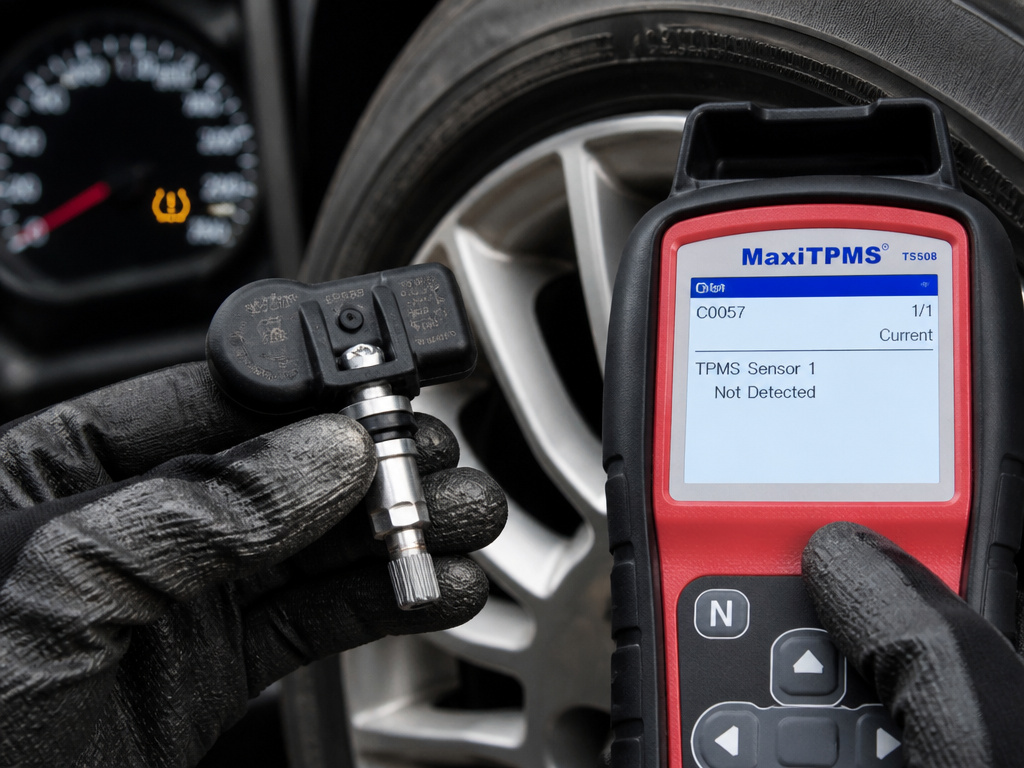
Every TPMS sensor has a small, non-replaceable battery sealed inside. General Motors states these sensors are designed to last for 10 years or 150,000 miles. When the battery dies, the sensor stops transmitting. Your car’s computer waits, and if it doesn’t hear from a sensor for a period of driving, it declares a malfunction.
This is where the light’s behavior is critical. A solid light indicates low pressure. A blinking TPMS light for about a minute, which then stays solid, is the universal signal for a system fault, often a dead sensor.
| Light Behavior | What It Means | Required Action |
|---|---|---|
| Solid, steady glow | Low tire pressure detected in one or more tires. | Check and adjust all tire pressures to the cold placard value. |
| Blinks for ~1 min, then stays solid | TPMS system malfunction (e.g., dead sensor, lost signal). | Diagnostic scan required to identify the faulty component. |
A single dead sensor will usually cause the system to show an error or incorrect reading for that tire’s pressure on the dashboard display. You can’t fix this with air. The sensor must be replaced, and the new sensor’s ID must be programmed into your vehicle’s computer. This is where knowing how to replace a TPMS sensor may be useful.
Blinking vs. Solid: What Your Light Is Actually Saying
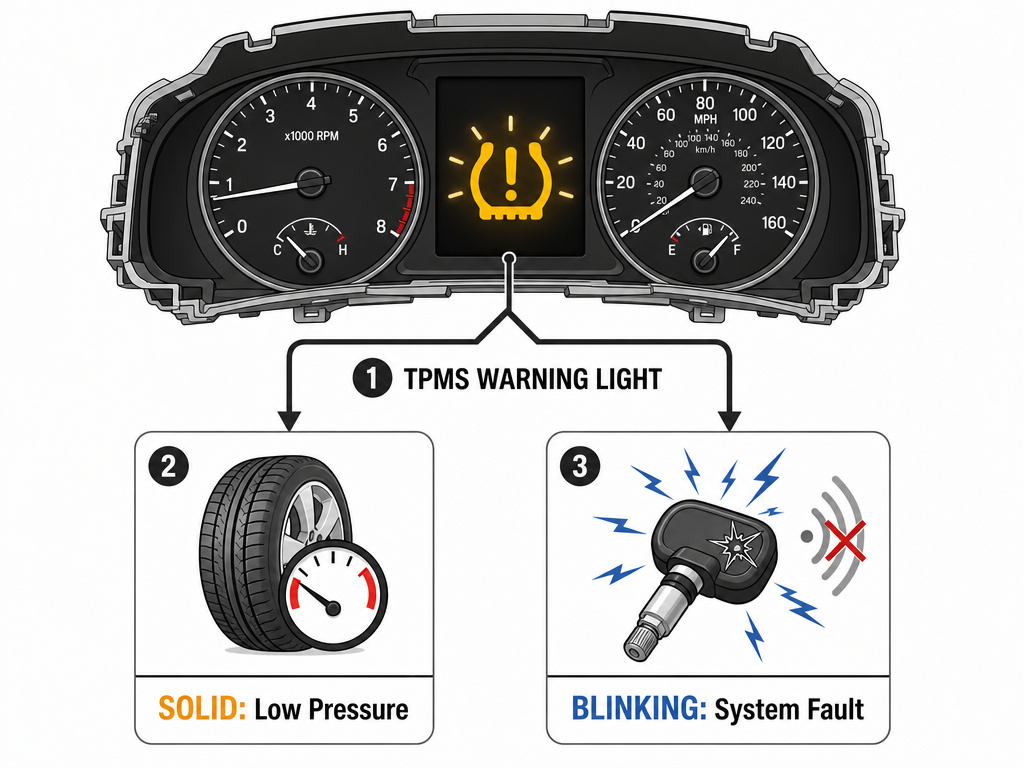
The difference between a blinking and a solid TPMS light isn’t a minor detail. It’s the system’s way of telling you whether the problem is with your tires or with its own ability to monitor them. Getting this wrong means you could be driving on a soft tire while blaming a computer glitch, or vice-versa.
A solid light means the system is functional and has received a low-pressure signal from at least one sensor. Trust it. Even if your manual gauge disagrees, the sensor’s reading is what the car uses. At high altitudes, a standard gauge can read higher than the actual pressure, which might explain the discrepancy.
The part nobody mentions: A blinking light isn’t always permanent. An intermittent fault, like a sensor with a weak battery that sometimes transmits, can cause the blinking warning to come and go on different drives. That inconsistency is itself a diagnostic clue pointing to a dying sensor.
If you see the blinking pattern, your next step is a professional diagnosis or a capable OBD2 scanner that can read TPMS codes. The fix could be replacing a sensor or a control module. But continuing to drive without knowing is a risk. A system that can’t warn you of low pressure is as bad as having no system at all.
How to Diagnose and Fix It: A Step-by-Step Flowchart
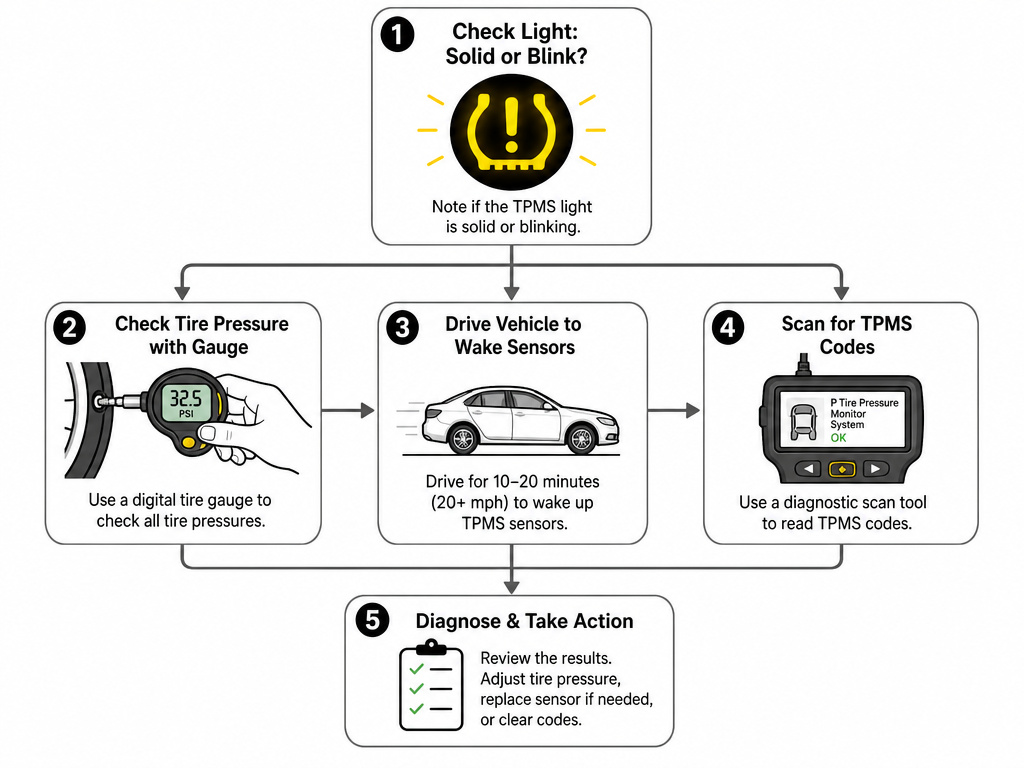
Don’t just guess. Follow a logical sequence. This chart covers the most likely causes in order of probability and cost to fix.
- Check the Light: Is it solid or did it blink first? If it blinked, proceed to sensor diagnosis (Step 5). If solid, move to Step 2.
- Check All Pressures with a Gauge: Do this when tires are cold (parked 3+ hours). Use the pressure on your driver’s door jamb sticker, not the tire sidewall. Fill all tires, including the spare if it has a sensor, to the exact spec.
- Drive the Vehicle: After filling, drive at speeds above 16-20 mph for several minutes. This wakes up the sensors and allows the system to update. For some 2009+ models, leaving the ignition in the “ON” position (engine off) after inflating can speed this up.
- Did the Light Go Off?
- Yes: The cause was underinflation, likely from temperature or slow natural loss. Monitor pressures weekly.
- No: The light remains solid. This suggests either a very slow leak (re-check pressures in 24 hours) or the system needs a relearn because tires were rotated. Consider if you’ve had recent tire service.
- Diagnose a Blinking Light or Persistent Solid Light: You’ll need a tool. A basic TPMS reset tool might trigger the sensors. A professional scan tool can read fault codes and identify the exact dead sensor. This confirms whether you need a TPMS sensor replacement.
| Your Scenario | Most Likely Cause | Fix (DIY vs. Pro) |
|---|---|---|
| Light on after cold snap, goes off after driving. | Temperature-related pressure drop. | DIY: Add air to cold placard pressure. |
| Light on, one tire is consistently 3-5 psi low every few days. | Slow leak (puncture, valve). | DIY/Pro: Find and repair leak. |
| Light on solid after tire rotation. | System needs positional relearn. | DIY/Pro: Perform TPMS reset/relearn procedure. |
| Light blinks, then stays solid. | Dead TPMS sensor or system fault. | Pro: Diagnostic scan to identify failed part. |
| Light on, all pressures perfect, no recent service. | Faulty sensor reading or system error. | Pro: Diagnostic scan required. |
Tools You Need (And What They Actually Do)
Confusion about tools is a huge barrier. Here is a clarification of the three main types.
- Tire Pressure Gauge: This only tells you the psi in the tire. It cannot communicate with your car’s computer. It’s for verification only. Every owner should have a digital or dial gauge.
- TPMS Reset/Relearn Tool: This tool talks to the sensors. It sends a signal to wake each one up so the car’s receiver can relearn their positions after a rotation. It does not diagnose faults or program new sensors. Brands like Autel and Bartec make common models.
- OBD2 Scan Tool: This plugs into your car’s diagnostic port under the dash. A advanced scanner can read TPMS fault codes, identify which sensor has failed, and often program new sensor IDs into the vehicle’s computer. This is what a shop uses.
You can’t use a gauge to fix a blinking light. You can’t use a reset tool to find a slow leak. Match the tool to the task.
Frequently Asked Questions
How long does it take for the tire pressure light to go off after filling?
It can take several minutes of driving at speeds above 16-20 mph for the system to update and extinguish the light. Some newer models may update faster if you leave the ignition in the “ON” position after inflating.
Is it safe to drive with the TPMS light on?
It depends. A solid light means at least one tire is significantly underinflated. You should reduce speed, avoid aggressive maneuvers, and check/fill the tires as soon as possible. Driving on a severely underinflated tire can cause it to overheat and fail. You can learn more about the risks in our guide on whether you can drive with TPMS light on. A blinking light indicates a system failure, meaning the light may not come on even if a tire goes flat. This is also unsafe and should be addressed.
Why does my tire pressure light come on when it’s cold?
As explained in the temperature section, air contracts as it cools, reducing tire pressure. If the pressure drops near or below the system’s 25% threshold, the light activates. It’s a direct physical effect, not a system error. We have a dedicated article exploring the TPMS light in cold weather.
Can overinflation trigger the TPMS light?
Generally, no. The federal standard (FMVSS 138) only requires the system to warn about underinflation. However, the Kia owner’s manual notes the light will turn off only if pressure is above the recommended inflation pressure. Some vehicle-specific systems might alert for overinflation, but it’s not the norm.
Before You Go
The TPMS is a backup, not a primary gauge. Its job is to yell when things are seriously wrong, not to whisper about a 2-psi deviation. When the light is on but tires seem full, the system isn’t lying, it’s working from different data.
The rule is mechanical, not mysterious. Start with a cold pressure check against the door sticker. If pressures are correct, note the light’s behavior: solid points to air pressure, blinking points to system hardware. That single observation cuts the problem in half. If you’ve rotated tires, assume a relearn is needed before you suspect a $200 sensor. And if the car is over a decade old, budget for sensor replacement as routine maintenance, like changing a timing belt. The battery inside doesn’t last forever.
Finally, understand what you’re paying for. Topping off air is free. A sensor relearn might cost a half-hour of labor. A single sensor replacement involves the cost of the part plus labor. Knowing the difference before you walk into the shop is how you avoid a $500 quote for a problem a $2 valve core could have solved.
