
Wheel Alignment Explained: Camber, Caster, Toe
This post contains affiliate links. As an Amazon Associate, we earn from qualifying purchases.
Wheel alignment explained means setting camber, caster, and toe to factory tolerances so tires roll straight, scrub less, and the steering wheel stays centered. Toe controls scrub fastest, camber affects tire tilt, and caster affects steering return. A copy of the alignment machine printout showing before and after alignment specifications records before and after values, and a pull check starts with camber, caster, and road crown.
That printout is where the real service lives, because a shop can turn bolts and still miss the tolerance range. The same numbers also separate a true alignment job from a cheap front-toe tweak. Road crown, tire force, and a bent part fake a bad angle.
What follows: the three angles, the pull checks, the printout fields, and the cases where alignment won’t fix the problem.
Key Takeaways
- Read the before and after printout before you accept the job.
- Pull checks start with camber and caster, while toe moves the steering wheel and scrub.
- Road crown fakes a pull, so a flat-road test matters.
- A modified suspension or tire set voids alignment warranty coverage.
- Front camber isn’t adjustable on VW models except Touareg.
Wheel Alignment Explained: What Camber, Caster, and Toe Do
Camber, caster, and toe set the tire’s contact patch and steering return. A camber, caster, and toe check is the core of wheel alignment explained.
Wheel alignment sets camber, caster, and toe to factory tolerances. Camber controls tire tilt, caster affects steering return, and toe controls scrub. Thrust angle links rear toe to steering center. SAI differences point to bent parts when they exceed 1 degree. A printout records before and after values. Shops compare them with model-specific ranges for warranty evidence.
Camber is the tilt of the wheel when viewed from the front. Positive camber leans the top outward; negative camber leans the top inward. Subaru and Volkswagen define camber this way.
Caster is the forward or rearward tilt of the steering pivot. A positive caster axis tilts toward the rear. It helps the steering return to center. Toyota and Lexus bulletins tie pull to caster values.
Toe is the direction the tires point when viewed from above. Toe-in points the fronts inward; toe-out points them outward. Subaru states that toe alignment causes off-center steering, dog-tracking, and tire wear, not drift or pull.
SAI is the steering pivot line compared with true vertical. Subaru says a left-right SAI difference over 1 degree points to damaged parts. If SAI is lower on one side, that may indicate a bent lower control arm. If SAI is higher on one side, that may indicate upper strut mount damage.
Thrust angle is the direction the rear axle points because of rear toe. A bad thrust angle makes the steering wheel look off-center.
What to check before you pay for an alignment?
A curb strike happens in one second. The damage hides until the tire edge feels sharp. Before you pay for a wheel alignment job, check for signs of misalignment on the car, not just the steering wheel.
GM requires the vehicle to be in Original Equipment condition for curb weight, tires, wheels, suspension, and steering. GM states vehicles modified in curb weight, tires, wheels, suspension, or steering configurations are not covered for wheel alignment warranty and must be in Original Equipment condition.
Before you start: A vehicle rolls if the parking brake isn’t set and the wheels aren’t chocked. A hot brake rotor burns skin near the hub. A loose wheel or under-torqued lug nut comes off during the first hard corner. Torque wheels to the service manual spec after any target removal.
- Severe pothole or curb impact.
- Collision damage to control arms, engine cradles, or axles.
- Worn suspension parts found during inspection.
- Added mass such as a large tool box or camper.
There is no universal rule for alignment intervals in these bulletins. Use the car’s service schedule, then check after impacts, part replacement, or uneven wear.
Subaru requires dealer alignment racks to be calibrated by a representative every six months. A rack that isn’t calibrated gives false readings.
Use a Longacre tire pressure gauge before you blame the rack, because tire pressure and tire force contribute to pull.
Two-wheel vs four-wheel alignment: which job fits your car?
0 to 120 miles is one boundary a Volkswagen and Porsche bulletin uses before any alignment. The bulletin warns against aligning a new vehicle between 0 and 120 miles (200 km) because settling is incomplete.
A two-wheel vs four-wheel alignment decision starts with the rear. Subaru says rear camber and toe set the thrust angle. Adjust the rear first. Then center and lock the steering wheel before setting front camber, caster, and toe.
A thrust angle error is why a front-only job leaves the steering wheel crooked.
Front-end alignment limits
Volkswagen’s four-wheel alignment technical bulletin states front camber isn’t adjustable on VW models except Touareg. Caster also isn’t adjustable except Touareg.
If sub-frame bolts are loosened, tightened, or removed, VW says replace them with new bolts because they are torque to yield.
Use current adjustment values assigned to the order type.
Common mistake: Aligning a new VW between 0 and 120 miles. The suspension hasn’t finished settling, so the first printout becomes stale before the break-in miles end.
What does an alignment printout actually show?
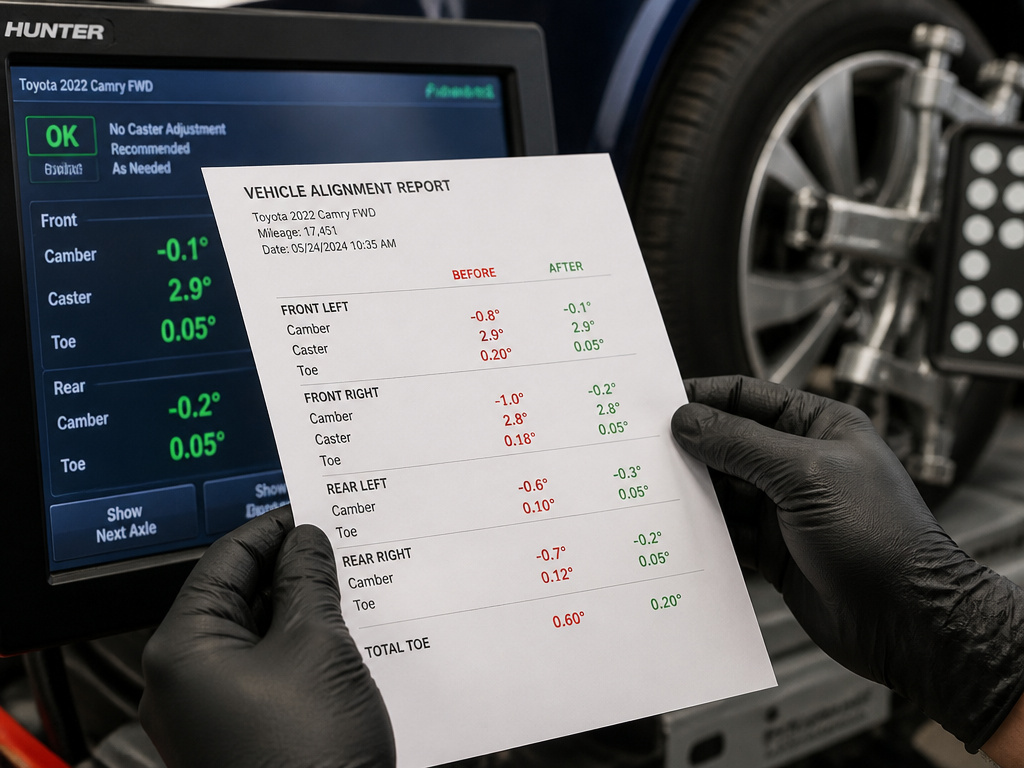
The paper is the job. An alignment printout records the values, and the values decide whether the service helped.
GM requires a copy of the alignment machine printout showing before and after specs attached to the job card for warranty claims. Subaru requires a completely filled Vehicle Alignment Data Sheet attached to the repair order for drift/pull and alignment warranty claims. Nissan requires a printed CONSULT Data Monitor screenshot showing the steering wheel at zero degrees.
Nissan/Infiniti wheel alignment warranty coverage is for 12 months or 12,000 miles, whichever occurs first, from the vehicle’s in-service date.
Fields worth checking
| Angle or field | Source value | Check |
|---|---|---|
| Front camber split | Subaru: < 0.5 degrees | Pull side and shoulder wear |
| Front camber per wheel | Toyota/Lexus: +/- 0.75 degrees from center; cross camber <= 1 degree | Model spec |
| Steering wheel position | Audi: +/- 2 degrees within toe tolerance | Not always a fault |
| Steering column tilt | VW/Toyota: center tilt; offset up to 1.2 degrees | Avoid false off-center |
These are model-specific limits, not one rule for every car.
Sources disagree on acceptable camber difference: Subaru says less than 0.5 degrees between front tires, Toyota/Lexus allows cross camber up to 1 degree, and Tesla specifies a front camber split of +/- 0.60° for the Model 3.
Tesla’s Model 3 manual provides separate alignment specification tables for ‘Performance’ and ‘Non-Performance’ model variants.
- Verify Original Equipment condition. Skip it, and a modified vehicle loses warranty coverage.
- Use current adjustment values assigned to the order type. Skip it, and you set angles to stale specs.
- Record before values. Skip it, and the shop has no proof of what changed.
- Adjust rear camber and toe first. Skip it, and thrust angle leaves the steering wheel off-center.
- Center and lock the steering wheel, then adjust front angles. Skip it, and front toe gets set to the wrong reference.
- Print before and after values. Skip it, and a warranty claim fails documentation.
Subaru also requires Absolute Steering Position calibration with the Global Diagnostic System on electric power steering cars after alignment.
When the steering wheel tolerance disagrees
Audi allows a steering wheel off by plus or minus 2 degrees within individual toe tolerance and calls it not a fault.
VW and Toyota require the steering column in the center tilt position. A full up or full down tilt creates an offset of up to 1.2 degrees.
Those are different definitions of an acceptable centered wheel. Ask which bulletin applies to your car.
How often should I get a wheel alignment check?
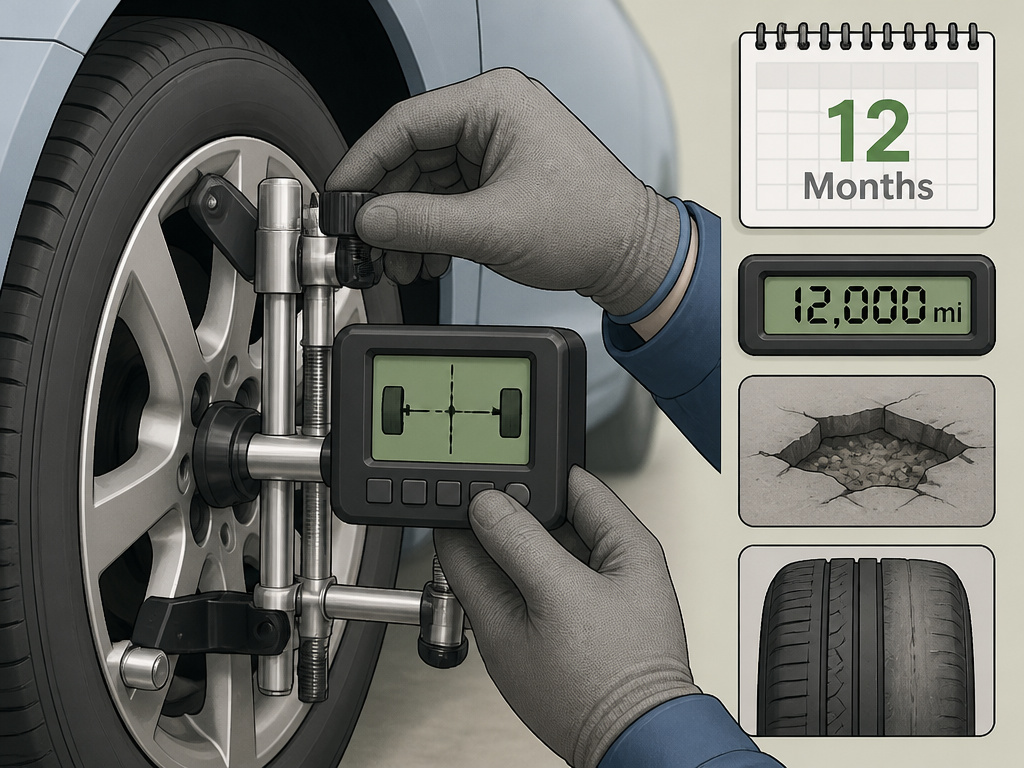
Regular alignment checks are part of routine maintenance. Nissan/Infiniti offers wheel alignment warranty coverage for 12 months or 12,000 miles. For instance, one warranty covers alignments for 12 months or 12,000 miles. It’s wise to have your alignment inspected after any significant impact, like hitting a large pothole or curb, or if you notice uneven tire wear or a persistent pull. Subaru requires that all dealer alignment racks be calibrated by a representative every six months.
Why does the car pull: camber, caster, road crown, and tire forces
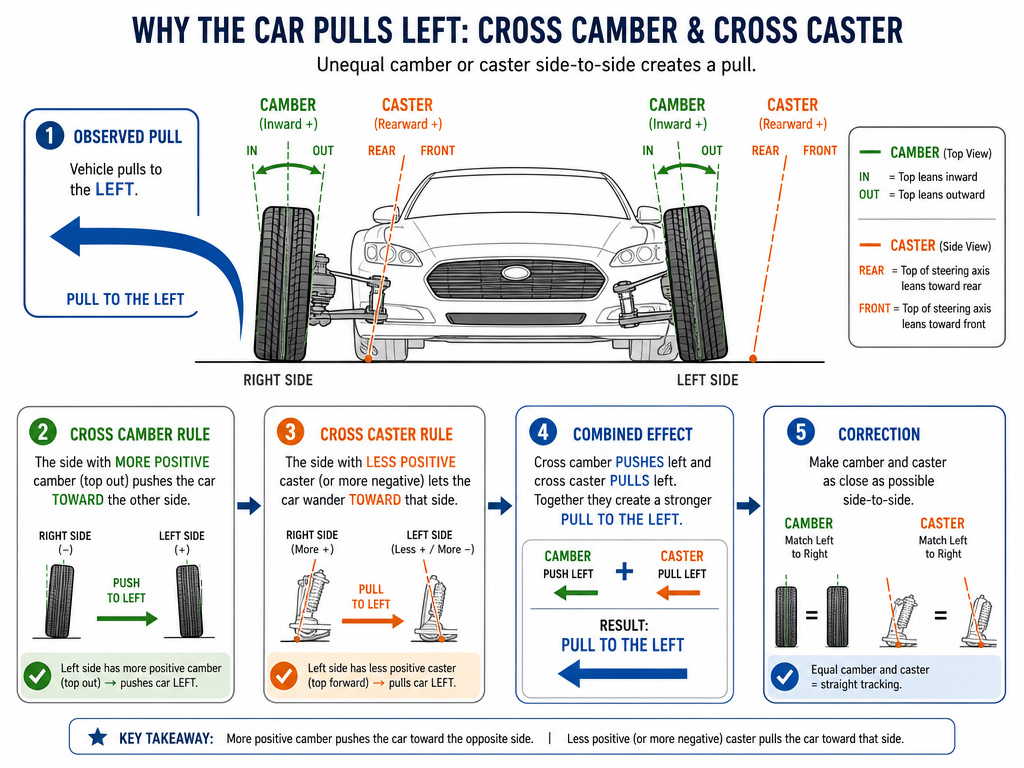
Is it the alignment, the tire, or the road? A pull starts with a signed angle, but the road decides much of the complaint.
Camber, caster, and pull direction
GM uses a signed cross-camber rule. Front cross camber (LH minus RH) with a positive value causes a left pull. A negative value causes a right pull. The same bulletin says front cross caster with a positive value causes a right pull; a negative value causes a left pull.
Sources disagree on which side a vehicle pulls relative to front camber difference: GM states positive cross camber (LH minus RH) causes a left pull, Subaru says it pulls toward the side with more positive camber, and Toyota/Lexus says it pulls toward the wheel with the larger camber value.
These bulletins use different wording, so read the sign convention before blaming a side.
Caster is simpler across the bulletins: Subaru says pull toward less positive caster; Toyota says pull toward the small caster value.
Toyota’s NHTSA technical service bulletin warns that road crown fakes a pull. Road crown is environmental, so no alignment angle fixes it.
BMW says road camber has a considerable effect on handling during the road test.
The [NHTSA vehicle pull diagnosis](https://static.nhtsa.gov
Frequently Asked Questions
What are the most common signs my car needs a wheel alignment?
You might notice uneven or rapid tire wear, such as the inside or outside edges wearing down faster. The vehicle may also pull to one side while driving on a flat road, or the steering wheel may be off-center even when driving straight. These symptoms often indicate that the camber, caster, or toe angles are out of their specified ranges.
How long does a professional wheel alignment typically take?
standard four-wheel alignment procedure usually takes about an hour to complete at a qualified shop. The time can vary based on the vehicle’s condition, the adjustability of its suspension, and whether any damaged components are discovered that need addressing before the angles can be set correctly.
Can I adjust the wheel alignment myself at home?
While basic toe adjustments are possible with some tools and knowledge, a precise alignment requires specialized equipment to accurately measure camber, caster, and SAI. Attempting it yourself risks setting angles incorrectly, which can lead to unsafe handling, accelerated tire wear, and potentially missing underlying damage to suspension components.
Why might my car still pull to one side after a recent alignment?
Persistent pulling can be caused by issues beyond basic alignment angles, such as uneven tire pressure or significant tread wear differences between tires. Other mechanical problems like a sticking brake caliper, worn suspension bushings, or a slightly bent component not detected during the initial check could also be the culprit.
