
Signs Your Tires Need Balancing: How to Tell
This post contains affiliate links. As an Amazon Associate, we earn from qualifying purchases.
To spot signs your tires need balancing, watch for a steering wheel shake at steady speed. Also watch for a floor or seat buzz and uneven tread wear. A Subaru bulletin sets a balance target within 5 grams and radial force variation (RFV) at 18 lbs or less for passenger tires.
Subaru’s 5-gram figure is why a shop can feel fine on a spin machine and still miss a highway shake. Balance is only one part. The tire’s stiffness variation can load the car once per revolution.
What follows: seven warning signs and a simple speed check. Then you get the specs that separate a balance fix from a tire replacement. I also list the questions to ask before weights go on.
Key Takeaways
- A highway shake that stays after 10 minutes above 45 mph points away from temporary flat spots, per a General Motors bulletin.
- Ask for road-force measurement if the wheel needs many weights or has low-profile tires.
- Don’t confuse pulling with balancing. Alignment checks can matter more.
- Check warm-tire procedure differences. Ford says RFV measurements MUST be taken with warm tires, while Subaru says cooling time is not required, and Volkswagen advises checking immediately after a test drive before tires cool down.
- Set pressure to the door placard before diagnosis. Improper inflation adds to RFV.
Signs Your Tires Need Balancing Show Up at Speed
A highway shake is the first clue. I treat it as a measurement problem.
Subaru’s service bulletin defines an acceptable wheel balance as within 5 grams (0.18 oz). The bulletin states passenger tire radial force variation must be 8.0 kg (18 lbs, 80 N) or less. RFV can rise after extended parking, when tires develop temporary flat spots, and improper inflation adds to the problem.
The Subaru service information bulletin sets the 5-gram balance target. The recommended tire balancing interval on a sticker doesn’t diagnose a highway shake.
If you can see the steering wheel move while driving straight without your hands, a General Motors bulletin has a clue. It says that likely points to a tire/wheel pulse once per turn. The wheel needs mass work, or the tire needs force work.
Steering Wheel Vibration
Front assembly trouble shows here. Volkswagen’s bulletin links steering wheel vibration at constant speed to front tire force changes or imbalance. Road-force measurement loads the tire while it spins.
Seat or Floorboard Buzz
The seat fabric can carry a fine buzz at highway speed. Volkswagen lists seat, floor, and footwell vibration. It also lists pedal and steering wheel vibration. Its table points whole-vehicle vibration to rear tire force variation or imbalance.
Uneven or Rapid Tire Wear
Wear alone doesn’t prove balance trouble. A Chevrolet bulletin says bumpy or uneven tread wear can point to improper balance or pressure. It also says excessive tread wear can mean replacement.
| Symptom | Likely Source | Check First |
|---|---|---|
| Steering wheel shake at constant speed | front imbalance or force changes | balance and RFV |
| Seat or floor buzz | rear assembly or tire force variation | road-force reading |
| Bumpy or uneven tread | improper balance or pressure | pressure and balance |
| 10 to 20 Hz reading | tire/wheel vibration | General Motors says continue |
Which Vibration Means Front Tires, and Which Means Rear?
I ask owners to note the speed where the shake starts. That one detail splits the diagnosis.
A front tire problem moves the steering wheel. A rear tire problem moves the seat, floor, or footwell.
Easy to miss: If a highway shake keeps going after 10 minutes above 45 mph, a GM bulletin gives a clue. It says temporary flat-spotting is less likely. Balance or RFV work becomes the real path.
Why Uneven Wear Can Mean More Than Balance
Wear alone doesn’t prove balance trouble. I wouldn’t replace a tire based on wear alone.
A Chevrolet bulletin says bumpy or uneven tread wear can point to improper balance or pressure. It also says excessive tread wear can mean replacement. That isn’t a warranty issue, per Chevrolet.
What to look for before blaming balance:
- Pressure check against the door placard.
- Sidewall scan for cuts, bulges, or damage. A damaged tire can shake even with perfect weights.
- Suspension clue such as worn sway bar bushings or links.
What Causes Imbalance After a Pothole or a Lost Weight?
Subaru defines wheel imbalance as uneven mass distribution. A tire imbalance shows up as uneven mass distribution. Subaru calls it the most common cause of steering wheel or vehicle body vibration at highway speeds.
The tire balancing process adds or moves weights to bring each assembly close to zero.
Subaru also lists balance problems beyond simple weight error. The list includes an unseated tire bead. It covers an improperly mounted assembly. It also covers wheel or tire damage, balancer damage, and debris inside the tire.
A missing clip-on weight is a simple version of the same problem. The mass is no longer where it should be.
Match-mounting pairs the tire’s high point with the wheel’s low point. General Motors says tire force variation equipment finds the low point of the wheel and the high point of the tire. That makes the tire and wheel pair better before weights go on.
How Do You Tell Balancing From Alignment?
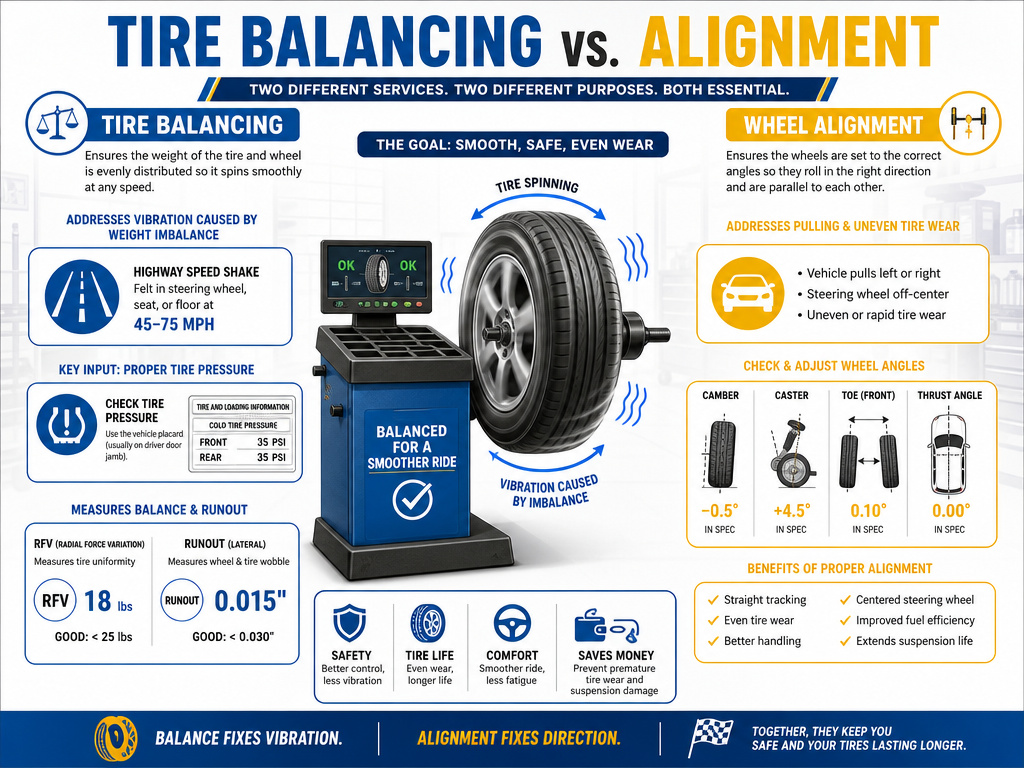
The difference between alignment and balancing is wheel angles versus mass around the wheel. Balancing fixes the spin. Alignment checks the steering and suspension angles.
Before you start: Subaru cautions that vehicle servicing by untrained persons could cause serious injury. Yokohama warns never exceed 40 psi to seat tire beads. Volkswagen warns excessive lubricant can make a tire slip on the wheel, changing balance and RFV readings.
- Note the speed where the shake starts. If you skip this, a cold flat spot and a balance defect can look alike.
- Drive 15 to 20 minutes at highway speed. Ford asks for 20 minutes, and General Motors asks for 15 to 20 minutes. If you skip it, temporary flat spots can skew RFV.
- Check tire pressure to the placard. Volkswagen sets tire pressure to 36 psi (2.5 bar) during all RFV measurements. If you skip it, improper inflation can raise RFV.
- Ask for RFV and runout numbers. Runout means the wheel or tire doesn’t spin true. If you skip this, a shop can add weights to a tire that is out of round.
| Issue | Position A | Position B |
|---|---|---|
| Cooling after drive | Subaru says tires can be removed right away; cooling time is not required. | Ford says RFV measurements MUST be taken with warm tires. Volkswagen says to raise the vehicle immediately after a test drive to check before tires cool down. |
| Drive time before RFV | General Motors: 15 mi | Ford: 20 min; Chevrolet: 30 min |
| Passenger RFV limit | Subaru, Volkswagen, Ford: 18 lbs | GM front: under 50 lbs; Corvette: 15 lbs |
| Runout specifications | General Motors specifies a maximum on-vehicle runout of 1.52 mm (0.060 in). Yokohama advises correcting wheels with 0.030 inch or more of radial or lateral runout. |
There is no single number that covers every vehicle. Use the lowest value that matches your vehicle and tire type.
What Should You Ask the Shop Before Weights Go On?
I once chased a highway shake until I asked for a road-force reading on a Hunter GSP9700. The wheel had enough weight. The tire’s high point and the wheel’s low point were not aligned. Match-mounting changed the result.
I want the RFV number before weights go on. A Hunter Road Force balancer service guide says warm tires for at least 15 minutes at highway speeds. Chevrolet says balance and RFV equipment should be tested and calibrated every 90 days or more.
I would ask for a Hunter GSP9700 road-force machine. A Snap-On RFV 2000 can do the same job. If the shop runs a Wegmann balancer, ask for the RFV printout. I skip balancing beads as a cure-all.
The difference between rotation and balancing matters if a rotated tire keeps shaking. The gap between static vs dynamic balancing matters when a wheel needs inner and outer weights. If pulling dominates, a wheel alignment check comes first.
Skip this if: The tire is cold after parking. A Ford bulletin says RFV must be measured warm. A cold reading can hide temporary flat spots and send you chasing weights.
What most people get wrong: I wouldn’t add more weights until the tire is measured warm, match-mounted, and checked for runout. A wheel that needs a pile of weights hides a tire or wheel defect.
Questions to ask before weights go on:
- RFV number for each corner, before and after correction.
- Match-mounting status, because a high tire point can sit on a low wheel point.
- Runout check, and the exact reading. Yokohama says correct wheels with 0.030 inch or more radial or lateral runout.
- Weight plan, because Subaru says tire weights after adjustment should be 5 grams or less.
- Tool used, because Chevrolet says use only a plastic tool when removing wheel weights.
Vehicle Pulling to One Side
If your vehicle consistently pulls to one side while driving on a level road, it can indicate an imbalance issue. This pull is often caused by uneven forces within the tire and wheel assembly. A significant imbalance on one side of the vehicle creates a variation in rotational force that can manifest as a steering pull. Before concluding it’s an alignment issue, consider that a tire with high radial force variation or a poorly balanced wheel can produce this symptom. A proper diagnosis involves checking the balance and the uniformity of the tires after they have been adequately warmed up from driving.
Unusual Noises Like Thumping
A rhythmic thumping noise that increases with vehicle speed is a classic sign of an unbalanced tire or wheel assembly. This noise is often the result of a heavy spot on the tire or wheel causing it to thump against the road surface with each rotation. The issue may stem from a weight that has fallen off, a tire with excessive radial force variation, or a wheel with too much runout. In colder weather, temporary flat spots from parking can also cause a thumping sound that may fade as the tires warm up, but a persistent noise points to a balance or uniformity problem that needs correction.
Frequently Asked Questions
How do I know if my tires need balancing?
Steady highway shake is the clearest clue. A General Motors bulletin says a 10 to 20 Hz reading points to a tire/wheel vibration. Check tire pressure and road-force data before adding weights.
Do all four tires need to be balanced?
Often yes. Each assembly gets its own weight target. Subaru says each assembly should be within 5 grams. If only one tire was repaired, a full check avoids leftover imbalance.
At what speed do you feel unbalanced tires?
Many drivers notice it at highway speed. Volkswagen’s bulletin lists 55 to 80 mph.
Is tire balancing the same as alignment?
No. Balancing addresses mass around the wheel. Alignment addresses wheel angles. A Chevrolet bulletin says alignment isn’t necessary unless the vehicle pulls or drifts.
How much does tire balancing usually cost?
The price varies by shop, wheel size, and whether road-force measurement is used. Ask for the RFV number before weights. A shop that only adds weight without measurement hides a tire or wheel defect.
Before You Go
The clearest signs your tires need balancing are a steady highway shake, a seat buzz, and wear that doesn’t match the tire’s job. That is the short version.
This week, write down the speed where the shake starts. Ask for the RFV number before weights go on. If the shop can’t give you that number, treat the diagnosis as incomplete.
If pulling or drifting appears, a Chevrolet bulletin says alignment becomes relevant. Balance fixes mass. Angles decide tracking.
