
Clip on vs Stick on Wheel Weights: Which Should You Buy?
This post contains affiliate links. As an Amazon Associate, we earn from qualifying purchases.
In clip on vs stick on wheel weights, choose clip-on for steel wheels or exposed rims, and stick-on for alloy wheels where hidden placement matters. Clip-on weights attach to the rim flange and adjust quickly; stick-on adhesive strips need a clean, dry, warm rim surface to stay bonded.
That surface rule decides the clip on vs stick on wheel weights job. Adhesive bonds to bare, dry metal, while a clip relies on mechanical interference with the rim flange. ISO 13988:2021 covers both types for passenger cars and defines retention force as the static force needed to remove a weight from the rim flange.
The rest walks the choice between flange clips and adhesive strips. It covers rim type, clip profile, surface prep, and retention limits. It also flags when a shop should change the balancing method instead of adding more weight.
Key Takeaways
- Match the clip profile to the flange. A steel-wheel clip can scratch an alloy rim if it doesn’t seat flush.
- Clean adhesive surfaces above 50 degrees F. Brake dust, wax, and cold metal break the bond.
- Use clip-on steel wheels. Perfect Equipment PZ-Series fits 13-inch to 17-inch steel passenger wheels.
- Use stick-on alloy wheels. WePro WPW-100S gives 1 oz strips; WPW-025BK gives 1/4 oz strips.
- Don’t trust one market-share number. Hennessy says adhesive is about 40%; Wegmann says 35%.
Which wheel type wins clip on vs stick on wheel weights?
Steel wheels and exposed flanges favor clip-on weights. Alloy wheels and hidden placement favor stick-on adhesive strips.
ISO 13988:2021 applies to clip and adhesive balance weights used on passenger car wheels. A clip balance weight is material of a specified mass with contours to conform to the surface of the rim flange. Size is expressed in grams, and retention force is the static force required to remove the weight, expressed in newtons.
The weight type is only half the job. Static vs dynamic balancing decides whether the correction goes on one plane or two.
Steel wheels: clip-on is the default
Perfect Equipment PZ-Series coated steel clip-on weights fit 13-inch to 17-inch passenger car steel wheels. The catalog lists sizes from 0.25 oz. To 3 oz. Perfect Equipment PZ-Series coated steel clip-on weights are one option for steel wheels.
Balancing using clip-on weights for both planes requires the least mass, per the Perfect Equipment catalog. A seated clip gives a short, solid tap. A loose clip will not be securely seated.
Alloy wheels: stick-on wins on looks
Modern wheels hide weight behind the spokes. Wurth USA says adhesive weights are less likely to rust or corrode over time than clip-on weights. Fortune Auto Parts says adhesive weights suit alloy and premium wheels for appearance and compatibility.
For silver strips, WePro WPW-100S lists 1 oz per strip and 3 oz per package. For black strips, WPW-025BK lists 1/4 oz per strip and 3 oz per package.
| Decision factor | Clip-on | Stick-on |
|---|---|---|
| Best wheel | Steel wheels | Alloy wheels |
| Placement | Rim flange | Inner barrel |
| Install speed | Fast, no cleaning | Needs clean surface |
| Visibility | Shows on edge | Hidden behind spokes |
| Reuse | Reusable | Single-use strips |
Is that flange painted, polished, or bare steel? The answer changes the choice.
- Steel wheels with an accessible flange: use clip-on weights.
- Alloy wheels with a painted or polished outer lip: use stick-on strips.
- Flangeless outer planes mean no outer rim lip for a clip. Use adhesive outside, and a clip on the inner flange if the wheel has one.
A 0.25 oz clip can fail if the flange profile is wrong
The clip is a shaped metal part. It isn’t a generic hook. ISO 13988:2021 defines a clip as specially formed metal affixed to the weight.
A poorly seated clip will not conform properly to the rim flange. That gap is where trouble starts.
Interference, not luck
The clip must conform to the rim flange. The clip must conform to the rim flange to provide secure retention. The Perfect Equipment catalog warns that striking the weight body, instead of the clip, can cause clip retention failure or weight movement.
I check the flange first. The clip profile is the first fitment check. Which is the whole problem.
Extra wheel weight cannot fix a tire that is out of round. It only hides the fault until the next highway shake.
- Select a clip profile that matches the specific contour of your rim flange.
The correct clip profile is harder to find than the weight size. Simple. Wrong profile, wrong result.
What surface prep does stick-on adhesive need?
Adhesive is a bond, not a clamp. The rim surface decides whether it holds.
Clean, dry, wax-free
Plombco lists 212FeS-52 standard adhesive as 52 strips per box, with 12 segments per strip. That packaging matters when the balancer calls for small increments. Plombco also lists 220FeS-OE as a 20 lb roll with 1820 segments.
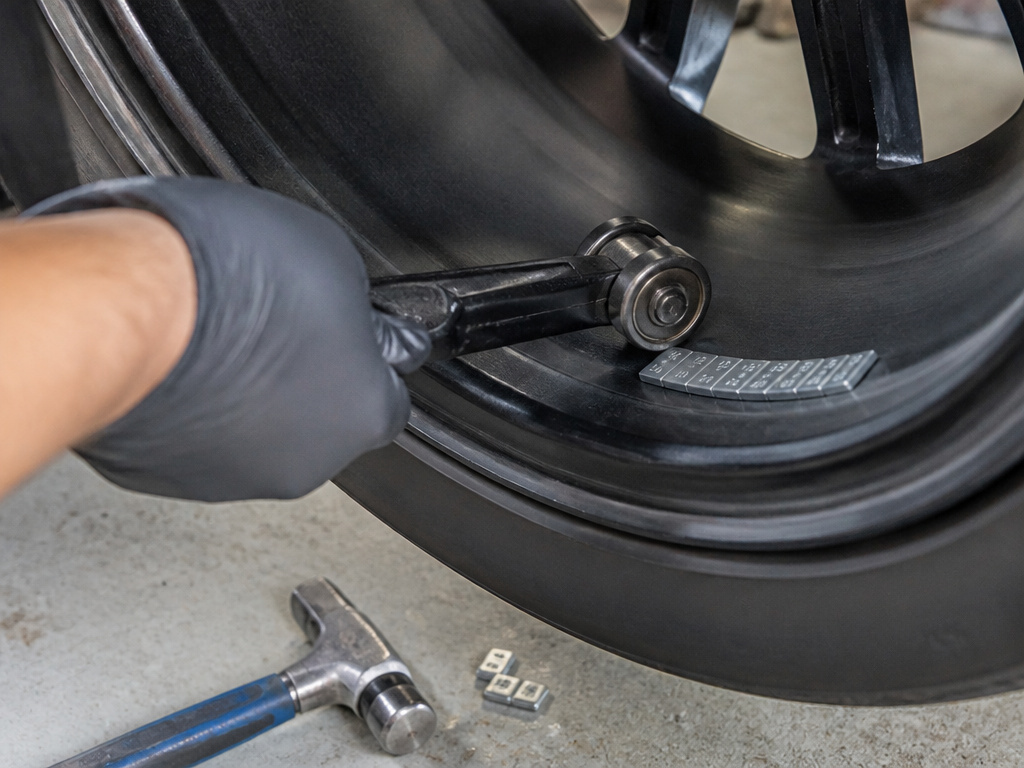
Before you start: Strike only the clip, not the weight body; hitting the body can cause clip retention failure or weight movement. Clean, dry, and warm the rim before adhesive; a dirty or cold strip can fling off at highway speed.
- A wheel balancer gives the amount and clock position. Skipping the balancer’s measurement puts weight in the wrong place.
- Clean the target spot with brake cleaner or isopropyl alcohol. Old adhesive, wax, and brake dust block the bond.
- Make sure the rim is dry and above 50 degrees F. Cold adhesive stays weak and can release at speed.
- Peel the liner and press the strip firmly. A soft press leaves air pockets and a weak bond.
- Let the bond set before hard driving.
- Re-spin to verify balance. A weight that moves after the first spin is a fitment problem.
What most people get wrong: Pressing adhesive strips over brake dust or tire-shine overspray. The bond fails at highway speed, and the wheel returns to vibration.
To remove old strips, warm the adhesive and use a plastic scraper. A metal blade can damage the wheel surface.
Warm above 50 degrees F
Below 50 degrees F, the adhesive won’t bond well. Warm the wheel indoors or use a heat gun. A cold rim turns a 10-second press into a future highway vibration.
Road-force tools and beads change the weight decision
A persistent shake is a measurement problem before it is a weight problem. I want the road-force reading, a tire stiffness measurement, before anyone stacks more weight.
[
Not a shortcut.
| Symptom | Likely cause | Fix |
|---|---|---|
| Stick-on strip falls off | Dirty, waxed, or cold rim | Clean, dry, warm above 50 degrees F |
| Clip rocks or moves | Body was struck, not the clip | Strike the clip with a weight hammer |
| Alloy rim gets scratched | Wrong clip profile for the flange | Use alloy clip or stick-on |
| Vibration stays after adding weight | Tire or rim problem | Re-measure before adding more weight |
What happens when the sources disagree?
The trade data doesn’t line up.
I would rather run stick-on strips on polished alloys than fight a clip profile that scratches the finish. On steel wheels, I keep clip-ons because they are quick and adjustable.
Hennessy Industries, maker of Bada weights, estimates adhesive wheel weights make up about 40% of the aftermarket. Wegmann Automotive USA puts the split at 35% adhesive and 65% clip-on. Modern Tire Dealer reports both.
Rugged use also splits. Wurth USA says clip-on weights are more secure in extreme conditions such as wet or off-road environments, while some users argue stick-on weights can also hold. A Tahoe/Yukon forum owner says stick-ons won’t get ripped off while off-roading. I don’t treat either claim as universal.
Material choices also differ by region. Perfect Equipment’s catalog says zinc is the industry standard material in Europe. It says steel is popular among some aftermarket and OEM companies in North America and Asia. ISO 13988:2021 recommends material free of lead.
Heavy-duty use needs care. Fortune Auto Parts says adhesive weights have reduced suitability for heavy-duty use and can degrade in extreme environments. The same source also says properly engineered adhesive systems withstand standard operating conditions.
I would not put adhesive weights on a heavy-duty wheel without checking the rim flange and service conditions.
Material types (lead, zinc, steel)
Wheel weights are made from different metals. Zinc is considered the industry standard material for wheel weights in Europe. Steel is mostly popular among some aftermarket and OEM companies in North America and Asia. ISO 13988:2021 defines a clip balance weight as material of a specified mass with contours to conform to the surface of the rim flange. Balance weight size is expressed in grams. When choosing a material, consider the wheel type and local industry practices, as material choice can affect weight retention and corrosion resistance over time.
Environmental considerations of materials
Material choice for wheel weights has environmental implications. The shift away from lead to alternatives like zinc and steel is driven by environmental regulations and concerns. These alternative materials aim to reduce the environmental impact when weights are lost during driving or at the end of a wheel’s service life. When selecting weights, consider the full lifecycle and local disposal regulations. Proper installation and secure retention also help minimize environmental contamination by preventing weights from falling off on roads.
Frequently Asked Questions
What is the difference between clip on and stick on wheel weights?
Clip-on weights attach to the rim flange with a formed clip. Stick-on weights are adhesive strips pressed onto a clean inner barrel. ISO 13988:2021 covers both for passenger cars.
Can you use clip-on weights on all wheels?
No. The clip profile must match the rim flange. A steel-wheel clip can fail to seat flush on an alloy rim.
Which wheel weight is better for alloy rims?
Stick-on strips win on alloy rims when appearance matters, because they hide behind the spokes. If the inner flange is accessible, a hidden alloy clip can work.
Do adhesive wheel weights fall off?
They can fall off on a dirty or waxed rim. They also fail on wet or cold rims. Clean the spot and warm the rim above 50 degrees F before pressing the strip.
Are clip-on wheel weights reusable?
Clip-on weights allow reuse, but a fatigued clip can lose tension. Use fresh weights when the clip no longer grips the flange.
Before You Go
If you want one answer for a daily driver with alloy wheels: use stick-on strips on a clean barrel. If the wheel is steel with an exposed flange: use clip-on weights. That covers most passenger cars.
One threshold matters. If the balancer asks for more weight than a typical passenger car wheel needs (somewhere between 0.5 oz and 3 oz total), stop adding weight and check the tire and rim for damage or out-of-round conditions. Check the tire and rim for damage or out-of-round conditions.
Named first step: write down the clock position and weight amount from the balancer before you touch a hammer or peel a liner. That record turns a guess into a fitment check.
This advice targets passenger car and light truck wheels. Heavy-duty truck wheels and motorcycle wheels need different fitment data. Match the weight to the flange, not the ad.
