
R1 vs R4 Tractor Tires: Key Differences Explained
This post contains affiliate links. As an Amazon Associate, we earn from qualifying purchases.
R1 (agricultural) tires are for maximum traction in soft soil like plowed fields, while R4 (industrial) tires are for durability and stability on mixed hard and soft surfaces like construction sites. R1 tires have deep, angled lugs that dig in but wear fast on pavement; R4 tires have a blockier, shallower tread that offers a smoother ride and higher load capacity, making them the default for compact utility tractors with loaders.
The difference isn’t just about where you drive. It changes how your tractor handles weight, how long the tires last, and whether your drivetrain stays healthy. Pick wrong, and you’re looking at poor performance, accelerated wear, or a warning buried in your operator’s manual about mismatched rolling circumferences, such as in the case of r1 vs r4 tractor tires.
What follows is a breakdown of the specs that matter: traction thresholds, ply ratings, load stability, and the one maintenance step that decides tire life more than any other. By the end, you’ll know which tire type fits your primary job, and why the “best of both worlds” hybrid setup is a gamble your tractor’s manufacturer explicitly warns against.
Key Takeaways
- R1 tires excel in soft, muddy soil for farming tasks like plowing and tilling, but their deep lugs cause a rough ride and fast wear on hard surfaces.
- R4 tires are built for loader work and mixed surfaces, with a higher ply rating (at least 6-ply) for greater durability and a flatter profile for stability.
- Never mix R1 and R4 tire types on the same machine unless your operator’s manual approves it; differences in rolling circumference can damage the drivetrain.
- Check and maintain tire pressure when tires are cold; a few PSI off significantly affects traction, wear, and can lead to premature failure.
- Consider tire chains for R4s in snow or ice; their shallower tread lacks the bite of R1 lugs, making chains a necessary add-on for winter traction.
How Tractor Tire Codes Actually Work
The “R” in R1 and R4 stands for radial construction, which is the standard for modern tractor tires. The number that follows is a service description code standardized by the Tire and Rim Association (TRA). It defines the tread pattern and intended application, not a performance grade. Think of it as the tire’s job title.
R1 and R4 are standardized service descriptions for radial tractor tires. R1 denotes an agricultural tread with a 23-degree bar angle designed for maximum soil penetration. R4 denotes an industrial/lugger tread with a square-shouldered, blockier pattern designed for durability on mixed surfaces.
An R1 tire is engineered to sink its teeth into the ground. Its tall, angled lugs are spaced far apart to clean out mud as they rotate. An R4 tire is engineered to resist abuse. Its shorter, wider lugs are closer together to spread the load and resist cuts from rocks and debris. This fundamental difference in mission drives every performance comparison in the r1 vs r4 tractor tires debate that follows. For a broader look at options, our guide to tractor tire types covers other patterns like turf (R3) and the newer hybrid R14.
Traction Face-Off: Mud, Dirt, and Hardpack
This is the core of the r1 vs r4 tractor tires debate. On paper, R1 tires are the clear traction champions in soft, yielding soil. The lugs are designed to penetrate and claw. In practice, the gap depends heavily on your soil conditions.
In deep mud or loose, plowed earth, R1 tires win. They dig down to solid footing. R4 tires, with their wider, flatter footprint, are more prone to “packing up”, the spaces between the lugs fill with mud, turning them into slick discs. You’ll feel the difference as wheel spin.
On firm, regular soil, the difference narrows. One source notes there’s not much performance difference between R1 and R4 tires on regular soil. The R4’s wider contact patch can provide adequate grip for many secondary tillage or transport tasks.
On hard surfaces like pavement or gravel, R4 tires win. The R1’s aggressive lugs have minimal contact, leading to a bumpy, inefficient ride. The vibration is palpable through the seat and steering wheel. R4 tires provide a noticeably smoother ride and far less tread squirm, which translates directly into slower wear.
Durability, Load, and Why Ply Rating Matters
If traction is the headline, construction is the fine print that determines cost of ownership. This is where the R4 tire’s industrial heritage shows.
Ply Rating and Puncture Resistance: A key documented difference is ply rating. For compact tractors, R4 tires are built with at least a 6-ply rating. Six-ply tires are cited as being 50% more durable than four-ply tires. This means stronger sidewalls and better resistance to punctures from stubble, rocks, and job site debris.
Load Capacity and Stability: The weight rating of R4 tires is significantly higher than that of R1 tires. This isn’t about raw tractor weight, it’s about stability under load. The R4’s flatter, stiffer sidewall and wider tread profile “squat” less under the weight of a loaded loader bucket. This reduces the unsettling feeling of the tractor rocking on its tires and improves safety on slopes.
Tread Life on Hard Surfaces: Driving an R1 tire on pavement is like running a file across its tread. The high-pressure points on the tall lugs wear down rapidly. R4 treads, with their broader, more evenly distributed lugs, last much longer when your work involves moving between fields on roadways. The trade-off is that in pure field work, the R1’s deeper lugs mean it takes much longer to wear down to the replacement depth.
| Aspect | R1 (Agricultural) Tires | R4 (Industrial) Tires |
|---|---|---|
| Best For | Farming in soft/muddy soil (plowing, tilling) | Loader work, construction, mixed hard/soft surfaces |
| Tread Design | Deep, angled, widely-spaced lugs | Shallow, blocky, closely-spaced lugs |
| Ride on Pavement | Rough, vibrates | Smoother, more stable |
| Key Construction | Often 4-ply rating | At least 6-ply rating |
| Soil Compaction | Higher ground pressure per lug | Wider footprint, lower ground pressure |
The Loader and Backhoe Stability Question
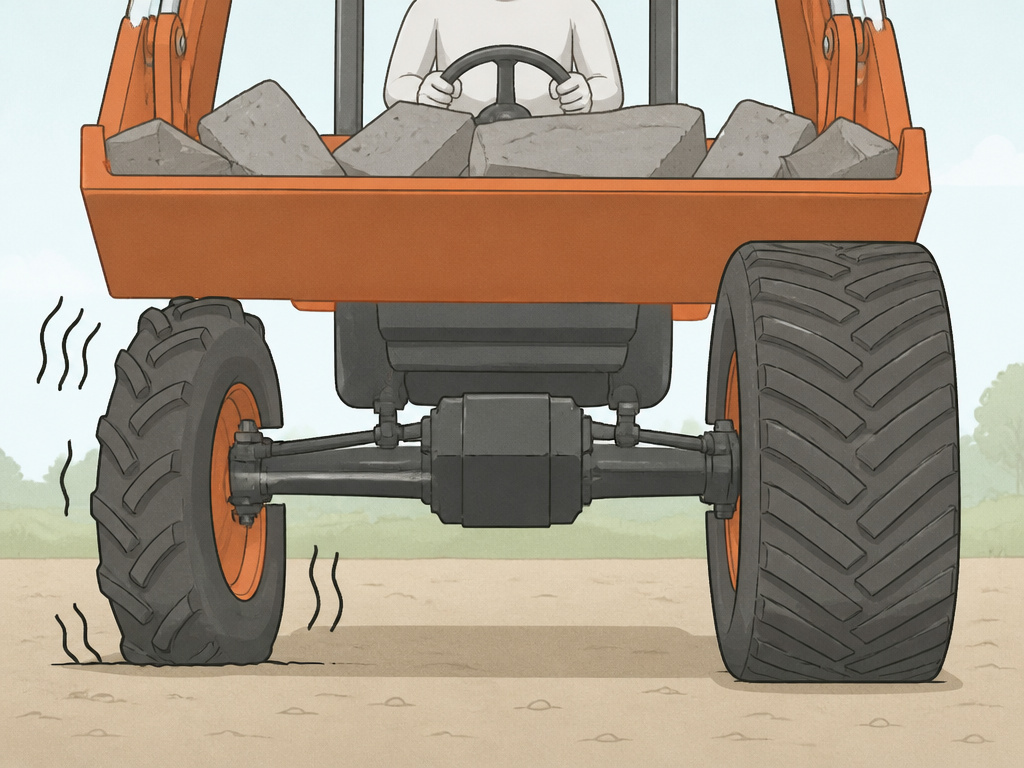
If you use a front-end loader or backhoe, tire choice directly impacts stability and safety. The center of gravity shifts dramatically when the bucket is raised or the backhoe is extended.
Where this goes sideways: Using soft, high-traction R1 tires on the front of a loader tractor. The squishy sidewalls can bulge excessively under heavy front loads, creating a unstable, bouncy feel. In a worst-case scenario, a front tire failure under load could lead to a tip-over.
R4 tires are the default recommendation for compact utility tractors (CUTs) with loaders for a reason. Their stiff sidewalls and wide footprint provide a stable platform. The weight ratio recommended for your tractor, often cited as 60% on the front axle and 40% on the rear when ballasted, is easier to achieve and maintain with tires designed to carry the load without excessive deformation.
For heavy rear-ballast tasks like plowing, some owners on forums like TractorByNet discuss a hybrid setup: R1 tires on the rear for traction and R4s on the front for loader stability. However, you must check your operator’s manual. Multiple OEM manuals explicitly warn against mixing R1 and R4 tire types on the same machine due to differences in rolling circumference, which can cause drivetrain binding and damage in 4WD models.
Soil Compaction: Tread vs. Tire Pressure
This is a point where sources genuinely disagree. Many equipment dealer articles claim R4 tires “reduce soil compaction” due to their larger footprint. Sources disagree on this point: the University of Nebraska Extension states compaction is primarily a function of axle load and inflation pressure, with tread design having a minor effect, while various tire OEM blogs and dealer articles claim R4 tires ‘reduce soil compaction’ due to a larger footprint.
An R4 tire at the same weight and pressure as an R1 will exert less pressure per square inch (PSI) on the soil because its footprint is larger. However, the biggest lever you have to reduce compaction isn’t your tire choice, it’s managing your axle load and, crucially, lowering your tire inflation pressure for field work. A properly ballasted and pressure-adjusted R1 tire can minimize its compaction footprint.
Common mistake: Running field tires at road pressure. For fieldwork, reducing pressure increases the tire’s footprint and cuts ground pressure significantly. Always re-inflate for road travel.
Snow Performance and the Chain Factor
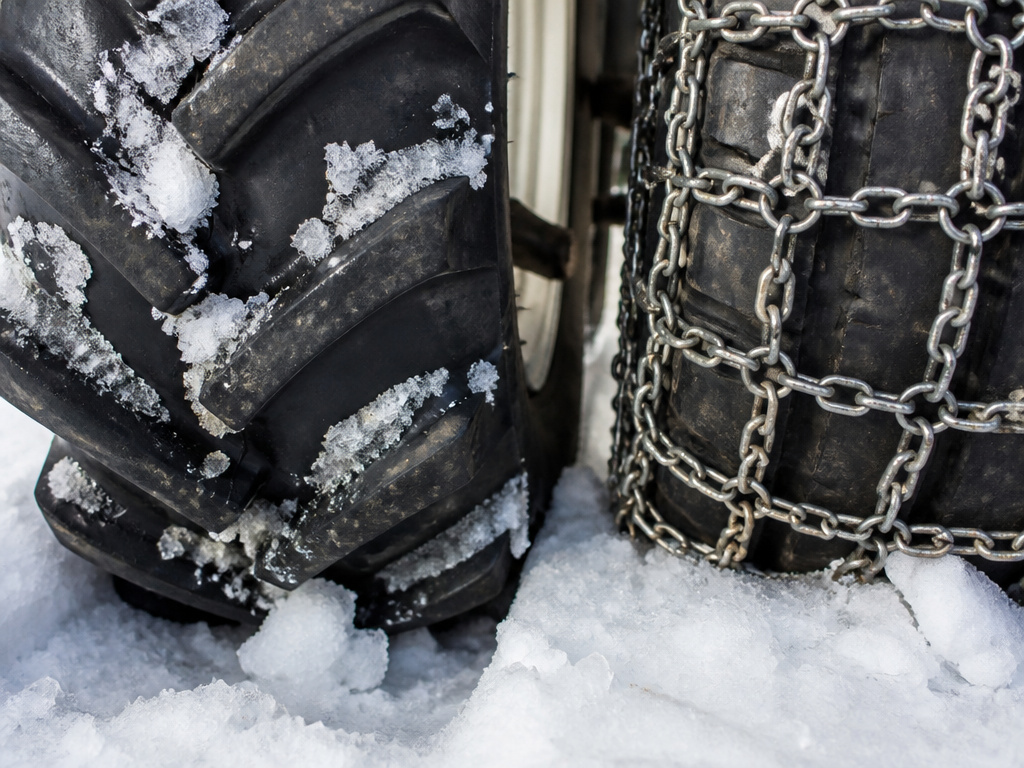
Neither tire is a dedicated snow tire, but they approach the problem differently. R1 tires rely on their lug depth to bite down through snow to the ground below. They can be effective in deeper, softer snow.
R4 tires, with their shallower tread, are more prone to packing with snow and losing grip on icy surfaces. Their advantage comes when you add chains. The blocky tread provides an excellent anchor point for tire chains, which then become the primary traction device. If you face significant ice or packed snow, planning for chains makes the R4 a viable year-round option. Our article on the best tractor tires includes models known for good winter performance.
Maintenance That Actually Extends Tire Life
Tire life is dictated by use, but neglect shortens it dramatically. The rules here are universal, but one is critical.
- Pressure is Everything. Check tire pressure when the tires are cold, before you drive a mile. I learned this after getting inaccurate readings from warm tires. Now I never trust a hot reading. Under-inflation causes overheating and sidewall damage; over-inflation reduces traction and increases wear. Consult your tractor’s manual.
- Rotate if You Can. On 2WD tractors, rotating front to rear can even out wear, especially if you do a lot of road travel. On 4WD machines, consult your manual, some specify a rotation pattern to maintain circumference matching.
- Ballast Correctly. Use appropriate tractor tire ballast (like calcium chloride or beet juice) to optimize traction and stability. Proper ballast reduces wheel slip and wear.
- Clean and Inspect. Regularly wash off mud and chemicals. Inspect for cuts, cracks, and embedded objects. A small puncture caught early is a repair; one caught late is a ruined tire.
The Step-by-Step “Which Tire For Me?” Checklist
Forget the marketing. Answer these questions in order.
- What is the SINGLE most common task for this tractor? (e.g., “Loading manure daily,” “Mowing fields weekly,” “Tilling 50 acres each spring”).
- What surface does that task happen on? If the answer is “soft, tilled soil” 80% of the time, lean R1. If it’s “a mix of gravel driveway, hardpack, and some field edges,” lean R4.
- Is a front-end loader permanently attached? If yes, R4 tires are the strongly recommended starting point for stability.
- How much road travel is involved? Significant road travel on pavement makes R4 tires a compelling choice for wear and comfort.
- What does your tractor’s operator’s manual say? It may have a specific recommendation or warning that overrides everything else.
This checklist helps cut through the noise. For example, a compact tractor used primarily for landscaping and loader work around a homestead is an R4 candidate. A larger utility tractor dedicated to pulling a chisel plow through clay soil is an R1 candidate. For deep specialization in crop farming, see our review of best agricultural tires for row crops.
Which Tractor Tire Gives a Smoother Ride?
The ride quality and ground clearance differ significantly between R1 and R4 tires. R4 tires are best for situations where a smoother ride is a key consideration. Their flatter, wider tread pattern provides more stability and less vibration on hard surfaces like pavement or hard-packed ground. R1 tires, with their aggressive, angled lugs, are designed for maximum traction in soft or muddy soil. This design can lead to a bumpier ride on hard ground but typically offers more ground clearance, which helps when working in deep ruts or over obstacles in a field. For a combination of hard and soft surfaces where ride comfort is a priority, the R4 is the recommended choice.
Frequently Asked Questions
What does R1 mean on a tractor tire?
R1 is a standardized service description for radial agricultural tires. It signifies a tread pattern with tall, angled lugs (typically at a 23-degree angle) spaced far apart, designed for maximum traction and self-cleaning in soft, muddy soil conditions. They are the standard for field work like plowing and tilling.
What are R4 tires good for?
R4 tires are good for industrial applications and mixed-use compact utility tractors. They excel at loader and backhoe work due to stable, stiff sidewalls, provide a smoother ride and longer wear on hard surfaces like pavement, and offer better puncture resistance thanks to a higher ply rating. They are a versatile choice for property maintenance, landscaping, and construction.
Can I put R1 tires on a tractor that came with R4s?
You can, but you must check three things. First, ensure the rim width is compatible with the new tire size. Second, verify the rolling circumference is acceptable for your tractor’s 4WD system (consult your manual or dealer). Third, understand you are trading loader stability and pavement comfort for superior field traction. It’s a swap, not a free upgrade.
Do R4 tires cause more soil compaction?
It’s not that simple. While R4 tires have a larger footprint that exerts less pressure per square inch at the same weight, soil compaction is driven more by total axle load and inflation pressure. A heavily loaded R4 at high pressure can compact more than a lightly loaded, properly ballasted R1 at low field pressure. Manage weight and pressure first.
Are R4 tires more expensive than R1 tires?
Typically, yes. Source comparisons note R1 tires in a range of $30-250, while R4 tires range from $90-500. The higher cost reflects the more robust construction (higher ply rating), thicker rubber compounds, and the versatility that makes them the default on many new compact tractors. The investment pays back in durability if your use matches their strengths.
The Bottom Line
Your tractor’s tires are its connection to the ground, they translate engine power into work. The R1 vs R4 choice is a trade-off between specialized traction and versatile durability.
For most compact utility tractor owners with a loader, the R4 is the right default. Its stability, toughness, and decent mixed-surface performance cover the widest range of chores. If your tractor is a dedicated field machine that rarely touches pavement, the R1’s superior traction is worth the ride and wear penalties. Before you consider a mixed set, find the page in your operator’s manual that discusses tire matching, the drivetrain warning is there for a reason.
Start with the job. The right tire follows from that.
