
What Is a Belted Bias Tire: The Sidewall Code Decoded
This post contains affiliate links. As an Amazon Associate, we earn from qualifying purchases.
A belted bias tire is a bias-ply tire with reinforced belts laid under the tread. On the sidewall, the letter B in the size description marks this construction, while D means diagonal (bias) and R means radial. The belts stiffen the tread area without changing the angled ply cords beneath them.
That letter is the tiebreaker I trust more than any brochure line. It sits next to the size and load data on the sidewall, not inside a marketing paragraph. When a listing, a forum thread, or a sales pitch leans on the word “belted,” the code is the only neutral place to check before anyone’s claim gets loud. For clarity, what is a belted bias tire? It’s a type with belts under the tread but with bias-ply casing layers.
What follows: the layered construction, the codes that separate belted bias from radial and plain bias, the belt-material disagreement between passenger and off-road specs, and the inspection thresholds that decide when a tire is done.
Key Takeaways
- Belted bias is a bias carcass with a belt under the tread, and the sidewall code B confirms it.
- The wear-out line is 2/32 inch, but front axles over 10,000 lb GVWR must come off at 4/32 inch.
- Underinflation or overloading can cause tread/belt separation later, not just on the spot.
- Service life is not set by calendar age; cracking and condition decide it.
What a Belted Bias Tire Actually Is (Read the B Code)
The B in a tire’s size description is the quiet signal that answers what is a belted bias tire, a carcass that is bias with a belt added under the tread. USTMA’s care guide assigns B to belted bias, D to diagonal (plain bias), and R to radial.
A belted bias tire combines an angled-ply carcass with reinforcing belts placed around the tire beneath the tread. The angled cords run bead to bead and provide sidewall stiffness, while the belts stabilize the tread area, limiting wear irregularity and supporting the load path. Construction type is identified by the letter B in the size description.
The federal glossary backs the same picture. The NIST belted bias tire definition cites ASB TR 097, the forensic terminology standard, and calls it a bias tire with added reinforced belts beneath the tread. Collins agrees, adding that the belt is steel or a strong synthetic material.
Read the sidewall.
| Marking | Meaning | Source |
|---|---|---|
| B | Belted Bias construction | USTMA |
| D | Diagonal (Bias) construction | USTMA |
| R | Radial construction | USTMA |
| 18.00-25 (hyphen) | Bias-ply OTR size | Tire Industry Association |
| 18.00R25 | Radial-ply OTR size | Tire Industry Association |
The details decide it. On a passenger or light-truck tire, the letter is the whole answer. On an off-road size, the hyphen or the R is the tell instead.
How the Layers Stack Up: Belt, Breaker, and Angled Plies
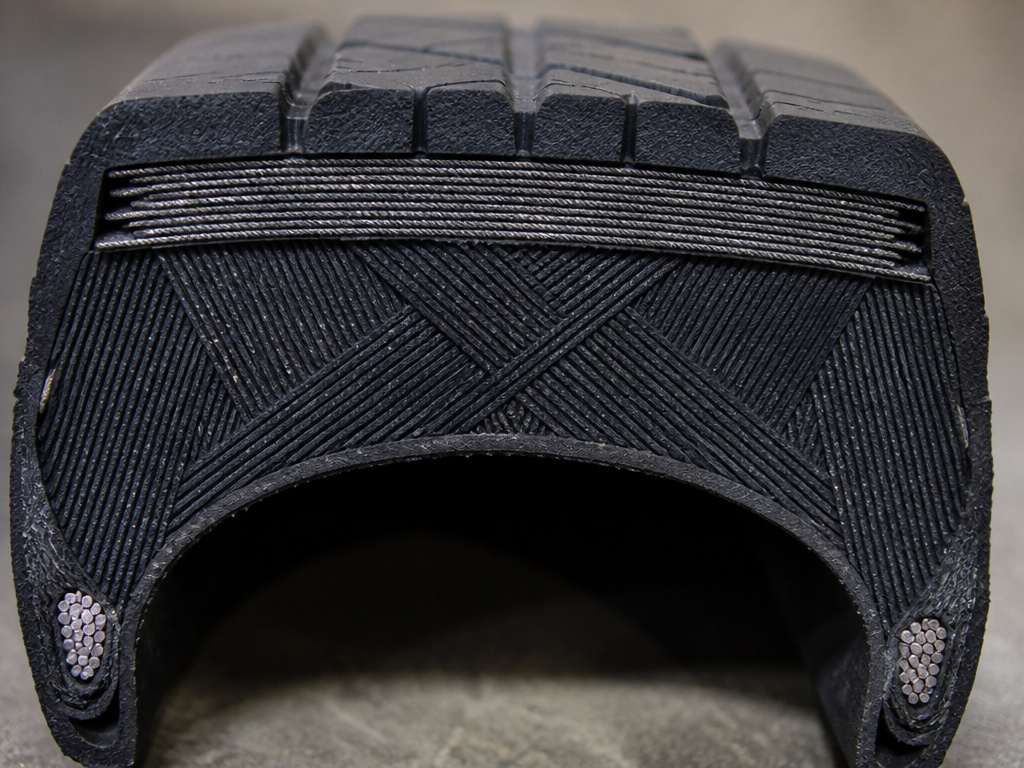
Slice a belted bias tire down the middle and three jobs show up. The angled carcass, the belt under the tread, and the bead that anchors it to the rim.
- The carcass: angled plies crossing bead to bead, the part that gives a bias setup its stiff sidewall.
- The belt or breaker: reinforcing layers under the tread.
- The bead: the wire-and-rubber ring that locks the tire to the wheel.
Run a thumb across a bias sidewall and it feels board-stiff compared with a radial’s softer flex. That stiffness is the construction doing its job.
The Carcass
The tire carcass is the load-bearing skeleton, and in a bias design its cords cross at an angle from bead to bead. That geometry is what people mean when they talk about sidewall toughness in parts of a tire. It is also why the belt matters: a stiff carcass alone does not hold the tread flat under load.
The Belt or Breaker
Under the tread sits the belt. For passenger and light-truck tires, USTMA describes it as two steel-cord layers laid at opposing angles. Off-road, TIA describes belt and breaker plies running around the tire, with nylon cord as the common material.
The two descriptions differ because they cover different tire classes. USTMA is talking about passenger and light-truck belts. TIA is talking about off-road breakers. I keep them in separate columns in my notes so I never quote one as the rule for the other.
I keep the carcass and the belt in separate columns when I compare tires. A strong belt cannot fix a soft carcass, and a marketing name will not tell you which one you are actually getting.
Is a Belted Bias Tire the Same as a Steel-Belted Radial?
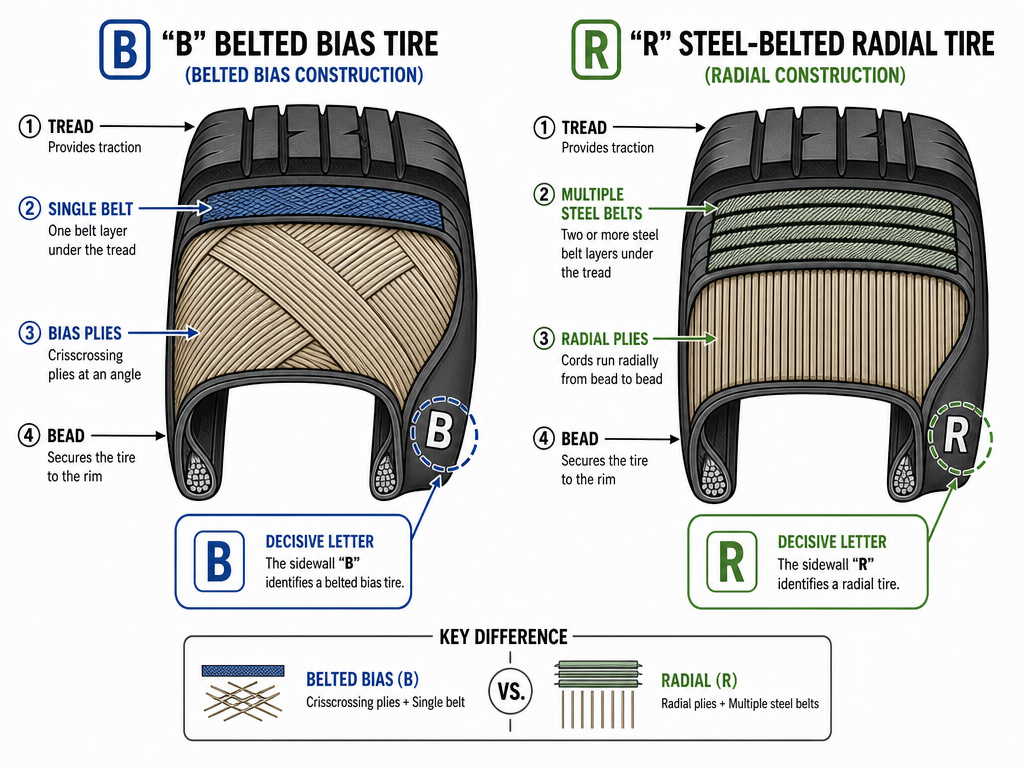
Ever seen “steel-belted” on a brochure and assumed it meant belted bias? You are not alone, and the confusion is baked into the vocabulary.
In everyday sales talk, “steel-belted” almost always means a radial with steel belts, not a what is a belted bias tire construction. The two share the word “belted,” and both can carry steel cords under the tread, but they are different constructions. The sidewall letter sorts it out: B is belted bias, R is radial. If you want the belt layout explained without the fog, the breakdown of steel-belted radial tires is where I send people.
Easy to miss: The word “belted” appears in both belted bias and steel-belted radial marketing. The sidewall letter, B or R, is the only thing that separates them.
So the next time someone leans on “belted” as a selling point, ignore the adjective. Find the letter. That single character is the claim you can actually verify.
When Would You Actually Pick Belted Bias Over a Radial?
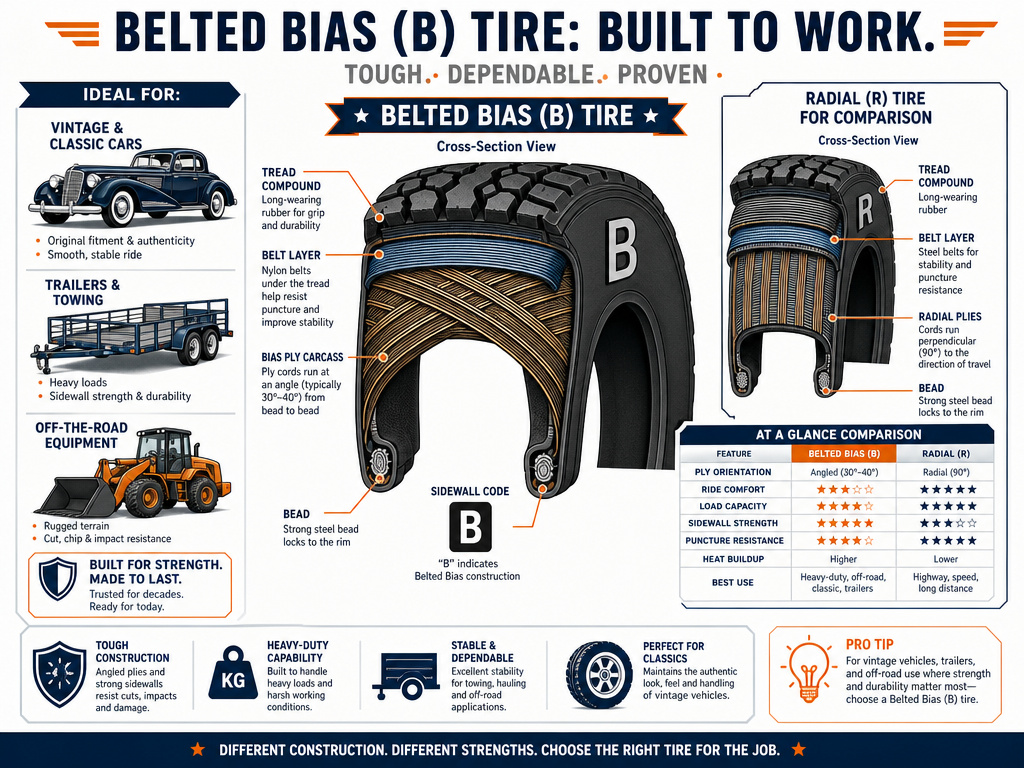
Most drivers should not buy a belted bias tire. Radial construction has settled the daily-driver question for most vehicles, and paying extra for a “belted” label on a commuter tire buys you little.
The honest uses are narrower. You are matching a vintage set, spec-ing a trailer, or keeping a stiff sidewall on a machine that wants one. For everything else, a radial tire is the calmer default. The full radial vs bias ply comparison is where the ride and heat differences get measured. If you do want the bias side of the ledger, the advantages of bias ply tires are real but specific.
- Vintage and classic cars, where a period-correct look is the point.
- Trailers and light commercial use, where a stiff sidewall is often wanted.
- Off-the-road equipment, sized with a hyphen instead of a letter.
| Construction | Ply cord direction | Sidewall code | Where it shows up |
|---|---|---|---|
| Belted bias | Angled, bead to bead | B | Vintage cars, trailers |
| Plain bias | Angled, bead to bead | D | Older passenger and light-truck sets |
| Radial | Perpendicular to centerline | R | Most modern passenger cars |
Belted bias earns its place when sidewall strength matters more than low rolling heat. Everywhere else, a radial is the calmer answer.
Two warnings here. Do not fit a belted bias to a high-mileage highway commuter expecting radial comfort. The angled carcass flexes as one unit and does not isolate the tread the way a radial’s perpendicular cords do, resulting in a harsher ride. And do not assume an XL or reinforced mark makes a tire tougher in every way. It means a higher load at a higher pressure, and run it at the wrong pressure and the center wears fast.
The 2/32 Rule Has a Heavy-Vehicle Exception at 4/32
Two thirty-seconds of an inch is the wear-out line for most passenger and light truck tires, and it is the number I check first. The thresholds come straight from the USTires passenger tire care guide.
Before you start: Underinflation or overloading can cause tread/belt separation even after a tire looks fine. Excessive tread or sidewall cracking removes a tire from service outright. And on vehicles over 10,000 lb (4,536 kg) GVWR, front-axle tires must come off at 4/32 inch, not the usual 2/32. Check placard pressure, measure depth with a gauge, and inspect the sidewalls before you trust any set.
- Read the construction letter first, B, D, or R. Skip it and you are inspecting a radial with belted-bias expectations, so the wear pattern you hunt for will not match what you see.
- Measure depth at the wear indicators. Built-in indicators appear at 2/32 inch (1.6 mm), and when they sit flush with the tread the tire is worn out.
- On a vehicle over 10,000 lb GVWR, measure the front axle separately. Federal rules 49 CFR 570.62 and 49 CFR 393.75(b) require front-axle removal at 4/32 inch (3.2 mm).
- Run a finger and an eye over the sidewall and tread. Excessive cracking removes the tire regardless of depth.
- Confirm cold inflation against the placard. Underinflation or overloading is a common trigger for tire belt separation, and it can fail at a later date, not just on the spot.
- If the tire sat stored, do a visual and tactile check before reuse. A vehicle stored on its tires should move every 3 months to change the flex area.
A tire about to separate may show signs of damage, and excessive sidewall cracking removes it from service regardless of tread depth.
Check the front axle.
Off-Road and OTR Sizes Use a Hyphen, Not a Letter
Off-the-road tires do not use the B code at all. A tube-type 18.00-25 is bias-ply, while 18.00R25 is radial. The hyphen is the tell. TIA’s bias-ply OTR retreading guidance adds that steel-fortified treads carry a wire layer above the breakers for cut protection, and that layer should not normally be stripped during retreading.
A retreaded off-road casing has to pass inspection for nonfills, porosity, and separations before it goes back to work.
Where this goes sideways: Treating an OTR hyphen size like a passenger B/D/R code will mislabel the tire. 18.00-25 is bias; 18.00R25 is radial.
Off-road is outside my daily bench, so for a machine that lives on a jobsite I defer to a specialist’s read rather than a blog post. Fair enough, but I will not pretend the two worlds share a sizing system.
How does a belted bias tire compare to a standard bias-ply tire?
The key difference is the addition of reinforced belts beneath the tread. A standard bias-ply tire has body cords that run diagonally from bead to bead. A belted bias tire uses that same diagonal carcass construction but adds a stabilizing belt, often made of steel or a strong synthetic material, that wraps circumferentially under the tread area. This belt reduces tread squirm and movement during rotation, leading to a more stable footprint. The result is a tire that offers improved tread life and more predictable handling over a standard bias-ply design, while maintaining the bias-ply’s inherent toughness and load-carrying structure.
What is the history of the belted bias tire?
The belted bias tire was an evolutionary step between the traditional bias-ply tire and the modern radial. For decades, the diagonal (bias) construction was standard. Engineers sought to improve tread wear and stability without a complete redesign of the tire’s fundamental carcass. The solution was to add reinforced belt plies under the tread of the existing bias-ply structure. This created a hybrid: the belted bias tire. It was a significant upgrade, offering a taste of radial-like tread performance while using familiar manufacturing techniques. The tire’s construction is still denoted by the letter ‘B’ in its size code, distinguishing it from the ‘D’ for diagonal bias and ‘R’ for radial.
What are the performance characteristics of a belted bias tire?
The reinforced belts under the tread directly enhance several performance areas. By limiting tread block movement, the belts improve handling stability compared to a standard bias-ply tire. This reduction in tread squirm also translates to longer tread life, as the rubber wears more evenly. The belts help manage the flexing of the underlying bias-ply carcass, which can aid in heat dissipation during operation. However, like all tires, performance can be compromised by underinflation or overloading, which can generate excessive heat and potentially lead to tread or belt separation. Always follow the vehicle manufacturer’s recommendations for inflation and load to maintain safe performance.
Frequently Asked Questions
What is better, radial or bias tires?
For most passenger driving, a radial wins on ride, heat, and tread wear. Bias and belted bias win where a stiff sidewall matters, like trailers and some vintage setups. The right answer follows the vehicle and the load, not the brand name.
Are steel-belted tires still made?
Yes. Most modern passenger tires are steel-belted radials. Belted bias with steel cords is now a niche, mostly on vintage and light-commercial sizes. The sidewall code tells you which one you are looking at.
How do I know if a tire is belted bias?
Look for the letter B in the size or service description, as D means plain bias and R means radial. D means plain bias and R means radial. On off-road sizes, a hyphen marks bias and an R marks radial instead.
At what tread depth is a belted bias tire worn out?
2/32 inch (1.6 mm) is the general line, matching the built-in wear indicators. Front axles on vehicles over 10,000 lb GVWR must come off at 4/32 inch (3.2 mm) under federal rules.
Does tire age decide when a belted bias tire is done?
USTMA states service life is not set by calendar age, and it has no data establishing a fixed limit. Cracking, load, inflation, and storage decide it, so judge condition, not a date.
The Bottom Line
Start with the sidewall. Find the letter before you read a brand name or a marketing line. B, D, or R tells you more in one second than a brochure page.
Then set your removal trigger by vehicle class. 2/32 inch (1.6 mm) is the line for a normal passenger tire, but 4/32 inch (3.2 mm) on the front axle of anything rated over 10,000 lb GVWR. Miss that and a “legal” tire is already out of spec.
Belted bias is a real construction with a real code, but I would still call it a niche for daily drivers. I keep my off-road and heavy-commercial advice secondhand, because that is not my bench. For a machine that lives on a jobsite, a specialist’s read beats mine, and I will say that plainly.
