
Types of Tire Tread Patterns: The Specs That Matter
This post contains affiliate links. As an Amazon Associate, we earn from qualifying purchases.
Many sources, such as Continental, describe three primary tread pattern categories for passenger vehicles: symmetrical, directional, and asymmetrical. However, other guides, like Firestone’s, list a fourth category: directional/asymmetrical. Symmetrical patterns offer quiet, long-wearing performance and flexible rotation. Directional patterns use V-shaped grooves for superior water evacuation and winter traction. Asymmetrical patterns combine a water-channeling inner half with a stiff, grippy outer half for balanced all-weather performance.
The pattern etched into your tire’s rubber isn’t just for looks. It’s a tuned system for evacuating water, biting into pavement, and managing noise. Those grooves, blocks, and sipes are arranged in a specific way to achieve a balance of traits no single pattern masters perfectly, which is why there are different types of tire tread patterns.
What follows is a breakdown of each primary pattern among the types of tire tread patterns, the specific rules that govern their use and maintenance, and a look at the entirely different classification system for off-road and heavy equipment tires. By the end, you’ll be able to look at any tire and understand not just what it is, but what job it was engineered to do.
Key Takeaways
- Symmetrical treads are the default for most passenger cars, offering a quiet ride and the simplest rotation scheme, they can move to any wheel position.
- Asymmetrical tires have a dedicated “outside” marking; mounting them backwards compromises both wet grip and cornering stability.
- Tread pattern is just one piece of the puzzle; the rubber compound and sipe density often matter more for real-world wet and winter traction.
- Federal law (49 CFR 571.119) mandates wear indicators at 1.6 mm (1/16 in) depth for most tires, but the U.S. Tire Manufacturers Association (USTMA) recommends replacing passenger/light truck tires at 2/32-inch for safety.
Symmetrical Tread: The Everyday Workhorse
Look at the tread on a standard family sedan or commuter car. If both halves of the tread are mirror images of each other, you’re looking at a symmetrical pattern. As defined by Continental, this design features continuous ribs or independent tread blocks repeated uniformly across the entire face of the tire.
The design prioritizes predictability and longevity. Because the pattern is identical on both sides, these tires can be rotated in any direction, front to back, side to side, or in a cross pattern. This flexibility is their biggest practical advantage, helping to promote even wear and extend tread life. The consistent design also tends to generate less road noise and offers lower rolling resistance, which can contribute to slightly better fuel economy.
Common mistake: Rotating symmetrical tires in a haphazard order. While they are flexible, sticking to a documented pattern (like a forward cross or X-pattern) is the only way to track wear and catch alignment issues early. Skipping a rotation beyond the recommended interval, which the USTMA suggests is every 5,000 to 8,000 miles (or per the tire manufacturer’s recommendations), lets wear patterns set in that later rotations can’t fix.
They are not specialists. A symmetrical tire will handle a rainy commute, but its uniform grooves are less aggressive at pumping water out from under the contact patch than a directional design. For a driver who prioritizes low cost-per-mile, a predictable ride, and simple maintenance, this is the pattern to choose.
Directional Tread: The Water Shedder
Directional tread looks purposeful. Its lateral grooves converge in the center to form a repeating V or arrowhead pattern, all pointing in one direction. This isn’t a styling exercise. The shape acts like a pump; as the tire rolls forward, the grooves scoop water and channel it outward and backward, away from the center of the tread.
The mechanics are straightforward. By aggressively evacuating water, the tire reduces the risk of hydroplaning, where a layer of water completely separates the rubber from the road. This makes the pattern a favorite for wet-weather and winter tires. The biting edges of the V-blocks also provide extra traction in loose snow and mud.
This specialization comes with strict rules. A directional tread can only roll in one direction. The sidewall will have an arrow marked “Rotation” to show the correct way. This means the tire is side-specific. You cannot swap a left-side tire to the right side unless you dismount it from the wheel and flip it around, a costly and impractical process for a routine rotation.
| Rotation Rule | Allowed Movement | Risk if Disobeyed |
|---|---|---|
| Front-to-Back Only | Driver’s front → Driver’s rear (and same for passenger side) | Reverses the V-grooves, trapping water and destroying wet-weather performance. |
| No Side-to-Side | Never swap left and right wheels | Forces a dismount/remount to correct direction, adding cost and risk of bead damage. |
Because of this, rotation for directional tires is limited to moving them from the rear to the front on the same side of the vehicle. If you ignore this and move a directional tire to the opposite side, the V-grooves will point backward, effectively holding water under the tire instead of ejecting it. The tire will become dangerously slippery in the rain.
Asymmetrical Tread: The Split Personality
An asymmetrical tire looks like two different tires fused together. The inner half and outer half of the tread have distinct patterns, each engineered for a specific task. According to Continental’s design guide, the inner shoulder is typically covered with smaller blocks, more grooves, and sipes to handle water displacement. The outer shoulder uses larger, stiffer tread blocks to provide lateral stiffness and grip during cornering.
This dual-zone approach aims for a best-of-both-worlds balance: wet-weather safety from the inner tread and crisp dry-road handling from the outer tread. It’s a common design for performance all-season and summer tires.
Where this goes sideways: Mounting an asymmetrical tire backwards. The sidewall is stamped “OUTSIDE” for a reason. If mounted incorrectly, the water-channeling inner tread is placed on the outside, where it can’t support cornering loads, and the stiff outer tread is tucked inside, where it’s useless for handling. The result is vague steering and poor wet grip.
Unlike directional tires, asymmetrical tires are not side-specific. You can move a left-side tire to the right side, as long as you keep the “OUTSIDE” sidewall facing out. However, their rotation is still restricted. Manufacturers like Firestone specify asymmetrical tires should only be rotated from the front to the back on the same side of the vehicle.
I once assumed all high-performance tires were directional. The first time I saw an asymmetrical pattern, I spent ten minutes trying to figure out which way the “arrow” pointed before I noticed the “OUTSIDE” marking. The lesson was simple: not all aggressive-looking treads are directional. Check the sidewall first.
The Fourth Pattern? Industry Debate and Off-Road Realities

How many primary tread patterns are there? Most sources, like Continental and Mavis, cite three. Firestone’s guide, however, lists a fourth: the directional/asymmetrical combination. This hybrid uses a directional V-pattern and different inner/outer tread designs. It’s a rare breed, found on some ultra-high-performance tires, and according to Firestone, it must be rotated from the back to the front only.
This disagreement highlights a key point: the three-pattern framework is a passenger-car construct. The moment you step into the world of heavy equipment, the classification system changes entirely.
For off-the-road (OTR) tires, the industry uses a functional taxonomy defined by standards like ISO 4250-1:2017. Here, patterns are categorized by the machine’s job:
- Rib: Long circumferential grooves for steering axles on graders and some haul trucks.
- Traction (Lug): Deep, spaced lugs for drive axles, providing forward bite in dirt and mud.
- Rock: Dense, cut-resistant blocks for extreme service in mining.
- Smooth: For compactors and finish work.
The YTC OTR guide warns never to cross these application lines, you never put an earthmover tire on a loader. This isn’t a performance nuance; it’s a safety and durability imperative. The engineering questions shift from “wet braking” to “cut resistance” and “ton-kilometer-per-hour” capacity.
Tread Wear, Law, and When to Replace
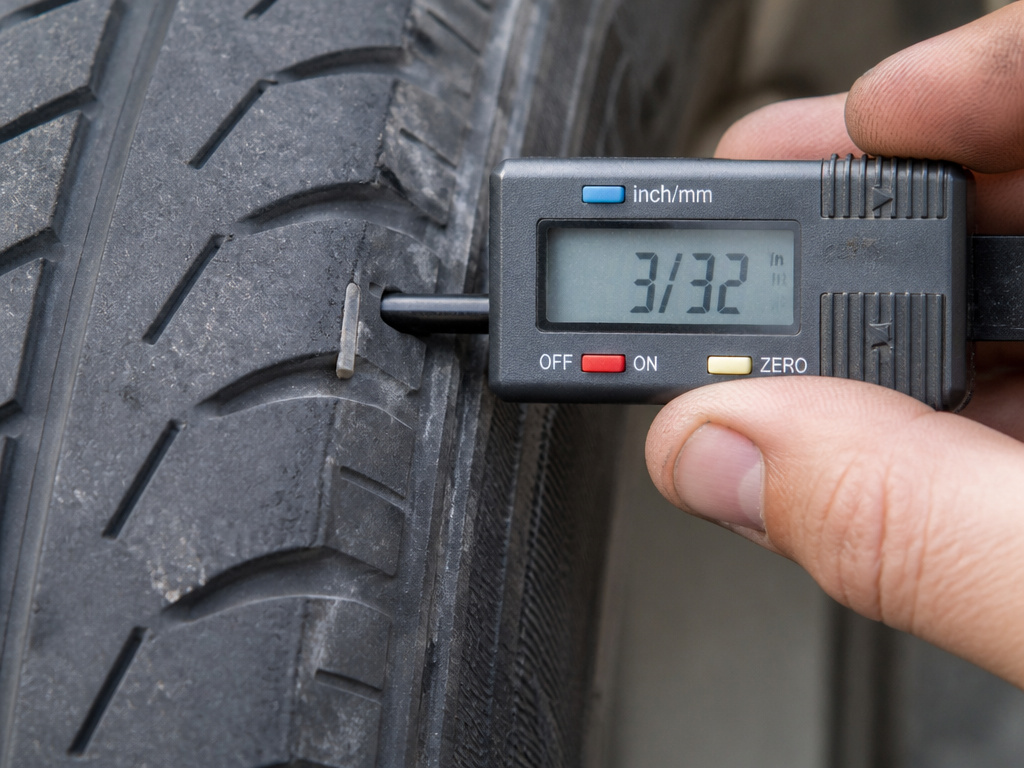
The pattern may dictate performance, but depth dictates safety. U.S. Federal regulation 49 CFR 571.119 sets the minimum legal standard: most tires must have at least six treadwear indicators that become flush with the tread at 1.6 mm (1/16 in) depth. For motorcycles, the threshold is 0.8 mm (1/32-inch).
Those little smooth bars that appear across your grooves are the legally defined end of your tire’s life. However, the U.S. Tire Manufacturers Association (USTMA) offers a more conservative, safety-focused guideline. While 2/32-inch is the legal minimum, wet-weather braking performance degrades significantly before that point. For vehicles with a GVWR greater than 10,000 lb (4,536 kg), the USTMA recommends replacing front-axle tires at 4/32-inch (3.2 mm) tread depth.
Worth knowing before you start: Measuring tread depth in just the center is a classic error. Wear is rarely even. I learned this the hard way after pronouncing a tire healthy based on a center measurement, only to find the inner shoulder was nearly bald. Use a gauge and check the inner, center, and outer grooves across several points. Treadwear indicators on OTR tires are often located one-fourth of the tread width from the shoulders, not in the center.
Here is a quick guide to the removal thresholds that go beyond simple tread depth:
| Condition | Source | Action |
|---|---|---|
| Tread depth ≤ 2/32″ (1.6 mm) | FMVSS 119 / USTMA | Replace tire (illegal & unsafe). |
| Tread depth ≤ 4/32″ (3.2 mm) on heavy vehicle front axle | USTMA | Replace tire for maintained safety margin. |
| Visible tread, sidewall, or ply separation | FMVSS 119 pre-test criteria | Replace tire immediately—structural failure. |
| Cuts exposing cord/fabric or unrepairable punctures | USTMA | Replace tire. |
| Age-related degradation (regardless of tread) | Industry guidance (based on rubber compound aging) | Strongly consider replacement. |
The rubber compound itself ages and hardens due to oxidation and exposure to ozone and heat, losing grip long before the tread is fully worn. A tire with plenty of tread but from 2012 is likely a harder, less grippy tire than a fresh one.
How to Choose Your Next Tread Pattern
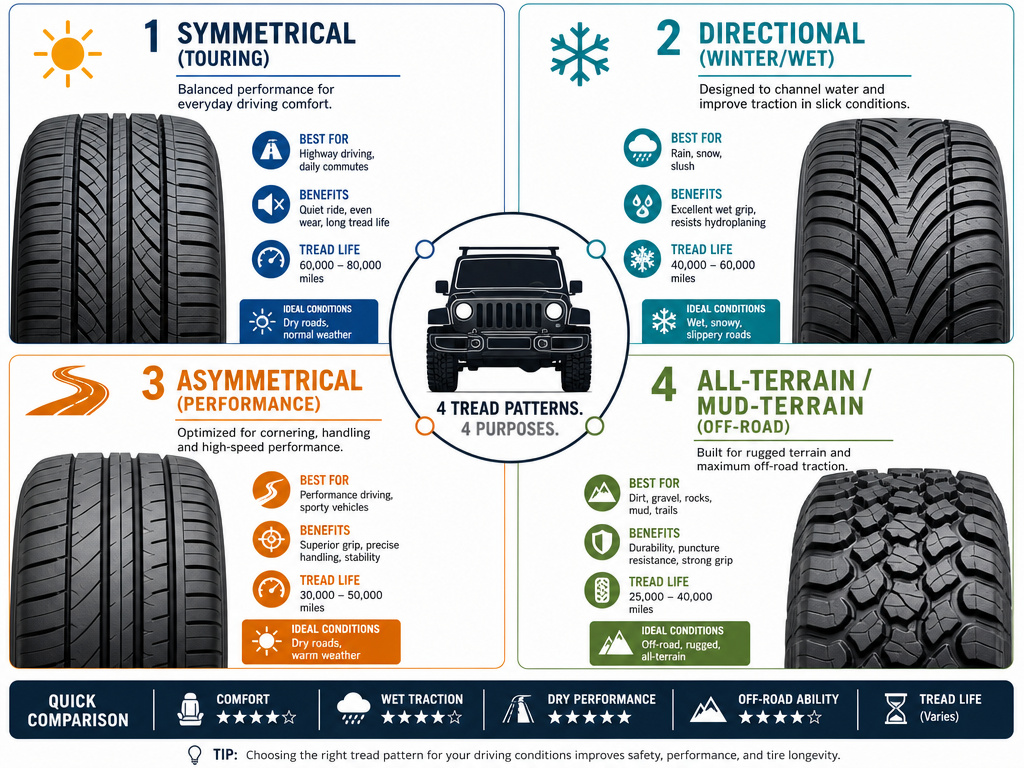
Forget the marketing. Start with your climate and driving style. The types of tire tread patterns you choose should follow from that.
- For predictable, low-cost commuting: A symmetrical pattern on a touring tire is the rational choice. You get longevity, quiet, and easy maintenance.
- For wet climates or snowy winters: Prioritize a directional or a highly sipped asymmetrical pattern. For verified winter performance, the tread pattern helps, but a soft, pliable compound is critical for grip on ice.
- For sporty driving on dry and wet roads: An asymmetrical performance tire is designed for this. It sacrifices some tread life for sharper handling.
- For trucks and SUVs used off-road: You leave the symmetrical/directional framework behind. Choose based on the OTR taxonomy, all-terrain (a hybrid), mud-terrain (traction/lug pattern), or rock patterns for severe service.
One strong opinion: an aggressive-looking tread does not guarantee better snow or wet performance than a premium touring tire with a sophisticated compound and dense siping. The pattern moves water, but the rubber grips the road. Read independent wet-braking test results. They often reveal that a “boring” tire with a great compound outperforms an aggressive one with a mediocre compound.
Finally, avoid mixing different tread patterns on your vehicle where possible. As Continental states, mixing can impair handling. If you must replace only two tires, ensure they match the pattern of the tires remaining on the vehicle.
How tire tread patterns affect fuel efficiency
Tire tread design directly influences rolling resistance, which is a key factor in a vehicle’s fuel economy. Tire tread design can influence rolling resistance, which is a key factor in a vehicle’s fuel economy. Symmetrical patterns with continuous ribs often promote efficiency, while more complex directional or asymmetrical designs for ultra-high-performance may prioritize grip over economy. Maintaining proper tire inflation is critical, as under-inflation increases rolling resistance and fuel consumption. Regular rotation, as recommended to prevent uneven wear, also helps maintain consistent performance and optimal efficiency over the tire’s life.
Combination asymmetrical and directional tread patterns
Some high-performance tires combine asymmetrical and directional designs into a single pattern. As noted, this combination is typically found on ultra-high-performance tires. The tread features the V-shaped grooves of a directional pattern for superior water evacuation, paired with the dual-zone design of an asymmetrical pattern. The inner half is optimized for water displacement, while the outer half uses rigid blocks to provide lateral stiffness for cornering and dry grip. This hybrid design has specific mounting and rotation rules. The tire must be mounted to rotate in the correct direction, and according to Firestone, it must be rotated from the back to the front only.
Frequently Asked Questions
What are the four types of tread designs?
Most industry sources describe three primary passenger tire tread patterns: symmetrical, directional, and asymmetrical. A fourth category, directional/asymmetrical, is sometimes listed for ultra-high-performance tires that combine both features. For commercial and off-road tires, the types are completely different and include rib, traction (lug), rock, block, and smooth patterns.
Which tread pattern is best?
There is no single “best” pattern. The symmetrical pattern is best for longevity, quiet, and easy maintenance. The directional pattern is best for evacuating water and providing traction in snow. The asymmetrical pattern is best for drivers who want a balance of wet-weather safety and dry-road handling. The best choice depends entirely on your driving conditions, vehicle, and priorities.
Are different tread patterns illegal?
Mixing different tread patterns on the same vehicle is not explicitly illegal under federal law, but it is strongly discouraged by every tire manufacturer and can be deemed unsafe. Mixing different tread patterns on the same vehicle is strongly discouraged by tire manufacturers as it can impair handling and safety. It is a definitive violation of best practices for vehicle safety.
How do I know if my tires are directional?
Check the sidewall for a marked arrow indicating the direction of rotation. The tread will also have a distinct, repeating V-shape or arrowhead pattern. If you see these, the tire is directional and must be mounted to roll in that specific direction.
Can I rotate asymmetrical tires myself?
Yes, but with a key restriction. Asymmetrical tires must always have the side marked “OUTSIDE” facing away from the vehicle. They can typically only be rotated front-to-back on the same side (e.g., front left to rear left). They should not be moved to the opposite side unless remounted on the wheel.
The Bottom Line
Your tire’s tread pattern is a tool for a specific job. Symmetrical for mileage, directional for water and snow, asymmetrical for balanced performance. The visible design matters, but the unseen rubber compound and the density of tiny sipes are equally critical for real-world grip.
Check the date code. Measure the tread in three places. Compare wet braking scores. Match the tire to your actual climate, not its adventurous appearance. And when the wear bars flush with the tread, or the rubber hits six years old, replace them. The pattern is the roadmap, but the rubber is the journey.
