
10 Best Analog Tire Pressure Gauges in 2026
This post contains affiliate links. As an Amazon Associate, we earn from qualifying purchases.
Our best overall analog tire pressure gauge is the JACO Superior Products JSP-014 for its ANSI-certified accuracy, durable brass construction, and convenient bleeder valve. We also recommend the Longacre 50417 for its precise deflator valve and the Milton S-986 for heavy-duty trucks and RVs. Correct tire pressure is critical for safety, even tire wear, and fuel economy, yet many drivers rely on inaccurate gas station gauges or visual checks.
This guide is based on research into specifications, expert round-ups, and patterns in owner feedback to help you select a reliable, durable gauge for your specific vehicle.
Top 10 Analog Tire Pressure Gauges in the Market

Certain content that appears on this site comes from Amazon. This content is provided "as is" and is subject to change or removal at any time.
The Best Analog Tire Pressure Gauges, Reviewed
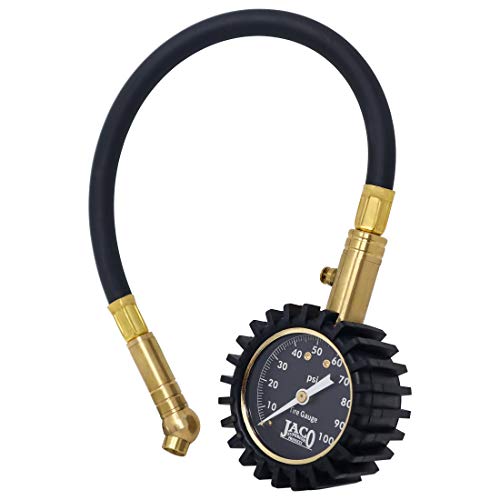
JACO Superior Products JSP-014 Analog Tire Pressure Gauge
What We Like
- ANSI-certified accuracy for reliable readings
- Solid brass construction with shock-resistant guard
- Built-in air bleeder valve for pressure adjustment
- Glow dial and 360-degree swivel chuck for ease of use
Trade-offs
- 100 PSI maximum limits use for heavy-duty trucks and RVs
- At 0.3 pounds, it is lighter than some heavy-duty gauges like the Rhino USA
- Single 100 PSI scale lacks dual-range versatility of some competitors
Certified calibration within ANSI standards means you can trust its readings for proper inflation, which helps with tire longevity and fuel efficiency. Built from solid brass with a shock-resistant guard, its construction is described as rugged and built to last. The 2-inch glow dial locks the reading in place until reset, and the flexible HybridFlex hose provides a soft feel while connecting to the valve.
The trade-off is its 100 PSI ceiling, which covers cars and light trucks but stops short of the demands for a semi truck or large RV. For those high-pressure needs, a dedicated gauge like the Milton S-986 is the required tool. For nearly everything else on the road, the JACO ElitePro delivers a no-battery, mechanically trustworthy reading that locks in place until you’re ready to reset it.
Product photos
Longacre 50417 Analog Tire Pressure Gauge

What We Like
- Built-in deflator valve for precise pressure reduction
- Large 2-inch glow-in-the-dark dial for easy reading
- High-flex hose and dual chuck for awkward valve stems
- Shock-resistant rubber bumper protects the gauge face
Trade-offs
- At 11 inches long, it's bulkier than pencil-style gauges.
A built-in tire pressure deflator valve gives this gauge a function many analog models lack. The feature allows you to reduce pressure in overinflated tires to a desired level, which adds a step of control during inflation. Combined with a protective shock-resistant rubber bumper, the design is built to last in a workshop environment.
Its 11-inch length makes it a tool for a toolbox rather than a pocket. The JACO ElitePro-X analog gauge, at 6 inches long, offers a more compact form. The Longacre’s size accommodates its high-flex hose and dual-angle chuck, which provide easier access to tire valves.
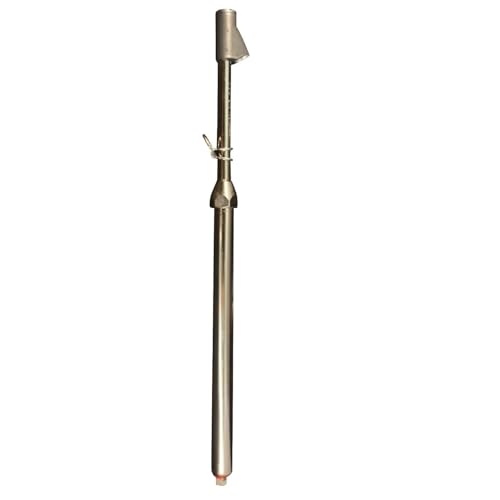
Milton S-986 Heavy Duty Tire Gauge
What We Like
- Wide 10-160 PSI range for heavy-duty tires
- Precision 2 PSI increments for accurate readings
- Durable plated brass tube construction
- Dual-head chuck fits various valve stems
Trade-offs
- The straight foot chuck design requires more clearance than angled models.
With a 10-160 PSI range and 2 PSI increments, this gauge precisely measures the high pressures required for semi-trucks, RVs, and other heavy-duty vehicles. Its plated brass tube and four-sided nylon indicator bar are materials chosen for durability. The 13 1/4-inch length provides a substantial handle for a firm grip during use.
The gauge’s 13 1/4-inch length makes it a tool for a glove box or workbench rather than a pocket. It reads in 2 PSI increments, which is standard for its pressure class but less precise than the 1 PSI scales found on some automotive-only gauges. This is an instrument built for a specific high-pressure task.
Product photos
JACO Superior Products EPX-60 Analog Tire Pressure Gauge
What We Like
- Quick-connect chuck locks instantly with a push
- Zero air loss with quick-release button
- Built-in bleeder valve for precise adjustments
- Comes with a padded pouch and lifetime warranty
Trade-offs
- 60 PSI max limits use on heavy-duty trucks and RVs
Its patented Lightning Chuck defines the experience, locking onto valve stems with a simple push to form an airtight seal without manual pressure. This ensures reliable readings without fumbling, and the quick-release button disconnects instantly with zero air loss. The aircraft-grade aluminum alloy construction feels durable yet lightweight, and the included heavy-duty storage pouch signals a tool built for long-term use.
The 60 PSI maximum capacity rules it out for checking dual tires on heavy-duty pickups or large RVs. For those vehicles, a model with a higher range is necessary, such as the Milton S-986 and its 160 PSI capacity. Within its range, the EPX-60 delivers speed and accuracy. The hose’s built-in fast-action bleeder valve also provides precise control for fine adjustments.
Product photos
ETENWOLF Tire Pressure Gauge

What We Like
- Manually calibrated for high process-level accuracy
- Large glow dial is easy to read in low light
- Swivel chuck allows reading from any angle
- Operates reliably in extreme hot or cold weather
Trade-offs
- At 0.6 lb, it's heavier than the 0.3 lb JACO EPX-60
- 75 PSI maximum may be insufficient for some heavy-duty RVs or trucks
- Its 4.8-inch length is shorter than some long-reach models like the Longacre 50417
Manual calibration to the ANSI B40.1 Grade A standard ensures a dependable reading you can trust for critical adjustments. This process-level accuracy suits drivers who prioritize precision, whether fine-tuning track-day pressures or seeking confidence in a weekly check. The 0-75 PSI range handles pickup trucks, motorcycles, SUVs, and RVs, while the large glow dial provides clear readings at night or in low light.
Its compact and solid build does come with a capacity limitation. The 75 PSI ceiling rules it out for some high-pressure applications, including certain commercial trucks. For those heavier-duty needs, you’d look to a model with a higher range, such as the Milton S-986 which measures up to 160 PSI.
Product photos
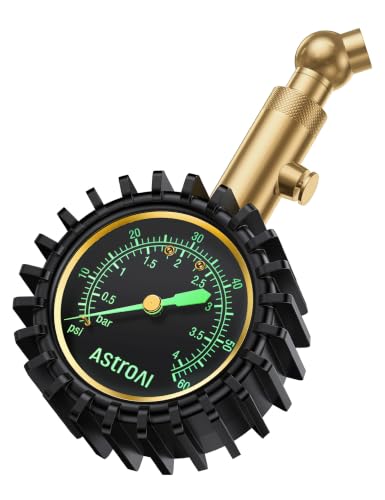
AstroAI A1 Battery-Free Tire Gauge
What We Like
- Battery-free operation for all-weather reliability
- Glow dial and dual scales for low-light use
- Rugged rubber armor protects against drops
- Calibrated to ANSI precision standards
Trade-offs
- Optimized 2-60 PSI range excludes heavy trucks
- Brass and rubber build adds some bulk
Optimized for the most common 2-60 PSI range with ANSI B40.1 calibration, this gauge provides accurate readings for typical car and SUV tires using clear, large scale divisions. Its glow-in-the-dark pointer and dual PSI/BAR scales make checking pressure in a dark garage or during a night-time emergency straightforward, with no need for mental unit conversions. Built with precision brass internals and no electronics, it works instantly in any weather, from winter cold to summer heat, without ever needing a battery. The shock-absorbing rubber armor and solid brass body are designed to survive years of accidental drops and rough storage in a trunk while maintaining its calibration.
The gauge’s 60 PSI maximum covers everyday sedans, SUVs, motorcycles, and pickup trucks, but vehicles like heavy-duty trucks or RVs often require pressures beyond that limit. For higher pressure needs, other models are available with a much higher rating, such as the 160 PSI Milton S-986. Relying on mechanical brass components instead of electronics, the AstroAI A1 delivers immediate, trustworthy readings for routine pressure checks. This makes it a dependable grab-and-go tool.
Product photos
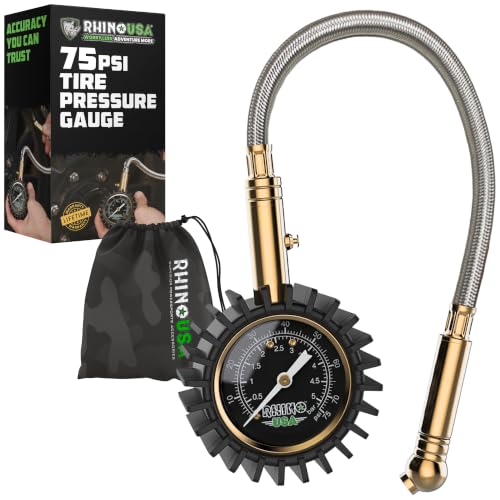
Rhino USA Heavy Duty Tire Gauge
What We Like
- Large 5 cm glow dial for easy reading
- Certified ANSI B40.1 accuracy
- Solid brass hardware for durability
- Backed by a lifetime warranty
Trade-offs
- At 7.5 inches long, less compact than pencil gauges
A certified ANSI B40.1 gauge with a 5 cm glow dial gives you confidence in accuracy, even in low light. This makes it a strong choice for drivers who want a reliable, easy-to-read tool for their car, truck, or motorcycle. The solid brass construction and lifetime warranty from a small family business signal a product built to last. That matters if you check your tires regularly and want a gauge that can handle being tossed in a glove box or tool bag for years.
The trade-off for that solid feel is a bit more bulk. At 7.5 inches long and half a pound, it’s not as pocket-friendly as a pencil gauge or as compact as some competitors. For most passenger vehicle use, the 75 PSI range is perfectly adequate. If you’re regularly checking pressures on a dually or RV, however, you’d need a gauge with a higher capacity, such as the Milton S-986 that goes up to 160 PSI. The Rhino excels as a durable, trustworthy tool for the typical driver.
Longacre 52-52003 Tire Pressure Gauge

What We Like
- Shock-resistant rubber bumper protects the gauge face
- Swivel angle chuck helps find valves at any angle
- Holds pressure readings until manually released
Trade-offs
- Length of 11.0 inches limits portability
- Weighs 0.6 pounds, heavier than some competitors
Its 2-1/2 inch dial glows in the dark, a practical feature for reading pressure in low light. A shock-resistant protective bumper surrounds the face, which should help the gauge survive drops. It includes a high flow air pressure release button to help avoid overinflation, and it holds pressure readings until you manually release them.
The trade-off for that large, clear dial is size. At 11 inches long, it’s a tool for your toolbox or workbench, not your glove compartment. For checking pressures on a passenger car or performance vehicle where 60 PSI is ample, it’s a reliable choice. If you need to handle the higher pressures of a dually or RV, the Milton S-986’s 160 PSI range is the more appropriate tool for that job. The Longacre excels where dial visibility and controlled pressure release are the priorities.
Milton S-976 Dual Head Tire Gauge
What We Like
- Dual chuck heads for inner and outer valves.
- Corrosion-resistant, durable brass construction.
- Factory calibrated across three pressure ranges.
- Five-gauge pack for multiple users or stations.
Trade-offs
- Scale reads in 2 PSI increments
- Pack of five may be excessive for individual users
The dual-head chuck design is the key feature here, letting you easily access both the inner and outer valve stems on a dually without struggling to angle a single chuck. That makes this Milton gauge a logical fit for fleet shops, RV service centers, or anyone regularly maintaining dual-wheel trucks and trailers. Its 10-160 PSI range covers everything from a lightly loaded pickup to a heavy commercial rig. The pack of five means you can outfit a whole maintenance bay or several service trucks without buying individually.
The gauge’s 2 PSI increment scale works well for general maintenance but is too coarse for tasks requiring hyper-accurate readings, like performance tuning or racing. For those precision needs, a gauge with a different range, such as the Longacre 50417 which covers 0-60 PSI, would be more suitable. For its core job of simplifying pressure checks on dual wheels and hard-to-reach valves, the Milton S-976’s straightforward design and durable construction deliver exactly what’s needed.
Product photos
AstroAI Pencil Tire Pressure Gauge

What We Like
- Extremely compact and pocketable design
- Rust-resistant stainless steel construction
- Battery-free for total reliability in all weather
- Includes integrated deflator valve and pocket clip
Trade-offs
- 75 PSI maximum limit excludes many trucks and RVs
- Small size can make the indicator bar harder to read
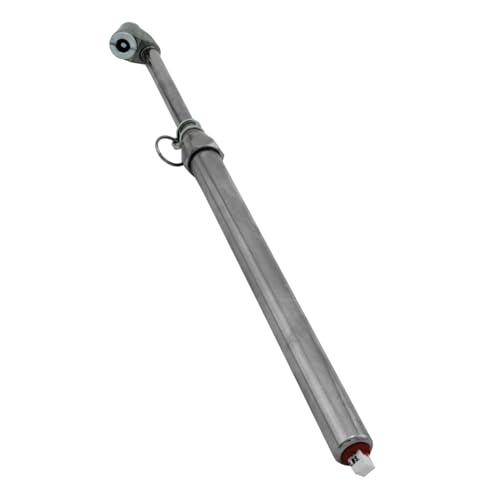
A 6.9-inch stainless steel body and 0.1-pound weight let this gauge stow easily in a glove box or pocket, which is the core of its appeal. The AstroAI pencil gauge is for the driver who wants a trustworthy, zero-maintenance checkup tool that’s always on hand. Its ±2% accuracy and integrated deflator valve handle the basics for cars and motorcycles without fuss. The pack includes two gauges.
One limitation is the 75 PSI ceiling, which rules out checking pressures on heavy-duty trucks or RVs. For those vehicles, a gauge like the Milton S-986 has a 10-160 PSI range. The stainless steel components prevent rust and corrosion, and the battery-free design provides total reliability under all weather conditions.
Product photos
How We Evaluated Analog Tire Pressure Gauges
Our evaluation began with manufacturer specifications and documentation to understand each gauge’s certified accuracy, pressure range, and construction. We then examined expert round-ups from automotive review sites to identify consistently recommended models and their noted strengths. Finally, we analyzed patterns in owner feedback across retailers to gauge real-world durability and ease of use.
The key criteria were accuracy and certification, pressure range and readability, and durability and features. ANSI B40.1 certification indicates a gauge meets recognized standards for precision, which is essential for correct inflation. The pressure range must suit your vehicle, from passenger cars to heavy-duty trucks, while a clear dial, often with glow features, ensures you can read it easily. Build quality from materials like solid brass and features like air bleeder valves or shock-resistant bumpers affect long-term reliability.
As a research-led evaluation, we cannot verify the precise calibration of individual units over time like a lab could. Our assessment identifies the best options based on design, reported performance, and value, but periodic calibration checks are a good practice for any mechanical gauge.
What To Look For In Analog Tire Pressure Gauges
An analog gauge is a simple, reliable tool that doesn’t need batteries. Choosing the right one means matching its capabilities to your vehicle and how you’ll use it.
Look for ANSI certification for assured accuracy, a pressure range that exceeds your vehicle’s needs, and a durable build with features like a bleeder valve or glow dial for practical use.
Accuracy and Certification
For trustworthy readings, seek out gauges calibrated to the ANSI B40.1 standard. This certification means the gauge’s accuracy has been verified against a recognized benchmark, often within +/- 1-2% of the reading. Some manufacturers perform additional manual calibration for even higher precision, which is valued in performance tuning. Without such certification, accuracy can vary significantly between units, leading to improper inflation that affects handling and tire life.
Pressure Range and Readability
Check your vehicle’s recommended tire pressure, usually found on the driver’s door jamb, and ensure the gauge’s maximum rating is well above it. Passenger cars and SUVs typically need under 50 PSI, so a 60 or 75 PSI gauge is sufficient. For trucks, RVs, or trailers, you’ll need a heavy-duty gauge with a range up to 120 or 160 PSI.
A clear dial is essential; look for large numbers, a glow-in-the-dark face you can charge with a light, and a swivel chuck or hose that lets you position the dial for an easy view.
Durability and Features
Construction materials dictate longevity. Solid brass internal mechanisms and housings resist corrosion and wear better than plastic. Rubber bumpers or armored sleeves protect the dial from drops. Practical features add convenience: a built-in air bleeder valve lets you release small amounts of air for perfect adjustment, and a quick-connect chuck simplifies one-handed operation. For a deeper dive into the pros and cons of different designs, our guide to tire gauge types is a useful resource.
- Confirm the gauge includes a chuck that fits your valve stems securely to prevent air loss during the reading.
- Consider the length and flexibility of any hose for reaching valve stems on large trucks or dual wheels.
- Check for a warranty, as lifetime coverage reflects manufacturer confidence in their product.
Always choose a gauge with a maximum pressure rating at least 25% higher than your vehicle’s requirement.
Analog Tire Pressure Gauges Compared
The table below compares key specifications for all ten of our top picks to help you quickly identify the right gauge for your needs.
| Product | Pressure Range | Accuracy | Chuck Type |
|---|---|---|---|
| JACO Superior Products JSP-014 Analog Tire Pressure Gauge | 100 PSI | ±1.5% per ANSI Standards | 360-degree swivel chuck |
| Longacre 50417 Analog Tire Pressure Gauge | 0-60 PSI | N/A | Angle and ball chuck |
| Milton S-986 Heavy Duty Tire Gauge | 10-160 PSI | N/A | Straight foot dual head |
| JACO Superior Products EPX-60 Analog Tire Pressure Gauge | 60 PSI | ±1.5% (ANSI B40.1) | Patented quick-connect Lightning Chuck |
| ETENWOLF Tire Pressure Gauge | 0-75 PSI | ±1% of span per ANSI B40.1 Grade A | 360-degree swivel |
| AstroAI A1 Battery-Free Tire Gauge | 2-60 PSI | ±1% | N/A |
| Rhino USA Heavy Duty Tire Gauge | 0-75 PSI | ANSI b40.1 accurate | 360 swivel |
| Longacre 52-52003 Tire Pressure Gauge | 0-60 PSI | N/A | Swivel angle and ball chuck |
| Milton S-976 Dual Head Tire Gauge | 10-160 PSI | N/A | Dual head |
| AstroAI Pencil Tire Pressure Gauge | 10-75 PSI | ±2% span | N/A |
Frequently Asked Questions
Which analog tire pressure gauge is the most accurate?
The most accurate analog gauges are those certified to the ANSI B40.1 standard, like our best overall JACO JSP-014. This certification verifies the gauge meets strict precision benchmarks. Some models, like the ETENWOLF, undergo additional manual calibration for what’s termed process-level accuracy, making them excellent for meticulous pressure management.
What is the advantage of an analog gauge over a digital one?
Analog gauges require no batteries, so they are always ready to use in any weather, from extreme cold to heat. They are generally simpler in construction, which can translate to greater long-term durability. For a look at the electronic alternatives, see our review of the best digital tire gauges.
How often should I check my tire pressure?
You should check tire pressure at least once a month and before any long trip. Tires naturally lose about 1 PSI per month, and temperature changes affect pressure. Regular checks are the only reliable way to maintain optimal pressure, as visual inspection is often inaccurate until pressure is significantly low.
Can I use the same gauge for my car and my RV?
Only if the gauge’s maximum pressure range is sufficient for both vehicles. Many passenger car gauges max out at 60 or 75 PSI, which is inadequate for RVs or heavy-duty trucks that may require 80 PSI or more. For mixed fleets, choose a gauge like the Milton S-986 with a wide 10-160 PSI range.
What does a bleeder or deflator valve do?
A bleeder or deflator valve is a small button or screw on the gauge that allows you to release air from the tire in a controlled manner. This is invaluable for fine-tuning pressure after using a high-flow air compressor, which often over-inflates tires. The Longacre 50417 is our top pick specifically for this precise deflation capability.
The Bottom Line
The best overall analog tire pressure gauge for most drivers of cars, SUVs, and light trucks is the JACO Superior Products JSP-014. It offers certified accuracy, a practical bleeder valve, and durable construction backed by a lifetime warranty. If you’re on a tight budget and drive a standard car, the ultra-compact AstroAI Pencil Gauge provides reliable, battery-free operation. For owners of heavy-duty trucks, RVs, or commercial vehicles, the Milton S-986 is the essential choice with its high-pressure range.
Regardless of your choice, prioritizing a gauge with a verified accuracy standard is the single most important factor for maintaining proper tire pressure, which ensures safety, extends tire life, and optimizes fuel efficiency.
