10 Best Motorcycle Tire Pressure Monitoring Systems in 2026
This post contains affiliate links. As an Amazon Associate, we earn from qualifying purchases.
Sykik Rider SRTP300 Wireless Tire Pressure Monitoring System is the best overall for riders who want a compact, water-resistant monitor with pre-set PSI and Fahrenheit values. FOBO Bike 2 Bluetooth Tire Pressure Monitoring System is the Best Smartphone Integration pick, and Zopsc Solar Motorcycle Tire Pressure Monitoring System is the Best Solar-Powered choice.
A motorcycle has only two tires, so a slow leak or hot tire changes handling quickly. The real problem is deciding whether you want a handlebar display, a phone app, or a solar receiver that wakes with vibration.
We reviewed 10 systems using manufacturer specs, installation notes, and recurring owner themes about power, sensor placement, and alerts. You get a shortlist for riders who want real-time pressure and temperature without turning every stop into a manual gauge check.
Top 10 Motorcycle Tire Pressure Monitoring Systems in the Market


Certain content that appears on this site comes from Amazon. This content is provided "as is" and is subject to change or removal at any time.
The Best Motorcycle Tire Pressure Monitoring Systems, Reviewed
Sykik Rider SRTP300 Wireless Tire Pressure Monitoring System
What We Like
- Compact 1.5-inch water-resistant monitor.
- Pre-set for PSI and Fahrenheit for immediate use.
- One-year US warranty with California-based support.
Trade-offs
- Monitor requires USB recharging every 9-12 months.
- No solar charging option for the display unit.
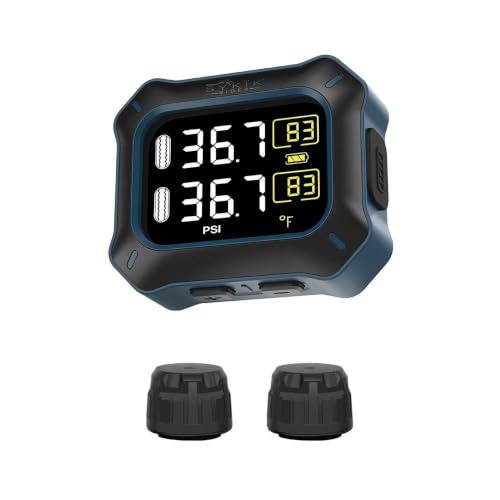
It’s built for riders who prioritize a clean, integrated look without sacrificing data. The system arrives ready to use with its default PSI and Fahrenheit readings, and the long-life batteries mean you’ll spend more time riding than managing accessories. This plug-and-play simplicity and compact design are why it stands out for general street use.
That compact monitor requires periodic USB recharging, unlike solar-powered alternatives such as the Zopsc. While a single charge provides up to twelve months of use, it remains a maintenance step that solar models avoid. Riders who frequently take long tours or store their bikes indoors might prefer a solar unit to skip charging entirely. The Sykik system is well-suited for daily commuters who prioritize a simple, low-profile setup over completely cable-free operation.
FOBO Bike 2 Bluetooth Tire Pressure Monitoring System
What We Like
- No separate display needed; uses your phone.
- Cloud sync and sharing for remote monitoring.
- Easy DIY installation with no tools required.
- Supports group ride monitoring for multiple bikes.
Trade-offs
- Requires a smartphone and internet for initial setup.
- No dedicated display; relies entirely on phone app.
Pairing directly to a smartphone via Bluetooth 5.0 eliminates the need for a separate handlebar display. This creates a clean setup for riders who already rely on their phone for navigation, as all tire pressure and temperature alerts appear in an app they always carry. Warnings for pressure drops come through whether the motorcycle is being ridden or is parked, feeding data into a single, familiar device. The system suits a rider who wants integrated monitoring and the option to share tire status with others.
A smartphone screen must be active to view live data while riding, unlike systems such as the Sykik Rider SRTP300 which have a dedicated monitor. The setup process requires an internet connection to initially register the sensors to a user account, as noted in the product review. For riders who prefer a self-contained, always-visible gauge, a system with its own display is a more practical choice.
Zopsc Solar Motorcycle Tire Pressure Monitoring System

What We Like
- Solar power enables continuous, cable-free operation
- Clear LCD screen works in all lighting conditions
- Six specific safety alarms for comprehensive protection
- External sensors install without tire disassembly
Trade-offs
- External sensors are more vulnerable than internal ones
The dual solar and USB charging system means you never have to worry about finding an outlet mid-trip, and the automatic power management conserves that energy when the bike is parked. This makes the Zopsc a strong choice for riders who prioritize a self-sufficient setup and want a display that provides real-time pressure and temperature data without needing a phone app. Its six distinct alarm modes cover everything from slow leaks to high temperature, giving you clear warnings for specific hazards.
Zopsc’s system uses external sensors that screw onto the valve stems for a tool-free installation, a process the brand says takes under ten minutes. These IPX7-rated units resist rain and dust, but their position leaves them more exposed to impacts from curbs or road debris than internal designs would be.
Product photos
LNKERCO Solar Motorcycle Tire Pressure Monitoring System
What We Like
- Auto wakes by vibration and sleeps after parking
- Solar charging reduces need for cable plug-ins
- Seven distinct alarms for pressure, temperature, and battery
- Factory-paired sensors for immediate installation
Trade-offs
- Receiver is larger than some models like the Sykik Rider SRTP300
- External sensors require periodic coin cell replacement
Its auto wake feature is triggered by bike vibration, so you never have to remember to turn the system on or off. This makes it ideal for riders who want a set-and-forget safety monitor that’s always watching when you’re rolling. The solar panel on the receiver cuts down on charging fuss. Its seven distinct alarms cover everything from rapid leaks to high tire temperatures, giving you a clear alert without staring at the screen.
The receiver’s size, at over six inches tall, requires more deliberate placement on a motorcycle’s handlebars compared to smaller units like the Sykik Rider SRTP300. This larger footprint can be a consideration for riders with crowded cockpit setups. Its design prioritizes a dedicated, always-on display that operates independently, without the need for a paired smartphone.
Product photos
QPKING Wireless Motorcycle Tire Pressure Monitoring System
What We Like
- Monitors tilt angle for enhanced cornering awareness.
- Displays all critical riding data on a single screen.
- Features a smart sleep mode to conserve battery.
- Supports both Bar/PSI and °C/°F unit displays.
Trade-offs
- Requires checking valve type and installation space before purchase.
- External sensors may be more vulnerable to damage than internal ones.
- Power supply limited to motorcycles with DC 11.5V-30V systems.
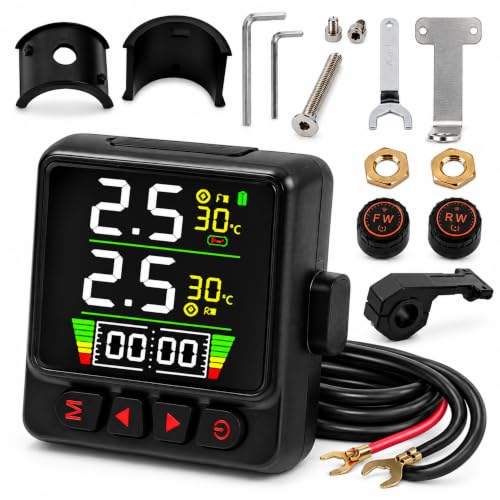
The QPKING system’s inclusion of a tilt angle monitor is its standout feature, providing a concrete metric for lean angle during aggressive cornering or when navigating uneven surfaces. This makes it a strong choice for riders who prioritize understanding their bike’s dynamics alongside basic tire safety. The comprehensive HD display consolidates pressure, temperature, voltage, and time, so you get a complete dashboard snapshot without switching screens. Its smart sleep mode, which activates after parking, is a thoughtful touch for preserving power between rides.
Potential buyers should first confirm their motorcycle’s valve type and available clearance, because the QPKING system uses external sensors that protrude from the wheel. This design makes installation simple with the provided wrench and lock nuts, but it also creates a potential snag point that internal sensor systems avoid. For riders prioritizing tilt angle data without needing a smartphone app, this system offers that core monitoring function directly on its display.
Product photos
Avutrel IP67 Motorcycle Tire Pressure Monitoring System

What We Like
- IP67 waterproof rating for all-weather riding.
- Real-time alerts for pressure leaks and overheating.
- Tool-free, anti-theft sensor installation.
- Includes magnetic charging and full accessory set.
Trade-offs
- External sensors are more exposed to damage than internal ones.
- Requires USB charging, not solar or permanent vehicle power.
An IP67 waterproof rating means this system shrugs off rain and road spray, making it a reliable companion for riders who don’t let the forecast dictate their plans. Its tool-free, anti-theft external sensors install in seconds, and the magnetic charging setup is built for the long haul. This configuration prioritizes durability and ease of use, perfect for the rider who values a rugged, self-contained unit over minimalism.
The Avutrel TPMS unit is over six inches long, which means it requires a sizable spot on your handlebars or dash. Riders seeking a smaller overall footprint could consider the Sykik Rider SRTP300, whose entire unit measures just two inches long. For long-distance travel, the Avutrel’s IP67 waterproofing and included full accessory kit provide a practical, all-weather setup.
Product photos
EOHMAK Motorcycle Tire Pressure Monitoring System

What We Like
- Real-time pressure and temperature monitoring
- Clear LCD display for tire information
- Waterproof and dustproof display design
- Universal fit for two-wheeled vehicles
Trade-offs
- External sensors may be vulnerable to damage
Real-time monitoring of both tire pressure and temperature means you get an immediate audiovisual warning if a tire starts to go soft or overheat, which is crucial for maintaining stability and safety on two wheels. The EOHMAK system suits riders who want basic, reliable monitoring without complex features, focusing purely on the essential numbers with a clear, weather-resistant display that handles any climate. Its straightforward design delivers the core function of a TPMS effectively for everyday use.
This system provides live pressure and temperature monitoring with an audiovisual alarm for abnormalities, which means riders get immediate warnings for safety. Unlike the FOBO Bike 2, it lacks smartphone integration, so all data is viewed on its dedicated physical display. That makes it a straightforward choice for riders who prefer a self-contained unit but limits remote checks or data logging.
Product photos
LEEPEE Bluetooth Motorcycle Tire Pressure Monitoring System
What We Like
- App provides real-time pressure and temperature monitoring
- Multiple, configurable alert modes for safety
- Sensors enter sleep mode to conserve battery
- Rugged, all-weather construction for durability
Trade-offs
- Requires a compatible smartphone to view data
- No dedicated display, relies solely on app
- Sensors are external, not internal
This system’s core advantage is delivering live pressure and temperature data directly to your smartphone via a dedicated app, which allows for detailed monitoring and customizable alerts without adding a fixed display to your handlebars. It’s ideal for riders who want a clean cockpit and prefer to keep diagnostic information on a device they already carry. The sensor’s intelligent sleep mode after ten minutes of inactivity helps extend battery life, making it a set-and-forget accessory for daily commuters.
This system relies entirely on a smartphone app for monitoring, which means you need to have your phone accessible to check tire status. For riders who already mount their phone on their motorcycle, this setup provides a clear display. However, it differs from products with a dedicated monitor, such as the Sykik Rider SRTP300, which offers at-a-glance viewing on its own 1.5-inch screen.
Product photos
FOBO Bike 2 Trike TPMS

What We Like
- Sends instant alerts to smartphone, smartwatch, or headset
- Monitors pressure and temperature in real time
- Intelligent system specifically designed for trikes
- Account-based sensor ownership allows transfer between vehicles
Trade-offs
- Requires initial internet connection for account setup
- Uses CR1632 batteries that will eventually need replacement
The FOBO Bike 2 Trike TPMS monitors tire pressure and temperature in real time through a smartphone app, sending instant audio, tactile, and text alerts if a tire starts losing air. This system takes the guesswork out of knowing your tire status, so you know exactly when to reach for a pump or address a leak. Its intelligent Bluetooth design is specifically for all motorcycle types with three wheels, which makes setup straightforward for those configurations.
The trade-off is that you’re tied to your phone for the interface. While the app is straightforward once paired, reviewers report you need an internet connection initially to create an account and register the sensors. Compared to systems with their own monitor, like the Sykik Rider SRTP300, FOBO keeps your cockpit clean but requires you to check your device for data. For trike owners who already ride with a phone mounted or connected via Bluetooth, this integration may feel natural.
Product photos
B-Qtech Bluetooth TPMS
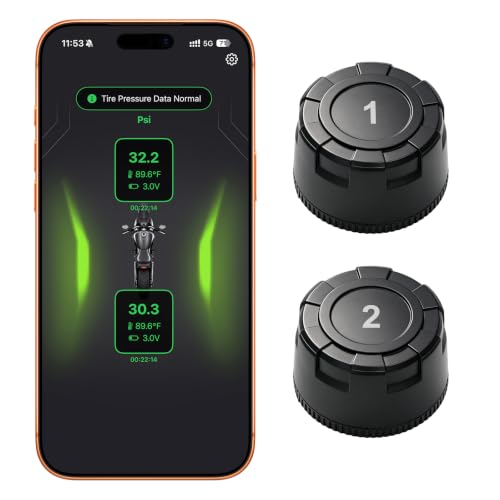
What We Like
- Six distinct alert modes for comprehensive monitoring.
- Compact, wireless sensors require no separate display.
- Bluetooth app allows real-time pressure and temperature data.
- User-replaceable sensor batteries simplify long-term maintenance.
Trade-offs
- Relies solely on a smartphone app for all data display.
- Limited to two sensors, not suitable for three-wheeled vehicles.
Six distinct alarm modes for leaks, low pressure, high pressure, high temperature, low battery, and sensor faults provide a detailed safety net designed to prevent blowouts and extend tire life. Riders get a comprehensive alert system that moves beyond simple pressure monitoring. All data and customization are managed through a dedicated smartphone app, which turns a mobile device into the system’s central display and diagnostic tool.
The trade-off is the complete dependence on that app; you have no physical display to glance at while riding. This design keeps the hardware minimalist and the installation wiring-free, but it means your phone’s battery and connectivity become part of the system’s reliability. If you prefer a dedicated, always-on display, a system with its own monitor, such as the Sykik Rider SRTP300, offers a more traditional, glanceable interface, though it may not pack the same breadth of smart alerts.
Product photos
How We Evaluated Motorcycle Tire Pressure Monitoring Systems
We reviewed aftermarket TPMS options using manufacturer specs, expert round-ups, installation notes, and recurring owner themes about power, sensor placement, and alerts. The list includes 10 systems, so we focused on details that change daily use rather than marketing language.
The criteria we weighed most were display type, power source, sensor placement, and alert clarity. A handlebar unit can show both tires at once, while phone-based systems rely on Bluetooth and app setup; understanding how TPMS works helps match the system to the bike.
A research-led guide cannot replace checking your motorcycle tire pressure before a ride, because sensors report what the system is designed to measure, not every leak or installation mistake. We also left out claims that depend on a specific bike, wheel, or app version.
What To Look For In Motorcycle Tire Pressure Monitoring Systems
The right system depends on how you want to see the data, how you power it, and where the sensors sit. If you are shopping for tire pressure monitors, start by deciding whether the display belongs on the bars, in your phone, or in a solar receiver.
Look for real-time pressure and temperature alerts, a display method you will actually check, and a power plan that avoids dead receivers. Weigh external versus internal sensors, then match your bike to a system that fits your dash, phone habits, and climate.
Display and Alert Visibility
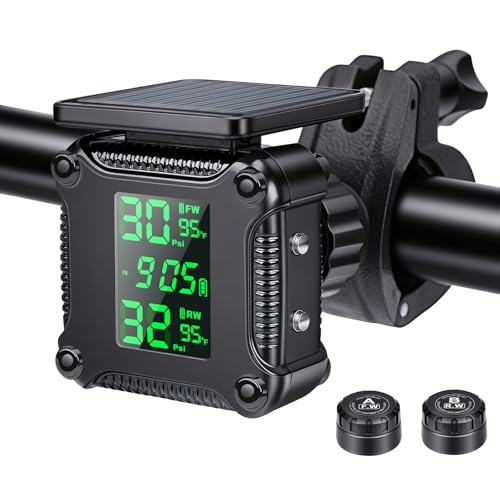
A dedicated screen helps when you want a glance without unlocking a phone. The Sykik Rider SRTP300 uses a compact 1.5-inch water-resistant monitor with pre-set PSI and Fahrenheit values. The QPKING Wireless Motorcycle Tire Pressure Monitoring System puts pressure, temperature, and tilt angle on one screen. If you want a top TPMS system that is easy to read at a glance, a handlebar display may suit you better than an app-only setup.
Power and Maintenance
Before you buy, think about the battery stack: a receiver, display, and TPMS sensors all need power. The Sykik Rider SRTP300 recharges by USB every 9 to 12 months. The Zopsc and LNKERCO Solar Motorcycle Tire Pressure Monitoring Systems use solar charging to reduce cable plug-ins; the LNKERCO also wakes by vibration and sleeps after parking. If your bike lacks dash space or a charging point, pair the system with a digital tire gauge as a backup for cold checks.
Sensor Placement and Installation
External valve-cap sensors avoid tire disassembly, but they sit in the open and can be more vulnerable than internal sensors. The Zopsc Solar and Avutrel IP67 Motorcycle Tire Pressure Monitoring Systems use external sensors. The QPKING Wireless system asks buyers to check valve type and clearance first. A portable inflator makes it easier to correct a low reading before you ride.
- Match the sensor type to the wheel clearance and valve stem.
- Confirm the receiver wakes by vibration or vehicle power.
- Decide whether a handlebar screen or phone app is safer to check.
- Verify the alarm limits match your tire’s cold pressure guidance.
- Check how sensor batteries are replaced before committing.
If you will not glance at the data before every ride, choose the display style that is hardest to ignore.
Motorcycle Tire Pressure Monitoring Systems Compared
The table below compares all 10 systems by award, display style, power source, sensor placement, and best fit.
| Product | Sensor Type | Alarm Modes | Power Source |
|---|---|---|---|
| Sykik Rider SRTP300 Wireless Tire Pressure Monitoring System | N/A | N/A | 9-12 month rechargeable |
| FOBO Bike 2 Bluetooth Tire Pressure Monitoring System | Wireless | Low pressure, fast/slow leak, temperature | Bluetooth 5.0 to smartphone |
| Zopsc Solar Motorcycle Tire Pressure Monitoring System | External sensors | Six intelligent modes | Solar and USB charging |
| LNKERCO Solar Motorcycle Tire Pressure Monitoring System | External sensors | 7 Smart Alarms | Solar panel + magnetic cable |
| QPKING Wireless Motorcycle Tire Pressure Monitoring System | 2 external sensors | High/low pressure, temperature, tilt angle | DC 11.5V-30V, Built-in USB port |
| Avutrel IP67 Motorcycle Tire Pressure Monitoring System | IP67 External Sensors | N/A | USB Rechargeable |
| EOHMAK Motorcycle Tire Pressure Monitoring System | 2 external sensors | Audiovisual alarm | N/A |
| LEEPEE Bluetooth Motorcycle Tire Pressure Monitoring System | 2 external sensors | Pressure, temperature, leakage, battery | N/A |
| FOBO Bike 2 Trike TPMS | N/A | Audio, tactile, text alerts | N/A |
| B-Qtech Bluetooth TPMS | 2 sensors | 6 modes | N/A |
Frequently Asked Questions
What is the best tire pressure monitoring system for motorcycles?
The Sykik Rider SRTP300 Wireless Tire Pressure Monitoring System is the best overall pick. It wins for a compact 1.5-inch water-resistant monitor, pre-set PSI and Fahrenheit values, and a one-year US warranty with California-based support. Riders who want a phone-first setup may prefer the FOBO Bike 2 Bluetooth Tire Pressure Monitoring System, while solar-minded riders can choose the Zopsc Solar Motorcycle Tire Pressure Monitoring System.
Which motorcycle TPMS works best with a smartphone?
The FOBO Bike 2 Bluetooth Tire Pressure Monitoring System is the Best Smartphone Integration pick. It uses a phone instead of a separate display, supports cloud sync and group ride monitoring, and installs without tools. The LEEPEE Bluetooth Motorcycle Tire Pressure Monitoring System and B-Qtech Bluetooth TPMS also rely on apps, but they need a compatible phone and app access for every check.
Do motorcycle TPMS sensors need tire disassembly?
Many valve-cap style sensors install without tire disassembly, including the Zopsc Solar Motorcycle Tire Pressure Monitoring System and Avutrel IP67 Motorcycle Tire Pressure Monitoring System. Internal sensors sit inside the rim and usually need tire work. Before buying, check valve type and stem clearance, especially on bikes with tight wheel space, because external sensors can be exposed to damage.
Are solar motorcycle TPMS displays maintenance-free?
No. Solar power reduces charging for the receiver, but sensors still need batteries or periodic care. The Zopsc Solar Motorcycle Tire Pressure Monitoring System and LNKERCO Solar Motorcycle Tire Pressure Monitoring System use solar charging, while the LNKERCO receiver is larger and its external sensors use coin cell batteries. The Sykik Rider SRTP300 Wireless Tire Pressure Monitoring System has no solar display and needs USB recharging every 9 to 12 months.
How do tire pressure alerts help motorcycle riders?
Alerts warn about low pressure, high pressure, temperature swings, and leaks before handling changes become severe. The Avutrel IP67 Motorcycle Tire Pressure Monitoring System sends real-time alerts for pressure leaks and overheating, and the B-Qtech Bluetooth TPMS offers six distinct alert modes. Still, a manual cold tire check remains useful because sensors report the data they are designed to show.
The Bottom Line
The Sykik Rider SRTP300 Wireless Tire Pressure Monitoring System is the best overall pick because it combines a compact 1.5-inch water-resistant monitor, pre-set PSI and Fahrenheit values, and a one-year US warranty with California-based support. It fits riders who want a discreet, plug-and-play display without leaning on a phone app.
Riders wanting the Best Budget Pick can look to the EOHMAK Motorcycle Tire Pressure Monitoring System, which pairs a clear LCD display with a waterproof and dustproof design. Trike owners should choose the FOBO Bike 2 Trike TPMS for smartphone alerts, while the QPKING Wireless Motorcycle Tire Pressure Monitoring System is the Best Tilt Angle Monitor pick for cornering awareness.
Choose by display method first: handlebar, phone, or solar receiver. If you will not glance at the data before every ride, the best system becomes another unused gadget.
