
10 Best On Board Air Compressors in 2026
This post contains affiliate links. As an Amazon Associate, we earn from qualifying purchases.
The ARB CKBLTA12 Brushless Twin Onboard Compressor is a leading choice due to its brushless motor design, active cooling system, and high airflow. For a complete system with an air tank, the VIAIR 450C is a top option, and the VIAIR 485C is well-suited for high-pressure applications like air suspension.
Choosing the right onboard system means balancing airflow, duty cycle, and available installation space. This guide, built from manufacturer specifications, expert round-ups, and owner feedback patterns, breaks down the key specs to help you install the right system for your vehicle.
Top 10 On Board Air Compressors in the Market
Certain content that appears on this site comes from Amazon. This content is provided "as is" and is subject to change or removal at any time.
The Best On Board Air Compressors, Reviewed
ARB CKBLTA12 Brushless Twin Onboard Compressor

What We Like
- 50% more output than ARB's brushed models
- Brushless motor and active cooling for longevity
- Electronic speed control for consistent performance
- Quick-release mounts simplify installation and removal
Trade-offs
- Weighs 15.8 pounds, requiring solid mounting points
- No included air tank for storage or high-demand tools
The ARB CKBLTA12 delivers 9.18 CFM of air, which means you can inflate multiple large off-road tires back to street pressure remarkably fast without stopping to let it cool. Its 100% duty cycle and brushless motor design are built for the long haul, making it a premium choice for serious overlanders who need reliable, high-volume air on demand. The integrated voltage protection and electronic speed control ensure it performs consistently whether you’re in desert heat or mountain cold.
Its dimensions and weight of 15.8 pounds indicate a substantial unit designed for vehicle mounting. Unlike the VIAIR 450C system listed with an integrated tank, this is a compressor unit. The cam-lock quick-release mounts are designed to simplify the process of installation and removal.
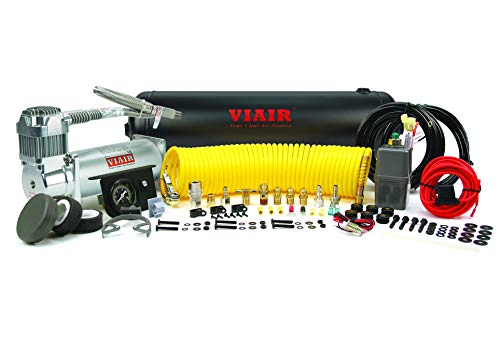
VIAIR 450C Onboard Air System with Tank
What We Like
- Includes a 2.5-gallon air tank for volume tasks
- IP67 rating allows for mounting inside or outside
- 100% duty cycle at 100 PSI for continuous use
- Comes with a 35ft coil hose and full installation kit
Trade-offs
- 26.5-inch length requires significant mounting space
- 1.8 CFM flow rate is slower than some twin-compressor setups
With a 100% duty cycle at 100 PSI, the compressor can run for up to an hour without overheating, making it reliable for extended tire reinflation sessions after a day on the trail. Paired with a 2.5-gallon tank, this VIAIR system provides a reservoir of air for quickly topping off multiple tires without constant pump cycling. Its fully weatherproof, IP67-rated build allows for flexible mounting inside or outside a vehicle, creating a permanent, ready-to-go setup for off-road enthusiasts. The package includes a long coil hose, wiring, and fittings, bundling the core components needed for inflation into one purchase.
The trade-off is its physical size; at over two feet long, you need to commit real estate under the hood or in the cargo area. Its 1.8 CFM fill speed is practical but can’t match the raw speed of a dedicated twin compressor like the ARB CKMTA12 for filling giant tires back-to-back. Choose this for its complete, tank-based system versatility. Look to a compressor-only kit if space is critically tight or your sole job is rapid tire inflation.
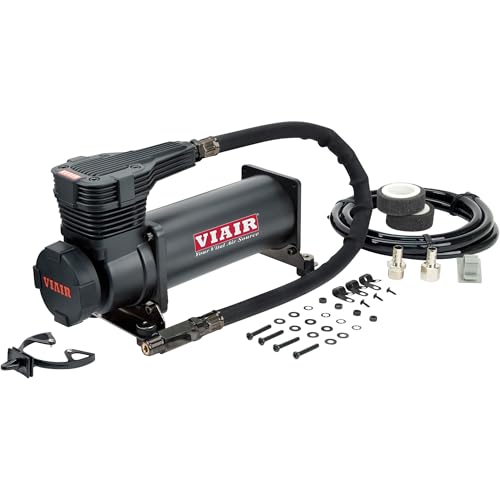
VIAIR 485C High Performance Compressor
What We Like
- 100% duty cycle at full 200 PSI pressure
- IP67 rating for dust and water resistance
- Includes extensive mounting and hardware kit
- Fills a 5-gallon tank in under 10 minutes
Trade-offs
- Single compressor design lacks the speed of a twin-motor unit
- At 11.1 pounds, it's heavier than simpler tire inflators
- Flow rate is best for system supply, not for rapid tire fills alone
A 100% duty cycle at its full 200 PSI rating means this compressor can run continuously without a cooldown period, making it a true workhorse for systems that demand constant air. The VIAIR 485C is built for the user who needs to feed a large air tank, power shop tools, or manage a demanding air suspension setup. Its 2.24 CFM flow and ability to fill a 5-gallon tank in under ten minutes are specs geared toward replenishment, not necessarily the fastest standalone tire inflation. This is the unit you install and forget, trusting it to keep up with repeated, high-pressure cycles.
The trade-off for that relentless duty cycle is that it’s a dedicated system compressor. For someone whose primary need is quickly airing up tires, other products like the ARB CKBLTA12 are described as ideal for faster tire inflating times. The 485C excels as the reliable heart of an onboard air system. It’s the right choice when your goal is maintaining pressure in a tank for bags, horns, or tools, not necessarily winning a race against the clock on tire bead seats.
ARB CKMTA12 Twin Air Compressor Bundle

What We Like
- Full wiring loom simplifies installation
- Thermally protected motors prevent overheating
- Precision deflator gauge with 1 PSI increments
Trade-offs
- Large footprint at 15.0 x 15.0 x 12.0 inches
- Air Locker manifold kit is a required separate purchase
- Weighs 15 pounds, requiring solid mounting space
A 174LPM flow rate gets large off-road tires aired up faster than nearly any other 12V compressor, which is the core reason serious overlanders and 4×4 enthusiasts consider it. This bundle pairs the twin-compressor unit with a precise, corrosion-resistant deflator tool, creating a complete system for managing tire pressure on the trail. The included wiring harness also makes it a plug-and-play foundation for those running ARB Air Lockers.
The trade-off is its physical size; this is not a compact unit you can tuck into a small corner. It demands dedicated real estate in a vehicle’s engine bay or cargo area. For users who need maximum flow but have less space, ARB’s own CKBLTA12 brushless twin offers a more compact footprint, though its output is framed differently as being 1.5X that of other models. The CKMTA12’s performance is uncompromising, but its installation requires planning.
Vixen Air Dual Compressor Onboard System

What We Like
- Dual compressors provide fast tank refills
- Large 5-gallon tank supplies high air volume
- Nine tank ports allow flexible accessory setup
- Sealed, permanently lubed compressors need little maintenance
Trade-offs
- Large 32 by 17 inch footprint demands significant mounting space
- Steel tank and dual compressors add considerable system weight
- Complex system requires more wiring and plumbing for installation
With dual 200 PSI compressors and a five-gallon tank, this system is built for high-demand air ride and load support. The twin 1.8 CFM units deliver rapid tank refill, which is necessary for applications like train horns or air tools. Each compressor includes a thermal overload protector switch to prevent overheating, and their sealed construction is moisture- and dust-resistant for durability in tough conditions.
The system’s size requires a solid mounting location. For comparison, the VIAIR 450C Onboard Air System with Tank has a 2.5-gallon capacity and a different footprint. The Vixen Air’s high-capacity tank with nine ports offers flexible setup for suspension, train horns, tire inflation, and air tools.
LLNSEAUTO Medium Duty Onboard Air System

What We Like
- Includes a 2.5-gallon air tank for immediate air supply
- Five 1/4" NPT ports allow multiple accessory connections
- Heavy-duty 40-amp relay and pressure switch for reliable control
- Complete kit includes wiring, fittings, and mounting hardware
Trade-offs
- 33% duty cycle limits sustained high-pressure work sessions
- Weighs 22.4 pounds, requiring solid mounting in a vehicle
A 2.5-gallon air tank paired with a 150 PSI compressor means you have a reservoir of air ready for train horns or topping off tires without waiting for the pump to cycle every time. This LLNSEAUTO kit is a solid fit for someone who needs a dedicated onboard system for auxiliary air accessories on a truck or SUV. The wiring and hardware are all included, so installation is straightforward for anyone comfortable with basic 12-volt connections. It delivers exactly what a medium-duty system should: reliable air pressure from a compact package.
The compressor’s 33% duty cycle at 100 PSI is the key trade-off. It’s built for intermittent use, not for continuously filling large tires one after another on a trail run. For that kind of heavy air demand, you’d want to look at a dedicated high-output unit like the ARB CKBLTA12. But for powering air horns or managing air helper springs, this LLNSEAUTO system provides a capable and well-outfitted foundation. The multiple tank ports give you flexibility, and the integrated pressure switch automates the refill process.
Product photos
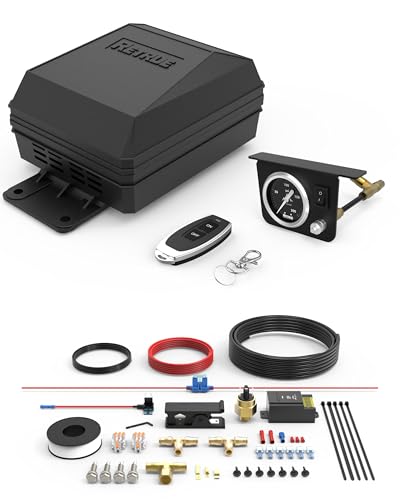
RETRUE Onboard Airbag Compressor System
What We Like
- Automatic inflation maintains preset airbag pressure
- Dual control via in-cab panel and wireless remote
- Fast inflation reaches 70 PSI in just over 2 minutes
- Complete kit includes all necessary hardware and lines
Trade-offs
- Maximum 100 PSI limits heavy-duty air tool use
- No integrated air tank for rapid pressure changes
The RETRUE system’s low-pressure sensor automatically tops up your airbags whenever they dip below your preset level, which is the core feature for maintaining a consistent ride height. This makes it a dedicated solution for drivers who need their suspension to self-correct for load changes without manual intervention. The dual control options provide flexibility, letting you adjust pressure from the driver’s seat or outside the vehicle while you watch the bags inflate. It’s built specifically for the set-and-forget convenience that air suspension users prioritize over raw power.
With a maximum pressure of 100 PSI, the RETRUE system is designed for inflating airbag suspensions, a task it handles efficiently. It can reach 50 PSI in 80 seconds and 70 PSI in just over two minutes, making adjustments quick compared to manual methods. The system includes dual controls, allowing operation from inside the cab or via a wireless remote outside the vehicle.
Product photos
CNRAQR 3-Gallon Compressor Tank Kit

What We Like
- Complete kit simplifies installation
- Durable, corrosion-resistant construction
- High 250 PSI intermittent pressure capability
- Compact 3-gallon tank saves space
Trade-offs
- Flow rate is measured at no load
- 18.7-pound weight requires secure mounting
- Smaller tank capacity than 5-gallon systems
This ready-to-install system for air suspension and horns combines a 150 PSI compressor with a 3-gallon air tank. Its compact footprint, at just 6.5 by 3.5 inches, fits in tight spaces where larger kits won’t. It’s built for the user who needs a complete, self-contained solution without hunting for separate components. The anti-corrosion coating and weather resistance mean it can handle under-vehicle mounting, delivering reliable pressure for bagged suspensions or a train horn.
With a 3-gallon tank, this kit holds more air than many compact systems, like the VIAIR 450C’s 2.5-gallon reservoir. That extra capacity means the compressor doesn’t have to kick on as often for routine tasks, which is handy for maintaining air suspension or giving a train horn a quick blast. For jobs that need a huge volume of continuous air, such as repeatedly filling multiple large tires from completely flat, a dedicated high-output system would still be a better match.
Product photos
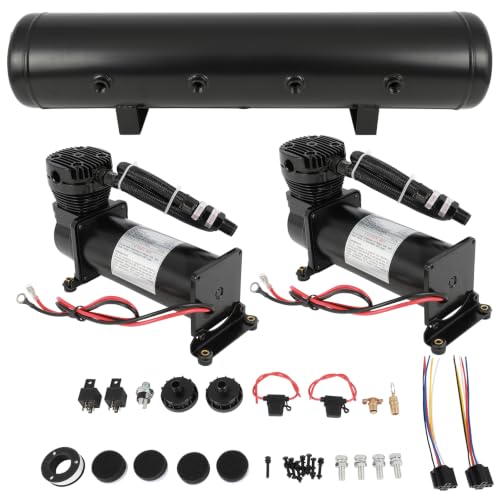
STAYTOP 5-Gallon Dual Compressor System
What We Like
- Dual compressors provide redundancy and power.
- Five-gallon tank stores ample air volume.
- Oil-less, maintenance-free compressor design.
- Powder-coated tank for corrosion resistance.
Trade-offs
- At 42.4 pounds, it's a heavy system to mount.
- Its 34.4-inch length demands significant under-vehicle space.
With a five-gallon tank and two compressors, this kit provides a substantial reservoir for running air horns or tools, which reduces how often the pumps need to cycle. It’s designed for applications like air suspension or lockers that benefit from consistent air volume. The rust-proof powder coating and oil-less compressor design suggest durability for long-term use in environments with moisture.
The trade-off for that capacity and dual-motor setup is physical bulk. Compared to a more compact system like the ARB CKMTA12 bundle, the STAYTOP is a stationary strong performer, not a portable unit you can easily move between vehicles. It’s a committed installation for someone whose truck or RV is a permanent workshop on wheels.
Product photos
Air Lift Load Controller II System

What We Like
- Automatic compressor activation from low pressure sensor.
- Single path system inflates two springs simultaneously.
- Easy-to-read dual-needle gauge for on-the-go adjustments.
- Compact and lightweight universal fit design.
Trade-offs
- Designed for light/medium duty, not for heavy 4×4 tire inflation.
- No integrated air tank for volume storage.
- Single-path system cannot inflate air springs independently.
Automatic pressure maintenance is the core feature, thanks to a low-pressure sensor that activates the compressor when needed. This creates a set-it-and-forget-it experience for keeping air springs level, ideal for light or medium-duty towing and hauling. Its single-path design inflates two springs simultaneously at the same rate, which is managed through an easy-to-read gauge with dual needles and simple inflate/deflate buttons.
The system is designed specifically for air spring suspension management, not for tasks requiring high air volume like quickly inflating large off-road tires. While the ARB CKBLTA12 brushless twin compressor is noted for higher output in the other-products list, the Air Lift Load Controller II focuses on its defined role. It provides reliable, automated leveling for its intended light or medium-duty applications.
Product photos
How We Evaluated On Board Air Compressors
Our evaluation is based on researching manufacturer specifications, product documentation, and expert recommendations. We also analyzed patterns in long-term owner feedback. We prioritized three key criteria: airflow (CFM), which dictates how quickly you can inflate tires; duty cycle, which determines how long the compressor can run continuously without overheating; and the physical footprint, which is critical for finding viable mounting space in a vehicle.
This comparison outlines key capabilities and trade-offs. The final choice depends on specific vehicle installation factors like available space and wiring. For more information on systems for full-size trucks, see the guide to onboard air compressors.
What To Look For In On Board Air Compressors
An onboard air system is a permanent upgrade, so matching its capabilities to your intended use is essential. The right choice depends on whether your primary goal is fast tire inflation, running air tools, or maintaining an air suspension system.
Key factors are airflow (CFM) for speed, duty cycle for continuous run time, and system pressure (PSI) for tool compatibility. Physical size and weight determine where you can mount it, and an integrated air tank provides instant volume for short, high-demand tasks.
Airflow and Duty Cycle
Airflow, measured in cubic feet per minute (CFM), is the most important spec for tire inflation speed. A higher CFM means filling a 35-inch tire takes significantly less time. Duty cycle is equally critical; a 100% duty cycle means the compressor can run continuously at its rated pressure, while a lower percentage requires cool-down periods. For off-roaders airing up multiple large tires, a high-CFM compressor with a 100% duty cycle, like those found in many off-road compressors, is a worthwhile investment.
Pressure Rating and Tank Capacity
Maximum pressure (PSI) determines what you can power. Tire inflation typically requires 30-50 PSI, but air tools or train horns need 90-150 PSI, and some air suspension systems require 200 PSI or more. An integrated air tank stores compressed air, allowing for rapid pressure changes, like firing an air horn, without waiting for the compressor to cycle on. A larger tank, such as a 5-gallon model, is beneficial for UTVs or systems running multiple accessories, but it adds considerable size and weight. For more on UTV systems, see our guide to UTV air compressors.
Physical Size and Installation
Onboard systems require secure mounting to vehicle frame rails, under the bed, or in an engine bay. Always measure your available space before purchasing, as compressor and tank dimensions vary widely. Consider the total system weight and the required wiring; a complete kit with a relay, switch, and plumbing fittings simplifies installation. For RV owners, finding a compact, powerful unit is key, which is why we have a dedicated resource on RV compressors.
- Check the compressor’s amp draw to ensure your vehicle’s electrical system can support it.
- Look for an IP67 or similar waterproof rating if mounting in an exposed location.
- Verify the kit includes all necessary mounting brackets, hardware, and wiring.
- Consider future needs, like adding air lockers or tools, when selecting CFM and pressure.
- Plan your hose routing and access point for the air chuck before drilling any holes.
Choose a system with a CFM and duty cycle that matches your most demanding regular task, not just an occasional need.
On Board Air Compressors Compared
The following table compares the core specifications of our top picks to help you see the differences in airflow, pressure, and physical size at a glance.
| Product | Max Pressure (PSI) | Flow Rate (CFM) | Includes Tank |
|---|---|---|---|
| ARB CKBLTA12 Brushless Twin Onboard Compressor | N/A | 9.18 CFM | N/A |
| VIAIR 450C Onboard Air System with Tank | 150 PSI | 1.8 CFM | 2.5 Gallon |
| VIAIR 485C High Performance Compressor | 200 PSI | 2.24 CFM | N/A |
| ARB CKMTA12 Twin Air Compressor Bundle | N/A | 6.16CFM | N/A |
| Vixen Air Dual Compressor Onboard System | 200 PSI | 1.8 CFM | 5-gallon steel tank |
| LLNSEAUTO Medium Duty Onboard Air System | 150 PSI | N/A | 2.5 gallon |
| RETRUE Onboard Airbag Compressor System | 100 PSI | N/A | N/A |
| CNRAQR 3-Gallon Compressor Tank Kit | 150 PSI | 2.03 CFM | 3 gallons |
| STAYTOP 5-Gallon Dual Compressor System | N/A | N/A | 5 gallons |
| Air Lift Load Controller II System | N/A | N/A | N/A |
Frequently Asked Questions
What is the best air compressor for an onboard air system?
The best compressor depends on your primary use. For the fastest, most reliable all-around tire inflation, a high-CFM twin-compressor like the ARB CKBLTA12 is an excellent choice. If you need a complete, ready-to-install system with an air tank for tools or horns, the VIAIR 450C kit is a top contender. Our guide to automotive compressors explores these use cases in more detail.
What is the most reliable air compressor brand?
Based on user feedback and industry reputation, ARB and VIAIR are frequently noted for reliable onboard performance. ARB compressors are recognized for their construction and integration with air lockers, while VIAIR provides a broad selection of systems with strong duty cycles and complete kits. Durability is often linked to a high duty cycle and effective thermal protection.
How much CFM do I need to inflate truck tires?
For efficiently inflating large off-road tires (33 inches and up), look for a compressor that delivers at least 2.0 CFM or more. This will significantly reduce wait times compared to lower-flow units. Remember, the valve stem itself can be a limiting factor, so using a multi-tire hose kit can help utilize the compressor’s full output. Many portable truck air compressors also meet this flow requirement.
Can I use an onboard compressor for air tools?
Some can, but it requires careful selection. You need both high CFM (typically 4+ CFM) and a large air tank to supply the volume tools demand. Many onboard systems are better suited for intermittent tool use or smaller tools. For continuous tool operation, a dedicated high-capacity system like the Vixen Air or STAYTOP 5-Gallon system is more appropriate. For mobile use, a portable off-road compressor might be a more flexible option.
What’s the difference between a portable and an onboard compressor?
Portable compressors are typically stored and connected when needed, while onboard systems are permanently mounted, wired, and plumbed into your vehicle. Onboard air offers faster deployment and a cleaner, more secure installation but requires a more complex setup. Portable units offer flexibility between vehicles. Both types are powered by 12V compressors, drawing from your vehicle’s battery.
The Bottom Line
For most users seeking powerful, reliable onboard air, the ARB CKBLTA12 Brushless Twin is the best overall choice, offering excellent airflow and durability perfect for frequent off-road tire inflation. If your budget is tighter or you need a complete system with a tank right away, the VIAIR 450C provides tremendous value. For specialized applications like automated air suspension management, the RETRUE system excels.
Your single most important decision is matching the compressor’s airflow and duty cycle to your actual usage, ensuring it can handle your tasks without strain or excessive wait.
