
10 Best Tire Changer Wheel Balancer Combos in 2026
This post contains affiliate links. As an Amazon Associate, we earn from qualifying purchases.
The XK 988-690 Tire Changer and Wheel Balancer Combo is our best overall pick for a professional-grade setup that handles high volume with speed and precision. Shops needing a wider clamp range should consider the KATOOL combo, while those prioritizing long-term protection will appreciate the MEMMAREX award.
Choosing the right pairing is a significant investment for any garage. The wrong specs can lead to damaged rims, wasted time, or a machine that can’t handle your most common jobs. A good combo should match your typical tire sizes, protect expensive wheels, and fit your shop’s workflow.
We researched professional specifications, manufacturer data, and patterns in owner feedback to compile this list of ten combos. This guide will help you identify the key features that matter for your specific needs.
Top 10 Tire Changer And Wheel Balancer Combos in the Market


Certain content that appears on this site comes from Amazon. This content is provided "as is" and is subject to change or removal at any time.
The Best Tire Changer And Wheel Balancer Combos, Reviewed
XK 988-690 Tire Changer and Wheel Balancer Combo
What We Like
- Includes bead blaster function for stubborn tires
- High 2500 kgf bead-breaker force
- Fast 4-7 second wheel balancer cycle
- Precise +/-1g balancing accuracy
Trade-offs
- 41-inch tire changer capacity excludes some large truck tires
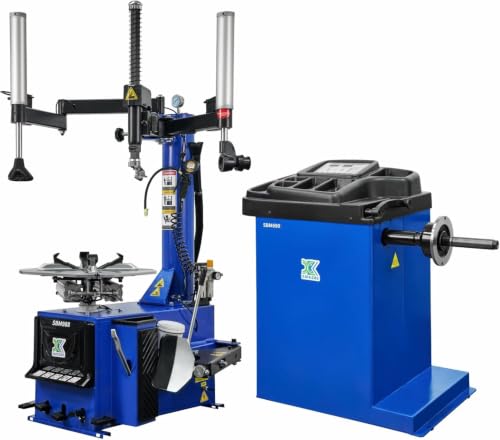
A 2.0 horsepower motor and a 2500 kilogram-force bead breaker mean this combo can handle stubborn off-road and light truck tires that stall weaker machines. The integrated air bead blaster adds another tool for seating difficult beads without extra equipment. This setup is built for a busy garage that needs to process passenger and SUV wheels reliably day in and day out. Its preset American standard measurements simplify setup for domestic shops, and the balancer’s quick cycle time keeps the workflow moving.
The trade-off is its substantial footprint and weight. At 840 pounds and nearly four feet in each dimension, this isn’t a portable unit you can roll into a corner. It demands a dedicated, level shop floor with a proper air supply. For shops that need to handle even larger diameters, like those on some dualies or commercial vehicles, the 41-inch maximum on the changer is a limit. The BILT HARD 26″ Tilt-Back combo, for instance, offers a larger 26-inch clamping range for bigger rims.
Product photos
XK XK-950-690 Tire Changer and Wheel Balancer Combo

What We Like
- Handles large 41-inch tires
- High 5600-lb bead break force
- Includes motorcycle balancing mode
- Relatively quiet under 70 dB
Trade-offs
- Heavy 580-lb shipping weight requires a stable floor
- 110V-only power limits shop electrical options
- High 145 psi air requirement needs a capable compressor
With a maximum tire diameter of 41 inches, this combo can handle the largest passenger and light truck tires commonly found in general repair shops. Its 5600-pound bead break force is substantial, which means it should handle stiff sidewalls on modern tires without much trouble. The balancer’s accuracy down to a single gram helps ensure smooth results, and the included motorcycle mode adds versatility for shops that service both cars and bikes.
The 580-pound shipping weight means this is a permanent installation that requires a solid concrete floor. It also needs a steady air supply between 120 and 145 psi, so your shop’s compressor must be up to the task. This combo’s capacity and power come with significant demands on your shop’s infrastructure.
Product photos
KATOOL KT-T830 and KT-B700 Tire Changer Balancer Combo

What We Like
- Extremely wide dual clamp range for versatility
- Built with hardened alloy steel jaws for durability
- Fully closed body protects internal components
- Includes soft jaw covers to protect custom rims
Trade-offs
- Large footprint at 47 by 39 inches requires significant shop space
- Heavy construction may complicate initial positioning in a garage
- Wide clamp range is less critical for shops specializing in standard passenger tires
The KATOOL combo’s standout feature is its dual clamping range, handling rims from 12 to 26 inches. This makes it a natural fit for shops that see a mix of passenger cars, light trucks, and larger SUV wheels, eliminating the need for multiple machines. The build quality backs up this versatility, with carburized alloy steel jaws and a fully sealed body designed to withstand high-volume use while minimizing maintenance. For a technician dealing with diverse wheel sizes daily, this machine streamlines the workflow from mounting to balancing in a single station.
That expansive capability does come with a physical trade-off. The unit has a substantial footprint, so it demands a dedicated bay with ample floor space. Compared to a more compact setup like the XK 988-690, which has a similar length and width but is designed for a different workflow, the KATOOL prioritizes range over a minimal footprint. It’s built for shops where space is available to leverage its full clamping versatility, not for tight garages where every square inch counts.
Motool Technology ME-T500 and B620 Tire Changer Balancer Combo
What We Like
- Stainless steel mounting head protects rims
- Alloy steel jaws with deep carburization for toughness
- Thick steel body minimizes vibration during operation
- Precise pressure sensor on a stable 8mm base
Trade-offs
- Inside clamp starts at 14", excludes some smaller rims
A 2.0HP motor with pure copper windings delivers the consistent torque needed for stubborn truck and SUV tires without overheating. This combo is built for shops that see a high volume of large-diameter wheels, thanks to its 24-inch clamping capacity and a body made from 3mm steel. The solid welding and thick base plate keep everything steady, which is critical when you’re working on expensive alloy rims day in and day out. It’s a setup designed for durability over countless cycles, not for occasional garage use.
This Motool Technology combo is built for larger tires, with an inside clamp range starting at 14 inches, so it’s not suited for the smallest compact car wheels. Its construction uses 3mm thick steel with solid welding, which translates to a high-strength frame designed for stability during operation. The design prioritizes this durable, vibration-resistant build over the portability or smaller footprints offered by some other combo units on the market.
Product photos
WEIZE Dual Assist Arm Tire Changer and Wheel Balancer Combo
What We Like
- Dual assist arms for run-flat and low-profile tires
- Integrated air bead blaster with 120-145 psi blast
- Wide 10-24 inch rim clamping range
- Quiet wheel balancer under 70 dB
Trade-offs
- Heavy 794.8 pound weight requires significant floor space
- No internal clamping below 12 inches
- Maximum 16 inch tire width limits some heavy-duty applications
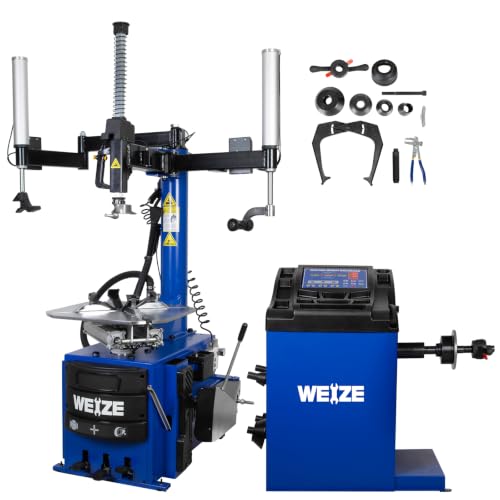
WEIZE’s exclusive dual assist arms act like a second pair of hands, pressing the bead down during mounting to prevent roll-back. This feature significantly reduces installation time, which is especially useful for shops dealing with run-flat and low-profile tires. The integrated air bead blaster delivers up to 2700 kg of break-force to seat tough beads instantly, while the wheel balancer operates below 70 dB for a quieter workspace.
This combo handles a broad clamping range from 10 to 24 inches and tire widths up to 16 inches, making it suitable for passenger cars and light trucks. It can also handle heavy-duty tires up to 41 inches in diameter. The machine is powered by a 2 HP motor for high-torque performance during tire mounting and changing.
BILT HARD 26" Tilt-Back Tire Changer and Wheel Balancer Combo
What We Like
- Tilt-back column eases tire mounting on large wheels.
- Independent bead blaster cylinder for stubborn bead seating.
- Automatic laser on balancer indicates weight placement.
- Four specialized balancing modes for alloy wheel designs.
Trade-offs
- 1.5HP motor offers less brute force than some 2.0HP rivals.
- Vertical balancer display may require specific shop layout.
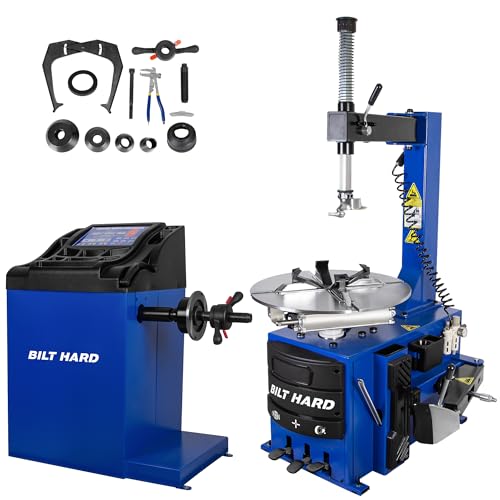
The tilt-back column design is the standout feature, creating extra clearance around the wheel during mounting and demounting. This makes the BILT HARD combo a smart choice for shops that frequently handle oversized or low-profile tires where space is tight. The independent bead blaster gives you direct control for seating tough beads without tying up the main cylinder. It’s built for the technician who values finesse and specific tool control over raw, single-purpose power.
The tilt-back column design creates additional clearance around the wheel during installation and removal, which makes handling larger diameter tires up to 43 inches more manageable in a compact shop space. A single helper arm provides support for stiff or low-profile tires, while an independent bead blaster uses a dedicated air cylinder for seating stubborn beads. The 1.5HP copper-wound motor delivers consistent torque for passenger and light truck applications, running on standard 110V power. An automatic laser on the wheel balancer indicates weight placement locations, simplifying the final balancing process with its upright display.
Product photos
MEMMAREX MC-950 and MC-510 Tire Machine and Balancer Combo
What We Like
- Includes complimentary product liability insurance coverage.
- Extended 14-month warranty exceeds industry standards.
- Balancer has three interchangeable cones for various hubs.
- Detailed manual and online video for setup and operation.
Trade-offs
- Self-modification of equipment voids the warranty entirely.
- Electro-pneumatic assist still requires operator effort.
Every purchase of the MEMMAREX MC-950 and MC-510 combo comes with a 14-month extended warranty, which exceeds typical industry standards. This longer coverage period, combined with complimentary product liability insurance that activates upon shipment, provides significant long-term security for the buyer. The package also includes a detailed English manual with illustrations and an online installation video, eliminating setup confusion and ensuring worry-free operation from the start.
The MC-950 tire changer handles a wide rim range from 10 to 24 inches, fitting cars, SUVs, and light trucks with its 2.0HP motor and electro-pneumatic assist. This power reduces operator effort during demounting and mounting, while a heavy-duty steel turntable and reinforced frame resist flexing under load. A specially engineered steel mounting head is designed to protect alloy and steel rims from scratches during the process.
Product photos
WEIZE 2.0HP Tire Changer and Wheel Balancer Combo

What We Like
- Wide clamping range from 10" to 24".
- Powerful 1200Nm shaft torque for tough tires.
- Multiple balancing modes for different wheel types.
- Heavy-duty, corrosion-resistant construction.
Trade-offs
- 717.8-pound weight demands a permanent shop location.
- Single assist arm versus dual-arm designs for some tasks.
- Maximum tire width of 14.96" excludes some oversized light truck tires.
This machine handles a common rim range from 10 to 24 inches, covering most consumer vehicle work. Its 2.0HP motor and powerful bead breaker tackle stubborn tires, and the balancer accommodates rims up to 28 inches for larger wheel options.
The trade-off for that wide compatibility is a substantial 717.8-pound footprint, so you’ll need to commit a dedicated space on a solid floor. Its single assist arm is efficient, but for high-volume shops dealing with particularly stiff sidewalls, a dual-arm setup like the other WEIZE model in this guide might offer a slight speed advantage. Compared to the BILT HARD 26″ Tilt-Back model, the WEIZE lacks a tilt-back function, which can make loading heavier truck wheels a more manual process.
Product photos
BILT HARD Swing Arm Tire Changer and Wheel Balancer Combo
What We Like
- Protected mount head prevents rim scratches
- Four ALU modes for hidden weight placement
- Hands-free pedal system for easier operation
- Handles both dynamic and static balancing
Trade-offs
- Manual input for balancer measurements requires more user setup
The protected mount head and four ALU balancing modes are the core features here, making this combo a strong pick for anyone prioritizing alloy wheel care. It handles a wide range of rim sizes, from 10 to 28 inches, so you can service everything from compacts to light trucks without worrying about cosmetic damage. This focus on preserving wheel finish suits mid-volume shops and serious DIYers who value a professional, scratch-free result above all else.
With 10 Bar of bead-breaking force, this combo is built to handle the toughest car and pickup tires. It delivers a professional workflow for mid-volume shops and serious DIY garages, focusing on a complete tire service setup. The system pairs a powerful 2.0HP motor for changing with a quiet 250W balancer, both running on standard 110V power.
Product photos
VEVOR Electric Tire Changer and Balancer Combo
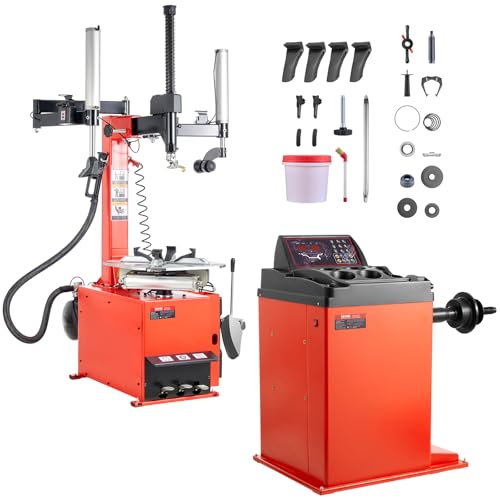
What We Like
- Handles tires up to 155 lbs and 37.8 in diameter
- Multi-function assist arm for heavy tire mounting
- Clamping jaws with protective covers for rim safety
- Includes inflation tank and pressure gauge
Trade-offs
- Weight of 720.9 pounds demands a permanent shop footprint
- Inner support rim diameter maxes out at 23.2 inches
A 2.0HP motor paired with a capacity for 155-pound tires up to 37.8 inches in diameter makes this combo built for bulk. The multi-function assist arm and protective clamping jaws are clear indicators it’s engineered for the heavy lifting of SUV and pickup tires, where rim protection and leverage are non-negotiable. This is a shop machine for the largest consumer vehicles, not a portable unit.
With a total weight of 720.9 pounds, this combo is built to stay put on a professional shop floor. That heft provides a solid foundation for the machine’s powerful 2.0HP motor, ensuring stable operation when handling heavy tires. Its design is for a dedicated workspace, not for moving around.
Product photos
How We Evaluated Tire Changer And Wheel Balancer Combos
Our evaluation focused on comparing professional specifications and manufacturer documentation. We analyzed key performance metrics like bead-breaker force, clamping range, balancing accuracy, and cycle speed to understand each machine’s capabilities and intended use case. We also studied industry expert round-ups to identify common criteria for commercial and serious DIY applications.
The most critical criteria were capacity and compatibility, construction and durability, and operator-friendly features. Capacity determines which vehicles you can service, while solid construction ensures the machine withstands daily use. Features like assist arms, bead blasters, and scratch-free designs directly impact efficiency and the safety of customer wheels.
This evaluation is based on published specifications, technical documents, and aggregated user reports. The goal is to provide a clear, comparative framework to help you make an informed decision among the many tire changer and balancer combos available.
What To Look For In Tire Changer And Wheel Balancer Combos
Selecting a combo requires matching the machine’s hard limits to your service mix. Look beyond horsepower to the specific measurements that define what you can and cannot work on.
Key specs include the tire changer’s maximum diameter and width, the balancer’s weight capacity, and the clamping range for both machines. Construction, assist features, and balancing modes are also critical for efficiency and rim safety.
Capacity and Compatibility
First, verify the machine can physically handle your wheels and tires. The tire changer’s maximum diameter and width are absolute limits; exceeding them risks damage. For instance, a 41-inch capacity excludes many large truck tires, while a 14.96-inch width limit may not fit some oversized light-truck tires. Equally important is the inner clamp range, which must accommodate both small passenger rims and large truck wheels. A balancer must support the weight of your heaviest assembly, with some models rated for tires up to 155 lbs.
Construction and Durability
These are heavy-duty machines meant for repetitive use. Look for strong materials like alloy steel jaws, thick steel bodies, and corrosion-resistant finishes. A well-built machine minimizes vibration during operation, which leads to more accurate balancing and a longer service life. For shops dealing with expensive alloy wheels, features like a protected mounting head or stainless steel components are essential for preventing costly scratches. The choice between manual and automatic tire changers also impacts durability and workflow speed in a professional setting.
Operator Features and Workflow
Features that reduce physical effort and improve accuracy define a professional workflow. Dual assist arms are invaluable for mounting difficult run-flat and low-profile tires. An integrated bead blaster saves time and effort on stubborn tire beads. On the balancer side, multiple modes, including specific settings for alloy wheels and motorcycle tires, ensure precise weight placement. Understanding static and dynamic balancing helps you choose a machine that offers the correct method for your accuracy needs.
- Check the air requirement: Many changers need 120-145 psi, requiring a capable compressor.
- Measure your space: Footprints often exceed 47 by 39 inches, and weights of several hundred pounds demand a stable, permanent floor.
- Review included accessories: Look for protective jaw covers, multiple balancing cones, and tool kits.
- Consider noise levels: Balancers under 70 dB are significantly quieter for shop environments.
- Understand the power needs: Most run on 110V, but verify your shop’s electrical setup.
Always choose a combo with a clamping range and tire capacity that exceeds your current needs to accommodate future jobs.
Tire Changer And Wheel Balancer Combos Compared
Use the table below to quickly compare the core specifications and strengths of all ten finalists.
| Product | Motor Power (Tire Changer) | Max Tire Diameter | Power Supply |
|---|---|---|---|
| XK 988-690 Tire Changer and Wheel Balancer Combo | 2.0 horsepower | 41" | 110V |
| XK XK-950-690 Tire Changer and Wheel Balancer Combo | N/A | 41 inches | 110V only |
| KATOOL KT-T830 and KT-B700 Tire Changer Balancer Combo | 2.0HP | N/A | N/A |
| Motool Technology ME-T500 and B620 Tire Changer Balancer Combo | 2.0HP | N/A | N/A |
| WEIZE Dual Assist Arm Tire Changer and Wheel Balancer Combo | 2.0 HP | 41 inches | 110V |
| BILT HARD 26" Tilt-Back Tire Changer and Wheel Balancer Combo | 1.5HP | Up to 43" | 110V/60Hz |
| MEMMAREX MC-950 and MC-510 Tire Machine and Balancer Combo | 2.0HP | 10" to 24" | 110V |
| WEIZE 2.0HP Tire Changer and Wheel Balancer Combo | 1.5 kW (2 HP) | N/A | 110V/60Hz |
| BILT HARD Swing Arm Tire Changer and Wheel Balancer Combo | 2.0HP | 39.4" | 110V/60Hz |
| VEVOR Electric Tire Changer and Balancer Combo | 2.0HP | 37.8 in | N/A |
Frequently Asked Questions
What is the best tire changer and wheel balancer combo?
The best combo depends on your specific needs. For a balance of speed, power, and precision in a professional garage, the XK 988-690 is an excellent all-around choice. It includes a bead blaster for tough tires and offers a fast balancer cycle with high accuracy.
Which tire balancing machine is the best?
The best wheel balancing machine works well with your tire changer and offers the precision your work requires. Look for a balancer with a high weight capacity, multiple balancing modes for different wheel types, and an accuracy of +/-1g. Our review of the best wheel balancing machines highlights these critical features.
What should I look for in a tire changer for a home garage?
For a home garage, prioritize a manageable footprint, a wide clamping range to handle family vehicles, and user-friendly features. A machine with a tilt-back column or a single assist arm can make solo operation much easier. You can explore specialized options in our guide to tire changers for home garages.
How do I prevent scratching alloy wheels during tire changes?
Preventing scratches requires both careful technique and the right equipment. Choose a tire changer with a protected mount head, soft jaw covers, and features specifically designed for alloy wheels. Machines like the BILT HARD Swing Arm combo are built with scratch-free operation as a primary design goal.
What’s the difference between a commercial and a DIY wheel balancer?
Commercial wheel balancers are built for high-volume, daily use with heavier construction, faster cycle times, and often more advanced calibration and diagnostic features. They are designed to maintain accuracy under constant demand. For insights into professional-grade equipment, review our analysis of commercial wheel balancers.
The Bottom Line
For most professional shops and serious DIYers needing a reliable, fast, and capable all-around machine, the XK 988-690 Tire Changer and Wheel Balancer Combo is the best overall choice. Its integrated bead blaster and precise balancer make it a workhorse for passenger and SUV tires.
If you’re on a tighter budget or have specialized needs, look to our award winners. The MEMMAREX combo offers exceptional warranty protection, while the KATOOL model provides unmatched clamp range versatility for shops seeing a huge variety of rim sizes.
Ultimately, the single most important factor is matching the machine’s hard technical limits, its maximum tire size, clamping range, and weight capacity, to the vehicles you actually plan to service. Getting this right ensures your investment pays off for years to come.
