10 Best Trailer Tire Pressure Monitoring Systems in 2026
This post contains affiliate links. As an Amazon Associate, we earn from qualifying purchases.
Our best overall trailer tire pressure monitoring system is the Tymate TM12 RV TPMS for its clear six-tire display and flexible charging. For smartphone-centric monitoring, the TireMinder Smart TPMS excels, and the GUTA GT20 is our choice for high-capacity fleets. Choosing the right system prevents costly blowouts and keeps your trip on schedule. This guide is based on a review of specifications, manufacturer data, and patterns in owner feedback across ten leading systems. We’ll help you match a monitor to your trailer’s size and your preferred style of use.
Top 10 Trailer Tire Pressure Monitoring Systems in the Market
Certain content that appears on this site comes from Amazon. This content is provided "as is" and is subject to change or removal at any time.
The Best Trailer Tire Pressure Monitoring Systems, Reviewed
Tymate TM12 RV Tire Pressure Monitoring System

What We Like
- Simultaneous display for up to six tires at once.
- Dual USB-C and solar charging for flexible power.
- Pre-programmed sensors allow for true plug-and-play installation.
- Wide 0-144 PSI range suits cars, RVs, and most trailers.
Trade-offs
- Solar charging output varies with light conditions.
- Monitor can only be manually turned off when not charging via cable.
- Large RV setups may require an additional repeater purchase.
The ability to monitor up to six tire pressures simultaneously on a single screen is the TM12’s killer feature. You get a complete safety snapshot without cycling through screens, which is a major advantage for long hauls with a loaded trailer. Its plug-and-play sensor setup and automatic pressure calibration mean you can install it yourself in minutes, avoiding a trip to the shop. This combination of comprehensive real-time data and straightforward installation makes it an exceptionally practical choice for most RV and trailer owners looking for a reliable monitoring solution.
A stable 50-foot wireless range works for many vehicles, though the manufacturer recommends adding an optional repeater when towing large RVs or if signal blockage is expected. External sensors install in minutes without a tire shop, but the product guide recommends using them with metal valve stems for stability. Compared to systems like the TireMinder i10, which uses flow-through transmitters, the Tymate TM12 employs a different sensor design.
TireMinder Smart TPMS with 10 Transmitters
What We Like
- Monitors both tire pressure and temperature
- Provides alerts for early warning detection
- Direct smartphone monitoring via app
- Includes rhino signal booster for range
Trade-offs
- The Bluetooth adapter adds a separate component to manage
- At 1.0 pounds, it is lighter than some dedicated display units like the TireMinder i10
- Requires a smartphone for primary interface, no built-in display
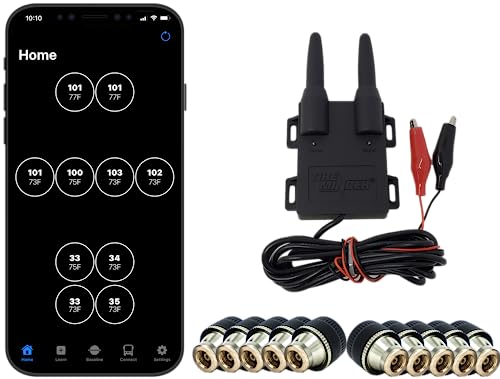
The TireMinder Smart TPMS sends tire pressure and temperature data directly to a smartphone app, eliminating the need for a separate dashboard screen. This system checks for issues every six seconds and uses an early warning alert system for tire health monitoring. Its dimensions are 6.0 by 0.6 by 2.4 inches, and it weighs one pound.
This TPMS relies entirely on a compatible iPhone, iPad, or Android device for its display, unlike systems such as the EEZ RV Products EEZ-Tire-TPMS Pro which includes a 3.5-inch color screen. The kit includes a 433MHz to Bluetooth adapter and a rhino signal booster to maximize signal range.
Product photos
GUTA GT20 Trailer Tire Pressure Monitoring System

What We Like
- Monitors up to 24 tires for large trailers and fleets
- Includes a signal booster for reliable long-range connection
- Customizable pressure and temperature alarm thresholds
- Large color LCD screen with adjustable orientation
Trade-offs
- Monitor battery lasts 15 hours, requiring frequent recharging on long hauls
- Requires mounting the signal booster in an open area on the trailer
- Sensors are only recommended for metal valve stems, not rubber
The ability to monitor up to 24 tires makes the GUTA GT20 a serious tool for large multi-axle trailers and commercial fleets. Its extended wireless range, backed by an included signal booster, ensures the connection stays solid even on long, complex rigs. You get six distinct alert modes covering everything from rapid leaks to low sensor battery, which is crucial for catching problems before they strand you. This system is built for operators who need to keep an eye on every single tire across a big vehicle.
With support for up to 24 tires, this system is built for large RVs, multi-axle trailers, or commercial fleets needing full-vehicle coverage. The monitor’s rechargeable battery lasts up to 15 hours on a full charge, so planning for overnight charging is necessary for continuous multi-day trips. Compared to a simpler six-sensor system like the Tymate TM12, the GUTA GT20 involves more hardware but delivers extensive monitoring capacity.
TireMinder i10 RV TPMS

What We Like
- Large 3.15-inch color display for clear readings
- Flow-through sensor design eliminates air loss during install
- Monitors an extensive fleet of up to 40 tires
- Checks for six critical tire issues every six seconds
Trade-offs
- Monitor unit is physically larger than many competitors like the Tymate TM12
- At 1.9 pounds, the monitor is heavier than the TireMinder Smart TPMS
The capacity to monitor up to 40 tires makes this system a logical choice for large RVs, motor coaches, and drivers towing multiple trailers. It covers every wheel on a big rig without needing a second monitor. The flow-through sensor design is the key practical feature, allowing you to install the transmitters without losing air pressure, which saves time and avoids the need for a compressor on the road. This focus on installation ease suits owners who prefer a straightforward, tool-free setup for their dual-wheel setups or multi-axle trailers.
The trade-off for that large screen and high sensor count is a bulkier monitor. The TireMinder i10’s display unit is substantially larger and heavier than more compact options like the Tymate TM12, so it demands more dedicated dash space. You also need to source and install the batteries for all six sensors yourself. For someone with a smaller trailer who values a minimalist dashboard, the physical footprint is a genuine consideration against its extensive monitoring capabilities.
EEZ RV Products EEZ-RV-TPMS4 Trailer Tire Pressure Monitoring System
What We Like
- Monitors very high tire pressure up to 210 psi
- Large color display for clear data visibility
- Independent controls for RV and trailer tires
Trade-offs
- Monitor is large at 10.7 x 7.5 x 3.2 inches
- Not compatible with the brand's older TPMS models
- Motion-sensitive monitor shuts off after 15 minutes idle
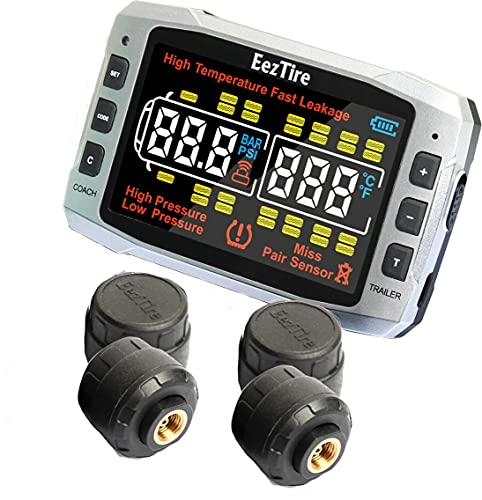
Handling tire pressure up to 210 psi means this system works with high-pressure tires common on heavy-duty trailers and fifth wheels. It monitors pressure and temperature, sending updates to the monitor every six seconds as long as the sensors are under pressure. The 4 ½” by 3″ screen is one of the largest available, and separate controls let you turn off the trailer display when driving the tow vehicle alone.
The monitor measures 10.7 by 7.5 inches, which is larger than units like the Tymate TM12, so you’ll need to consider dash space. It can be programmed with anti-theft or flow-through sensors, and a booster can be added for signal strength. The system starts with four sensors and can be expanded to monitor up to twenty-six tires.
Product photos
Flydew RV Tire Pressure Monitoring System

What We Like
- Customizable pressure and temperature alerts up to 144 PSI.
- Six distinct alarms for comprehensive monitoring.
- Dual solar and USB-C charging for monitor power.
- Clear color display shows all six tire positions.
Trade-offs
- External sensor design requires manual installation on each valve stem.
- Solar charging effectiveness depends on daytime driving conditions.
This system monitors a 0–144 PSI range, making it a versatile tool for trailers, dually trucks, and RVs that operate across a wide pressure spectrum. It essentially doubles as a reliable pressure gauge. Flydew’s kit suits owners who need to monitor a standard six-wheel setup, like a trailer and its tow vehicle. They also value the ability to fine-tune high and low-pressure warnings based on their specific load and driving conditions. The color display clearly shows all six positions at once, which is a practical advantage when you need to quickly identify a problem tire on a dual-rear-wheel setup.
With a monitoring range up to 144 PSI, this system can handle the high pressures needed for many RVs and trailers, doubling as a reliable pressure gauge. It uses six external sensors that install directly onto standard tire valve stems. The color LCD clearly shows readings for all six positions, which is especially useful for identifying a specific tire on dual-wheel setups or trailers.
Product photos
B-Qtech Wireless Bluetooth TPMS
What We Like
- Uses your phone as the display, no extra screen needed.
- IP67 waterproof sensors with ±1.5 PSI precision.
- App supports multiple pressure units and tire rotation.
- Compatible with vehicles from 2 to 40 wheels.
Trade-offs
- Requires a smartphone for all monitoring and alerts.
- Bluetooth range limits monitoring to near the vehicle.
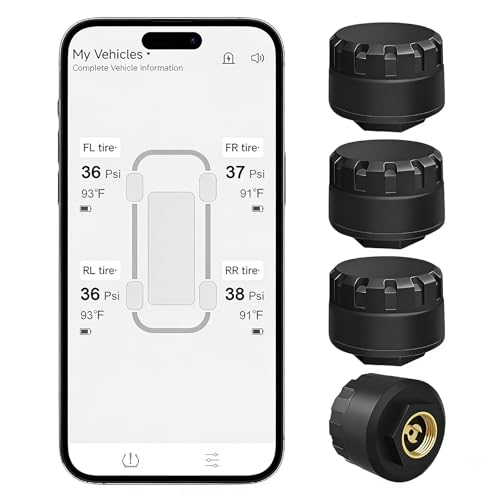
This tire pressure monitoring system connects via Bluetooth to a smartphone app, eliminating the need for a separate display. Real-time pressure and temperature data transmits wirelessly to a dedicated app for iOS or Android. The app supports customizable alerts and multiple pressure units like PSI and BAR. Compatibility ranges from cars and SUVs to RVs, trailers, and trucks with 2 to 40 wheels.
Monitoring relies entirely on a smartphone with the dedicated app installed. Systems like the EEZ RV Products EEZ-RV-TPMS4 include a dedicated color display for constant visibility. The B-Qtech system uses Bluetooth to transmit data from its four external sensors to the phone.
Product photos
Tymate TM7 RV Tire Pressure Monitoring System

What We Like
- Plug-and-play power from the cigarette lighter.
- Compact monitor with a vibrant color LCD screen.
- Dual USB outlets for charging mobile devices.
- Accurate to ±1.5 PSI with wide pressure range.
Trade-offs
- Requires a separate repeater for trailers over 36 feet long.
- Sensors require metal valve stems for installation.
Its plug-and-play power from the cigarette lighter socket is the defining feature, making it a true five-minute install with no wiring. That compact, 2.3-inch wide monitor also packs a color LCD with adjustable backlight, so you can read your pressures clearly day or night. This system is for the driver who wants a straightforward safety upgrade for an older vehicle or trailer, valuing simplicity and a clean dashboard with the bonus of two USB charging ports. It turns a basic socket into a monitoring hub without any permanent modification.
Powering directly from the cigarette lighter socket makes setup straightforward, but it permanently occupies that outlet. For towing setups longer than 36 feet, the system requires an optional repeater to maintain a stable connection. Compared to the Tymate TM12, which has a wider but slimmer monitor, the TM7 prioritizes simple plug-and-play installation.
GUTA GT30 Trailer Tire Pressure Monitoring System
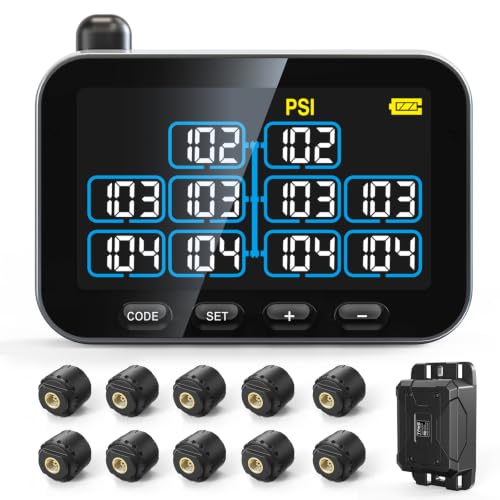
What We Like
- Large color display shows up to 10 tires at once
- Signal repeater extends range up to 100 feet
- Automatically saves installed pressure as reference
- Six distinct alarm modes for comprehensive alerts
Trade-offs
- Monitor requires recharging every 12-14 days
- Manufacturer advises against use on rubber valve stems
For owners of large rigs, the GT30’s standout feature is that it can track up to 46 tires without manual switching. A single screen can automatically cycle between a truck and a long fifth wheel, which simplifies oversight on complex towing setups. Its six alarm modes, including a specific 158°F temperature alert, help identify issues like overheating before they escalate during a trip.
Power management is a key consideration with this system. The monitor’s internal battery lasts up to 14 days on a charge, so you’ll need to plan for periodic recharging. To maintain a stable signal on long trailers, the kit includes a repeater that extends transmission up to 100 feet, a practical feature for oversized RVs.
Masoll RV Tire Pressure Monitoring System

What We Like
- Dual solar and USB charging for power flexibility
- Auto-configures alarm values from installed pressure
- Replaceable sensor battery simplifies long-term maintenance
Trade-offs
- Requires a signal booster for trailers longer than 38 feet
- Monitor must be on before sensor installation
Setting up alerts without menu diving is a major plus for drivers who prefer simplicity. After installing the sensors at the recommended tire pressure, the monitor automatically uses that reading to set its own high and low pressure warning thresholds. This automatic configuration, paired with the flexible solar and USB charging, creates a user-friendly system for owners of four-wheel vehicles like RVs, sedans, or pickups seeking essential monitoring.
The four-sensor limit is the clear trade-off. While perfect for a standard RV or truck, it can’t monitor a fifth wheel’s additional axles or a trailer’s full set of tires without buying a second kit. For larger rigs, a system like the GUTA GT20 with ten sensors is a more appropriate, albeit more involved, setup. The need for a signal booster on long trailers is another specific limitation to check against your rig’s length before committing.
Product photos
How We Evaluated Trailer Tire Pressure Monitoring Systems
Our evaluation was research-based, analyzing product specifications, manufacturer documentation, and expert round-ups. We focused on the pressure range, number of tires supported, power source for the monitor, and the type of alerts provided. We also prioritized systems with features that solve common trailer-owner problems, like long-range signal reliability and easy sensor installation. Since this was not a hands-on test, our assessment relies on reported performance and design; real-world durability over years is something only long-term owner feedback can confirm.
What To Look For In Trailer Tire Pressure Monitoring Systems
A good TPMS gives you peace of mind by watching your tires for you. The right choice depends on your trailer’s setup and how you prefer to receive information.
Look for a system that monitors your specific tire pressure range, supports all your axles, and provides clear, timely alerts. Consider whether you want a dedicated display or app-based monitoring.
Coverage and Compatibility
First, ensure the system can monitor all your tires. Count your trailer’s wheels, including any spares you want to watch. Our high-capacity pick handles 24 tires, while budget kits often cover four or six. Next, verify the pressure range; standard systems often max out at 144 PSI, but high-pressure trailers may require a monitor rated for 210 PSI. Also, check the manufacturer’s recommendations for valve stem type, as many sensors are designed for metal stems only.
Display and Alerts
The monitor is your command center. Dedicated displays, like our best overall pick’s, show several tires at once without needing a phone. App-based systems offer detailed logs and customization but require your smartphone to be active and in range. All systems should provide immediate visual and audible alarms for rapid pressure loss or high temperature. Look for customizable thresholds so you can set warnings before a critical low-pressure level is reached.
Power and Installation
Consider how the monitor gets power. Plug-in designs are simple but occupy a 12V socket. Rechargeable units offer placement flexibility but need periodic charging; solar-assisted models can extend time between charges. For installation, flow-through sensors allow you to attach them without losing air, while external sensors simply screw onto the valve stem. For long trailers, a built-in or optional signal booster is crucial for maintaining a connection between the sensors and the display cab.
- Confirm the monitor’s power source matches your vehicle’s available outlets and your tolerance for recharging.
- Check if the kit includes a signal repeater or if one is recommended for your trailer’s length.
- Verify sensor battery life and replacement procedures for long-term maintenance.
A system that’s easy to install and power is one you’ll actually use.
Trailer Tire Pressure Monitoring Systems Compared
The following table compares key specifications across all ten systems to help you see the differences at a glance.
| Product | Max Sensors Supported | Pressure Range | Alarm Modes |
|---|---|---|---|
| Tymate TM12 RV Tire Pressure Monitoring System | 12 sensors across 4 zones | 0-144 PSI | 6 modes (high/low pressure, temp, etc.) |
| TireMinder Smart TPMS with 10 Transmitters | N/A | N/A | N/A |
| GUTA GT20 Trailer Tire Pressure Monitoring System | 24 tires | 0 to 188 PSI | 6 real-time alert modes |
| TireMinder i10 RV TPMS | Monitors up to 40 tires | 0-199 psi | N/A |
| EEZ RV Products EEZ-RV-TPMS4 Trailer Tire Pressure Monitoring System | N/A | 210 psi | N/A |
| Flydew RV Tire Pressure Monitoring System | N/A | 0-144PSI | 6 (pressure, temperature, leakage, battery, signal) |
| B-Qtech Wireless Bluetooth TPMS | N/A | 0-116 PSI | 6 professional modes |
| Tymate TM7 RV Tire Pressure Monitoring System | N/A | 0 to 144 PSI | Six distinct modes |
| GUTA GT30 Trailer Tire Pressure Monitoring System | 46 tires | 0-188 PSI | 6 Alarm Modes |
| Masoll RV Tire Pressure Monitoring System | N/A | 99 psi | Six Alarm Mode |
Frequently Asked Questions
What is the best tire pressure monitoring system for trailers?
The best system depends on your trailer. For most RV and travel trailer owners needing to watch up to six tires, the Tymate TM12 RV TPMS is an excellent plug-and-play choice with a clear display. For very large fifth wheels or commercial fleets, a high-capacity system like the GUTA GT20 is necessary.
How does a trailer TPMS improve safety?
A TPMS provides continuous monitoring, alerting you to slow leaks or sudden pressure drops before a tire fails. Catching a problem early allows for a controlled stop, preventing a blowout that could cause an accident or damage your trailer.
Can I use one TPMS for my truck and trailer?
Yes, many systems support multiple vehicles. Our best multi-vehicle display pick can monitor up to ten tires across different setups. You simply assign sensors to specific positions on the monitor, allowing you to watch both your tow vehicle and trailer simultaneously.
Are TPMS sensors universal?
No, sensors are typically proprietary to their specific monitoring system. You cannot mix and match sensors from different brands. Always purchase replacement sensors designed for your exact TPMS model to ensure proper communication and calibration.
Do I need a signal booster for my trailer?
If your trailer is longer than approximately 36 to 38 feet, a signal booster or repeater is often required. The metal frame and distance can block the wireless signal from the rear tires to the cab-mounted monitor. Some kits include a booster, while others offer it as a separate accessory.
The Bottom Line
For most trailer owners, the Tymate TM12 RV TPMS strikes the best balance with its six-tire display, flexible power, and straightforward setup. If you’re on a budget and only have four tires to monitor, the Masoll system offers capable tracking. For those who manage a large fleet, the GUTA GT20‘s 24-tire capacity is essential.
Ultimately, the most important factor is choosing a system that reliably monitors every tire on your rig. Consistent pressure is the foundation of tire safety, preventing blowouts and uneven wear on the road.
