
Can You Put Wider Tires on Stock Rims: Is It Worth It?
This post contains affiliate links. As an Amazon Associate, we earn from qualifying purchases.
You can put wider tires on your stock rims, but only if the rim’s width falls within the tire manufacturer’s officially approved range for that specific tire size, as defined by standards like ISO 4000-1 and required by U.S. Law. A width increase may be possible, but the final answer is in the tire’s spec sheet, not a forum post. Ignoring this range risks handling instability, accelerated wear, and voids tire warranties.
The legal line is specific. Federal law states a rim must match the dimensions of one listed by the tire maker as suitable. Your vehicle’s stock rim width is a starting point, but the tire’s own engineering table is the final rule. This is a published engineering standard with a safety margin built in, not about aesthetics or a community rule of thumb. A common question is, can you put wider tires on stock rims?
What follows is a breakdown of that standard, the practical steps to check your fit, and the real-world consequences of stepping outside the lines. This guide explains how to find your tire’s approved rim width, test for physical clearance, and understand why a ‘stretched’ or overly wide fit changes how the tire was designed to work.
Key Takeaways
- The legal and technical limit is the tire’s approved rim width range, published by the manufacturer per standards like ISO 4000-1.
- For most all-wheel drive vehicles, you must replace all four tires with the same size unless the factory fitment was staggered.
- A change in overall tire diameter greater than ±3% can affect your speedometer, ABS, and stability control systems.
- Load capacity and speed rating of the new tire must meet or exceed the original equipment specifications.
- Physical clearance checks must account for tire growth and deflection under load, not just static measurements.
The Law and the Standard: What Actually Defines a Fit?
The question is what the tire is engineered and certified to work with, not what your wheel can physically hold. Two documents draw the line.
The U.S. Federal tire selection standard, 49 CFR § 571.110, states that rims must be “constructed to the dimensions of a rim that is listed by the manufacturer of the tires as suitable for use with those tires.” The keyword is tire manufacturer. Your car’s manual might list a rim size, but the legal onus is on the tire maker’s recommendation. This isn’t a suggestion.
The international engineering benchmark, ISO tire and rim standard (ISO 4000-1), defines a “Range of approved rims” for every standardized tire size. For a given tire size, this isn’t a single width, it’s a range defined by standards like ISO 4000-1. Mounting that tire on a 6.5-inch or 9.0-inch rim falls outside the standard.
Continental’s technical bulletin puts it bluntly: “Only use industry approved tire size and rim width combinations.” They explicitly do not approve combinations outside of TRA, ETRTO, or JATMA standards. Ford’s manual is equally direct: “Use only approved wheel and tire sizes, using other sizes could damage your vehicle.”
So, can you go wider? Yes, but only to the upper limit of the tire’s approved range. Finding that range is your first step. It’s not on your car’s door sticker; that’s for the vehicle. You need the tire manufacturer’s technical documentation for the specific model you’re buying.
How to Find Your Tire’s Approved Rim Width (And Why It Matters)
You’re looking for a chart, usually called a “Technical Data Book” or “Fitment Guide,” from the tire brand. A Google search for “[Tire Brand] [Tire Model] technical data sheet” often finds it. This is an engineering spec, not marketing material.
Inside, you’ll find your tire size and a corresponding “Measuring Rim Width” and “Approved Rim Width Range.” The measuring rim is the width used to define the tire’s dimensions. The approved range is the span of rim widths the tire is designed to perform safely on.
Here’s a simplified example of what that data looks like for common sizes:
If your stock rim is 7 inches wide and you have a 225/45R17 tire with a 7.0–8.5 inch approved range, moving to a 235-width tire on the same rim is often fine, you’re still inside the range. But if your stock rim is 8.5 inches and you want a 255-width tire with an 8.0–9.0 inch range, you’re at the limit. A 265-width tire might demand a 9.0-inch minimum rim, ruling out your stock wheel.
Where this goes sideways: Choosing a tire where your rim width is at the extreme lower end of its approved range. The sidewall will bulge, reducing steering response and increasing the risk of the tire rolling under the rim in a hard corner. At the extreme high end, the sidewall is stretched, which can compromise impact protection and make the bead seal less secure.
This is the core of any tire size change, including when you compare a can you put wider tires on stock rims scenario. The approved range exists because the tire’s casing and bead are engineered for those widths. Outside of it, the shape distorts, and the performance and safety margins the engineers built in simply vanish.
The Physical Check: Clearance, Diameter, and Rolling Circumference
Even if the rim width is approved, the tire must fit your car. This is a three-part check: static clearance, dynamic clearance, and overall diameter.
First, static clearance. With the current tire off, use a ruler to measure the space between the wheel and the closest point on the inner fender liner, suspension component, and frame. A wider tire will extend outward from the wheel’s centerline. You need to know if that extra width will contact anything when the wheel is straight and at full lock.
Second, and most overlooked, is dynamic clearance. Tires aren’t rigid. Under cornering loads, the sidewall flexes. Under high speed, the tire grows slightly in diameter. Continental’s guideline specifically says to check clearance “under all service conditions, accounting for tire growth and deflection under load and cornering.” A fit that looks fine in your driveway can rub on a freeway on-ramp.
Third is overall diameter and rolling circumference. This is critical for your vehicle’s electronics and speedometer. Continental Tire states that a change in rolling circumference within plus or minus 3% does not generally require adjustments to systems like speedometer, ABS, or ESP. Beyond that, your speedometer will be off.
Use a tire size calculator for this. Input your old size and your proposed new size. It will show you the difference in diameter, width, and revolutions per mile. If the diameter change is over 3%, reconsider. This is a non-negotiable step in any plan to upsize tires.
Load, Speed, and Pressure: The Non-Negotiable Specs
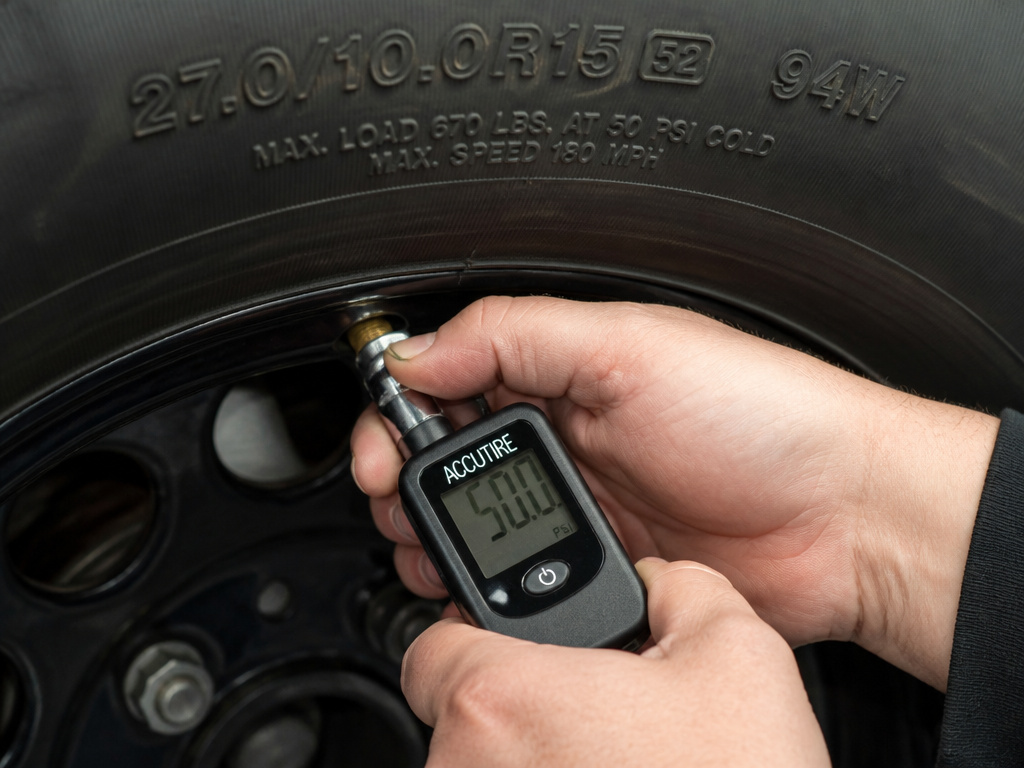
Changing width doesn’t absolve you from matching the tire’s fundamental job: carrying the weight of your car at speed.
Load Index: The new tire’s load capacity must be equal to or greater than the original. This number is on your door jamb sticker and the tire sidewall. A wider tire with a lower load index is a dangerous downgrade. Federal law (49 CFR 571.110) requires that for vehicles with passenger car tires, the vehicle normal load on the tire shall be no greater than 94 percent of the derated load rating at the manufacturer’s recommended cold inflation pressure.
Speed Rating: The new tire’s speed symbol must meet or exceed the OE rating. There’s one exception: winter tires. For driving in winter conditions, it’s generally acceptable to use a winter tire with a lower speed rating, but you must then limit your vehicle’s maximum speed accordingly.
Inflation Pressure: Never use a pressure lower than the vehicle manufacturer’s recommendation on the door jamb. A wider tire does not automatically mean lower pressure. More critically, always maintain the front/rear pressure relationship specified by the OEM. Changing this balance can drastically alter the car’s handling.
Ignoring these specs doesn’t just risk a blowout. It directly changes how the vehicle handles emergency maneuvers. It can also raise questions about how tire changes affect warranty coverage if a failure occurs, especially when exploring can you put wider tires on stock rims.
The Enthusiast Divide: Stretched, Wide, and the Standard’s Edge
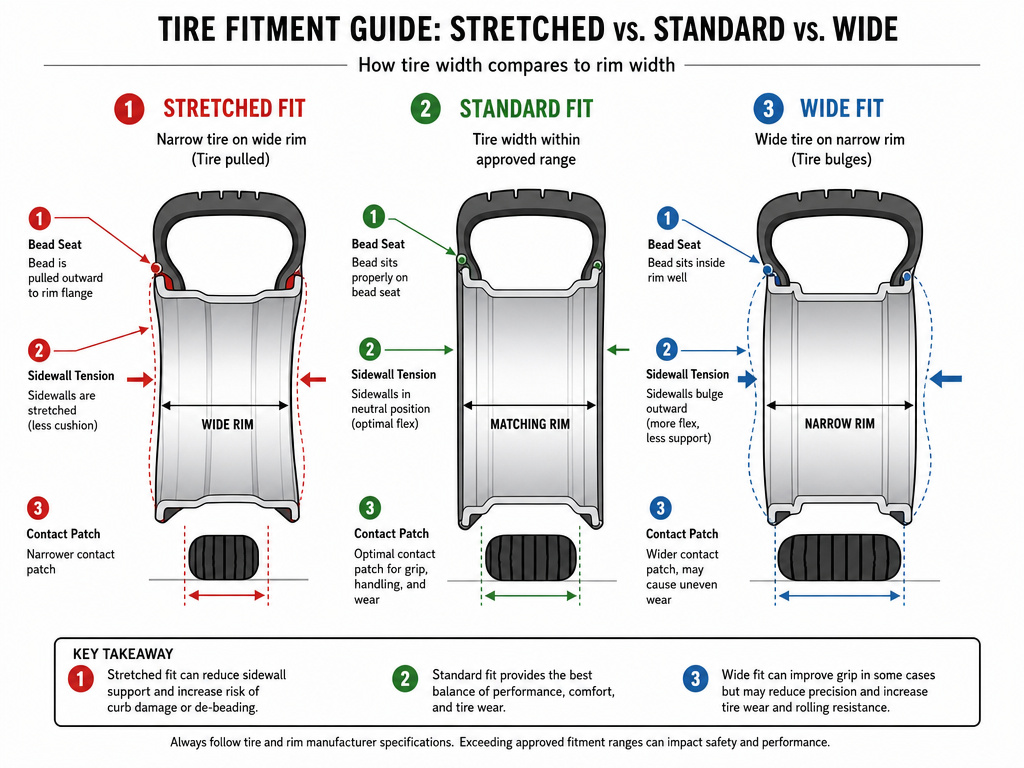
In car communities, you’ll see “stretched” fits (a narrow tire on a wide rim) and “wide” fits (a wide tire on a narrow rim). This is the explicit point where owner practice diverges from engineering standards: Continental Tire and ISO standards require using only approved tire size and rim width combinations, while the automotive enthusiast community commonly uses fitments outside these approved ranges for aesthetic or handling goals.
The stance scene prizes the stretched look for its aesthetic. The track community sometimes uses a slightly wider rim than approved to stiffen the sidewall for sharper response. Both accept trade-offs: a stretched tire has less impact protection and a precarious bead seat; an overly wide tire on a narrow rim feels vague and can overheat.
Common mistake: Assuming a fitment is safe because “everyone runs it.” Online forums are full of anecdotal success stories that ignore the long-term risks of running outside the approved range. Tire wear becomes uneven, often wearing the center tread excessively. The risk of a bead unseating during a hard impact increases. And if you have a tire-related failure, the manufacturer’s warranty is void.
This is the full picture of how tire width affects handling. Within the approved range, a wider patch can improve dry grip. Outside that range, you’re experimenting with the tire’s structural integrity. It’s why understanding the pros and cons of stretched tires requires acknowledging you’re operating outside the design parameters.
Special Cases: AWD, Staggered Sets, and Spare Tires
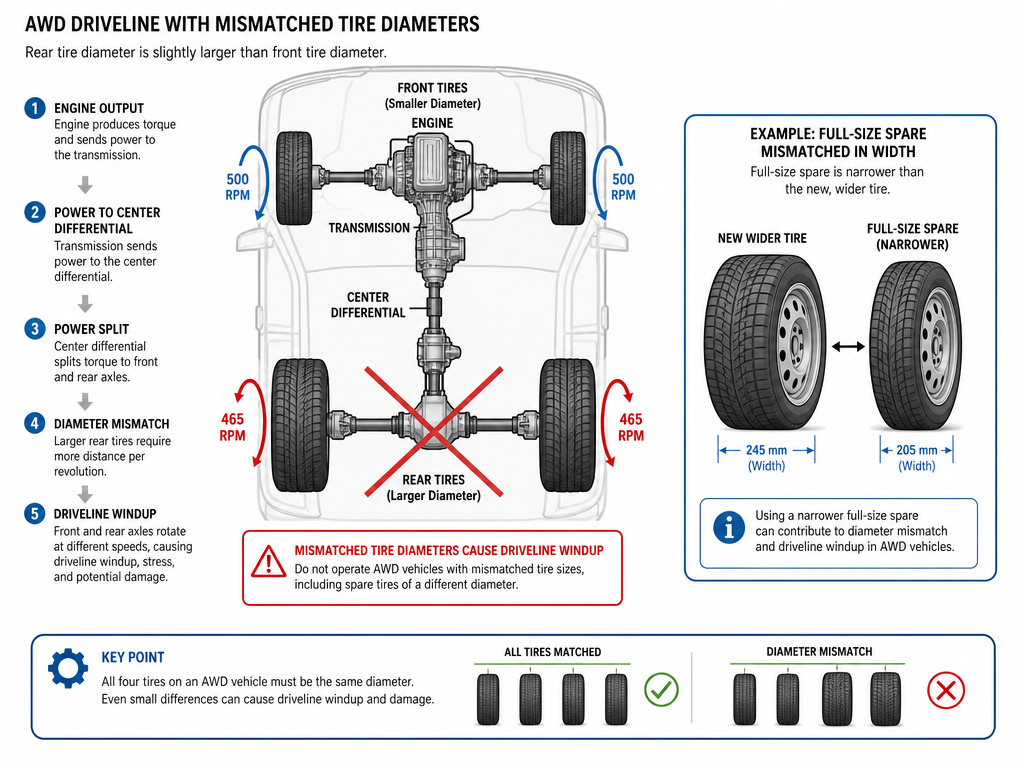
The rules tighten for all-wheel and four-wheel-drive vehicles. These systems rely on the front and rear axles turning at nearly identical speeds. A difference in tire diameter, even from tread wear, can cause binding and damage the driveline.
For AWD/4WD vehicles, the universal rule is to replace all four tires with the same size, unless the vehicle came from the factory with a “staggered” fitment (wider tires in the rear). Even then, you must maintain the factory’s front/rear diameter difference.
Your spare tire matters, too. Ford’s manual warns that in AWD vehicles, “if there is a significant difference between the size of a spare and the remaining tires, All-wheel drive functionality may be limited.” A full-size spare that doesn’t match your new wider tires can leave you stranded in a different way.
This is all part of a coherent plus sizing strategy. Plus-sizing, increasing wheel diameter while lowering tire profile, is a structured way to change appearance and handling while maintaining overall diameter and staying within approved specs. Haphazardly slapping on wider tires is not.
Vehicle-specific examples and user experiences
While individual stories vary, the core principles apply to all vehicles. A common experience involves owners checking the sticker on the driver’s door jamb or the owner’s manual for the manufacturer’s approved tire and wheel sizes. For all-wheel drive vehicles, a key takeaway from user reports is the critical need to keep all tires the same size to avoid damaging the drivetrain, unless the vehicle originally had a staggered setup. Many find that even minor changes to tire diameter can affect speedometer readings. The most consistent advice from those who have done it is to consult an authorized dealer or a tire professional to verify any planned fitment against the tire manufacturer’s approved rim width charts and to physically check for clearance at full lock and under load.
Frequently Asked Questions
How much wider can I go on my stock rims?
You can go as wide as the tire manufacturer’s approved rim width range for your chosen tire size allows. A common safe increase is 10-20mm in section width (e.g., from 225 to 235 or 245), but this must be verified against the approved range for the specific tire model. Your stock rim width must fall within that new tire’s range.
Can a tire be too wide for a rim?
Yes. If the rim width is below the tire’s approved minimum, the sidewall will bulge excessively. This reduces steering precision, increases the risk of the tire rolling off the bead in hard cornering, and can lead to uneven wear and shoulder damage. The tire is not supported as designed.
Do wider tires improve grip?
On a dry road, a wider tire on an appropriately sized rim can provide a larger contact patch, which may improve grip. However, in wet or snowy conditions, a narrower tire often performs better by cutting through water and slush to reach the pavement. The effect on handling is nuanced and depends on the tire compound and tread design as much as width.
Will wider tires affect my fuel economy?
Typically, yes. Wider tires generally have increased rolling resistance, which can reduce fuel economy.
The Bottom Line
The spec sheet decides it. The urge to put wider tires on stock rims is about looks and perceived performance. An engineering table in an ISO standard and federal law governs this. Your stock rim’s width is just one number in the equation; the other is the approved range for the tire you want to buy.
If your rim width sits comfortably within that range, and the overall diameter stays within 3% of stock, and the load and speed ratings are met, the swap is technically sound. Then you must physically verify clearance, remembering that a tire moves and grows when driven.
One rule most guides skip: if you’re even 1% outside the approved rim width range, you are accepting a risk the tire engineer did not sign off on. For a daily driver, that’s a poor trade. For a weekend car, it’s a calculated one. Know which you’re making.
