
How Fast Can You Drive on a Donut Spare Tire? What to Know
This post contains affiliate links. As an Amazon Associate, we earn from qualifying purchases.
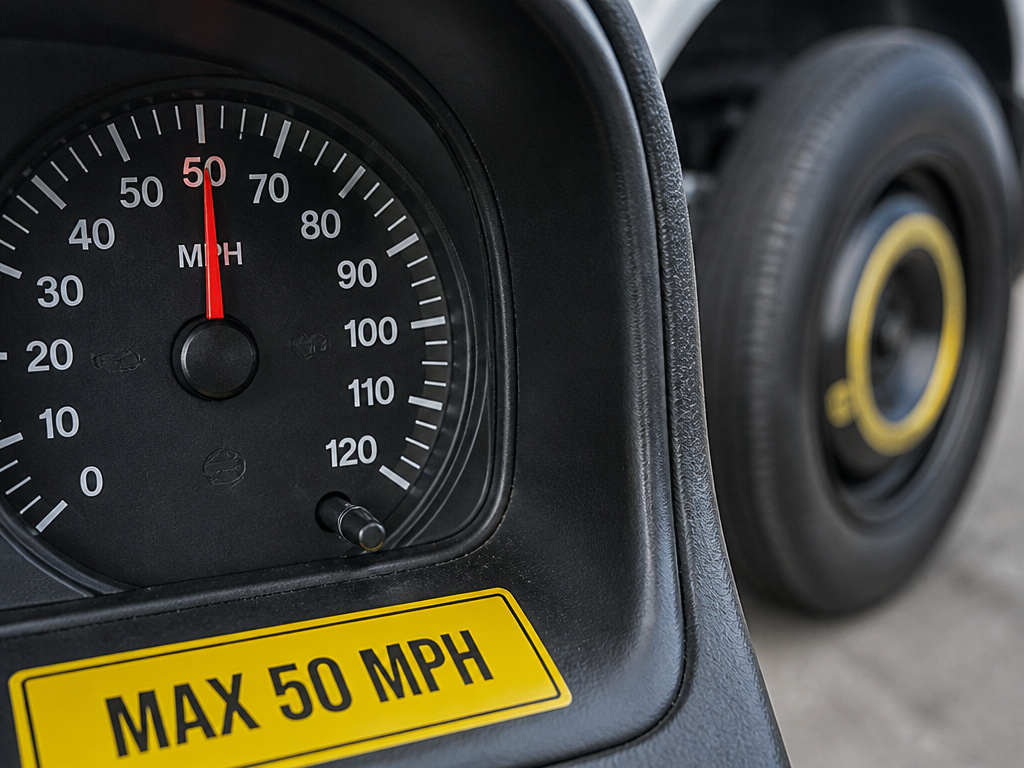
You can drive a maximum of 50 mph (80 km/h) on a donut spare tire. This is a design and safety limit, not a conservative suggestion. Exceeding it risks tire failure and loss of vehicle control.
That speed limit comes from a specific regulatory carve-out. The U.S. National Highway Traffic Safety Administration (NHTSA) exempts temporary spares labeled “MAX. SPEED 50 MPH” from standard tire performance grading. Manufacturers like Ram and Kia build to that limit, and the Irish Road Safety Authority sets an identical 80 km/h cap. It’s a ceiling, not a target, which directly answers the question of how fast can you drive on a donut spare tire.
What follows is a breakdown of why that number is essential, how a donut spare changes your vehicle’s handling, the conflicting advice on how far you can drive, and the immediate steps to take after you bolt one on.
Key Takeaways
- The absolute speed limit for a donut spare is 50 mph (80 km/h). This is a manufacturer and regulatory maximum, not a recommended cruising speed.
- Drive to the nearest repair shop. Conflicting guidance exists: Michelin cites 100–200 km (62–124 miles), while AAA advises no more than 50 miles.
- Check the inflation pressure immediately after installation. Donut spares often require 60 psi—much higher than your regular tires.
- Never install more than one donut spare on the vehicle at a time, and never tow a trailer while using one.
- A donut spare reduces ground clearance by about 1 inch (25 mm), requiring slower, more deliberate driving.
The 50 MPH Rule: It’s a Design Limit, Not a Suggestion
That 50 mph figure isn’t arbitrary. It’s the legal and engineering boundary for a tire built to be lightweight and compact, not durable. The NHTSA official interpretation letter states that temporary-use spares labeled with “MAX. SPEED 50 MPH” are exempt from Uniform Tire Quality Grading standards. In short, the government allows these tires to skip performance tests because they are strictly limited to low-speed, short-distance use.
Temporary use spare tires labeled for a maximum speed of 50 mph are exempt from standard tire quality grading requirements. This exemption is conditional on the tire being used within its stated speed and distance limitations.
Manufacturer manuals are unequivocal. The 2022 Ram 2500/3500 owner’s manual states, “do not drive more than 50 mph (80 km/h).” Kia’s manual for multiple models repeats the same warning. The consistency isn’t a coincidence—it’s the design spec.
Where this goes sideways: Treating 50 mph as a target speed. On a highway with a 65 mph limit, you are a hazard. The tire’s lighter construction and shallower tread can’t dissipate heat or handle the forces of high-speed cornering or emergency braking. If you must use a highway, stay in the right lane and keep your speed well below the posted limit. Surface roads are always safer.
Donut vs. Full-Size Spare: Why the Limits Exist
Understanding the “why” requires looking at what a donut spare actually is. Officially called a compact or temporary-use spare, its job is to save space and weight. It is not a replacement tire.
| Aspect | Donut / Compact Spare | Full-Size Spare |
|---|---|---|
| Construction | Lighter, thinner, smaller diameter | Identical to your other four tires |
| Speed Limit | 50 mph (80 km/h) maximum | No limit (same as other tires) |
| Distance Limit | 50–200 km (conflicting guidance) | Can be driven indefinitely |
| Purpose | Temporary emergency use only | Direct replacement for any flat tire |
| Ground Clearance | Reduces by ~1 inch (25 mm) | No change |
The physics are simple. A smaller, lighter tire has less rubber and steel to absorb road impacts and manage heat from friction, which is the core of the how fast can you drive on a donut spare tire question. Its load capacity is also lower. Kia’s manual explicitly warns not to exceed the vehicle’s maximum load rating or the capacity shown on the spare’s sidewall. Overloading a donut, especially at speed, is a direct path to a blowout.
This is the core reason a full-size spare is a superior, if bulkier, option, especially when you compare a how fast can you drive on a donut spare tire. As the Irish Road Safety Authority notes, a full-size spare “could be the same brand or a different brand with no limitations to speed and distance.”
How Far Can You Actually Drive on a Donut?
Here’s where official sources disagree, and it’s a critical gap in most advice. You need to know which guideline to follow.
- Michelin’s Stance: The tire manufacturer states mini spares have “a distance limit of about 100–200 km” (approximately 62 to 124 miles).
- AAA’s Stance: The automotive association advises driving “no more than 50 miles” on a donut spare.
Common mistake: Assuming you have a 100-mile grace period. If you follow AAA’s stricter 50-mile rule, you have half the range Michelin suggests.
Why the discrepancy? It likely comes down to risk tolerance and tire condition. A brand-new donut on a smooth road in cool weather might handle 100 miles. An old, under-inflated spare on a hot day on rough roads might fail in 20. The conservative rule is the safest: get to the nearest qualified repair facility, not the one 90 miles away that’s cheaper. Your goal is to drive on a spare as briefly as possible.
The Immediate Post-Installation Checklist
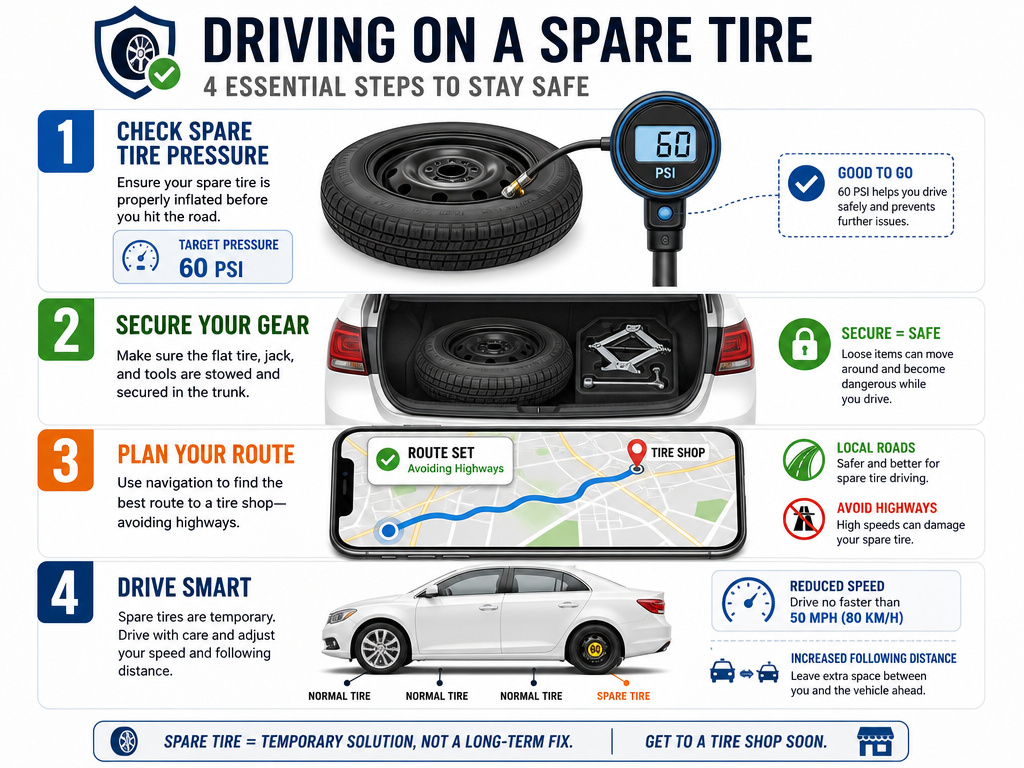
Once the donut is on, your driving approach must change. Follow this list before you move the vehicle.
- Check and Adjust Tire Pressure. This is the most skipped step. A donut spare can require 60 psi (per Kia manuals), which is often higher than the pressure for regular tires. An under-inflated spare is unsafe. Use a gauge.
- Stow All Equipment. Secure the flat tire, jack, and wrench. An unsecured tire becoming a projectile in a crash is a real danger.
- Plan Your Route. Open a maps app and find the closest tire shop or dealership. Avoid highways, potholed roads, and steep grades if possible.
- Adjust Your Driving. You now have three matching tires and one smaller, harder spare. Acceleration, braking, and cornering will feel different. Drive smoothly and leave extra space.
This checklist is part of a broader mindset of spare tire maintenance. A spare you check regularly is a tool; one you haven’t checked in years is a liability.
Specific Risks and Prohibited Uses
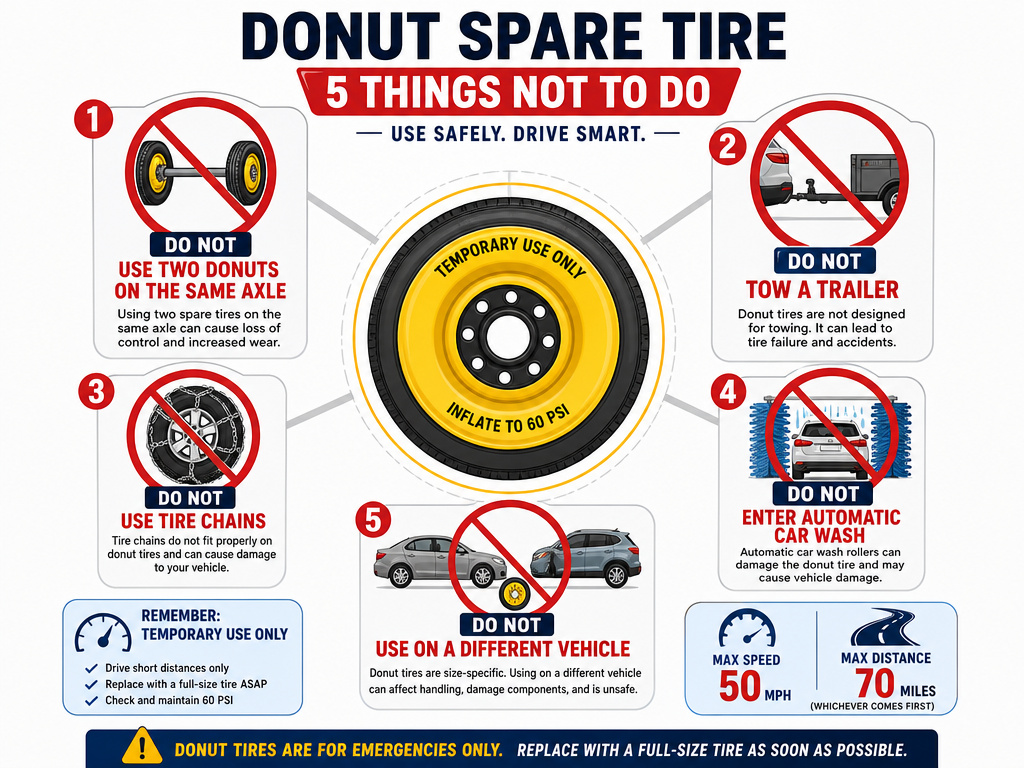
The manuals list clear “do not” commands. These aren’t suggestions.
- Do Not Install More Than One. Both Ram and Kia state you should not operate the vehicle with more than one compact spare in use at a time. The mismatched diameters and handling characteristics can damage drivetrain components, especially in all-wheel-drive vehicles.
- Do Not Tow. Kia is explicit: “Do not tow a trailer while the compact spare tire is installed.” The spare’s reduced load capacity cannot handle the extra strain.
- Do Not Use Tire Chains or Wheel Covers. The smaller size means chains won’t fit properly and can damage the vehicle. Wheel covers aren’t designed for the spare wheel.
- Avoid Automatic Car Washes. The guided track or rollers can damage the smaller tire or wheel.
- Do Not Use on Other Vehicles. The spare is specifically engineered for your vehicle’s weight and brake clearance. Using it on another model is unsafe.
These restrictions highlight that a donut is a get-you-home device, not a substitute tire.
What About Run-Flat Tires?
Run-flats are a different technology, but they come with similar temporary-use limits. They have reinforced sidewalls that allow driving after a puncture with little to no air pressure.
According to the USTMA Tire Information Service Bulletin, run-flat tires are “intended for limited service” at reduced speed and distance. The Irish Road Safety Authority sets a limit of 50 km/h for a punctured run-flat, while USTMA context implies a higher limit.
The critical difference is that run-flats are your regular tires. You don’t stop to change a wheel, but you must still get the tire repaired or replaced promptly. The bulletin also stresses that a functioning Tire Pressure Monitoring System (TPMS) is required with run-flats to alert you to the pressure loss.
Where to Put the Donut Spare on Your Vehicle
If you have a choice, the rear axle is the preferred location for a donut spare.
If you must place it on the front (e.g., a front-wheel-drive car with a flat front tire), move a full-size rear tire to the front and install the donut on the rear. This extra five-minute swap significantly improves safety and drivability.
What Happens When You Ignore the Speed Limit on a Donut Spare Tire?
Drivers who push a donut spare beyond its limits often report a sudden, severe loss of control. The lighter construction that makes the tire compact also makes it unstable at higher speeds. Many find their vehicle begins to vibrate excessively or feels loose and wobbly in corners, especially on highway ramps or during lane changes. This isn’t just poor handling; it’s a warning that the tire’s limited capabilities are being exceeded. The consensus from those who’ve had a scare is clear: treat the spare as a strict ‘get-me-home’ device. Drive slowly and carefully, avoid hazards like potholes, and head directly to a repair shop to swap it out.
Frequently Asked Questions
Can you go 70 mph on a donut tire?
No. Exceeding 50 mph risks immediate tire damage from overheating and excessive centrifugal force. Handling becomes unpredictable, and the chance of a sudden failure increases dramatically. The 50 mph limit is a hard ceiling.
Can I drive 2 hours on a donut spare?
Probably not, and you shouldn’t plan on it. At an average speed of 40 mph, two hours is 80 miles. This exceeds AAA’s 50-mile guideline and pushes the upper bound of Michelin’s 124-mile limit. The goal is to drive the shortest distance to repair, not the longest distance the tire might survive.
How long does a donut spare last in storage?
Donut spare has a shelf life like any tire. Rubber degrades with age, becoming brittle and unsafe over time, regardless of tread depth. Check the DOT date code on the sidewall.
What happens if I get a flat tire and my donut is also flat?
You’re stranded. This is why checking your spare’s pressure during routine spare tire maintenance is critical. A compact spare can lose pressure over time just sitting in the trunk. An annual check with a gauge is the minimum.
Before You Go
The rule is simpler than most people make it: 50 mph max, nearest shop, drive like you’re injured.
The donut spare is engineering’s answer to a very narrow problem—moving a disabled vehicle a short distance at low speed. It is not a license to continue a road trip. Respect its severe limits, understand the conflicting distance advice leans toward the shorter range, and never let its presence delay repairing your proper tire. Your vehicle’s safety systems, from ABS to stability control, are calibrated for four matched tires. A donut on one corner turns those systems into approximations.
Check its pressure today. Not when you need it.
