
How Often to Rotate Tires: What the Spec Sheets Say
This post contains affiliate links. As an Amazon Associate, we earn from qualifying purchases.
How often to rotate tires depends on who you ask. The USTMA says 5,000 to 8,000 miles. Bridgestone says 5,000. Hyundai’s 2025 manual says 8,000. GM’s service bulletins say 7,500. The practical answer: every 5,000 to 7,500 miles, or the moment you see uneven wear.
That spread exists because each number was calibrated for a specific drivetrain, tire compound, and alignment spec. A front-drive sedan wearing 225/65R17 all-seasons doesn’t load its tires the way a rear-drive Camaro on staggered Pirelli P-Zero summer rubber does. The answer to how often to rotate tires is a starting point, not a law.
What follows: the OEM comparison table, the first-rotation rule nobody mentions, the staggered and directional exceptions that break every pattern, and the hand-over-the-tread test that tells you it’s time now.
Key Takeaways
- Major tire makers and automakers give different intervals, such as 5,000, 5,000-8,000, 6,000, 7,500, and 8,000 miles; your owner’s manual overrides all of them.
- The first rotation matters most because fresh, deep tread is the most vulnerable to uneven wear in its first 5,000 miles.
- Running your hand across the tread in both rotation directions reveals heel-toe wear before you’d ever hear it.
- Staggered and directional setups can’t follow the standard cross pattern; some vehicles only allow side-to-side swaps.
- Skipping rotation can void your tire warranty and accelerate feathering past the point where a rotation can fix it.
How Often to Rotate Tires: Five Manufacturers, Five Answers
Five sources. Five different numbers. Zero agreement.
| Source | Recommended Interval | Context |
|---|---|---|
| USTMA manual | 5,000 to 8,000 miles | Fallback if no period specified |
| Bridgestone | Every 5,000 miles | “Or per vehicle manufacturer” |
| Honda TSB | 6,000 or 7,500 miles | Model-specific, non-directional |
| Hyundai 2025 manual | 8,000 miles (13,000 km) | Or sooner if irregular wear |
| GM service bulletin | 7,500 miles (12,000 km) | Modified X-pattern rotation |
Toyota’s position cuts through the noise differently: “Tire rotation frequency (and the rotation pattern) are vehicle-specific and you should follow the recommendations set forth by your vehicle manufacturer.” That’s the real answer. The interval on your placard beats every article on the internet, including this one.
But here’s what the number actually means when you can’t find your manual. The USTMA tire care and service manual gives 5,000 to 8,000 miles as the industry fallback. That’s the widest honest range you’ll find. If your car pulls left under hard braking, if you live in the hills, or if you drive a front-drive SUV with a 3,500-pound curb weight, lean toward 5,000. If you cruise flat highway in a rear-drive sedan, 7,500 to 8,000 is defensible.
Driving style changes the math. The USTMA manual notes that “any vehicle showing a tendency for wear differential should have tires rotated more often.” Hard cornering, aggressive acceleration, and heavy loads all accelerate the front axle. I set a phone reminder at 5,000 miles and check tread depth each time. That habit has caught two alignment issues before they ate a tire.
The First Rotation Is the One That Matters Most
New tires are the most vulnerable tires. Deep, fresh rubber has more independent block movement, and those blocks haven’t yet worn into a stable pattern. The USTMA manual states plainly: “The first rotation is the most important.”
Rotating new tires by the 5,000-mile mark repositions each tire before the front axle’s steering, braking, and drive forces establish a dominant wear pattern. Uneven wear that starts in the first 5,000 miles becomes permanent once the tread blocks deform past their elastic range, and no subsequent rotation reverses it.
Bridgestone’s maintenance page echoes this: “It is especially important to rotate new tires by 5,000 miles because deep, fresh tire tread is more susceptible to uneven wear.”
For most drivers, this aligns with the first oil change after new tires go on. If your vehicle’s interval is 7,500 miles (Hyundai) or 8,000 miles (also Hyundai, per the 2025 manual), the first rotation still lands inside your first oil-change window. That’s the easiest way to never miss it: tie rotation to oil service. You’re already on the lift.
One thing I check at every rotation and most people skip: the DOT date code on each sidewall. A tire that sat in a warehouse for three years before mounting is aging whether you drive it or not. Check the sidewall.
What Happens When You Skip It
You’ll hear the noise before you see the damage. Past about 15,000 miles of skipped rotation, GM’s Camaro service bulletin warns that “heel/toe treadwear if allowed to progress past about 15,000 miles (24,000 km) may result in increased or objectionable tread noise.” That low hum that gets louder on rough pavement? That’s your tread blocks cupping in sequence.
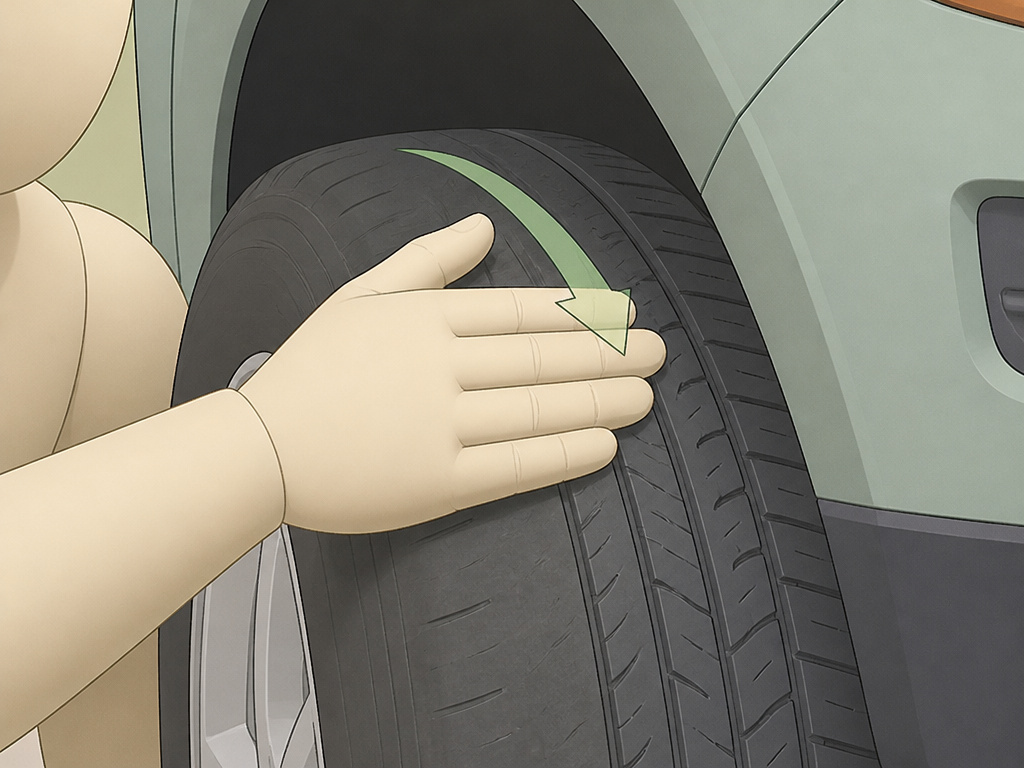
The physical tell comes first. Run your palm across the tread in the direction the tire rotates, then back the other way. If one direction feels smooth and the other feels like corrugated cardboard under your hand, you have heel-toe wear. The NHTSA tire service bulletin documents Honda’s revised rotation pattern.
GM’s 2016 bulletin goes further: if a customer hasn’t rotated within 12,000 km (7,500 mi), the fix isn’t an alignment. “A tire rotation in the modified X-pattern is necessary to clean-up the feathering, rather than placing the vehicle on the alignment machine.” Feathering looks like one edge of each tread block is worn higher than the other, like a tiny sawtooth you can feel with a fingertip.
What most people get wrong: Assuming a vibration means your tires need balancing. Sometimes it means one tire is 3/32 inch deeper than its partner because you skipped two rotations. Check tread depth with a gauge before reaching for a balance weight.
Skipping rotation also costs you warranty coverage. Toyota’s guidance is blunt: “Skipping or prolonging tire rotation may void your tire’s mileage warranty.” If you don’t rotate tires on schedule, the tire maker can deny a premature wear claim. That’s not a threat. That’s the fine print.
Directional, Staggered, and AWD: When the Standard Pattern Breaks
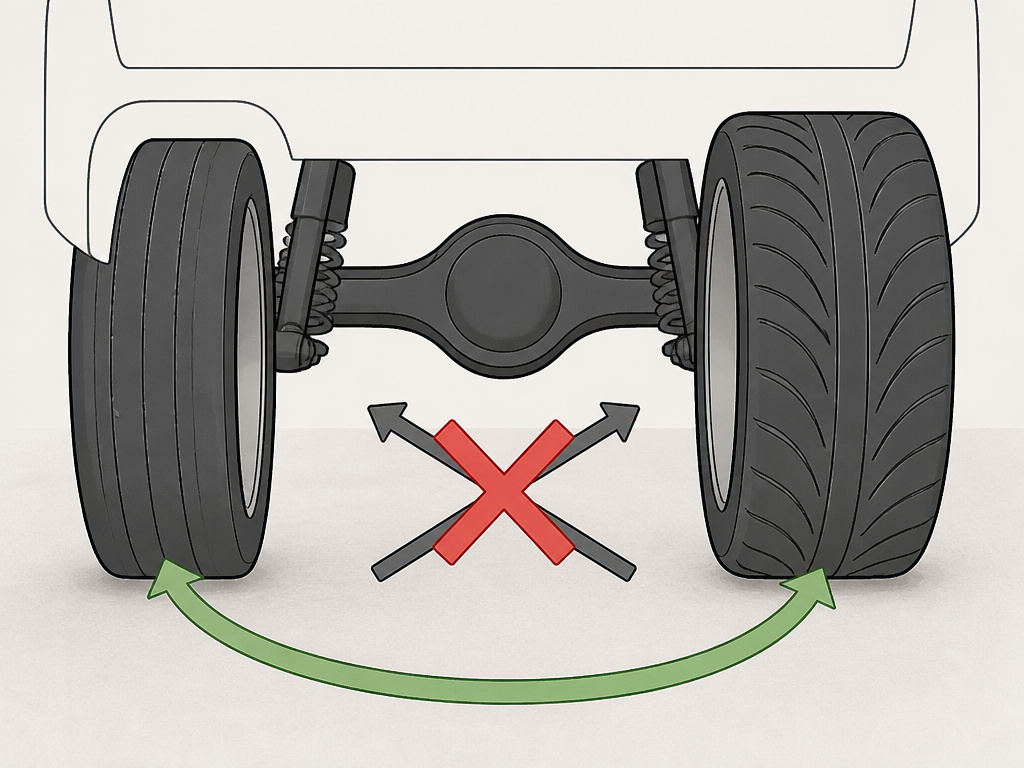
A reader emailed me last month with photos of a staggered setup: 245/35R20 in front, 275/35R20 in the rear. He’d been doing the standard cross pattern on every rotation for two years. The front tires were on the rear axle and the rears were on the front. Both pairs were now wearing wrong-side shoulders because the alignment specs for each axle are different.
That’s the mistake I see most. Staggered fitments (different front and rear tire sizes) mean the tires physically cannot swap axles. The Camaro TSB is explicit: “Tires on this vehicle must never be rotated front to rear, or rear to front; only rotating left rear to right rear and left front to right front is acceptable.”
Staggered Setups: Side-to-Side Only
If your car has different-sized tires front and rear, you get one rotation: side-to-side on each axle. Every 7,500 miles, per GM’s bulletin. That’s it. No cross, no X-pattern, no front-to-rear.
Directional tires have their own rule. They rotate the same direction they came from, so you can only swap them side-to-side on the same axle. The Honda TSB confirms “the tire rotation pattern for directional tires has not changed” even as they revised the non-directional pattern. If you need to rotate directional tires, the arrow on the sidewall is your only guide.
What to Do With Your Spare
If you have a matching full-size spare, the USTMA manual recommends including it in the rotation. That turns a four-tire job into a five-tire job. I walk through the full five-tire rotation pattern on a separate page because the spare placement gets confusing fast.
Temporary “T-type” spares stay out. They’re not sized or rated for rotation. The USTMA manual states: “Do not include a ‘Temporary Use’ or T-type spare tire in any of the rotation patterns.”
AWD Changes Everything
On all-wheel-drive vehicles, even a small tread-depth difference between axles stresses the center differential. Bridgestone notes that “evenly worn tires lower the stresses on the drivetrain, reducing wear on expensive drive components.” The tire rotation for AWD pattern is the X-pattern (all four tires move diagonally).
One step people forget on AWD vehicles with TPMS: the NHTSA technical service bulletin covering Honda’s revised pattern reminds you to re-register tire positions after rotation. If your TPMS (Tire Pressure Monitoring System) sensors are position-coded and you don’t re-pair them, the dashboard tells you the front-left is low when the problem is actually the rear-right.
Rotation vs. Balancing vs. Alignment: Three Different Jobs
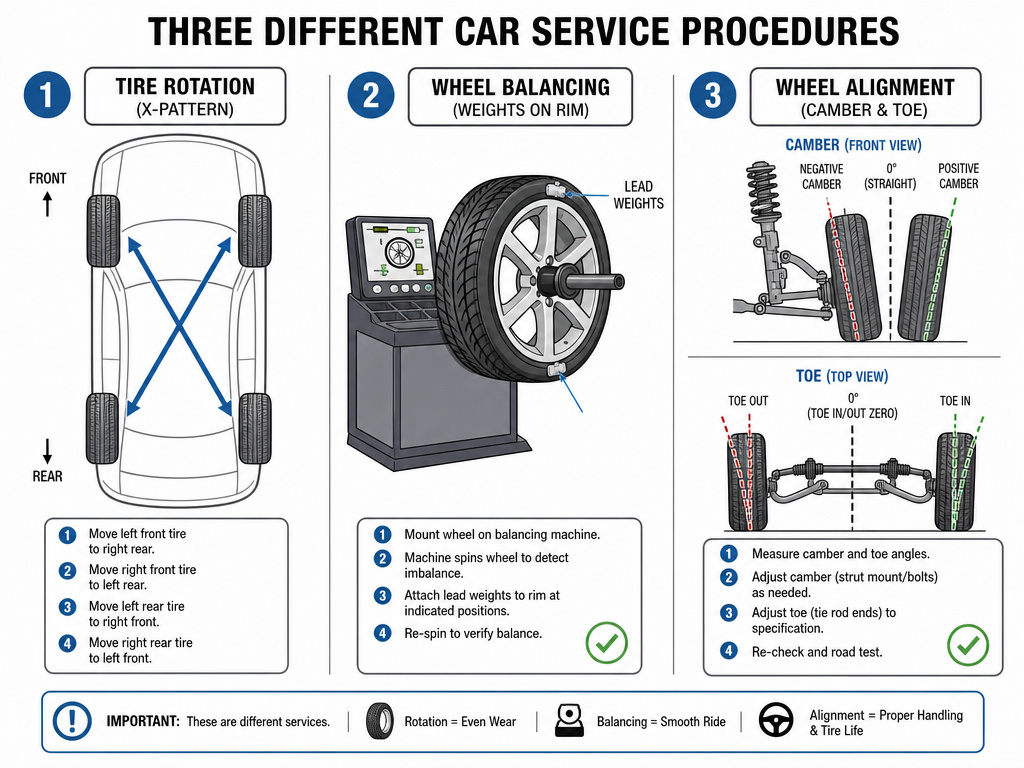
These get tangled in every forum thread, so let me separate them.
Rotation moves tires to different positions on the vehicle. You do it every 5,000 to 8,000 miles to equalize wear.
Balancing adds small lead weights to the wheel rim so it spins without wobble. You do it when you feel a vibration through the steering wheel or seat, or whenever you balance tires as part of a rotation service.
Alignment adjusts the angles of your suspension (camber, toe, caster) so the tires meet the road at the correct angle. You do it when tread wear is concentrated on one shoulder, or after hitting a curb.
The tire rotation and alignment distinction matters because GM’s 2016 bulletin explicitly says feathering from skipped rotation is NOT an alignment problem. “A tire rotation in the modified X-pattern is necessary to clean-up the feathering, rather than placing the vehicle on the alignment machine.” If a shop recommends a $120 alignment to fix wear that a free rotation would correct, walk.
The step-by-step tire rotation guide covers the actual wrench work. I use a torque wrench set to the vehicle’s spec (Hyundai’s 2025 manual says 79 to 94 lbf·ft) and an alignment check only when wear patterns point to a suspension angle issue. Two different tools for two different problems.
How to Tell Your Tires Need a Rotation Now
You don’t need to count miles. Your tires will tell you.
| Symptom | Likely Cause | Action |
|---|---|---|
| Corrugated feel across tread | Heel-toe wear from skipped rotation | Rotate immediately |
| One shoulder worn smooth | Camber or toe alignment off | Get alignment checked |
| Hum grows louder on rough roads | Feathering past 15,000 mi | Rotate, then recheck at next service |
| Steering wheel shakes above 60 mph | Balance weight shifted or lost | Balance before rotating |
The hand test is the fastest diagnostic. Park on flat ground, run your palm over the tread from the shoulder to center, then back. Smooth in one direction, rough in the other means heel-toe. The common tire rotation patterns explained page shows which cross-pattern corrects which wear type.
Before you start: Ensure you have the proper equipment and safety measures in place. Lug nuts must be torqued to spec after rotation (79 to 94 lbf·ft on Hyundai, per the 2025 manual). Under-torqued nuts vibrate loose; over-torqued nuts strip threads or warp the rotor.
At rotation time, also check the things nobody looks at unless the tire’s already off. The Hyundai 2025 manual reminds you that “disc brake pads should be inspected for wear whenever tires are rotated.” You’re holding the wheel. Glance at the pad thickness. Also confirm inflation pressures match the placard for each tire’s new position, since front and rear pressures often differ by 2 to 4 psi.
How much does a tire rotation cost
Since the fact sheet does not provide specific pricing, the cost is typically a standard service fee. Many drivers include a rotation with an oil change, while others schedule it as a standalone service. The price can vary based on your location, the service provider, and whether you have a vehicle that requires a special pattern, like side-to-side only. To manage the expense, consider it as part of your regular maintenance budget. Skipping this service to save money can lead to uneven wear, which may void your tire’s warranty and force you to replace tires sooner, a far greater cost.
Frequently Asked Questions
Is it okay to rotate tires every 10,000 miles?
You can, but you’re gambling. The USTMA’s upper bound is 8,000 miles, and that’s before accounting for aggressive driving or heavy loads. At 10,000 miles, front-axle tires on a front-drive car may already show irreversible heel-toe wear. I’d rather see a rotation at 7,500 than find cupping at 10,000.
Do tires really need to be rotated every 5,000 miles?
If you drive gently on flat roads in a car with balanced weight distribution, every 7,500 to 8,000 miles is defensible (Hyundai and GM both publish 7,500 to 8,000). But if your daily commute includes hard stops, curving mountain roads, or a heavy truck with a loaded bed, 5,000 is the safe number. The USTMA says “at any sign of uneven wear” rotate immediately, regardless of mileage.
Should you rotate tires at every oil change?
For most drivers, yes. It’s the simplest way to build the habit. If your oil interval is 5,000 miles, you’re inside the rotation window every time. If it’s 7,500 or 10,000 miles, skip one oil change between rotations. Bridgestone’s page makes the same point: “For many of you, that will mean when you get your vehicle’s oil changed.”
How often do you really need a tire rotation?
Check your owner’s manual first. If it says 7,500, do 7,500. If you can’t find the manual, 5,000 to 6,000 miles is the conservative interval that keeps you inside every OEM’s range. The first rotation after new tires go on is the one you absolutely cannot skip.
Can I rotate tires myself or do I need a shop?
You can do it at home with a floor jack, jack stands, and a torque wrench. The actual swap takes 30 to 40 minutes. What you can’t do at home is the TPMS re-registration on some vehicles, or a Hunter Engineering-style alignment check if you find shoulder wear. Many shops include rotation free with tire purchases, though I’ve found those packages rarely get used because nobody remembers the interval.
The Bottom Line
Here’s the one rule that overrides every table above: if your owner’s manual says 7,500, rotate at 7,500. If it says 5,000, rotate at 5,000. The disagreement between manufacturers is real, and it exists because their drivetrains load tires differently.
My personal practice, and I’ll own this one: I rotate every 5,000 to 6,000 miles and write down tread depth at each position. That log catches a slow alignment drift two rotations before the wear becomes visible to the eye. It’s the underrated diagnostic nobody talks about.
One concession. If you drive a performance car with a staggered setup and the correct rotation is side-to-side only, budget for replacing tires as needed, and put the new tires on the rear axle (Hyundai’s bulletin is clear on this for wet stability).
What extends tire life is moving the tire to a different axle before the forces at its current position carve a permanent groove into the rubber. Rotate on schedule. Record the depths. Let the numbers tell you when the next one is due.
