
How Tire Traction Works: The Science Behind the Grip
This post contains affiliate links. As an Amazon Associate, we earn from qualifying purchases.
How tire traction works is a story of two physical forces, adhesion and hysteresis, fighting to keep a patch of rubber stuck to the road. It’s not about tread “biting” into pavement; it’s about the rubber compound’s ability to conform to microscopic road texture and the tread’s job of evacuating water before it creates a lubricating film.
The grip you feel comes from a complex dance between chemistry, physics, and engineering, which is central to understanding how tire traction works. A high traction rating tells you about wet braking on specific government test surfaces, but it says nothing about cornering grip or snow performance. The real-world variables, temperature, pressure, load, and that critical contact patch, decide whether you stick or slide.
What follows: a breakdown of the two fundamental friction mechanisms, what tread patterns actually do, how the government grades tires, and the practical factors that erode traction long before the tread wears out.
Key Takeaways
- Tire traction is generated by adhesion (molecular bonding) and hysteresis (energy loss) as the rubber deforms against road texture.
- The UTQG traction grade (AA, A, B, C) only measures straight-line wet braking on specified asphalt and concrete, not cornering, acceleration, or snow grip.
- Peak friction between a tire and road normally occurs at 18–30% wheel slip, which is why anti-lock braking systems (ABS) pulse in that range.
- On wet pavement, tread works by channeling water away through grooves to prevent hydroplaning; sipes provide edges for biting into thin water films.
- Accurately predicting a tire’s service life based on calendar age is not scientifically possible, despite common 6–10 year replacement advice.
The Two Physical Forces That Create Traction
Forget the idea of tread claws digging in. On a dry, hard surface, grip comes from two rubber-specific mechanisms working in the contact patch, the flattened area where tire meets road.
Adhesion is the molecular attraction between the rubber and the road surface at a microscopic level. Hysteresis is the energy lost as the viscoelastic rubber deforms over the pavement’s rough texture and then slowly recovers its shape. Together, they create the friction force that resists sliding.
Adhesion acts like a temporary, weak glue. The rubber compound is formulated to maximize this stickiness within the tiny peaks and valleys of the asphalt or concrete. Hysteresis is the rubber’s internal damping. As the tire rolls, the leading edge of the contact patch compresses and stretches over road particles. That deformation takes work, and the rubber doesn’t snap back instantly; the delayed recovery creates a drag force that opposes sliding. A softer, more pliable tire compound typically has higher hysteresis, which is why performance summer tires feel grippier, and wear out faster, than long-life touring tires.
The balance between these forces shifts with speed, temperature, and surface. The PennDOT pavement friction guide details this relationship, noting that adhesion dominates on smooth, clean surfaces, while hysteresis becomes more critical on rough or contaminated roads.
How Tread Actually Works on Pavement
If traction is about rubber meeting road, why does a bald tire lose grip in the rain? The tread isn’t for digging; it’s for managing water.
On a perfectly dry road, a slick racing tire provides maximum grip because it offers the largest possible rubber contact area. Introduce water, and everything changes. A thin film acts as a lubricant, drastically reducing adhesion. The job of the tread pattern is to evacuate that water so the rubber can still reach the pavement.
| Tread Element | Primary Function | What Happens If It’s Worn |
|---|---|---|
| Grooves (Channels) | Move large volumes of water out from under the contact patch to prevent hydroplaning. | Water cannot escape quickly, leading to a loss of direct contact and a sudden drop in traction. |
| Sipes (Thin Slits) | Create hundreds of biting edges to penetrate thin water films and provide micro-grip on wet or icy surfaces. | The tire loses its ability to “wipe” the surface clean, increasing stopping distances in light rain. |
| Blocks/Ribs | Provide stable footing and distribute vehicle load; their independent movement helps maintain contact over uneven surfaces. | Reduced stability and increased squirm, which can lead to longer braking distances and vague steering feel. |
The pattern itself is a compromise. Deep, aggressive grooves move more water but reduce the amount of rubber on the road, hurting dry grip. The arrangement of blocks affects noise, wear, and how tire width affects traction by influencing pressure distribution. This is why all-season, summer, and winter tires have distinctly different patterns, each is optimized for a different set of conditions.
The Government’s Take: What UTQG Traction Ratings Really Measure
When you see a “Traction AA” rating on a sidewall, that’s the result of a specific federal test designed to measure how tire traction works in a controlled scenario. It is not a general grip score.
The Uniform Tire Quality Grading (UTQG) system, defined in 49 CFR § 575.104, assigns traction grades (AA, A, B, C) based solely on a tire’s straight-ahead braking performance on two wet surfaces: a specified asphalt and a specified concrete. The test measures the adjusted traction coefficient as the tire locks up and slides.
The thresholds are precise:
- Grade C: ≤0.38 on asphalt or ≤0.26 on concrete.
- Grade B: >0.38 on asphalt and >0.26 on concrete.
- Grade A: >0.54 on asphalt and >0.38 on concrete.
The legal UTQG traction grade is explicitly based only on straight-ahead braking traction tests on wet asphalt and concrete. The standard warns it does not include acceleration, cornering, hydroplaning, or peak traction characteristics.
This is the critical limitation. A tire with an “A” rating has demonstrated good wet braking grip under those controlled test conditions. It tells you nothing about how it will corner in the rain, handle in snow, or resist hydroplaning. The test surfaces themselves are standardized to have traction coefficients of 0.50 ±0.10 (asphalt) and 0.35 ±0.10 (concrete). For more on these benchmarks, the DOT tire grading guide outlines the entire system.
Other standards exist for different comparisons. The ASTM wet traction test standard (F1649) provides methods for evaluating wet braking performance on vehicles equipped with anti-lock brakes, which is more reflective of modern cars.
The Traction Variables You Can Control
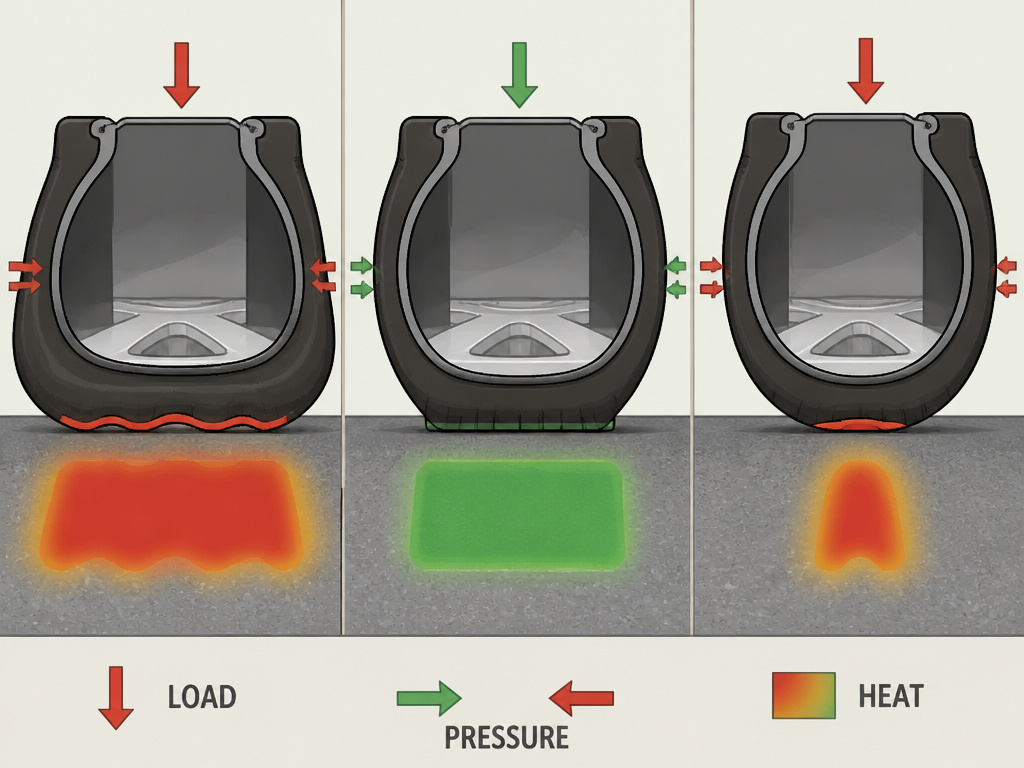
Beyond the tire’s built-in specs, three everyday factors dramatically influence available grip: inflation pressure, load, and temperature.
Tire Pressure is a Lever
Under-inflate a tire, and the sidewalls flex excessively. The contact patch area may increase, but it becomes uneven, the tread center bows inward, and the rubber overheats from internal friction. Over-inflate it, and the patch shrinks to just the center of the tread, reducing the total gripping area. Both extremes hurt traction. The doorjamb sticker’s recommended pressure is the starting point for a balanced contact patch.
Load Changes the Equation
Traction does not increase linearly with load. Doubling the weight on a tire does not double its grip. The friction coefficient often decreases as load increases, a principle explained in vehicle dynamics texts. This is why a heavily loaded vehicle or one taking a corner at speed has less grip per tire than a light, straight-running one. Exceeding a tire’s load index is a direct path to overheating and failure.
Temperature Cuts Both Ways
Rubber is viscoelastic. Its properties change with temperature.
- Too Cold: The compound hardens, losing its ability to conform to road texture (reduced hysteresis). This is why summer tires feel like hockey pucks below 45°F and winter tires use softer, cold-flexible compounds.
- Too Hot: Excessive heat from high speed, low pressure, or aggressive driving can soften the compound past its optimal range, leading to a greasy feel and accelerated wear.
A quick glance at the sidewall after a spirited drive can tell you a lot. If the rubber is hot enough to smell faintly sharp, you’ve pushed it past its happy place.
When Traction Breaks: Slip, ABS, and Hydroplaning
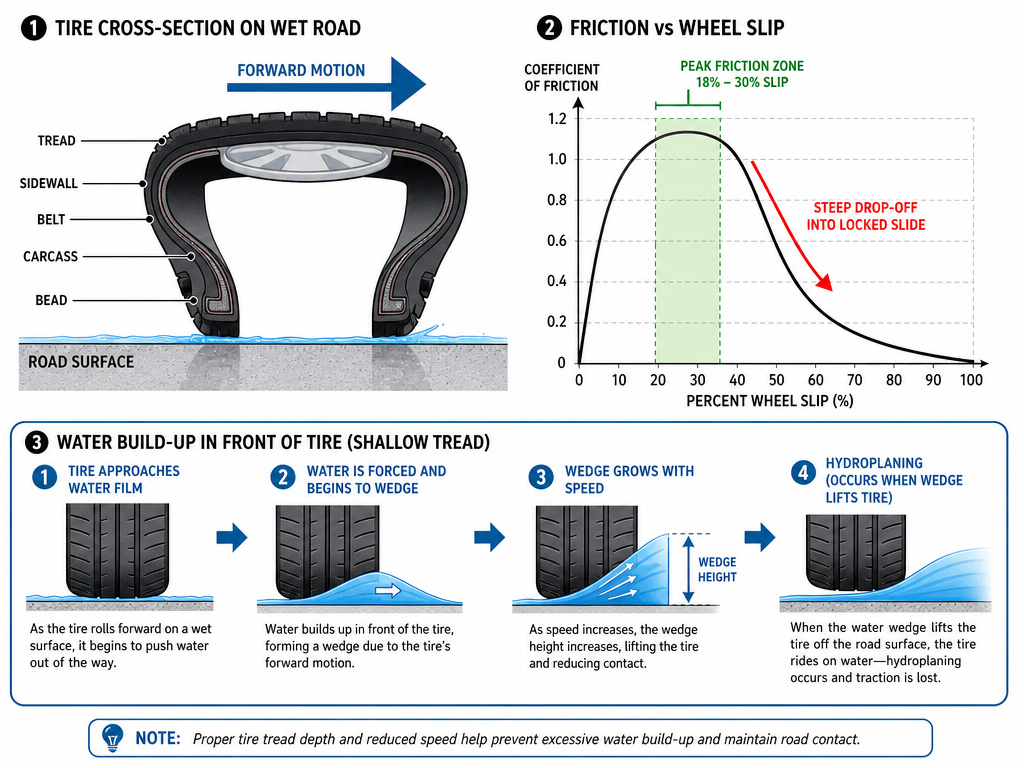
Losing grip isn’t a binary event. It’s a process that starts before the tire visibly slides.
The relationship between wheel slip and friction is key. When you brake hard, the wheel wants to slow faster than the car. The difference is expressed as percent slip. Research, including the PennDOT guide, shows the peak coefficient of friction “normally occurs between 18 and 30 percent slip.” This is the sweet spot for maximum braking force.
Where this goes sideways: Braking past that 30% slip point. Friction drops off as the tire transitions from rolling with partial slip to a fully locked slide. Stopping distance increases dramatically.
This is the entire reason anti-lock braking systems (ABS) exist. They pulse the brakes to keep wheel slip hovering in that 18-30% window, maximizing deceleration and maintaining steering control. Modern stability and traction control systems use the same principle for acceleration and cornering, managing throttle and braking individual wheels to keep each tire near its peak grip.
Hydroplaning is a different failure. It occurs when water pressure in front of and under the tire lifts it completely off the road surface. The tire is now skating on water, and all traction vanishes. Speed, water depth, and tread depth are the deciding factors. Worn tread simply cannot move enough water, which is why legal minimum tread depth requirements exist.
The Lifespan Debate: When Do Tires Lose Traction from Age?
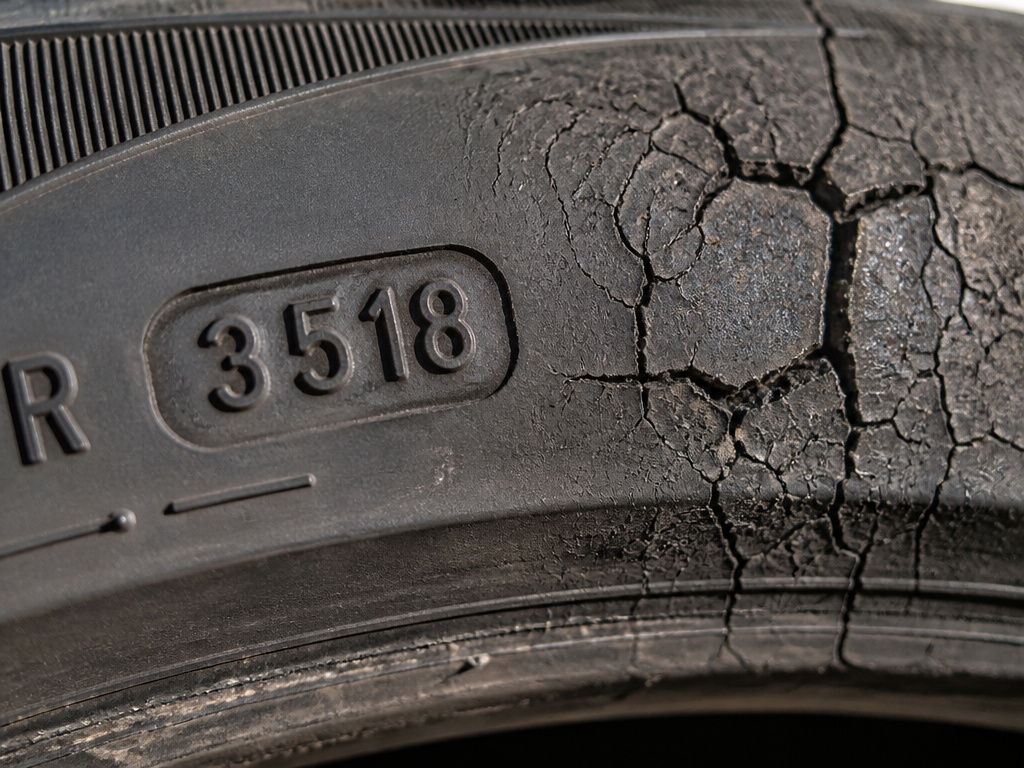
Tread wear is an obvious traction killer. Age is a stealthier one.
The U.S. Tire Manufacturers Association (USTMA) states clearly in its care guide: “Accurately predicting the service life of any specific tire based on calendar age is not possible.” They add that there is no scientific data establishing a specific minimum or maximum service life. This directly contradicts common advice from organizations like AAA and NHTSA, which recommend replacement after 6-10 years regardless of tread, a position the USTMA states is not supported by scientific data.
Who’s right? Both are, from different angles. The USTMA position is that variables like storage, climate, and use are so vast that a single calendar rule is scientifically indefensible. The safety organizations argue that rubber oxidation and compound degradation over time create an unavoidable risk. The NHTSA Pneumatic Tire manual discusses these material science factors.
Check the sidewall. The DOT date code (a 4-digit number like “3524” for the 35th week of 2024) tells you when the tire was made. A tire stored properly in a cool, dark, dry place may perform well for years. One baking in the Arizona sun on a daily driver is a different story. The rubber will harden and crack, destroying the adhesion and hysteresis properties long before the tread bars are flush.
How do tire chains and other traction devices work?
These devices provide grip in conditions where a tire’s normal adhesion and hysteresis mechanisms fail, such as on ice or deep snow. Chains create a mechanical link to the road surface, with metal links biting into the packed surface. Fabric socks and plastic mats work by increasing the surface area and creating a textured interface that the tire can push against. They are designed for temporary, low-speed use to get a vehicle moving or to navigate a short, hazardous section of road. Always follow the manufacturer’s instructions for installation and speed limits, as improper use can damage your vehicle or the road.
Frequently Asked Questions
Are you supposed to drive with traction control on or off?
Leave it on. The system is designed to help maintain control in low-traction situations like rain, snow, or gravel by reducing engine power or applying brakes to spinning wheels. The only time to consider turning it off is if you are stuck in deep snow or mud and need wheel spin to dig out. Re-engage it as soon as you’re moving.
At what speed do most tires lose traction?
There is no single speed. Traction loss depends on the available friction coefficient and the maneuver. A sharp turn taken too fast can cause a slide at 25 mph on a wet road. Hydroplaning can begin at relatively low speeds in heavy standing water with worn tread. The critical factor is the forces (braking, cornering, acceleration) exceeding the tire’s available grip, not the speedometer reading alone.
Is lower PSI better for traction?
Not reliably. While a slight drop in pressure can increase the contact patch area, it also causes uneven wear, excessive sidewall flex, and heat buildup, all of which degrade consistent traction and can lead to failure. Always use the vehicle manufacturer’s recommended cold tire pressure as the baseline. Off-road or specific competitive driving are the only exceptions, with their own prescribed techniques.
What are the downsides of traction control?
The primary downside is that it can limit engine power or apply brakes at times when the driver wants maximum wheel spin, such as when rocking a vehicle out of deep snow or sand. On some older or less sophisticated systems, the intervention can feel abrupt or intrusive. However, for normal road driving, the safety benefits vastly outweigh these minor drawbacks.
The Bottom Line
Traction isn’t magic. It’s the sum of a rubber compound’s chemistry, a tread pattern’s geometry, and the physical forces acting on a footprint the size of your hand. The ratings on the sidewall give you a narrow, useful data point, not the whole story.
Match the tire to your reality. If you see mostly rain, prioritize wet braking distance scores and look for a tread with plenty of sipes. Check the tread depth regularly with a tread depth gauge. And remember that a tire’s grip depends as much on you keeping it properly inflated and within its load limit as it does on the engineer’s design.
Look past the marketing. The numbers that matter are the ones tied to a verifiable test. Everything else is just noise between you and the road.
