
How Tires Affect EV Range? The New-Tire Surprise
This post contains affiliate links. As an Amazon Associate, we earn from qualifying purchases.
How tires affect EV range is decided by rolling resistance and air pressure. Under-inflation and high-resistance tires cut range 3 to 7 percent in ExxonMobil road tests, and swapping worn tires for identical new ones can drop it 2 to 14 percent at highway speeds, per the ORNL replacement tire study.
An underinflated tire is less stiff, so it flexes harder through the contact patch. That extra deformation turns battery power into heat instead of motion. In the data I compared, tire pressure moved range more than tire brand.
What follows: the tire variables that move the numbers, the replacement trap, and the load-index check most shops skip.
Key Takeaways
- Check pressure monthly against the door-jamb sticker, because tires leak about 4.8 percent of air each month.
- Do not trust the TPMS light to protect range; it warns only after pressure has already dropped enough to hurt efficiency.
- A new set can cost range: identical replacement tires cut range 2 to 14 percent versus worn originals at highway speeds.
- Match the load index, not just width and diameter, since EVs run roughly 300 kg heavier.
- Air retention beats brand badges: ask how well the tire holds air, not whether it says “EV-ready.”
Why Tires Hit an EV Harder Than a Gas Car
Understanding how tires affect EV range starts with rolling resistance, which eats four times more battery energy in an EV than in a combustion car, per ExxonMobil Chemical, while MotorTrend puts the effect closer to three times. MotorTrend puts the effect closer to three times. The two sources disagree on the multiplier but agree on the direction: tires matter more to an electric car.
Rolling resistance is the energy lost as a tire deforms through its contact patch, a process called hysteresis. ISO 28580 is the standard lab method for measuring the coefficient. Because, per MotorTrend, an electric drivetrain converts about 80 percent of battery energy into motion versus roughly 25 percent in a combustion engine, each watt lost at the tire draws from the range budget.
The reason is simple math. A gas engine wastes three quarters of the fuel before the wheels turn, so a few extra watts at the tire barely shows. An EV sends most of its energy straight to the road, so the tire is now a visible line item. I trust the lab standard here, not the brochure.
That is also why the how rolling resistance works story gets amplified on an electric car. The same tire that was an afterthought on a gas sedan is a range decision on yours. A 2015 EV rolling resistance paper modeled exactly this, running urban and highway cycles against a chassis model to size the recoverable energy.
How Much Does Tire Pressure Really Change EV Range?
Proper air pressure extends battery range 3 to 7 percent in ExxonMobil’s on-road tests, a key part of how tires affect EV range. The same air loss that costs range also costs tread: under-inflation can shorten tire life by as much as 45 percent on any vehicle.
Tires lose an average of 4.8 percent of pressure per month in use. That is why ExxonMobil argues EV tires need better air retention than gas-car tires, since an EV often sees only one maintenance visit a year.
Before you start: Drive on a significantly underinflated tire and handling and braking degrade before the TPMS light glows. Check pressure against the door-jamb sticker, not the sidewall maximum.
Michelin is blunt about the warning light: do not rely on it to manage EV pressure, because it alerts only after the drop is already large. Check manually at least monthly. Check it, don’t assume it.
A set running significantly underinflated wipes out the premium-tire advantage in my reading of the test data. Properly inflated tires also improve braking distance by as much as 7 percent, which is the safety half of the same coin. The EV tire pressure guide walks the door-jamb numbers step by step.
Do Bigger Wheels and Wider Tires Cost You Range?
Larger wheels paired with lower-profile tires generally raise rolling resistance versus smaller wheels with taller sidewalls. They also add tire noise. The factory spec is an engineering balance across aero, handling, and load, so changing it is a trade, not a free upgrade.
Width works the same way through a different door. A wider tire spreads a bigger contact patch, and that patch deforms and burns energy on every rotation. A wider tire spreads a bigger contact patch, and that patch deforms and burns energy on every rotation.
Anyone quoting you a single number for “wide tires cost X miles” is guessing. What the sources do support is the direction and the mechanism.
Weigh how tire size affects energy use against the look you want, because the bill arrives at the charger.
The New-Tire Surprise: When a Fresh Set Cuts Range
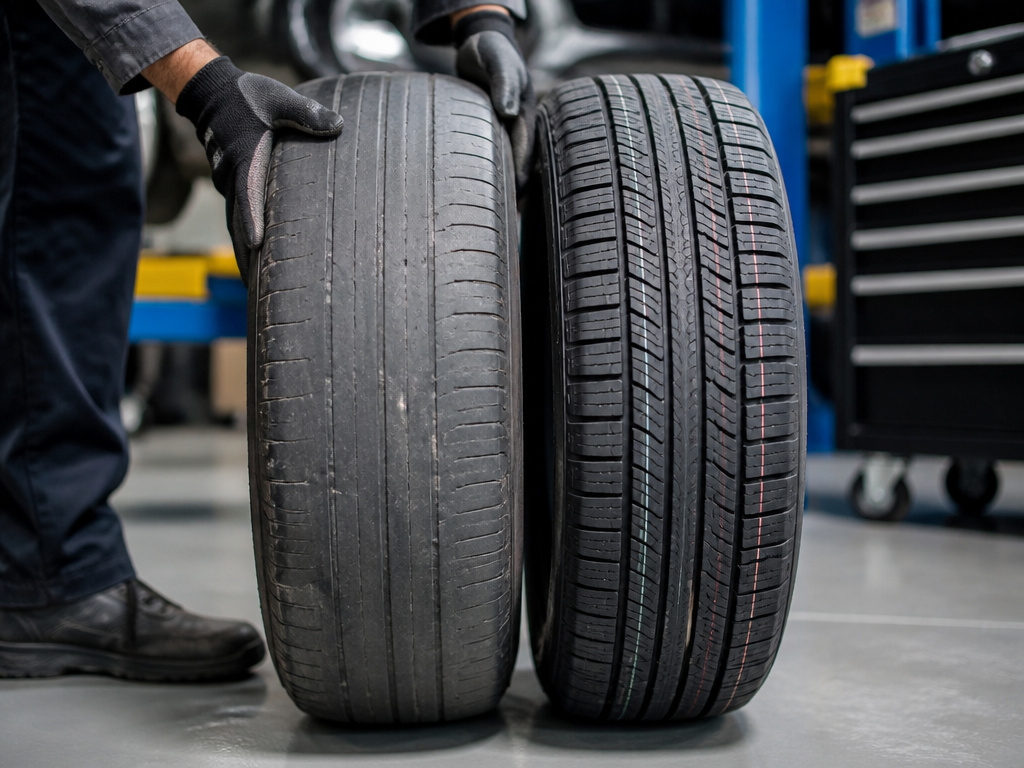
You roll out of the shop on a brand-new set and the range estimate drops. Nothing is broken. This is the ORNL study’s central edge case, and almost no buyer sees it coming.
Replacing worn original tires with identical new ones can cause a sudden 2 to 14 percent range loss at highway speeds. The worn tires had gradually given a 4 to 15 percent range increase as they thinned, so the new set is worse only in comparison to what you drove last.
ORNL adds a twist that upends the usual assumption: the effect of tire friction differences shrinks above about 50 MPH, because aerodynamic drag takes over the energy budget at speed. The replacement tire range loss study is the primary source behind every number in this section.
The sources do not fully agree on the size of the wear effect, so here they are side by side:
| Source | What they measured | Range effect reported |
|---|---|---|
| ORNL 2024 study | Worn OE tires swapped for identical new tires | 2 to 14 percent loss at highway speeds |
| Michelin | Worn versus new tire, same model | Worn about 6 percent better |
| ExxonMobil and Geely | Variable rolling resistance over vehicle life | Up to 4 percent battery-charge difference |
Read that table as a range, not a rule. The direction is settled; the magnitude depends on what you compare and how fast you drive.
Monthly Checks That Protect Your EV Range
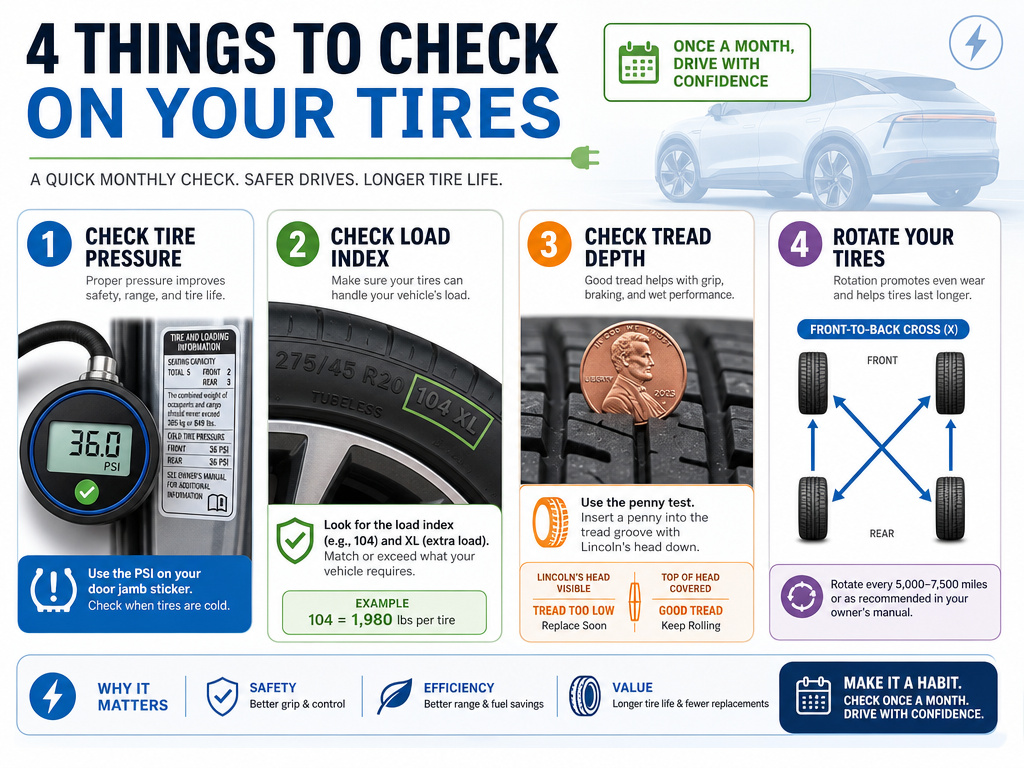
Consistency beats any single upgrade. Four habits guard the numbers: pressure, load index, tread depth, and rotation.
- Check cold pressure monthly against the door-jamb sticker. If you skip this, the 4.8 percent monthly leak accumulates until pressure is 6 to 8 psi low, reducing the range you paid for.
- Verify the load index on the new sidewall before the tire is mounted. A standard-load tire in the same size sits several index points below the XL or HL version, and on a 4,500 lb EV that margin is the whole point.
- Read tread with a penny, not by eye. Once the top of Lincoln’s head shows in the groove, the tire is worn enough to change both grip and rolling behavior.
- Rotate on schedule. Boring, which is exactly why it works.
The full routine lives in how to make EV tires last longer.
EV Tires vs Standard Tires: Where the Premium Pays Off
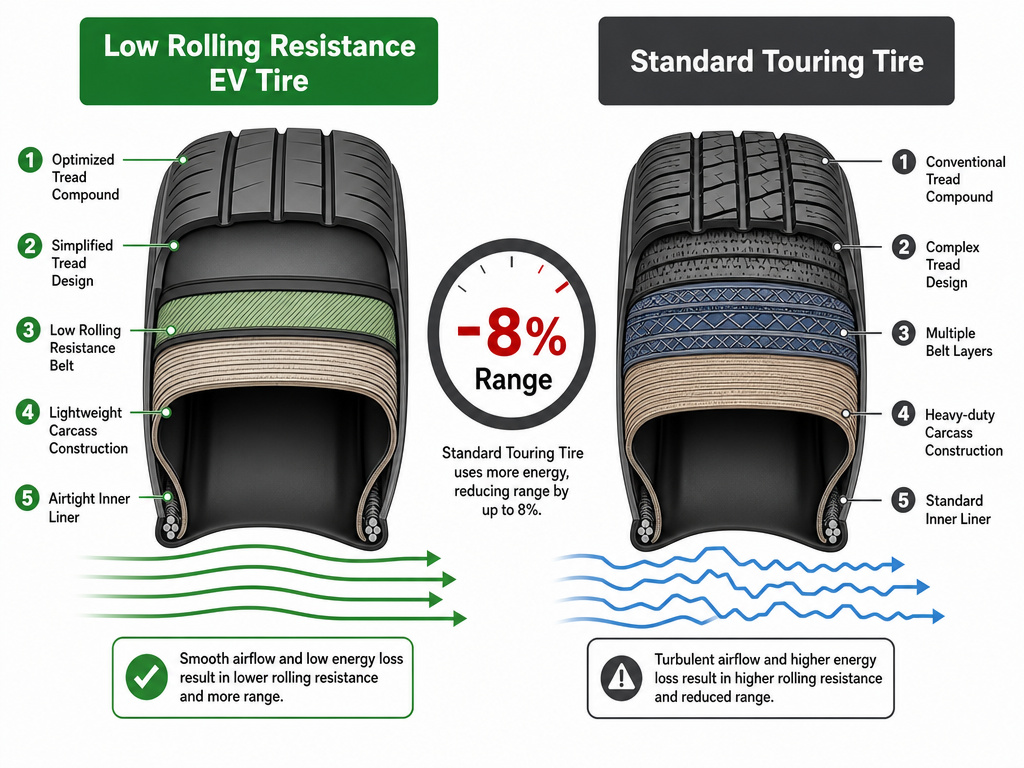
Michelin’s Primacy MXM4 and Defender sit at opposite ends of the same trade-off. The Primacy MXM4 is engineered for low rolling resistance and carries up to 25 percent lower rolling resistance among competitors, per Michelin. Move from the Primacy to the Defender, which favors tread life, and Michelin expects a 6 to 9 percent range decrease.
On a long-range EV, that 6 to 9 percent can represent a significant mileage loss. Stacked against a worn-to-new change, the combined impact on range can be significant.
Here is the short version on compounds.
That habit now reads the pros and cons of low rolling resistance tires before the brand name.
On independent range-impact tests, the gap between a low-rolling-resistance EV tire and a mainstream touring tire can be noticeable.
The OEM co-development behind this is real engineering, not marketing. The Chevy Volt tire development paper documented how General Motors and Goodyear balanced tire properties against range when the Volt launched. Check the load index letters before you check the brochure copy.
The Air-Retention Detail Most Buyers Never Ask About
This one detail separates a tire that holds air from one that quietly bleeds. ExxonMobil and Geely surveyed production tires and found more than 48 percent had poor air retention, defined as an inflation pressure loss rate above 3 percent. Only 6 percent hit the best tier, under 1.7 percent.
IPLR (inflation pressure loss rate) is a standard measurement. The inner liner drives it. Four test tires from the study show the spread clearly:
| Tire | Inner-liner compound | IPLR | Pressure lost in 6 months |
|---|---|---|---|
| A | 70/30 butyl blend | 3.16 percent | 76 KPa |
| B | 70/30 butyl blend | 2.89 percent | 70 KPa |
| C | 100 butyl | 1.92 percent | 50 KPa |
| D | Exxpro 3563 | 1.73 percent | 45 KPa |
Composition matters most. Switching from the 70/30 blend to all-butyl improved IPLR, while increasing inner-liner thickness by 15% delivers an 18% IPLR improvement. Reducing the permeability coefficient by 40 percent delivered a 30 percent improvement. The highest-barrier polymer, BIMSM sold as Exxpro 3563, held the line best.
Geely tightened its TPMS trigger from under 3.5 percent IPLR in 2018 to under 2.5 percent in 2019, and ExxonMobil expects under 1.8 percent to become the class-leading target. Over a vehicle’s life, a drifting rolling-resistance coefficient can account for up to 4 percent battery-charge difference.
If a tire cannot hold air, every other efficiency claim on the label is being measured in a lab that your driveway is not.
Ask one question at the counter: how well does this tire hold air? Halobutyl inner liners are the air-barrier technology that does the work.
Frequently Asked Questions
How much do tires affect EV range?
Pressure alone swings range 3 to 7 percent in ExxonMobil road tests. Wear and replacement add a further 2 to 14 percent swing per ORNL. On the EU tire label, an A-rated versus a D-rated rolling-resistance tire is about a 15 percent difference, per Michelin.
What is the 3 percent rule for tires?
It refers to IPLR, the inflation pressure loss rate. ExxonMobil and Geely flagged more than 48 percent of surveyed production tires as poor retainers once they leaked above 3 percent. Tires under 1.7 percent were the best tier.
Do new tires reduce EV range?
Yes, versus worn ones. ORNL found identical new tires caused a sudden 2 to 14 percent loss at highway speeds because the worn set had gradually improved range by 4 to 15 percent. Michelin puts the worn-versus-new gap at about 6 percent.
Do winter tires hurt EV range?
Cold weather lowers tire pressure, which raises rolling resistance, so a winter fitment usually costs some range. I have not found published EV-range numbers isolating the winter tread itself, so treat any exact figure as a guess. Keep the pressure at spec and the loss stays small.
What drains an EV battery the most?
At highway speeds above 50 MPH, aerodynamic drag dominates per ORNL. Below that, rolling resistance and drivetrain losses lead. Cabin heat and air conditioning also run off the battery, so climate control competes directly with range.
Before You Go
Do one thing this week: read the door-jamb sticker and set all four tires to that number when cold. Write it down. A set running significantly underinflated costs more range than the premium tire you are debating buys back.
The concession I owe you: I cannot give a single clean percentage for a wider tire or a winter tread, because the published EV data does not isolate them. The pressure, load index, and air-retention numbers above are solid; the rest is direction, not a figure.
Fair warning on the badge. An “EV-ready” sticker is marketing, not a measurement. The load index letters and the inner-liner compound are the specs that actually carry a 300 kg heavier car and hold its air. Check the date code and the load index before you check the brand.
If you want my default pick for a daily-driver EV, start with a Michelin Primacy MXM4 in the factory size and the factory load index, then verify the pressure against the door jamb. It is the balanced choice for most owners.
