
How to Convert Metric Tire Sizes to Inches: Step-by-Step
This post contains affiliate links. As an Amazon Associate, we earn from qualifying purchases.
To convert a metric tire size to inches, you need three numbers from the sidewall: the width in millimeters, the aspect ratio, and the rim diameter. The formula is straightforward: calculate the sidewall height in millimeters (width × (aspect ratio ÷ 100)), convert that and the width to inches by dividing by 25.4, then add twice the sidewall height to the rim diameter for the overall diameter. A 285/70R17, for example, calculates to 32.71 inches tall and 11.22 inches wide. This is the basic method for how to convert metric tire sizes to inches.
The catch, when you compare a how to convert metric tire sizes to inches result, is that a calculated 32.71-inch tire is routinely called a “33-inch” tire in shops and forums. The two sizing systems, metric and traditional American inch, are built on different grids, so a perfect, one-to-one match is rare.
What follows is the math, why the numbers never line up perfectly, and how to use a tire size calculator to check your work against real-world fitment.
Key Takeaways
- The core conversion uses the U.S. Federal Highway Administration’s constant: 1 inch = 25.4 mm.
- A metric tire like 285/70R17 calculates to 32.71×11.22R17, not a round “33-inch” size.
- The nearest flotation size is often significantly wider, which is the real fitment challenge.
- Always verify calculations with an online tire size calculator before buying.
- Treat conversion results as close approximations, not exact equivalents, due to different manufacturing ladders.
Why Two Systems Exist (And Why They Don’t Match)
You don’t have two systems because one is better. You have them because they solved different problems for different markets and never merged.
Metric sizing (like 225/55R17) is the international standard. It tells you the tire’s section width and the sidewall height as a percentage of that width. This gives engineers a precise way to specify profiles. Inch sizing, often called flotation sizing (like 33×12.50R17), is a traditional North American format for light trucks and off-road tires. It states the overall diameter and section width directly in inches, simple for a buyer visualizing a bigger tire.
The problem is in the graduation. Flotation sizes move in whole inches for height and half-inch steps for width (9.50, 10.50, 11.50). Metric sizes use a production ladder of standardized widths (225, 235, 245 mm) and aspect ratios in steps of five (65, 70, 75). These two grids almost never intersect. When someone says a 285/70R17 “is a 33,” they mean it’s closer to 33 inches than 32. The real number is 32.71.
Common mistake: Assuming a “33-inch” tire listing matches your calculated 32.71-inch conversion. The label is a marketing approximation; the math is the spec.
How to Convert Metric to Inches: The Step-by-Step Formula
We will use a 265/70R17, a common size for mid-size trucks and SUVs, as our example. You’ll need the three numbers from the sidewall: 265 (width in mm), 70 (aspect ratio), and 17 (rim diameter in inches).
The process is mechanical. Follow it once and you’ll see the pattern.
Step 1: Find the sidewall height in millimeters.
Multiply the width by the aspect ratio (as a decimal).
265 mm × 0.70 = 185.5 mm
This is the height of the rubber from the rim to the tread on one side.
Step 2: Convert the sidewall to inches.
Divide the sidewall height by 25.4, the official conversion factor from the U.S. Federal Highway Administration.
185.5 mm ÷ 25.4 = 7.30 inches
Step 3: Calculate the overall diameter.
Add the rim diameter to twice the sidewall height.
(7.30 inches × 2) + 17 inches = 31.6 inches
This is the tire’s total height.
Step 4: Convert the width to inches.
Divide the original width in millimeters by 25.4.
265 mm ÷ 25.4 = 10.43 inches
Your inch-equivalent size is approximately 31.6×10.4R17.
The formula for converting a metric tire size to inches is a direct application of the 25.4 mm per inch constant. Calculate sidewall height (width × aspect ratio/100), convert sidewall and width to inches (÷ 25.4), then determine overall diameter (sidewall inches × 2 + rim diameter).
I keep a calculator on my desk for this. The first few times I did it in my head, I’d transpose numbers or forget to double the sidewall. A 31.6-inch tire isn’t a 32-inch tire, and the difference can throw off a speedometer calibration if you’re not careful.
The Calculator vs. Reality Gap
You can run the math perfectly and still be wrong. Not because your arithmetic failed, but because a tire’s physical dimensions live in the real world of manufacturing tolerances and marketing shorthand.
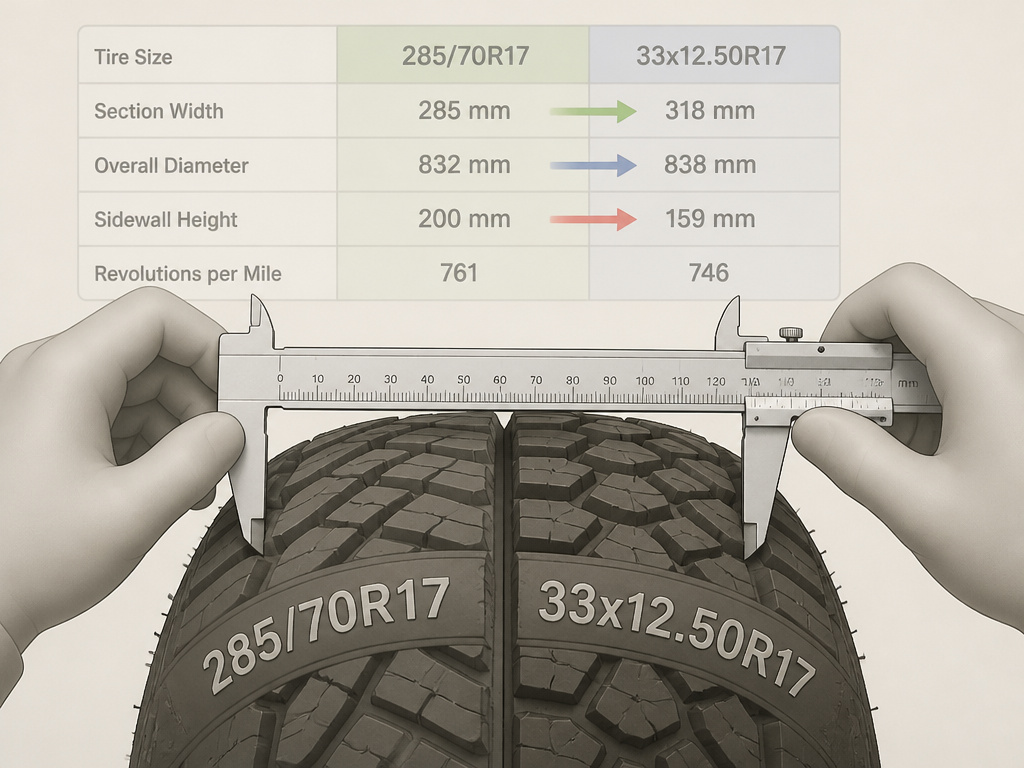
Take the classic off-road comparison: 285/70R17 versus 33×12.50R17.
- 285/70R17 calculates to: 32.71 inches tall, 11.22 inches wide.
- 33×12.50R17 is defined as: 33.00 inches tall, 12.50 inches wide.
The flotation tire is 0.29 inches taller and a full 1.28 inches wider. Everyone obsesses over the height; the width is what stops the install.
| Dimension | 285/70R17 (Metric) | 33×12.50R17 (Flotation) | Practical Difference |
|---|---|---|---|
| Overall Diameter | 32.71 inches | 33.00 inches | 0.29″ – minor speedo error |
| Section Width | 11.22 inches | 12.50 inches | 1.28″ – major fitment risk |
| Common Label | “33-inch” tire | True 33-inch tire | Marketing vs. Specification |
This gap exists because the flotation tire sizes grid and the metric grid are different. Converting from one to the other finds the nearest point on the other ladder, not an identical twin.
Common Metric to Inch Conversions (And Their Caveats)
Most drivers are looking for a ballpark. This table shows where common metric sizes land on the inch grid and, more importantly, how far off they are.
The “Difference” column is the key. A 0.3-inch height variance is usually workable. A width gap over an inch might not be.
| Metric Size | Calculated Inches | Nearest Flotation Size | Height Difference | Width Difference |
|---|---|---|---|---|
| 215/75R15 | 27.7×8.5R15 | 28×8.50R15 | +0.30 inches | +0.04 inches |
| 265/70R17 | 31.6×10.4R17 | 32×10.50R17 | +0.40 inches | +0.10 inches |
| 285/70R17 | 32.7×11.2R17 | 33×12.50R17 | +0.29 inches | +1.28 inches |
| 315/70R17 | 34.4×12.4R17 | 35×12.50R17 | +0.60 inches | +0.10 inches |
Notice the 285/70R17 again. Its nearest flotation match is significantly wider. This is why you can’t just swap a “33-inch” metric tire for a “33-inch” flotation tire without checking clearance. The equivalent tire sizes are only equivalent in theory.
For a deep dive on a specific popular size, our guide on what a 33-inch tire is in metric breaks down the math and the myths.
Converting Back: Inches to Metric
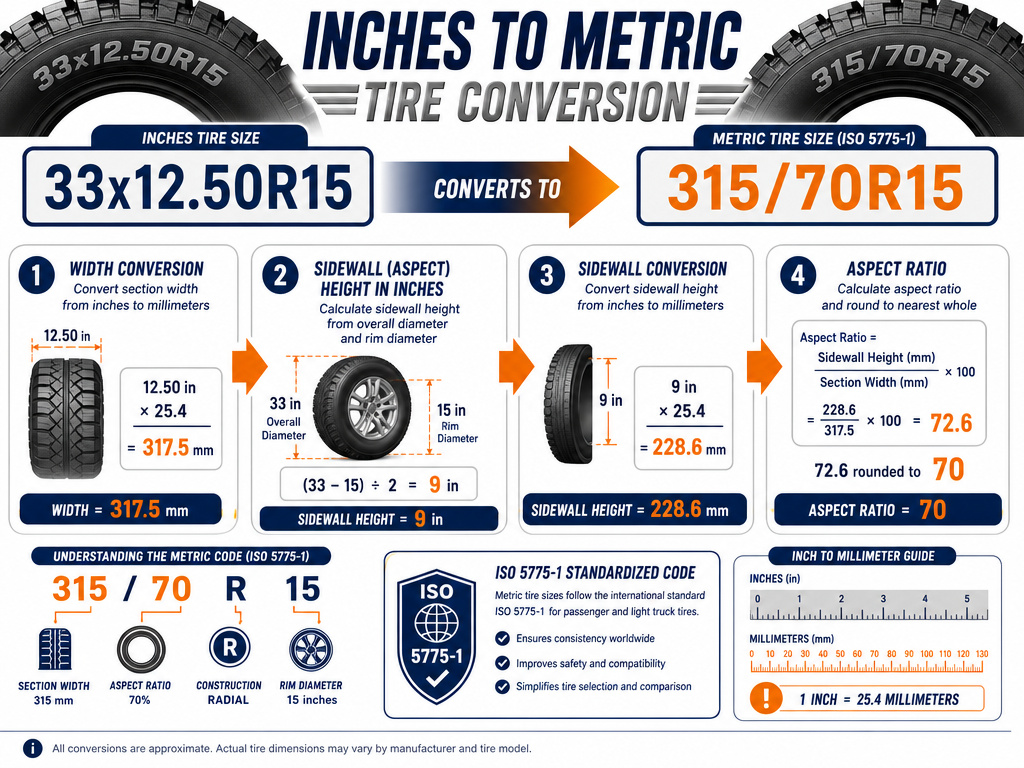
Sometimes you have an inch size and need to find a metric equivalent. This process is even more approximate because you have to round your results to the nearest standardized metric codes.
We will convert a 33×12.50R15.
- Convert width to mm:
12.50 inches × 25.4 = 317.5 mm. The nearest standard metric width is 315 mm. - Calculate sidewall height in inches:
(33 - 15) ÷ 2 = 9 inches. - Convert sidewall to mm:
9 inches × 25.4 = 228.6 mm. - Calculate aspect ratio:
(228.6 mm ÷ 315 mm) × 100 = 72.6. The nearest standard aspect ratio is 70.
The closest standard metric size is 315/70R15. It won’t be exactly 33 inches tall, which shows the “lossy” nature of crossing between systems. The international ISO 5775-1 tire and rim standard governs these standardized codes, which is why you can’t have a 318/72R15 even if the math points to it.
Tools and Double-Checks
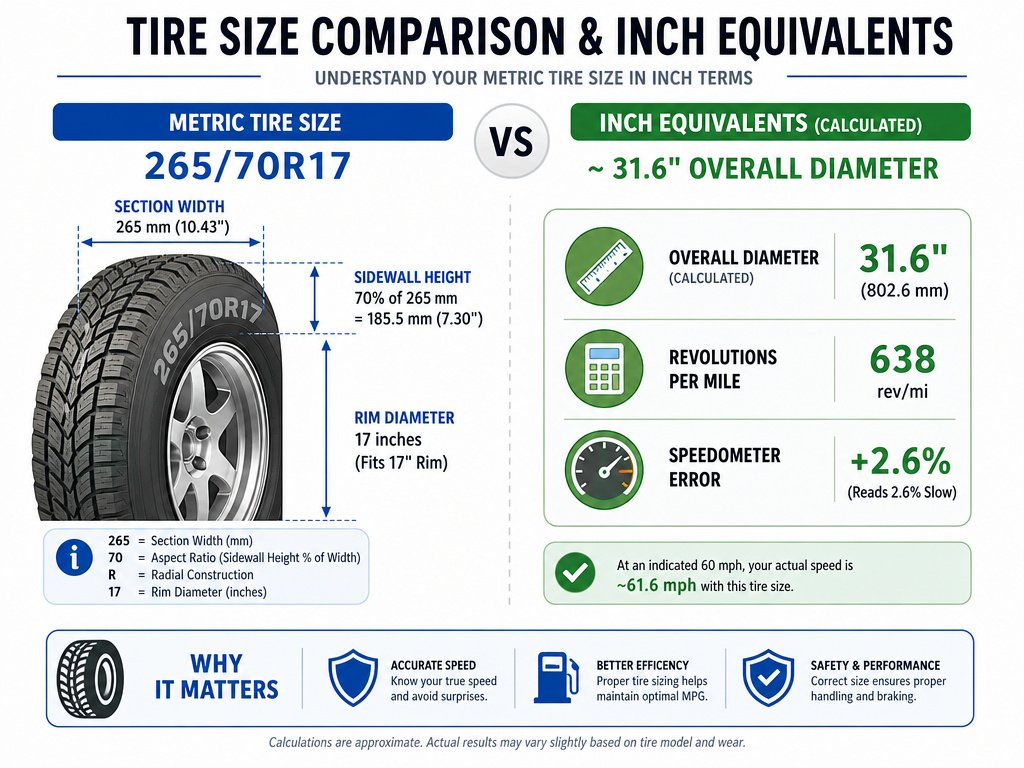
Never trust a single source. After you do the manual math, run the size through an online calculator like tyrecalculator.com. Good calculators will show you the exact same breakdown we just did: diameter, width, circumference, and revolutions per mile.
I use a dedicated tire dimension calculator for this. It catches my rounding errors and instantly shows the speedometer error percentage, which is the real-world consequence of getting the diameter calculation wrong.
Here’s what to look for in your results:
- Revolutions per mile: This is critical for your speedometer.
- Section width vs. Tread width: Calculators usually show section width (the bulging width).
- Rim width range: Your calculated tire width assumes a specific rim width. Mount it on a rim that’s too narrow or too wide, and the actual width and profile change.
Where This Goes Sideways: Real-World Pitfalls
The formulas are clean. Real garages are messy. Two tires with the same size molded into the sidewall can measure differently once mounted and inflated.
Two tires with the same size molded into the sidewall can measure differently once mounted and inflated. Mold designs and rubber compounds cause this. It’s why the final check is always physical. If you’re replacing a worn tire with a new one marketed at a similar size, you may gain more height than you planned.
The other pitfall is older, alphanumeric sizes (like F78-15). If you’re working on a classic car, you need a different conversion approach. Our resource on vintage tire sizes covers that niche.
Easy to miss: The load index and speed rating. Converting the size doesn’t automatically preserve these critical specs. Always read the tire size code fully, including the small letters and numbers at the end.
Using a Tire Size Calculator
Manual calculations can be tedious. An interactive tire size calculator automates the conversion process for you. You simply enter your metric tire code, and it instantly provides the equivalent overall diameter and width in inches. These tools apply the standard conversion of 25.4 millimeters per inch to the section width and perform the full diameter calculation, which involves the wheel size and two sidewalls. The result gives you a precise inch measurement, which you can then compare to common flotation sizes that are marketed in whole inches. Since the two systems are built on different standardized grids, the calculator’s output helps you see the often small but real differences between a calculated metric equivalent and a traditional inch tire.
Frequently Asked Questions
How do you convert a metric tire size to inches?
Take the metric size (e.g., 265/70R17). Divide the width (265) by 25.4 to get width in inches (10.43). Calculate sidewall height: 265 × 0.70 = 185.5 mm, then divide by 25.4 for inches (7.30). Overall diameter = (7.30 × 2) + 17 = 31.6 inches. The inch equivalent is ~31.6×10.4R17.
What is a 33-inch tire in metric?
A true 33-inch tire (33×12.50R17) converts roughly to a 315/70R15, but it is not an exact match. The term “33-inch” is often used loosely for metric tires near 33 inches, like a 285/70R17 (32.71 inches).
What is a 32-inch tire in metric? Exact matches are rare, but metric tires are marketed near whole-inch sizes.
What is a 31-inch tire in metric?
Common equivalents are 265/70R17 (~31.6 inches) and 235/85R16 (~31.7 inches). The nearest flotation size is typically 31×10.50R15. The tire aspect ratio explained shows how a lower aspect ratio on a wider tire can yield a similar diameter.
Can you just replace a metric tire with an inch tire of similar diameter?
You can, but you must verify three things: the exact calculated diameter, the section width (for clearance), and the rim diameter. A “similar” 33-inch flotation tire is often over an inch wider than a “33-inch” metric tire. Always test-fit if possible.
Before You Go
Run the numbers, then check them with a calculator. The difference between a 32.7-inch tire and a 33.0-inch tire isn’t the problem. The extra inch of width on the flotation tire is what finds your fender.
If your calculated metric size doesn’t land on a clean inch equivalent, that’s normal. The two systems aren’t designed to align. Your goal is to find a tire that fits your wheel, clears your vehicle, and keeps your speedometer honest, not to achieve a mathematically perfect conversion.
When in doubt, pick the smaller width. A tire that’s slightly narrower than the nearest flotation equivalent almost always fits where a wider one won’t. The sidewall has the final say, so always read tire size markings carefully before you buy.
