
How to Read Semi Truck Tire Sizes: Decoding the Numbers
This post contains affiliate links. As an Amazon Associate, we earn from qualifying purchases.
To read a semi truck tire size, you need to decode a string like 295/75R22.5. The first number (295) is the width in millimeters. The second number (75) is the aspect ratio, the sidewall height as a percentage of the width. The letter (R) indicates radial construction. The final number (22.5) is the rim diameter in inches. Two extra numbers, like 144/141L, are the load index (weight capacity) and speed rating.
That code is your starting point, not the whole answer. A tire that physically fits the rim can still be wrong for the load, the axle position, or the truck’s job. The sidewall tells you what the tire can do; your job is to match that to what your truck actually does. This is why understanding how to read semi truck tire sizes is so critical.
What follows is a breakdown of every number and letter when you compare a how to read semi truck tire sizes guide, why the load index matters more than brand, and the three rules for pairing dual tires that prevent early wear and blowouts.
Key Takeaways
- The load index (e.g., 144/141) is the most critical spec, mismatched load capacity on duals forces one tire to carry more weight and overheat.
- Always check the DOT Tire Identification Number for the manufacture date; the last four digits are the week and year (2710 = 27th week of 2010).
- For dual assemblies, the maximum allowable diameter difference is 1/4 inch; a larger mismatch causes irregular wear and can damage the differential.
- Radial and bias-ply tires must never be paired as duals; their flex patterns are incompatible and lead to rapid failure.
- Tire width changes with rim width, a 1/4-inch wider rim adds 0.1 inch to tire width, which can affect minimum dual spacing.
How to Read the Tire Size Code (295/75R22.5)
Look at the sidewall. The largest string of numbers and letters is the size designation. For a common tire like a 295/75R22.5, here’s what each part means.
295 is the nominal section width. It’s the tire’s width from sidewall to sidewall, measured in millimeters. Some older sizes use inches, like 11R22.5. You can physically verify this by measuring the tire’s widest point with a tape measure or calipers, but do it across the sidewalls, not just the tread. The published width assumes a specific “preferred wheel” width. Go off-spec, and the tire’s actual width changes.
75 is the aspect ratio. This is the sidewall height expressed as a percentage of the section width. A 75-series tire has a sidewall height that is 75% of its 295mm width. A lower number, like 70, means a shorter, stiffer sidewall. This affects ride comfort and fuel economy. According to Bridgestone, fleets using 70-series instead of 75-series tires can see up to a 5% boost in MPG from lower rolling resistance, but lower profile tires may cost 3–8% more upfront.
R denotes the tire’s construction. “R” stands for radial, meaning the internal steel belts run perpendicular to the direction of travel. You might also see a dash (“-”), which indicates a bias-ply construction. Never pair a radial and a non-radial tire as duals. Much less common are “B” for bias-belted and “D” for diagonal.
22.5 is the wheel diameter in inches. This must match your truck’s rim size. It’s not the overall tire height. Choosing between a 22.5-inch and a 24.5-inch rim is a major spec decision that affects tire availability and vehicle height.
The published “Overall Width” of a tire is measured on a specific recommended wheel width. According to Michelin’s technical data, the overall width changes by approximately 0.1 inch (2.5 mm) for every 1/4-inch change in wheel width. This is critical for calculating minimum dual spacing.
Following the size code, you’ll see a service description like 144/141L. This is where the real work starts.
Decoding Load Index and Speed Rating (144/141L)
The size gets the tire on the rim. The load index and speed rating determine if it can handle the job. Ignoring these two numbers is how fleets end up with premature failures and violations.
The load index is a numerical code for the tire’s load capacity. In 144/141L:
- 144 is the load index for a single tire application.
- 141 is the load index when the tire is used in a dual assembly.
- L is the speed symbol, indicating a maximum rated speed of 120 km/h (75 mph) under full load.
You must cross-reference these numbers with a load-inflation table. For a 295/75R22.5 Load Range G with a 144/141L service description, the USTMA manual states the maximum load for a single application is reached at 760 kPa (110 psi) cold inflation pressure. The load index isn’t a suggestion, it’s a certification based on that pressure.
Where this goes sideways: Assuming the load index is just a recommendation. For a tire with a 144/141L rating, the dual load capacity (index 141) is lower than the single capacity (index 144). Mounting it as a dual and loading it to the single rating is an overload from day one.
Calculate your needs. If each tire on a dual-axle has a load index of 141, and there are four tires per axle, you multiply the weight capacity per tire by four to get the total axle capacity. Exceed that, and you risk tire failure.
The speed rating matters for fuel efficiency and legality. An L-rating (75 mph) is standard for highway trucks governed at similar speeds. Using a higher-rated tire doesn’t hurt, but it doesn’t help either. The rating assumes proper inflation and load. An underinflated or overloaded tire can fail well below its speed rating.
The Critical Step Everyone Skips: Measuring Your Tires
Sidewalls fade. Replacement wheels might be a different width. The only way to know what you actually have is to measure.
You need a steel tape measure. For width, measure the distance from the outer sidewall to the inner sidewall at the widest point. For overall diameter, wrap the tape around the tire’s circumference and divide by 3.1416. Do this at least 24 hours after the tires are inflated to allow the casing to settle into its final shape.
Why measure? If you’re matching duals, the industry standard from the USTMA is clear. The maximum allowable differences between a tire and its dual mate are:
- Radius: 0 to 1/8 inch
- Diameter: 0 to 1/4 inch
- Circumference: 0 to 3/4 inch
A difference larger than 1/4 inch in diameter means the larger tire carries more of the load. It over-deflects and overheats. The smaller tire scuffs and wears irregularly. On tandem drive axles, the average diameter difference between the two axles should be no more than 1/4 inch to avoid damaging the differential.
Matching Dual Tires: The Three Non-Negotiable Rules
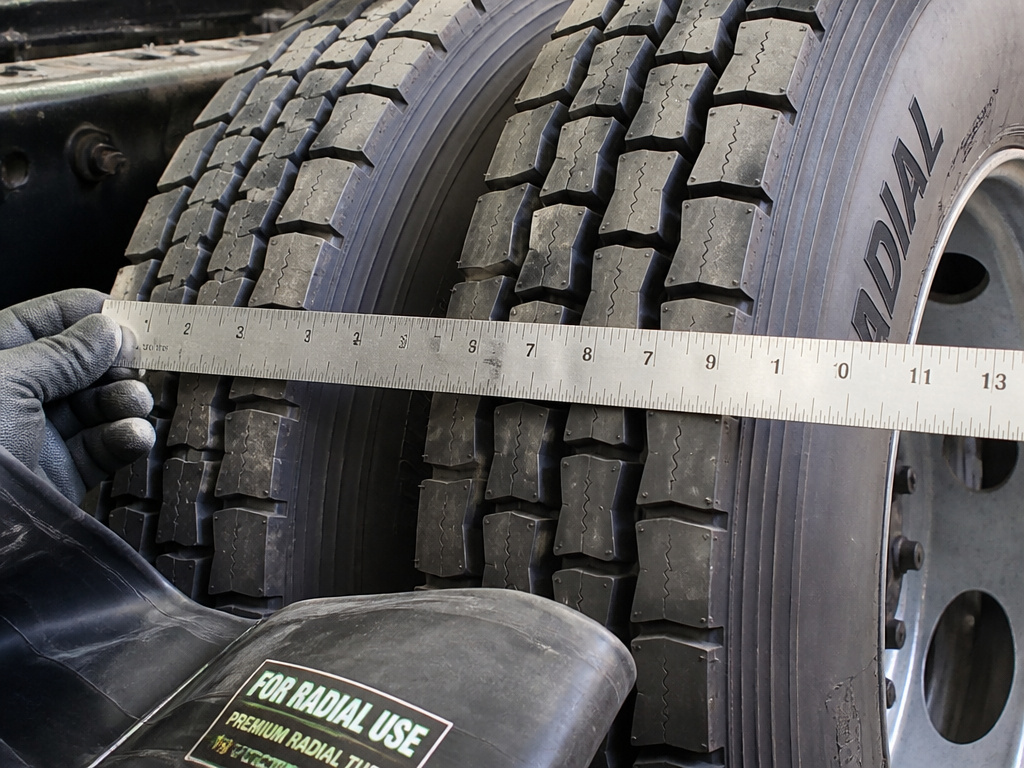
Mixing tires on a dual assembly is a fast track to a blowout. The rules aren’t complicated, but they are absolute.
First, paired tires must be the same size designation, same construction (radial or bias-ply), and have the same tread design. This isn’t about brand loyalty; it’s about matching flex patterns and rolling circumference. A radial tire and a bias-ply tire flex in fundamentally different ways. Pairing them is not allowed as their flex patterns are incompatible.
Second, the outside diameters must be as close as possible. Use the measurements you took. The 1/4-inch diameter tolerance isn’t a goal, it’s a maximum. Closer is always better.
Third, you must use the correct tubes and flaps for radial tires. A radial truck tire requires a tube specifically marked for radial ply use. The tube size must match the tire size exactly. The flap must also be a radial flap, sized per the tire manufacturer’s specifications. Using a bias-ply tube in a radial tire restricts the casing’s movement and creates a hot spot that can fail.
| Rule | Requirement | Consequence If Broken |
|---|---|---|
| Construction | Both tires must be radial (or both bias-ply) | Differential flex causes overheating and can lead to ply separation. |
| Diameter Match | Diameter difference ≤ 1/4 inch | Larger tire becomes overloaded, leading to potential blowout; smaller tire experiences irregular wear. |
| Components | Radial tubes & flaps matching tire size | Tube chafing, localized heat, sudden air loss at highway speed |
How Tire Size Affects Your Truck’s Performance
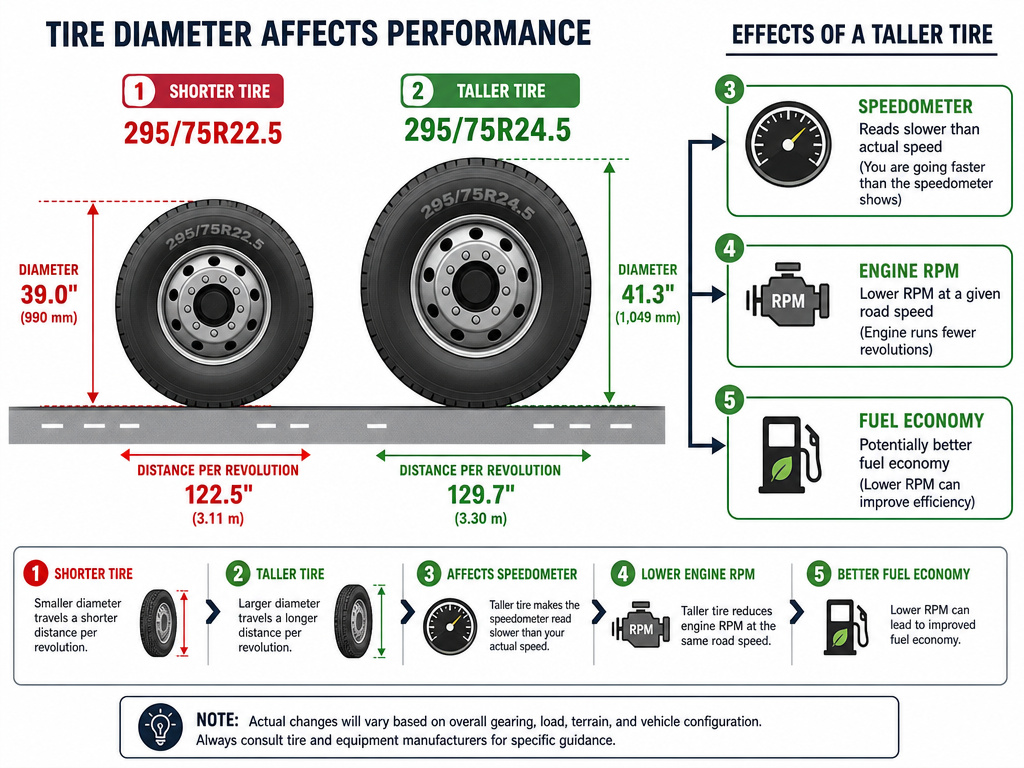
The right size is a balancing act. You’re trading between traction, fuel economy, cost, and wear.
A wider tire generally offers a larger contact patch and better traction. The trade-off is increased rolling resistance and a slight dip in fuel economy. A taller tire can lower engine RPMs at cruising speed, which saves fuel. This is why some fleets spec a 70-series tire instead of a 75-series, the shorter sidewall reduces flex and can improve MPG.
But changing the overall tire diameter changes your effective gear ratio and speedometer reading. If you switch from a 295/75R22.5 to a tire with a larger overall diameter, your truck will travel farther per driveshaft revolution. Your speedometer will read slower than your actual speed. Your engine will run at a lower RPM for a given road speed, which can help fuel economy but may hurt grade-climbing power.
Before switching sizes, check clearance. A taller or wider tire might rub against suspension components or the frame at full turn or under load. Also, verify that the new size’s load index meets or exceeds the original specification for your axle weights.
Finding and Checking the DOT Date Code
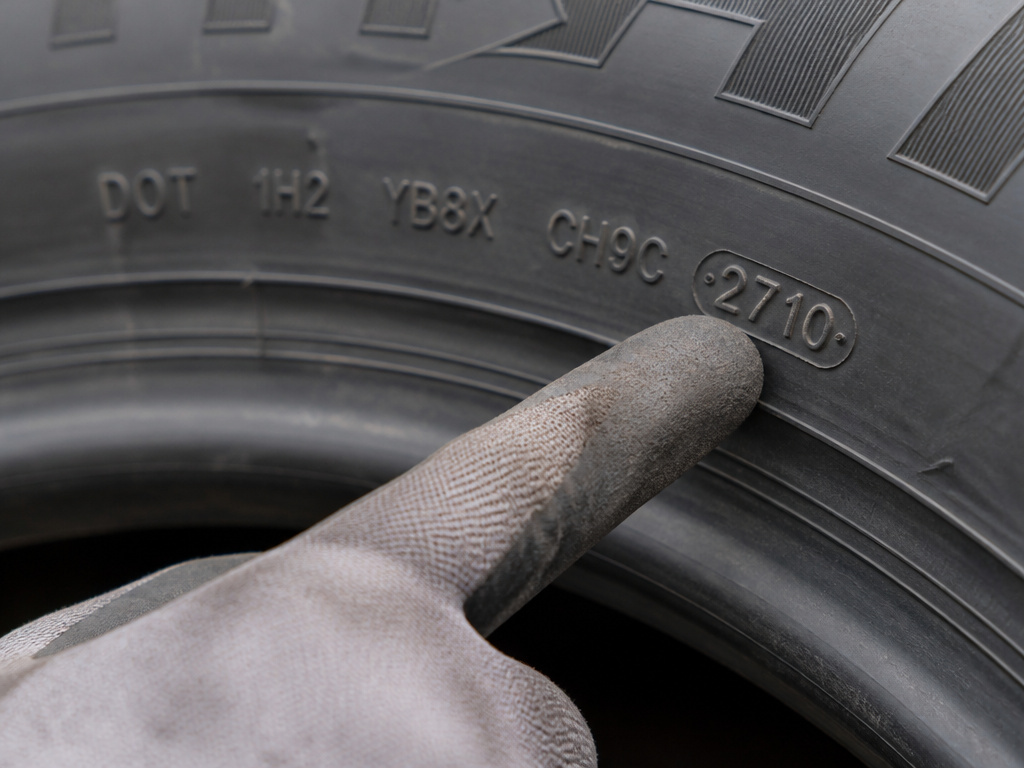
The Tire Identification Number (TIN) is stamped on the sidewall, usually following “DOT.” The last four digits are the date code. The first two of those four are the week of manufacture (01 to 52). The last two are the year.
For example, 2710 means the tire was built in the 27th week of 2010. This matters because rubber compounds age and degrade regardless of tread depth. Rubber compounds age and degrade regardless of tread depth. The casing might be fine for retreading, but the rubber degrades over time. The casing might be fine for retreading, but the rubber has lost some of its resilience.
Check this on every tire you buy, new or used. A “new” tire that’s been sitting in a warehouse for years has aged before use.
What does the prefix on a tire size mean?
You might see prefixes like LT, P, or ST before the numbers on a passenger or light truck tire, but these are not typically used for commercial semi-truck tires. For heavy-duty truck tires, the size usually starts directly with the section width, such as 295. The letter in the size, like ‘R’ for radial, indicates the construction. A dash instead of an ‘R’ signifies a bias-ply tire. Other letters like ‘B’ for bias belt or ‘D’ for diagonal are much less common. Always check the sidewall for the correct size and construction type when selecting a replacement.
Why is correct tire pressure so important?
The load capacity marked on your tire is directly tied to a specific cold inflation pressure. For example, a 295/75R22.5 Load Range G tire with a 144/141L service description reaches its maximum single load capacity at 110 psi. Running tires underinflated relative to the load they carry is a primary cause of failure, as the sidewalls flex excessively and overheat. Conversely, overinflation can lead to a harsh ride and uneven tread wear. You must use a load-inflation table to match your vehicle’s actual axle weights to the correct pressure, checking it when the tires are cold.
How does the aspect ratio change my ride?
The aspect ratio is the percentage of the tire’s sidewall height relative to its section width. A lower number, like 70, means a shorter, stiffer sidewall compared to a 75-series tire. This lower profile can improve handling stability and, in some cases, offer up to a 5% boost in fuel efficiency due to lower rolling resistance. However, a taller sidewall from a higher aspect ratio generally provides a softer ride and can help absorb road impacts better. Your choice affects traction, fuel economy, and ride comfort, so consider your application when comparing sizes.
Frequently Asked Questions
How do you tell tire size on a semi truck?
Look at the sidewall for the largest string of numbers and letters, like 295/75R22.5. If the sidewall is worn or painted over, you must physically measure the tire. Measure the width from sidewall to sidewall in millimeters. Measure the overall diameter by wrapping a tape around the circumference. The rim diameter is stamped on the wheel itself.
What does 315/80R22.5 mean?
It’s a metric tire size. 315mm width, 80% aspect ratio (so the sidewall is 80% of 315mm tall), Radial construction, for a 22.5-inch rim. The higher aspect ratio (80 vs. 75) means a taller sidewall and a larger overall tire diameter, which can affect gearing and speedometer accuracy.
What is the most common 22.5 tire size for semi-trucks?
According to Bridgestone’s fleet data, the most common sizes in recent years are 295/75R22.5, 275/70R22.5, and 225/70R19.5. The 295/75R22.5 offers a balance of width, load capacity, and availability that fits a wide range of tractors and trailers.
Can you mix tire sizes on the same axle?
You can, but you shouldn’t. For single tires on an axle (like steer axles), they must be the same size to ensure even handling and wear. For dual tires, the rules are stricter: they must be the same size, construction, and have closely matched diameters. Mixing sizes on duals is a direct violation of the USTMA tire care manual and leads to overload and failure.
Do I need different tires for steer, drive, and trailer positions?
Yes. Tires are engineered for specific axle positions. Steer tires have ribbed patterns for stability and wet-weather braking. Drive tires have aggressive lug patterns for traction. Trailer tires are designed for even wear and rolling efficiency. Using a drive tire on a steer axle is dangerous. Our guide to steer, drive, and trailer tires explains the differences in detail.
Before You Go
Reading the size code is literacy. Applying it is wisdom. The number one mistake isn’t misreading the aspect ratio, it’s ignoring the load index and assuming all tires of the same physical size are equal.
Before you order a set, do three things. First, check the date code on your prospective tires. Second, calculate the actual load each axle carries and verify the load index covers it. Third, if you’re replacing one tire in a dual set, measure the diameter of the old tire still on the truck. The new one must match within a quarter-inch.
Specs first, opinions second. The sidewall gives you the facts. Your job is to listen to them.
