
Mud Terrain Tires Pros and Cons: Should You Buy?
This post contains affiliate links. As an Amazon Associate, we earn from qualifying purchases.
Mud terrain tires pros and cons track to traction and trade-offs. Mud-terrain (M/T) tires dig well in mud and rock with deep lugs and tough sidewalls, while road noise, wear, wet grip, and fuel economy take a hit. For most drivers, an all-terrain or rugged-terrain tire fits better.
That traction comes from wide voids and blocky lugs, so the same pattern that clears mud also pumps air and flexes on pavement. The trade-off shows up in highway drone, tread wear, and rolling resistance.
What follows: a spec-first pros and cons list, an AT vs MT decision table, and the mileage thresholds that separate a need from a mood.
Key Takeaways
- BFGoodrich KM3 ATV/UTV sizes lack U.S. DOT highway approval.
- Rotation interval differs by source; use the shorter one.
- M/T fuel-economy penalties range from 1-2 to 2-4+ in reports.
- Real-world tread life often lands near 40,000-45,000 miles.
- A 3PMSF all-terrain beats most M/Ts in daily snow.
Mud Terrain Tires Pros and Cons: What You Trade
Mud-terrain (M/T) tires use big lugs and wide voids to clear mud and grip rock. That same geometry hurts pavement manners.
Mud-terrain tread uses large, widely spaced lugs and deep voids to clear sticky material and maintain bite in mud. The open pattern increases air-pumping noise and reduces continuous rubber contact on pavement. Sidewall stiffness helps rock and transmits more impact into the cabin. Tread depth and block shape define the off-road edge.
| Advantage | Trade-off |
|---|---|
| Deep lugs clear mud | Wide voids pump noise |
| Tough sidewalls resist rock | Stiff carcass transmits impacts |
| Bite in loose ruts | Pavement contact patch shrinks |
| Aggressive stance | Faster highway wear |
The deep voids are the feature and the flaw. Wide voids clear mud. They also pump air and shrink continuous rubber contact.
Are Mud Terrain Tires Good for Daily Driving?
Do you actually need the bite on Tuesday traffic? For a paved daily driver, I’d skip M/Ts.
Noise and comfort
New mud-terrain tires run louder for the first 500-1,000 miles, per Level 4×4. The dominant drone sits near 1,000 Hz at highway speed, per Sandberg’s 2003 paper cited by Level 4×4. Low energy below 50 Hz arrives as seat and floor vibration, per Ishihama’s 2016 study cited by Level 4×4. You hear a hum. You feel it in the steering wheel.
Air-pumping, cavity resonance, and tread pitch explain why mud tires are loud.
Wet and winter grip
Wide voids help on wet trails but reduce continuous contact on flooded pavement. Most M/Ts lack the Three-Peak Mountain Snowflake stamp, per Taco Tires. That stamp means a tire passed a standardized deep-snow test. A 3PMSF all-terrain like Falken Wildpeak A/T4W or BFGoodrich KO2/KO3 is the better winter daily, per Taco Tires.
Skip M/Ts if:
- Your commute is paved.
- You tow loads and need stable braking, because heavier LT tires blunt response.
- Winter roads are a real risk, not a photo op.
Tread Life, MPG, and the Warranty Fine Print
Warranty numbers sell tires; wear strips decide them.
I once compared two tires using only the treadwear number and declared one the clear winner. Later I learned each maker runs its own test, so the number is a rough guide between brands. That lesson changed how I read a warranty.
| Issue | One source | Another source |
|---|---|---|
| Rotation interval | BFGoodrich: 6,000-8,000 miles | Tire Advise: 5,000 miles |
| Premium MT life | Tire Advise: 40,000-45,000 miles | Kumho MT71: 50,000-mile warranty |
| MPG hit | Tire Advise: 1-2 MPG for Nitto vs AT | Taco Tires: 2-4+ MPG vs stock |
| Rock pressure | Tire Advise: 12-18 PSI | The Tire Reviews: 15-18 PSI |
Tread life reality
BFGoodrich places treadwear indicators at 2/32 inch remaining tread depth. The Tire Reviews projected 40,000-45,000 miles for a Nitto Trail Grappler. Taco Tires says M/Ts commonly land near 40,000 miles or no warranty. Tire Advise lists a 50,000-mile warranty for Kumho Road Venture MT71, and reports owners reaching 50,000-plus miles with Goodyear Wrangler MT/R with Kevlar.
BFGoodrich’s standard limited warranty covers defects for the life of usable tread or 6 years from purchase, whichever occurs first. BFGoodrich also says different front and rear sizes cut the rear tire warranty in half.
Owner reports can be worse. The BFGoodrich Mud-Terrain T/A KM2 owner reports include tires worn unevenly at 20,000 to 25,000 miles. A depth gauge showed 11.5/32 inch on a Nitto Trail Grappler at 15,000 miles, down from 18/32 inch new. That is a short-life tire.
I treat a 50,000-mile M/T warranty as a ceiling, not a promise. Highway miles, alignment, and rotation habits chew through the margin.
What most people get wrong: Treating the warranty mileage as a real-world promise. Owners hit 20,000 to 25,000 miles with uneven KM2 wear, per BFGoodrich Canada reports.
Fuel economy split
The MPG (miles per gallon) penalty depends on the source and the tire. Taco Tires puts M/Ts at 2-4+ MPG versus stock highway tires. The Tire Reviews expects 2-4 MPG with M/Ts versus OEM. Tire Advise reports owners seeing a 1-2 MPG reduction with Nitto Trail Grappler M/T versus all-terrain alternatives. The spread is real, so don’t promise a single number.
When Do Mud Terrain Tires Make Sense?
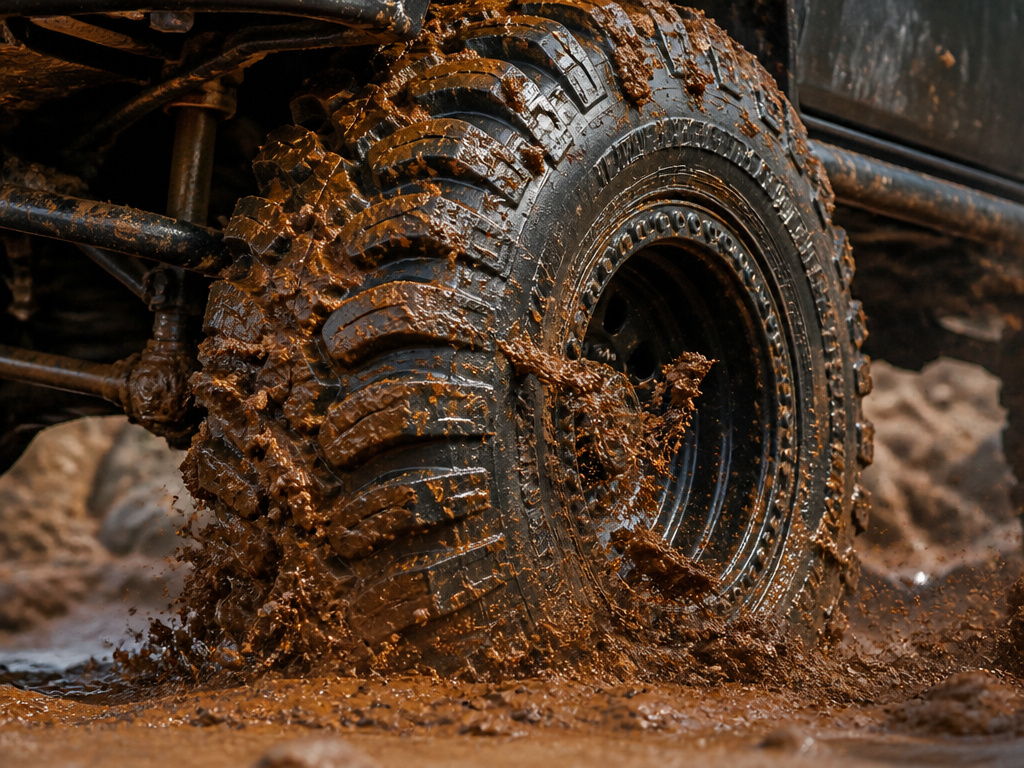
A truck stops at a mud hole. The lugs pack, clear, and keep moving. That is the case for M/Ts.
Rock, mud, and sidewall strength
I don’t wheel hard enough to call myself an M/T specialist, but the spec sheet is clear. Deep lugs and wide voids clear sticky mud. Reinforced sidewalls resist cuts on rock.
Tire Advise names BFGoodrich Mud-Terrain T/A KM3 as the balanced pick. It also names Goodyear Wrangler MT/R with Kevlar for durability, and Nitto Trail Grappler M/T for on/off balance. The best mud-terrain tires include those models. Tire Advise says the Goodyear’s Kevlar sidewall gives roughly 35% better puncture resistance than standard mud-terrain construction.
Choose M/Ts when:
- Deep mud, wet clay, or technical rock is routine.
- You air down often and accept the road penalty.
- Sidewall protection matters more than quiet.
For rock crawling, sources differ: Tire Advise points to 12-18 PSI community guidance, while The Tire Reviews recommends 15-18 PSI. For pressures below 14 psi, the BFGoodrich notice requires AT (all-terrain) rim contours. The BFGoodrich KM3 ATV/UTV tire notice states specific KM3 sizes are not DOT approved for highway use. The maximum speed for these tires is Q (99 mph).
Some counties and states allow ATV/UTV road use, but the notice still marks those sizes not DOT approved.
Pick from best mud tires for trucks after checking load range. The NHTSA tire safety guidance warns that excessive sidewall flex generates heat at highway speed. Air down off-road. Reinflate before the highway.
Towing and load capacity
Aggressive M/Ts are usually LT (light truck) tires, and Taco Tires says that extra weight adds unsprung and rotational mass (weight at the wheels and rotating parts). It blunts acceleration and braking. For towing, match or exceed the factory load index (weight rating);
Cost of ownership also rises. Off Road Rim Financing cites J.D. Power that M/Ts cost more to buy and maintain over time. Shorter tread life plus the fuel penalty raises cost per mile.
Modern designs narrow some gaps. Tire Advise says variable pitch tread designs have made 3-5 dB improvements over less refined competitors. It also says Toyo Open Country M/T uses a compound that stays pliable in freezing temperatures.
How to Buy: 80/20 Road, 60/40 Trail, or 40/60 Mud
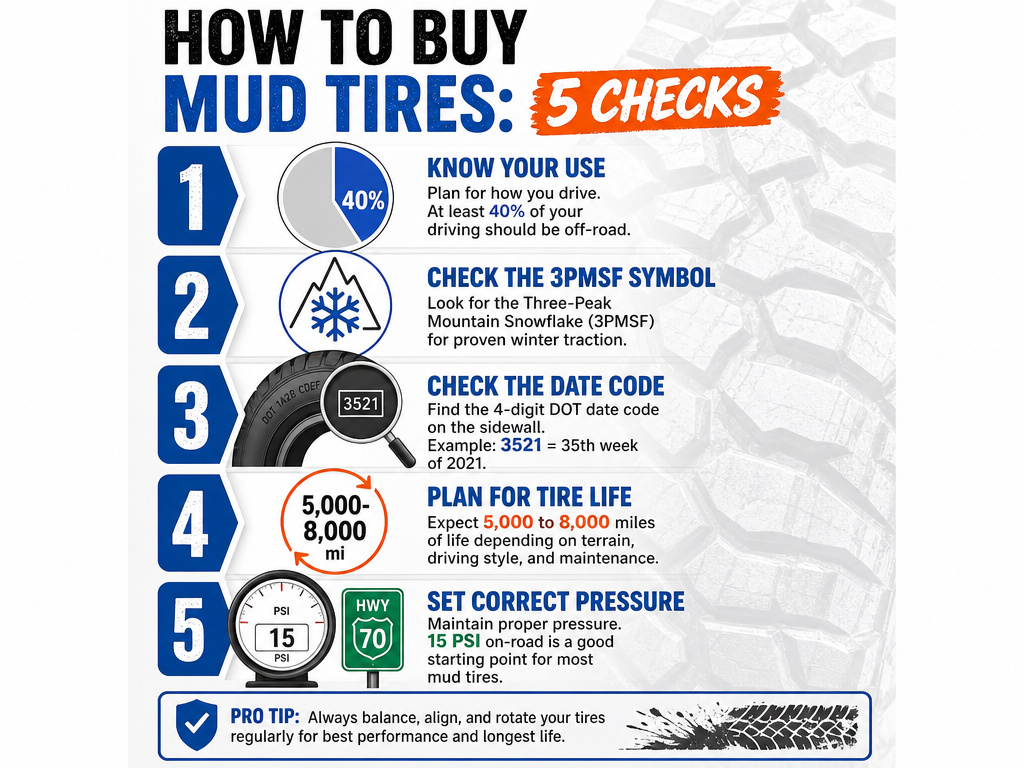
Three driving splits decide this faster than any brochure. The difference between all-terrain and mud-terrain starts with void ratio.
Before you start: Check three things. BFGoodrich says tires outdoors unused for a month or more risk damage, so store them indoors with weight removed. BFGoodrich says a hot closed trunk weakens a spare over time, so inspect it before trusting it. NHTSA warns excessive sidewall flex generates heat at highway speed, so reinflate aired-down tires before driving.
I learned to check the date code after a tire deal turned out to be roughly six years old. That mistake taught me to read the sidewall before the price tag.
- Count terrain miles. If off-road is under about 40 percent, buy an all-terrain or rugged-terrain tire, per Taco Tires. Skipping this buys noise and wear for rare mud.
- Check the snow stamp. If winter roads matter, choose a 3PMSF all-terrain. Most M/Ts lack it, per Taco Tires. Skipping this leaves poor ice grip.
- Read the date code and age. BFGoodrich says replace tires 10 years or more from manufacture, even if they look fine. The code uses four digits for the week and year of manufacture. Skipping this risks old rubber.
- Pick the rotation interval that protects the warranty. Sources differ: BFGoodrich says 6,000-8,000 miles for warranty; Tire Advise says 5,000 miles. Use the shorter interval your vehicle and tire maker allow. Skipping this voids warranty claims and worsens uneven wear.
- Air down only off-road. Sources differ on recommended pressure: Tire Advise points to 12-18 PSI, while The Tire Reviews recommends 15-18 PSI for rock crawling. Reinflate before highway speed. Skipping this risks heat buildup and failure.
For most drivers, I’d pick a 3PMSF all-terrain first. For true mud and rock, I’d pick BFGoodrich KM3 or Goodyear Wrangler MT/R with Kevlar.
All-Terrain vs Mud-Terrain Tires
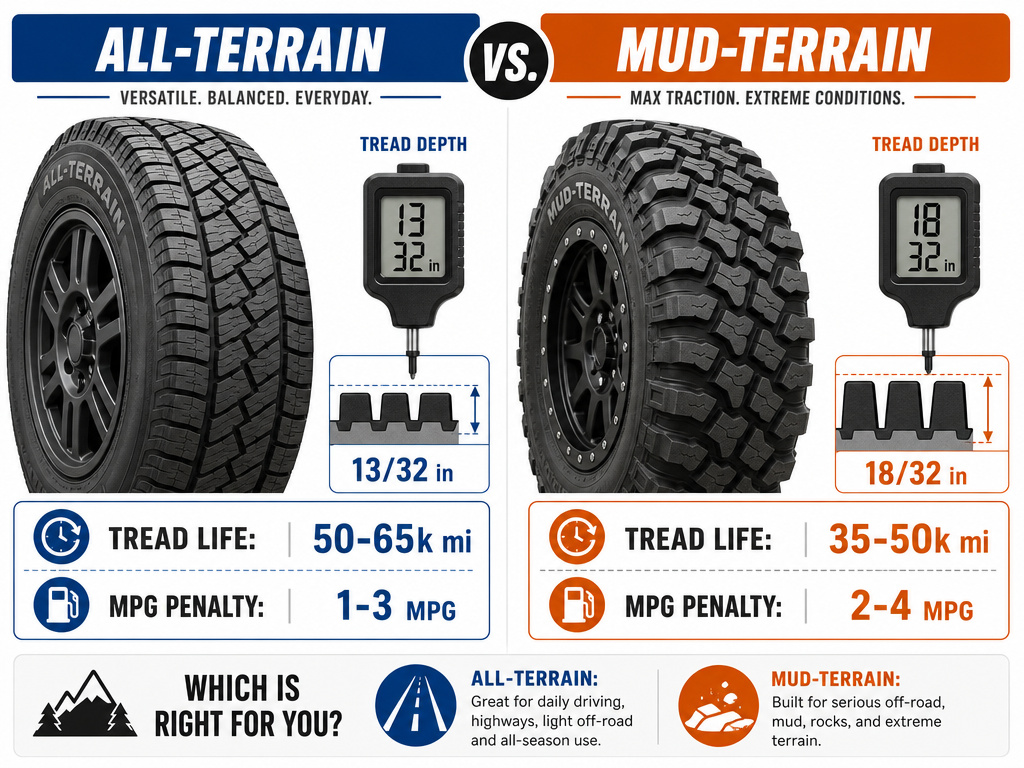
Mud-terrain tires are built for extreme off-road traction, especially in deep mud and rocks, but this comes with trade-offs for daily driving. All-terrain tires commonly carry longer warranties, often in the 50,000-65,000 mile range, while mud-terrain tires typically have a shorter treadlife around 40,000 miles or may come with no warranty at all. The fuel economy impact is also larger with mud-terrain tires, with owners reporting a drop of 2-4 miles per gallon compared to stock tires, whereas all-terrain tires usually have a smaller penalty. For mixed use, a mud-terrain tire makes the most sense when your actual trail use exceeds about 40 percent of your total driving.
Mud Terrain Tire Cost and Price
Mud-terrain tires typically cost more to buy and to maintain over time than all-terrain tires. The initial purchase price is generally higher, and their shorter average tread life means you will need to replace them more frequently. While some premium mud-terrain models may offer warranties around 40,000 to 50,000 miles, all-terrain tires often have longer warranties, directly affecting long-term cost. Additional maintenance costs can come from the need for more frequent rotations to promote even wear and the increased fuel consumption, which adds to the overall expense of running these specialized tires.
Frequently Asked Questions
Are mud terrain tires good for daily driving?
Paved daily driver does better with an all-terrain or rugged-terrain tire. M/Ts add noise, wear, and a fuel penalty. If the daily route is mud, gravel, or logging roads, an M/T fits.
What are the downsides of mud terrain tires?
Highway drone, faster pavement wear, weaker wet and ice grip, and a fuel-economy hit are the main downsides. Some ATV/UTV sizes also have DOT and speed-rating limits.
How long will mud terrain tires last?
The Tire Reviews projected 40,000-45,000 miles for a Nitto Trail Grappler. Taco Tires says M/Ts commonly land near 40,000 miles or no warranty. BFGoodrich Canada reports include KM2 owners seeing uneven wear at 20,000 to 25,000 miles.
Are mud terrain tires safe for highway driving?
Highway safety depends on the exact tire, load range, inflation, age, and DOT status. BFGoodrich says specific KM3 ATV/UTV sizes are not DOT approved and list a Q speed rating of 99 mph. Aired-down tires need reinflation before highway speed.
Do mud terrain tires hurt gas mileage?
Reports vary. Taco Tires cites 2-4+ MPG versus stock. The Tire Reviews cites 2-4 MPG versus OEM. Tire Advise reports owners seeing 1-2 MPG with Nitto Trail Grappler M/T versus all-terrain alternatives.
Mud Terrain Tires Pros and Cons: The Bottom Line
The threshold is simple. If trail use is under about 40 percent, buy an all-terrain or rugged-terrain tire.
This week, read the date code, load index, and DOT status on your current tires. A tire 10 years or more from manufacture needs replacement, per BFGoodrich.
If your daily route is a muddy farm road, the usual advice flips. The M/T’s self-cleaning lugs and tough sidewalls become the sensible choice.
The voids decide it.
