
Multi Piece Wheels Explained: The 3 Types and Safety Rules
This post contains affiliate links. As an Amazon Associate, we earn from qualifying purchases.
Multi-piece wheels are wheel assemblies built from two or more separate metal components that bolt or lock together, most commonly seen as 2-piece, 3-piece, and bolt-together designs. They are distinct from dangerous historical “split rims” and require strict adherence to OSHA and ISO safety procedures during service to prevent explosive failures that have caused fatalities.
That definition covers the what, but the why matters more. For a clear understanding, multi piece wheels explained: they aren’t just fancy car parts; they’re engineered systems where a mismatch in components or a skipped safety step has a physical consequence measured in thousands of foot-pounds of energy.
What follows is a breakdown of the three main types, the specific safety protocols written in blood (and federal code), and the real trade-offs between customization and risk that every shop and owner needs to understand in a multi piece wheels explained guide.
Key Takeaways
- Modern multi-piece wheels for cars and trucks are engineered assemblies, distinct from the lethal split rims still found on some heavy equipment.
- ISO 14400:2021 mandates that tires be fully deflated before unbolting and that inflation must happen inside a safety cage or with safety chains. OSHA 1910.177 establishes other safety requirements for servicing multi-piece rim wheels.
- A mismatched component can fail catastrophically after months of normal use, as documented in a fatal incident report where a painted-over ring hid the problem.
- For medium- and heavy-duty vehicles, manufacturers like Alcoa specify that only 2-piece nuts or 2-piece sleeved nuts be used, and chrome-plated contact surfaces are prohibited.
- The point of multi-piece wheels is fitment flexibility and repairability for specialized applications, not a performance gain for most street vehicles.
The Three Main Types of Multi-Piece Wheels
Let’s cut through the jargon. When people say “multi-piece wheel,” they’re usually talking about one of three constructions. The number refers to the main structural metal parts, not the total count of bolts or seals.
A 2-piece wheel typically consists of a rim barrel welded or bolted to a center disc. A 3-piece wheel has a separate center disc and two rim halves (outer and inner barrels) that bolt together. A bolt-together wheel, common for heavy machinery, uses large bolts to clamp two half-pieces around a central hub.
2-Piece Wheels
This is the most common type you’ll see on aftermarket cars. The wheel center, the part with the bolt pattern and spokes, is manufactured separately from the outer barrel. These two pieces are then permanently joined, usually via welding. The main advantage here is that manufacturers can use different manufacturing methods for each piece (e.g., a forged center with a spun barrel) and offer a wider range of widths and offsets without creating hundreds of unique molds. It’s a production efficiency and customization play.
3-Piece Wheels
Here’s where true customization shines. A 3-piece wheel has three independent metal components: the center disc and two separate rim halves (an outer lip and an inner barrel). These are assembled with a series of bolts around the circumference and sealed with an internal O-ring or gasket. The big benefit is serviceability. You can damage a rim lip and replace just that half, or change the wheel’s width by swapping to different barrel sizes. The downside is potential for air leaks at the seals and significantly higher cost due to machining and assembly labor. For a deep dive on how wheels are made, our guide on forged vs cast wheels breaks down the material science.
Bolt-Together Wheels (Industrial)
This category is critical to distinguish. Common in mining, construction, and heavy crane applications, these are literal multi-piece rim wheels as defined by OSHA. Think of a massive, two-piece metal ring that bolts together around a tire, often for giant off-road equipment. They are designed for extreme strength and the ability to handle tires that are impossible to mount on a one-piece rim. Servicing these follows the most stringent safety protocols. Confusion often arises because the term “split rim” is incorrectly used for all multi-piece designs; true split rims are a specific, hazardous subtype within this category, which our split rim wheel safety guide covers in detail.
Multi-Piece vs. Single-Piece: The Real Trade-Offs
Is one inherently better? That’s the wrong question. The right question is: which one solves your specific problem? Most passenger vehicles come with single-piece wheels, cast or forged from a single block of aluminum. They’re sealed, relatively inexpensive, and perfectly sufficient.
| Aspect | Multi-Piece Wheels | Single-Piece Wheels |
|---|---|---|
| Customization | High. Width, offset, and barrel design can be mixed. | Low. You buy the complete configuration. |
| Repairability | High. Individual components (lips, barrels) can be replaced. | Low. Damage often means a full wheel repair or replacement. |
| Potential for Leaks | Yes. Relies on gaskets/O-rings; requires proper torque. | No. Monolithic construction is inherently sealed. |
| Cost | Very High. Precision machining and assembly. | Low to High. Simple cast wheels are cheap; complex forged ones are not. |
| Primary Use Case | Show cars, custom fitments, specific heavy-duty industrial applications. | Every production passenger vehicle on the road. |
The details in a multi piece wheels explained analysis are where wheels win or lose. A custom 3-piece wheel allows for a perfect aggressive stance. But that O-ring seal is a failure point a one-piece wheel doesn’t have. For most drivers seeking performance, a high-quality one-piece cast or flow-formed wheel offers better value. The weight savings and strength from processes like flow forming often outweigh the modular benefit.
The Critical Safety Rules (This Isn’t Optional)
This is where we move from hobbyist discussion to life-and-death procedure. The safety rules for servicing multi-piece wheels aren’t suggestions; they are the direct result of forensic analysis of fatal accidents. The OSHA multi-piece rim wheel standard (1910.177) exists because the hazard is explosive separation.
Rule 1: Deflate Completely Before Any Disassembly
This is the cardinal rule. ISO 14400:2021 states explicitly: on multi-piece rims, “the tyres shall be fully deflated before the unbolting of the wheel and tyre assembly from the vehicle axle is started.” This applies to both tires in a dual-wheel setup. The reason is physics: the air pressure is the only thing holding the lock ring or side ring in its gutter. Unbolting anything while pressure remains is like uncapping a shaken soda bottle, the component becomes a projectile.
Rule 2: Use a Restraining Device
You never inflate a multi-piece wheel assembly outside of a safety cage or without safety chains fastened around it. OSHA’s analysis of a controlled failure showed a 10.00 x 20 tire released 8,200 ft.-lbs. Of energy when it separated at 105 psig. A safety cage is designed to contain that. The standard allows one exception: a tire may be inflated to just 3 psig without a restraining device for the sole purpose of seating the wheel components.
Rule 3: Never Interchange Unidentifiable Parts
Where this goes sideways: Using a component that “looks about right.” ISO 14400 is absolute: “Wheels or parts of wheels which cannot be identified shall not be used even if they seem to have the correct functions and the identical dimensions.”
A CLAS Hazard Alert documents a mismatched multi-piece rim assembly that failed catastrophically after the tire had been properly inflated and driven for about four months. The ring had been painted black, obscuring its markings. When matched, it was found to be mismatched to the rim base. The tire had been properly inflated and driven for about four months before the catastrophic failure. The takeaway is brutal: if the markings are painted over or illegible, the assembly should not be serviced. This is a hard stop.
Proper Assembly and Maintenance Protocols
Assuming you have the correct, identifiable parts, the procedure is methodical. This isn’t a place for shortcuts or hammer-based persuasion.
Component Matching and Preparation
Manufacturers like Topy provide instruction manuals that reference required standards and matching specifications. These are not guidelines; they are engineering specifications. The lock ring must match the rim base’s gutter profile exactly. Before assembly, all contact surfaces must be clean and free of rust, dirt, or old rubber. ISO specifies using a “neutral non-aggressive mounting paste or liquid” to lubricate the tire beads, never soapy water or petroleum-based grease, which can degrade rubber.
Mounting, Inflation, and the Quarantine Period
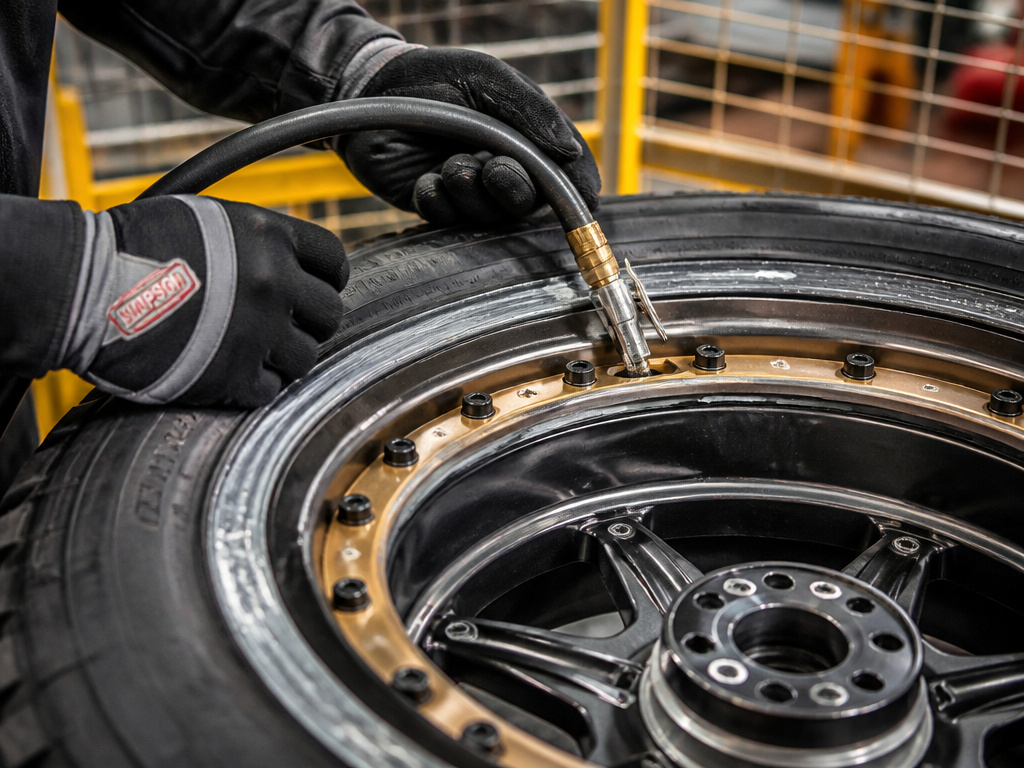
After physically assembling the dry components in the safety cage, inflation is a controlled process. Use a clip-on chuck with a long hose so the operator can stand clear of the trajectory path. Once inflated to seat the beads, you visually inspect for proper seating of all rings.
For certain assemblies, the manual mandates an extra step: a quarantine period of at least 24 hours after assembly and before final installation. The assembly is marked and set aside, then re-checked for air leaks before final installation. This catches slow-seating seals.
Final Installation on the Vehicle
This is where fastener choice is critical. The 1980 OSHA rim wheel rulemaking established that only tools recommended in the rim manual be used. For modern aluminum wheels, the Alcoa service manual is emphatic: 1-piece nuts are not approved. You must use 2-piece nuts or 2-piece sleeved nuts. It also warns: “Never use nuts with chrome-plated contact surfaces.” The chrome can flake, creating inconsistent clamping force and leading to loosening. All hardware should be grade 8 or metric 10.9.
Torque sequences matter. The OTR crane wheel manual, for example, specifies retorquing clamping nuts to 310–360 Nm (230–265 ft.-lbs.) in a star pattern, and its bolt cover ring screws to 27–34 Nm (20–25 ft.-lbs.). This isn’t just tight; it’s even.
How do multi-piece wheels affect performance?
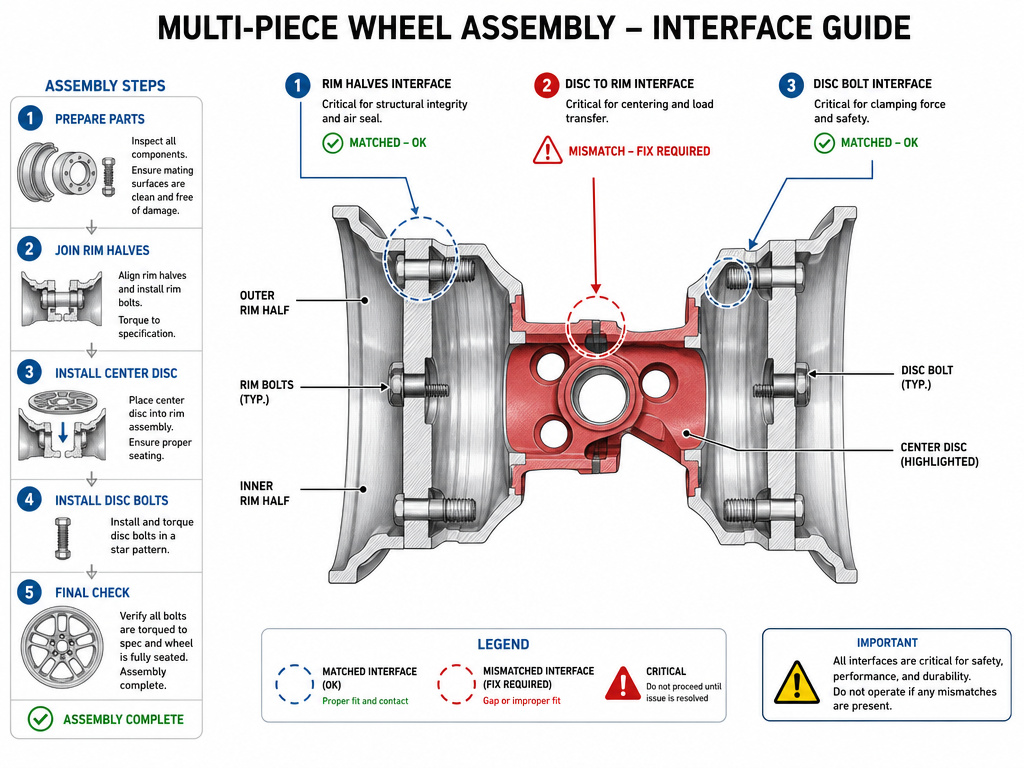
Multi-piece wheels can have significant performance implications. The strength of the assembly is critically dependent on correct component matching and installation; mismatched parts can fail catastrophically even after months of seemingly normal operation. For optimal handling and safety, never mix different tire sizes or constructions on the same axle, and ensure all components are properly identified and assembled by trained personnel using only recommended tools and procedures.
Frequently Asked Questions
What is the point of multi-piece wheels?
For custom street wheels (2- and 3-piece), the point is fitment flexibility and style. You can achieve widths and offsets that aren’t feasible with one-piece molds. For industrial bolt-together wheels, the point is functionality: they allow the mounting of giant, stiff tires that cannot be stretched over a one-piece rim.
Are all 6 tires on a Dually the same?
Yes, they should be. This is critical for safety and vehicle dynamics. Mismatched tires on a dual-wheel axle (a “dually”) can create differences in rolling radius, causing one tire to drag and overheat, leading to blowouts. Always match tire size, brand, model, and tread depth across an axle.
Are split rims illegal in the US?
No, split rims themselves are not illegal. However, certain types of multi-piece rim wheels (often called “split rims”) are subject to stringent OSHA regulations (29 CFR 1910.177) for how they must be serviced in a workplace. Their use on commercial vehicles is governed by DOT regulations. The danger leads many fleets to phase them out in favor of safer single-piece tubeless rims.
What’s better, 2-piece or 3-piece wheels?
It’s not about better, it’s about purpose. A 2-piece wheel is a balance of customization and sealed reliability for most custom car builds. A 3-piece wheel is for the enthusiast who values the ability to repair or reconfigure the wheel’s dimensions above all else, and accepts the maintenance and cost that comes with it. For a look at other specialty constructions, see our article on beadlock wheels, which serve a different off-road purpose.
The Bottom Line
Multi-piece wheels are a tool for a specific job. For the custom car builder, they offer a solution you can’t get elsewhere. For the heavy equipment manager, they are a necessary component. In both cases, the margin for error is defined by physics and regulation, not opinion.
The single most important thing you can do is respect the identification and matching process. A painted-over lock ring isn’t a minor issue; it’s a hidden failure waiting for a trigger. The safety protocols, deflate completely, use a cage, follow the manual, exist because people have died ignoring them.
Before you buy or service any multi-piece assembly, understand its full lineage. Check the markings. Have the manual. And remember that in the world of wheels and tires, the difference between a perfect fit and a fatal one is often just a few stamped letters on a metal ring. For a broader perspective on where these fit in the automotive ecosystem, our overview of types of car wheels provides context.
