
Passenger Car Tires vs SUV Tires: Which Should You Buy?
This post contains affiliate links. As an Amazon Associate, we earn from qualifying purchases.
In passenger car tires vs SUV tires, the deciding spec is load capacity, not the vehicle name. LT-marked SUV tires carry higher loads and stress, while passenger car tires favor lighter construction and comfort. Check the placard size, load index, and speed rating before you buy.
The placard number (the tire and loading label on the vehicle) is the load and inflation target for the vehicle. A tire with the wrong load index feels fine on a dry street and fails sooner under highway heat, rain, or a full cabin.
What follows: the sidewall codes, the load-rating difference, the 4WD replacement dispute, and a simple checklist for choosing the right tire for your vehicle.
Key Takeaways
- Check cold pressure once a month after three hours without driving.
- Replacement tires must meet or exceed original load capacity, even if size looks right.
- Age advice differs: NHTSA cites 6 to 10 years; USTMA focuses on inspection.
- For four-wheel-drive (4WD) SUVs, Michelin urges all four identical; USTMA and Consumer Reports emphasize matching OE size, speed rating, and construction but do not explicitly mandate identical brand/model or simultaneous replacement of all four tires.
Passenger Car Tires vs SUV Tires: What the Sidewall Says
The sidewall carries the load and speed clues that decide the swap. I start with the sidewall because the vehicle name alone misleads. Check it.
Passenger vehicle tires carry a size code such as P215/65R15 95H. The P marks passenger car service, the R marks radial construction, the 95 is the load index, and the H speed symbol indicates the maximum sustained speed rating. Light truck tires for SUVs use LT markings or load range letters B, C, D, and E.
The sidewall markings provide critical information about the tire’s specifications. The placard tells the vehicle’s target (the doorjamb label, not the tire sidewall). The sidewall tells the tire’s limits. For federal tire safety information, the NHTSA tire safety page covers placard location, pressure checks, and tread depth.
| Marking | Typical vehicle | Construction clue |
|---|---|---|
| P or passenger size | Sedans, minivans, crossovers | Passenger car tires serve vehicles with GVWR of 10,000 lbs or less |
| LT with load range B-E | Light trucks, SUVs, trailers | More layers and heavier materials for higher pressure and loads |
| All-season SUV tire | CUVs and SUVs | Built for SUV weight and driving conditions |
| All-terrain tire | Off-road SUVs and trucks | Aggressive tread and squared-off sidewalls |
Read the size code
A P-metric code (passenger car marking) marks passenger car service. That is the family covered by the passenger car tires category. An LT code (light truck marking) signals a light truck build. The touring vs performance split matters more than the vehicle name.
Find the load index
The load index is the tire’s carrying capacity. Replacement tires must meet or exceed the original equipment (OE) load capacity, per the USTMA passenger tire care guide. Light truck tires use additional components and heavier-duty materials for higher pressure and greater loads.
Check the speed symbol
The speed symbol is the maximum sustained speed rating. Don’t step down from the original rating without checking the vehicle maker’s guidance. Using a tire with a lower speed rating than the vehicle’s original specification can risk performance. Check tire weight when you compare a light car tire with a heavier truck-built tire.
Can You Put Passenger Car Tires on an SUV?
Only if the size, load index, and speed rating match the placard. I would not swap them on a hunch. Match the placard.
What does your placard say? Passenger car tires are defined for vehicles with a GVWR (gross vehicle weight rating) of 10,000 lbs or less, per 49 CFR 571.110. That definition points to the load rating as the real test.
Easy to miss: A passenger car tire fits the wheel but misses the load. FMVSS No. 110 (a federal tire standard) uses a 1.10 load service factor to reduce the load rating when a passenger car tire is installed on an MPV (multipurpose passenger vehicle), truck, bus, or trailer.
If you tow, carry passengers, or drive a full-size SUV, the tire sees more stress. A light car tire runs hot under overload. The UTQG warning (the government tire grading system) says underinflation or excessive loading causes heat buildup and possible tire failure.
Are you towing? If yes, a light truck build is necessary. If you drive pavement, a passenger or SUV all-season tire is enough.
Consumer Reports tested a 2016 Toyota RAV4 in size 225/65R17. The Bridgestone Dueler H/L 422 Ecopia balanced low rolling resistance with a 65,000-mile predicted tread life. For a daily crossover, I would shortlist a Michelin Primacy or Continental TrueContact Tour that meets the placard load index.
If you take a Jeep Wrangler off-road, all-terrain SUV tires are the right tool.
Skip these swaps:
- A passenger tire below the placard load index.
- A lower speed rating without maker approval.
- A mismatched set on a 4WD SUV.
Which Tire Type Fits Your Vehicle? A 5-Step Decision Process
Three specs decide the swap: size, load index, and speed rating. I use the same order at the shop. Follow it.
Before you start: Ensure you have the correct vehicle specifications and understand the safety requirements for tire installation.
- Read the driver’s doorjamb placard or owner’s manual. Skipping this means you buy by tire width instead of vehicle load target.
- Compare the load index and speed rating with the original spec. A lower speed rating risks capability, per Consumer Reports.
- Match the tire type to real use. If you tow or drive gravel, choose a light truck build. If you drive pavement, choose a passenger or SUV all-season tire.
- Check the date code (the manufacturing code molded into the sidewall). Old rubber cracks even with deep tread. NHTSA says some manufacturers recommend replacing tires at 6 to 10 years regardless of treadwear.
- Balance and rotate. New tires should always be balanced when installed, per NHTSA. Skipping rotation can lead to uneven wear.
USTMA lists factors that drive tire safety. The short version:
- Proper size, type, and load capacity.
- Inflation pressure.
- Vehicle loading.
- Regular tire rotation.
- Regular inspection.
- Proper tire repair.
- Vehicle condition, alignment, and maintenance.
- Good driving habits.
The all-terrain vs all-season choice is about service, not looks. Before you upsize wheels, review the tire size pros and cons.
Which Safety Numbers Matter More Than Brand Marketing?
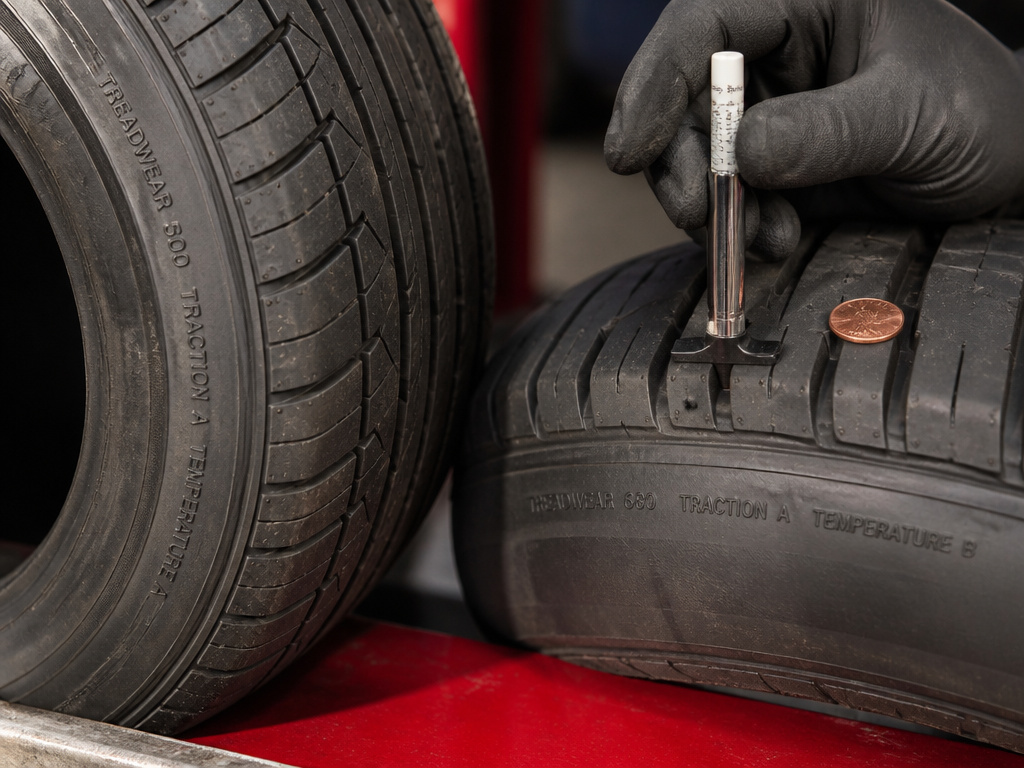
Tire traction grades indicate a tire’s wet grip capability.
Do you see snow? Consumer Reports says winter/snow tires should always be used in sets of four.
Tires are no longer safe when tread wears to 2/32 inch, per NHTSA. The penny test gives the same answer: if the top of Lincoln’s head is visible, replace the tire. Underinflation causes excessive heat buildup, which can lead to tire failure.
The UTQG system grades treadwear, traction, and temperature. The 2024 UTQG consumer guide gives a simple example. A tire graded 150 would last one and a half times the distance of one graded 100 on the government test course. Traction grades run AA, A, B, and C. A tire marked C has the lowest traction grade. Temperature grade C is the minimum required under FMVSS No. 109 (a federal tire standard).
The Federal Register tire safety standards list a 34-hour endurance test at 80 km/h (50 mph).
UTQG treadwear numbers are most useful for comparing tires within a single manufacturer’s lineup.
Age, Mileage, and 4WD Replacement Rules
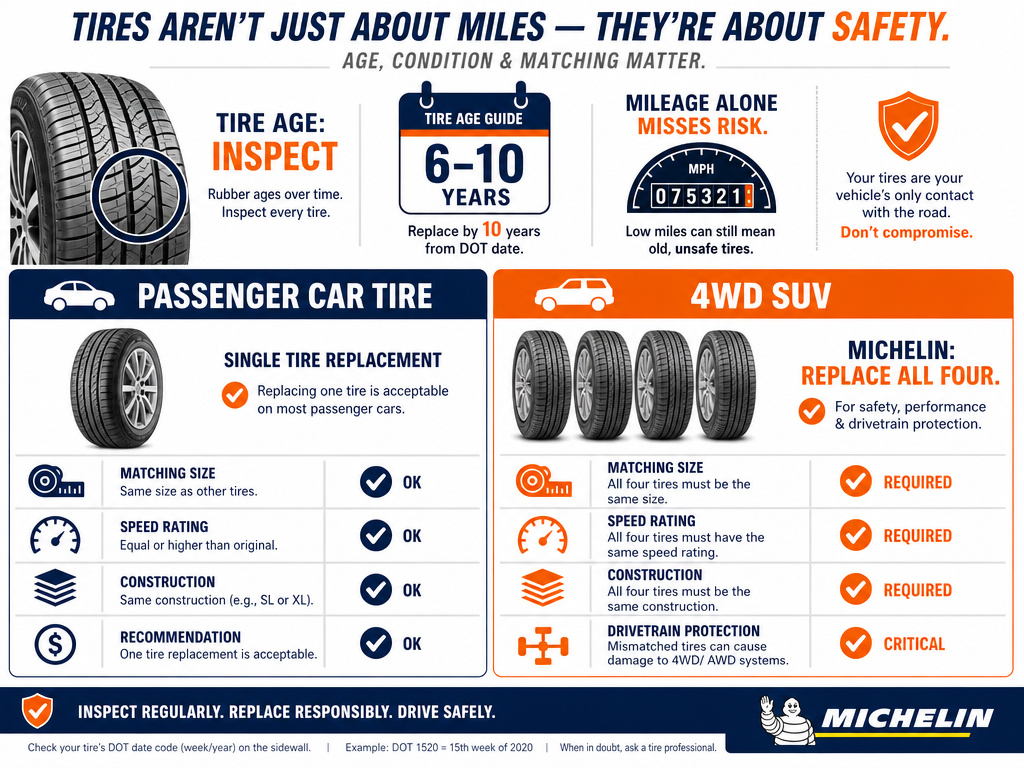
Age is the quiet failure mode. I wouldn’t let a low-mileage vehicle carry an old tire without a close look. Inspect it.
Are you replacing one tire on an all-wheel-drive (AWD) SUV? The source positions differ.
| Question | Source position | Practical read |
|---|---|---|
| Tire age | NHTSA cites 6 to 10 years | Inspect; mileage alone misses risk |
| Tire age | USTMA focuses on inspection | No blanket timeline in its guide |
| 4WD set | Michelin urges all four identical | Matching wear reduces mismatch |
| 4WD set | USTMA stresses size and construction | Match specs; check vehicle guidance |
Michelin strongly advises equipping 4WD SUVs with 4 identical tires: same make, model, size, and wear. It recommends changing all four simultaneously. USTMA and Consumer Reports emphasize matching OE size, speed rating, and construction. They don’t explicitly mandate identical brand/model or simultaneous replacement of all four tires.
For a 4WD SUV, I lean toward Michelin’s advice because it removes wear mismatch. Recommendations for 4WD tire replacement vary by source.
Cost comparison
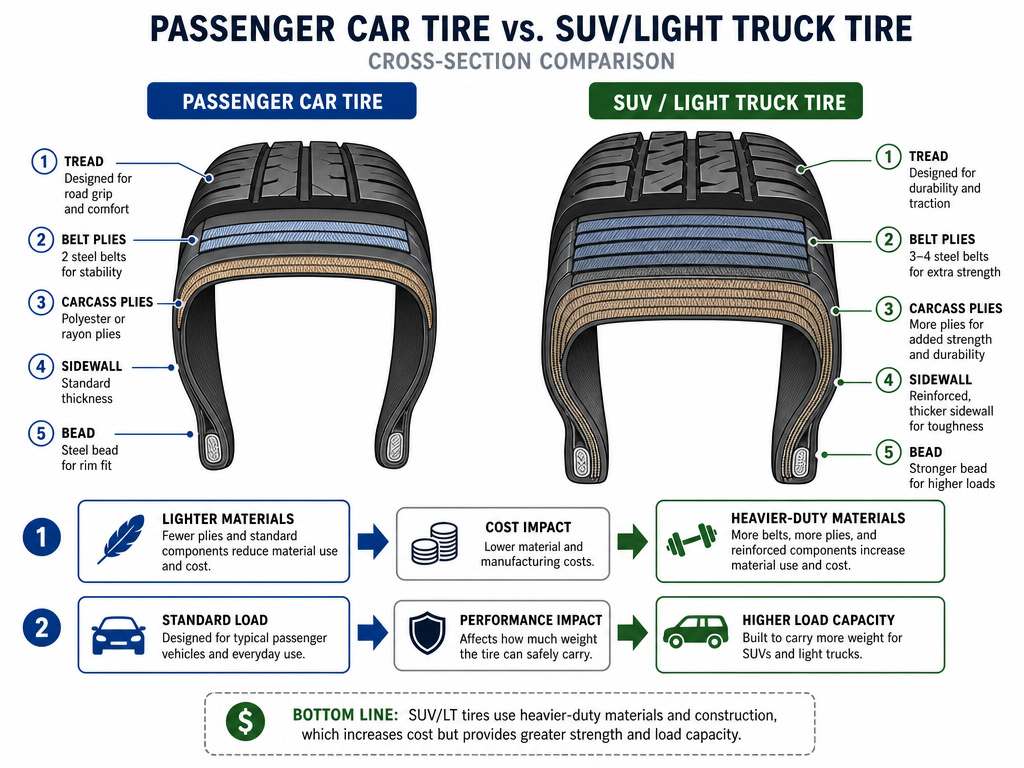
Light truck tires typically cost more than passenger car tires due to their more robust construction. The cost difference stems from construction. Light truck tires are built with additional components and heavier-duty materials to handle higher inflation pressures and greater loads. This more robust construction typically comes at a higher price point than passenger car tires. When budgeting for replacement, focus on the required specifications for your vehicle. Always factor in the cost of having new tires balanced when they are installed.
Frequently Asked Questions
What is the difference between passenger car tires and SUV tires?
Passenger car tires are defined for vehicles with a GVWR of 10,000 lbs or less. LT-marked SUV tires use additional components and heavier-duty materials for higher pressure and greater loads.
Can I use a passenger tire on my SUV?
Use a passenger tire on an SUV only if the size, load index, and speed rating meet the vehicle placard. FMVSS No. 110 reduces the load rating of passenger car tires when installed on an MPV, truck, bus, or trailer.
Does it matter if a tire says passenger tire?
Yes. The P-metric marking identifies passenger car service. It affects load rating, not just the label.
What tires should you stay away from?
Stay away from tires below the OE load capacity, mismatched speed ratings, tires worn to 2/32 inch, and old tires with cracking. NHTSA says some manufacturers recommend replacing tires at 6 to 10 years regardless of treadwear.
Can I use SUV tires on a car?
Use SUV tires on a car only if the size, load index, and speed rating match the car’s placard. A heavier truck build must still meet approved options, so verify the vehicle maker’s guidance.
The Bottom Line
If you want one answer, buy from the placard first. Take a photo of the driver’s doorjamb label before you go shopping. That one step prevents most passenger car tires vs SUV tires mistakes.
Aggressive all-terrain tires may not be necessary for a crossover used only on pavement. If you tow, carry heavy loads, or drive rough gravel, that stance changes. The tire needs the load rating and construction for the job.
One threshold matters: replace the tire at 2/32 inch tread, and don’t ignore a 6-to-10-year age warning. Always prioritize the vehicle manufacturer’s specifications.
