
Storing Tires on Rims vs Off Rims: How to Choose?
This post contains affiliate links. As an Amazon Associate, we earn from qualifying purchases.
Storing tires on rims vs off rims depends on mounting. Rims support the tire, so Michelin and Pirelli advise hanging or stacking mounted sets. BFGoodrich and Pirelli say unmounted tires stand upright. Yokohama and USTMA add pressure and date-code checks. Michelin notes tires lose air naturally, around one PSI per month.
That rim support changes the whole storage problem. A mounted assembly carries its shape through the steel or alloy barrel, while a loose tire has only rubber and bead to hold it. The disagreement among makers is real; it affects whether you hang, stack, or stand each set.
What follows: two orientation methods, the pressure numbers that differ, the storage environment, and the date-code habit that decides whether a stored set is worth remounting.
Key Takeaways
- Mark each position before pulling a set, then rotate correctly at install.
- Rim support changes the load path; sources disagree on whether to hang, stack, or stand mounted tires.
- Sources disagree on stacking unmounted tires: Michelin, Pirelli, and BFGoodrich advise against stacking and recommend standing upright, while USTMA allows sidewall-to-sidewall stovepipe stacking.
- Keep away from motors and sunlight; Yokohama cites ozone below 0.08 ppm (parts per million).
- Date code decides aging; a five-year-old stored tire needs annual inspection.
Storing Tires on Rims vs Off Rims: What Changes?
The short answer is that a rim changes the load path. A wheel rim carries the tire’s bead and spreads weight around a hard ring. A loose tire has only rubber and bead, so its shape depends more on how the load rests.
Mounted tire/wheel assemblies are stored on the tread, hung through the rims, or stacked horizontally, depending on the source. Unmounted tires are kept upright or stacked sidewall-to-sidewall. Rim support, load path, inflation pressure, and exposure to ozone, heat, and sunlight decide the safest method. Seasonal sets should be marked by position and date before storage.
Before you start: Move tires away from electric motors, hot pipes, and fuel storage. Yokohama advises ozone below 0.08 ppm (parts per million). Pirelli warns UV (ultraviolet) rays and heat cause cracking. If you skip this, sidewall checking can appear after one season in a hot garage.
Clean, Dry, and Mark Before Storage
Do this before you pick an orientation.
- Note the position of each tire. Skipping it leaves you guessing at install, and rotation patterns fail.
- Inspect for cuts, bulges, and embedded stones. A cut or bulge is a weak point when the tire warms and flexes.
- Wash with soapy water, then dry well. Pirelli warns petroleum-based cleaners react with rubber compounds and break them down.
- Mark the date and position on the bag or sidewall. A date mark ties the tire to the DOT code and storage clock.
Yokohama says used tires should be cleaned before storage. It also says don’t store them with tire shine or other treatments.
Simple. Don’t skip it.
Environment Decides More Than Orientation
A hot garage smells like warm asphalt and fuel. Michelin says keep tires away from fuel, solvents, and oils.
- Cool, dark, indoor space beats a shed or loft because temperature swings are milder.
- Pirelli says a basement is the most logical choice.
- Keep off damp concrete; use clean wood or a rack.
- Keep away from furnaces, compressors, sump pumps, central vacuums, and electric motors.
- Whitewall or raised white lettering faces each other to avoid staining.
A tire storage guide should start with marking positions. Covers come later.
I bag mine, squeeze out extra air, and keep them off the floor. Rubber ages like a sauce left on a hot burner: the flavor changes before you taste it.
Should You Hang, Stack, or Stand Mounted Tires?
Picture four wheel/tire assemblies in a garage corner. One source says hang them. Another says stack them. A third says stand them.
The disagreement is real.
If you want to prevent flat spots, the load path matters.
| Source | Mounted on rims | Why |
|---|---|---|
| Michelin AU | Stand upright, hang, or stack two by two max | Gives three options |
| Michelinman and Pirelli | Hang or stack horizontally; avoid upright | Rim weight on one contact point can stress the tire |
| Continental and Yokohama | Prefer upright | Upright reduces stress; Yokohama strongly recommends upright |
| USTMA | Store on the tread, inflated to vehicle recommended pressure | Industry bulletin for ready-to-use assemblies |
The practical split is simple. If the set will be remounted soon, a hard rim carries the shape. If it sits for years, pressure and orientation matter more.
Mounted sets save a mounting visit, but they take more floor space and need rim protection.
Short-Term Seasonal Storage
For one season, a mounted set can sit with less fuss if it is clean, inflated, and inside.
A Globe and Mail columnist makes that case. He says mounted sets sit for one season with little attention to orientation if they are inflated properly and stored inside.
That is close to what winter tire storage looks like for a seasonal set.
Long-Term or Multi-Season Storage
For longer storage, follow the stricter source.
The USTMA tire service bulletin from the U.S. Tire Manufacturers Association says mounted assemblies should go on the tread and inflate to the vehicle’s recommended pressure. It also says move a stored vehicle at least every three months.
High-performance tires with a nylon belt overlay are a special case. USTMA says move those vehicles every 30 days and temporarily inflate to the maximum pressure molded on the sidewall.
If the tires stay on the vehicle, BFGoodrich says block the car and keep placard pressure.
I would rather store mounted sets on the tread or hung, because the USTMA bulletin treats ready-to-use assemblies as the default.
A rim changes where the stress lands. It still ages.
Why Do Unmounted Tires Need a Different Storage Method?
Two failure modes drive this section: bead distortion and ozone cracking.
I keep loose tires upright because the sources split, and upright is the least risky for tires without rims.
The tire storage position you choose should match whether the rubber is mounted.
Michelin AU, Pirelli, and BFGoodrich say unmounted tires should stand upright side by side. BFGoodrich adds rotate occasionally. USTMA allows sidewall-to-sidewall stovepipe stacks (sidewall-to-sidewall).
The disagreement is real. Pick one source and follow it for the whole set.
The Globe and Mail columnist suggests changing orientation a couple of times per season.
Bead Distortion vs Flat Spots
A loose tire has no rim to hold the bead (the edge that seals to the rim). Stack it sidewall-to-sidewall under the wrong advice, and the weight of one tire presses on the bead of another and distorts it.
| Symptom | Likely cause | Check |
|---|---|---|
| Temporary flat spot (a load shape change) | Tires under vehicle weight | Drive about 25 miles; USTMA says it disappears |
| Fine sidewall checking | Ozone, heat, or UV exposure | Look near motors, hot pipes, or sunlight |
| Uneven bead seating | Stacked unmounted tires pressing on beads | Store upright or follow USTMA stovepipe with care |
A temporary flat spot disappears after about 25 miles, per USTMA. Yokohama warns flat spotting after long storage may not disappear.
You feel it as a low thump through the wheel.
Sun-aged sidewalls show fine spider cracks near the bead.
Common mistake: Storing loose tires on a hook. Michelin and BFGoodrich warn against hanging unmounted tires because the bead and rubber deform.
How Long Can Stored Tires Sit Before the Clock Wins?
The DOT date code is the first number that matters.
I check the date code first on every tire I research or recommend. It takes about ten seconds and has saved me from vouching for tires that were older than they should have been.
The last four digits of the DOT (Department of Transportation) tire identification number, or TIN, are the week and year the tire was made.
Reading the DOT Date Code
Check the sidewall for a four-digit code. The first two digits are the week, and the last two are the year.
The tire shelf life question starts with the date code. Tread depth comes later.
Michelinman says inspect any tire closely if it has been stored for several years.
Yokohama recommends an annual inspection by a qualified tire professional once a tire reaches 5 years.
Yokohama also says use the oldest stored set first.
USTMA says a tire service professional should inspect stored tires before service.
Michelinman says inspect any tire closely if it has been stored for several years.
Check the date code.
What Garage Storage Gear Actually Saves Floor Space?
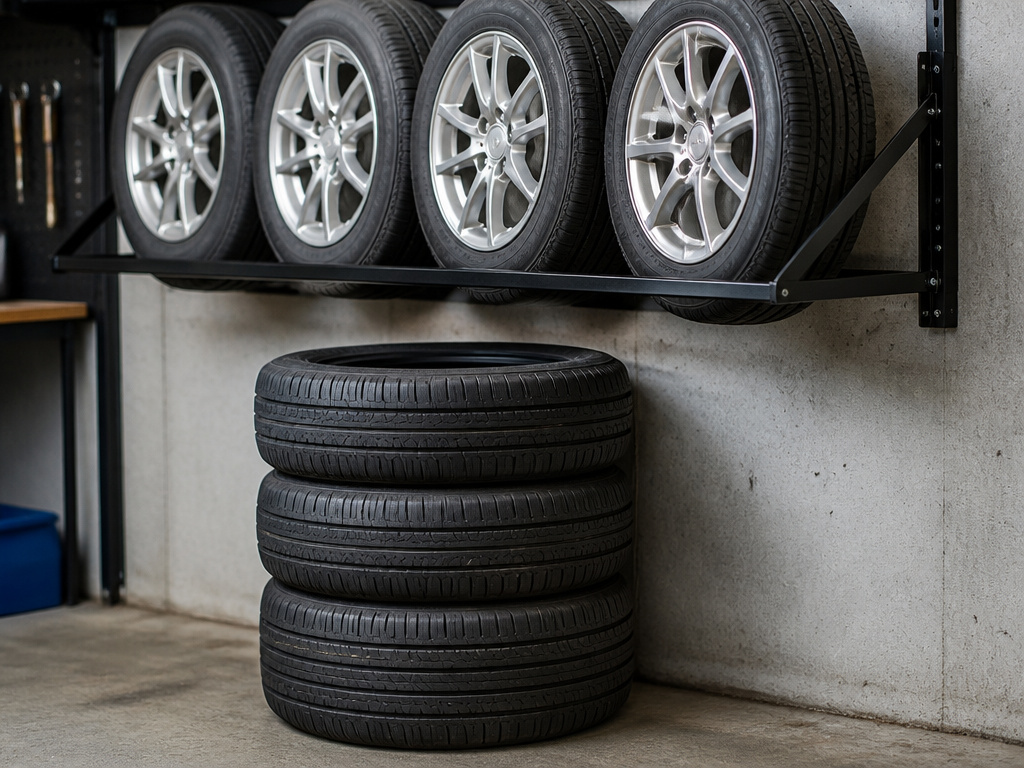
Floor space is the real constraint.
A wall rack lifts eight assemblies off the floor, while a four-tier rack holds 36 tires on the tread.
Garage storage plans start with the wall. Floors come later.
Garage storage plans start with the wall. Floors come later.
Small-Space Options
Commercial racks work in a home garage too.
- Martins Industries Wall-Mount Rack MWM-80 holds 8 assemblies, up to 34 inches OD, and 500 lb (pounds).
- Martins Industries 4-Tier Shelving Rack MTSR-4 holds 36 tires, up to 28 inches, down to 18 inches, and 2000 lb.
- WeatherTech Wheelstackers are 24-inch plastic rings. They keep stacked assemblies from touching and deter pests.
The Martins Industries MPSTR rack handles tires up to 48 inches OD (outside diameter) and 2200 lb. It stacks up to 6 loaded racks.
Olpin Group automated storage systems deliver tires within 20-30 seconds, but that is shop gear. A home garage needs simpler racks.
If your wall is the only clear space, check availability for the Martins Industries Wall-Mount Rack MWM-80. For stacked assemblies, compare the WeatherTech Wheelstackers product page on Amazon.
If you plan to mount a tire later, keep the valve stem accessible. Before you remove a tire, mark the wheel and note the inflation step your source gives.
Outdoor Short-Term Storage
Outdoor storage is a compromise. Treat it as a stopgap.
Raise tires off black asphalt. Use an opaque waterproof cover with vent holes. Keep them away from reflective sand or snow.
Continental says don’t store tires in the open air, even under a cover. Pirelli says short-term outdoor storage is manageable with protection.
Michelinman says tires outdoors unused for extended periods dry out, and surface cracks appear.
Don’t leave tires unprotected on piers, ship decks, or open fields.
Easy to miss: A sealed cover traps moisture. USTMA warns a closed cover creates a heat box or steam bath. Use vent holes.
Frequently Asked Questions
Can you store tires on rims standing up?
Some sources say yes. Michelin AU and Yokohama allow or recommend upright storage for mounted tires. Michelinman and Pirelli advise hanging or stacking and warn against upright storage for inflated mounted tires. USTMA says mounted assemblies should be stored on the tread.
How much pressure should mounted tires have in storage?
The numbers differ. Michelinman says reduce below normal driving pressure. Continental says preferably 15 psi (pounds per square inch). Yokohama says deflate to 50 percent of normal pressure and keep valve caps in place. USTMA says use the vehicle’s recommended pressure, the number on the tire placard. Tires lose about one PSI per month, so check before driving.
Should unmounted tires be stacked or standing?
Michelin AU, Pirelli, and BFGoodrich say stand upright side by side. BFGoodrich adds rotate occasionally. USTMA says sidewall-to-sidewall stovepipe stacking maintains shape. The disagreement is real, so pick one source and follow it for the whole set.
How long can tires sit in storage?
Yokohama recommends an annual inspection by a qualified tire professional once a tire reaches 5 years. Michelinman says the same 5-year inspection and 10-year replacement guideline applies from the manufacture date, even in storage. The DOT TIN’s last four digits show the week and year made.
Do tires need bags before storage?
Pirelli says individual opaque bags limit oxidation (slow rubber ageing from air), ozone exposure, and oil evaporation. Make sure tires are dry first, then squeeze out extra air before sealing. Yokohama says bagging whitewall or raised white lettering helps prevent staining.
Before You Go
One practical trigger: if a mounted set has sat in a hot garage near a motor, inspect for fine sidewall checking before remounting.
This week, check the date code and move stored sets away from the furnace, compressor, or sump pump.
If the DOT code shows five years, get a professional inspection, even if the tread looks deep.
If your garage is too hot or damp, dealer storage is an option. Michelin AU says most dealers offer it.
Storing tires on rims vs off rims turns on load path, pressure, and date code. Read the sidewall first.
