
Studded vs Studless Winter Tires: Which Fits Your Route?
This post contains affiliate links. As an Amazon Associate, we earn from qualifying purchases.
Studded vs studless winter tires: studded tires bite glare ice, while studless tires use soft compounds and sipes for snow, wet, and plowed roads. In the 2025 Tekniikan Maailma test, the studded Nokian stopped 28% shorter on ice, but the studless Continental was slightly better on snow.
That 28% ice margin is real, but it is narrow. The same test put the studless tire ahead by 1% in snow braking. It was 2% faster in snow handling. The choice in the studded vs studless winter tires debate depends on glare ice versus packed snow.
What follows: test numbers, legal traps, stud break-in, and a short checklist for matching the tire to your route.
Key Takeaways
- Choose studs only when ice is routine, not occasional.
- Break in a new studded set for 300-500 miles before hard launches.
- Run the same type on all four wheels; mixing studded and studless is unsafe.
- Check replacement depth with care: 5/32 or 4/32 depends on the source (TireGrades recommends 5/32″, while Autrex recommends 4/32″).
- If your commute is plowed asphalt, studless rubber wins on noise and wear.
Which winter surface decides the studded vs studless winter tire choice?
28% shorter braking on ice is the headline, but it is only one line on the test sheet.
In the 2025 Tekniikan Maailma test, the studded Nokian Hakkapeliitta 10 stopped from 50 km/h on ice in 33.9 meters, while the studless Continental VikingContact 8 needed 47.1 meters. In snow braking, the same test recorded 49.6 meters for the Continental and 50.3 meters for the Nokian, showing the ice advantage doesn’t transfer to every winter surface.
The numbers above come from 2025 Tekniikan Maailma test data.
Three numbers matter most:
- 33.9 meters is the studded ice braking distance.
- 47.1 meters is the studless ice braking distance.
- one test result is not a universal verdict.
That is the ice story.
On ice, a stud makes a sharp, metallic tick as it bites; a studless tire gives a softer, rubbery hush.
Studs work because metal pins penetrate hard ice. Studless tires work because silica-heavy compounds stay pliable in freezing temperatures, per TireGrades.
TireGrades says the gap has closed substantially, stating modern studless tires grip ice ‘nearly as well as studs,’ but the Tekniikan Maailma test shows a 28% shorter ice braking distance for the studded tire. The Tekniikan Maailma numbers show a 28% braking gap. The honest read is that compound quality closes the gap, but the gap remains on pure glare ice.
If you want a shortlist for glare-ice routes, check the best tires for ice.
Why Snow and Pavement Flip the Winner
The Continental VikingContact 8 is the tire to watch on snow.
In the same test, it stopped in 49.6 meters on snow, while the Nokian needed 50.3 meters. The studless tire was 1% shorter.
In snow traction, the Continental accelerated in 5.8 seconds versus 6.0 seconds for the Nokian. In snow handling, the Continental completed the lap in 80.2 seconds versus 81.44 seconds.
Tire Advise rates both tire types ‘Very Good’ for packed snow grip. Top Tire Review says the studless tire edged the studded tire in snow braking, traction, and handling. These are close calls.
Noise is where the difference is easy to hear. The subjective test scored the Nokian at 7 points and the Continental at 9 points. That is a 10% higher comfort rating for the studless tire.
Metal studs striking pavement create vibration and drumming. Soft studless blocks absorb impacts.
On dry pavement, studs add a steady metallic rattle; studless rubber hums.
So that result is a partial pavement picture.
A set of Nordic winter tires covers city to city routes without studs.
| Surface | Studded Nokian | Studless Continental | Read |
|---|---|---|---|
| Ice braking | 33.9 m | 47.1 m | Studs win |
| Ice traction | 4.8 s | 6.3 s | Studs win |
| Snow braking | 50.3 m | 49.6 m | Studless wins |
| Snow handling | 81.44 s | 80.2 s | Studless wins |
| Noise score | 7 points | 9 points | Studless wins |
Read the table as a route map.
Studdable tires without studs are a third thing
A studdable tire is not a dedicated studless tire. It has empty stud holes and a tread pattern built for later stud installation.
Some shops only fit factory-studded tires, so studdable tires create a service gap. If you want a studless tire, buy a studless tire.
When do studded tires actually make sense?
A rural Alberta highway off-ramp at the tail end of a chinook cycle is one place studs earn their keep.
Prince Tires reports testing shows a 4-6 meter difference in stopping distance from 30 km/h on glare ice. That is a real margin at an icy intersection.
Use studs when:
- Unplowed ice roads are routine.
- Steep shaded hills glaze over often.
- City commutes are not your main use case.
Skip studs for city commutes.
The legal layer is not a footnote
Alberta has no seasonal ban on studded tires. Prince Tires says causing road damage with studs is an offence under traffic legislation.
Norway allows southern studs from early November until after Easter. Northern Norway runs from mid-October to end of April.
Oslo, Bergen, and Trondheim charge a daily fee for studded tires inside city limits. Check studded tire laws before assuming a set is legal for your route.
Some service centers, such as PitStop & Go, only fit factory-studded tires. So the option of how to stud tires is limited.
Easy to miss: A new studded set needs 300-500 miles of gentle use. Hard launches before that can accelerate stud loss and retention problems.
The Hankook Winter i*Pike RS2 W429 is a factory-studded set with 130-190 studs depending on size; check availability.
The Nokian Hakkapeliitta 10 lists 190 steel studs per tire in size 205/55R16, with a double-layer stud structure for retention.
Before choosing, weigh the pros and cons of studded tires against your route. If studs are justified, start with best studded winter tires rather than a random studdable set.
How to Choose Without Guessing
Three route questions settle this before any brand talk.
Before you start: Check local stud dates and city fees. Fit the same type on all four wheels. Confirm load index and speed rating from the door-jamb label.
- How many glare-ice stops do you make each week? If the answer is near zero, choose studless. If it is frequent, studs earn their keep. Skipping this leads to noise and wear you did not need.
- Check legal dates and fees. If your route crosses Ontario, BC, or a Norwegian city fee zone, the choice changes fast. A wrong set can mean fines or fees.
- Choose the tire type first. Buying studs for plowed roads adds noise and wear.
- If studs are justified, confirm factory-studded availability. The Nokian Hakkapeliitta 10 is a strong studded option; current reviews on Amazon. Some shops only fit factory-studded tires, so a studdable set can leave you waiting.
- Break in and rotate. A studded set needs 300-500 miles of gentle use. Then rotate on schedule to keep wear even.
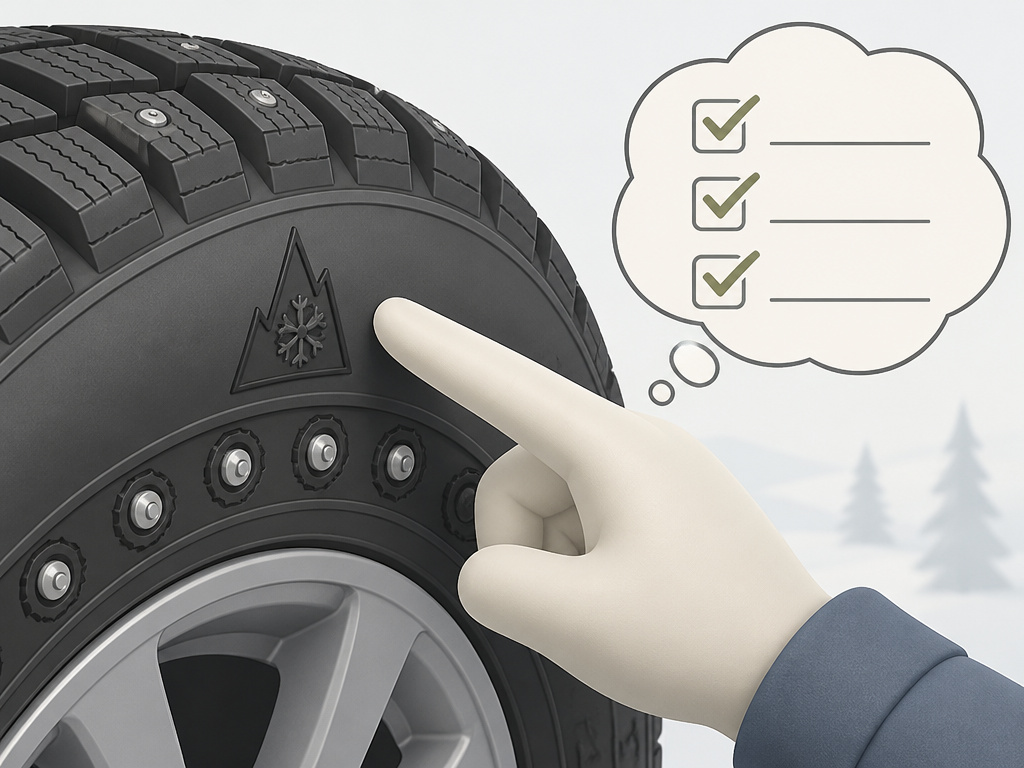
Check the sidewall.
| Check | Source guidance | Why it matters |
|---|---|---|
| Stud count | Nokian 190 studs; Hankook 130-190 | Retention and ice bite depend on size |
| Certification | 3PMSF is performance; M+S is tread pattern | It proves winter traction testing |
| Break-in | 300-500 miles for studded sets | Studs seat and retention improves |
| Replacement depth | TireGrades says 5/32; Autrex says 4/32; Norway legal 3 mm | Winter traction drops before summer minimum |
The Three-Peak Mountain Snowflake symbol is the winter traction certification. Studded tires must also meet stud protrusion and retention rules under ECE Regulation 117.
The default pick, stated plainly
If you want one answer for most plowed-road drivers: choose a studless tire such as the Bridgestone Blizzak WS90.
If your route is mostly glare ice and unplowed hills, choose a factory-studded set. The Nokian Hakkapeliitta 10 or Hankook Winter i*Pike RS2 W429 are clean starting points.
The Continental VikingContact 8 is the studless benchmark in the 2025 test; product page on Amazon.
TireGrades says most winter tires last 3-4 seasons with proper use and storage. Norway Explained says replace at 4 to 5 millimeters in practice. Norwegian law sets 3 millimeters as the minimum for passenger vehicles up to 3,500 kg.
Those tread-depth numbers disagree (TireGrades says 5/32″, Autrex says 4/32″, and Norway law sets 3 mm), so check your local rule and your own braking feel. (a tread depth gauge is cheap)
In the 2025 test, the studded Nokian Hakkapeliitta 10 cost €147, while the studless Continental VikingContact 8 cost €156, about 6% higher for the studless tire. Treat price as a local quote, not a rule.
These sources do not give a universal stud-loss rate, so treat any fixed mileage claim with caution.
How long do studded and studless winter tires last
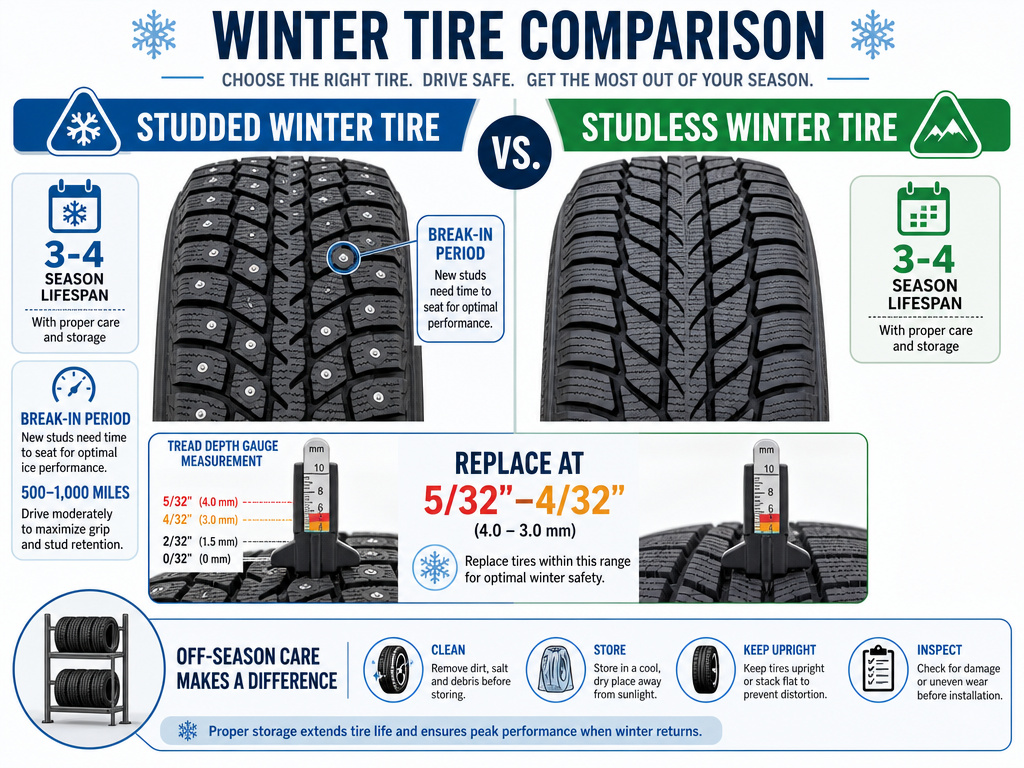
Both studded and studless winter tires typically last three to four seasons with proper use and storage. Studded tires require a break-in period to seat the studs properly. For longevity, winter tires should be replaced well before they reach the legal minimum tread depth. Recommendations for replacement depth vary (TireGrades says 5/32″, Autrex says 4/32″), but it is significantly higher than for summer tires. Using winter tires on dry pavement, especially studded ones, will accelerate wear. Storing them correctly off-season helps preserve the rubber compound’s flexibility.
Are studded tires more expensive than studless
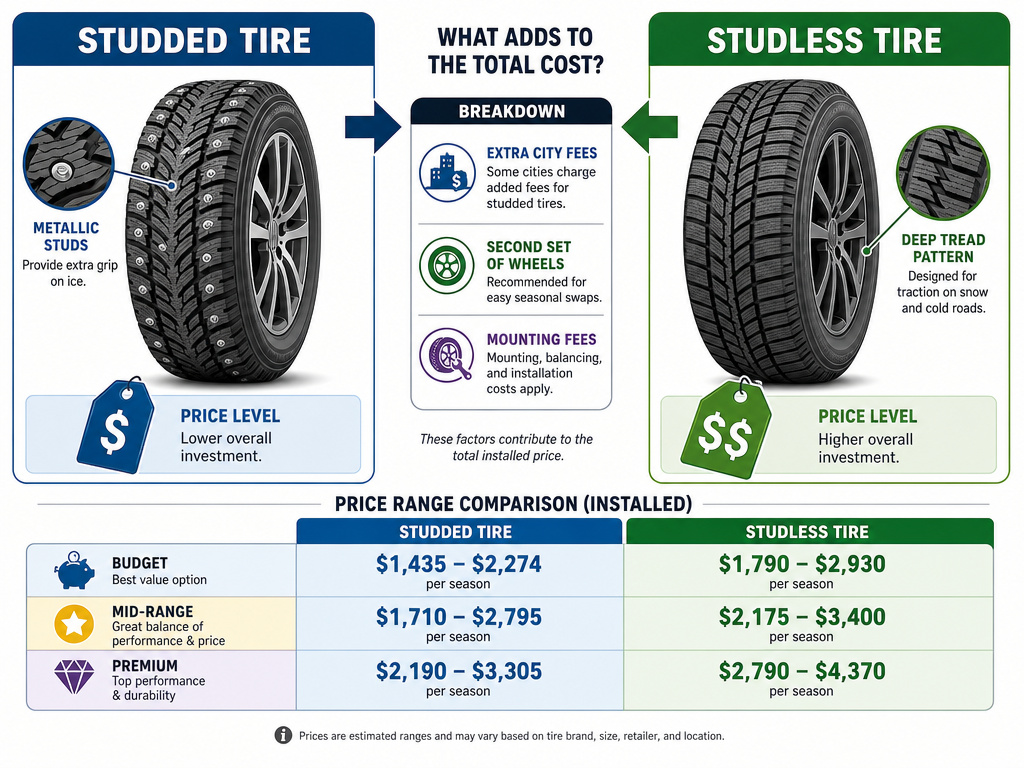
In a direct tire-to-tire comparison, the price difference can be minimal. One test showed a specific studded model costing about 6% less than a comparable studless premium tire. However, the total cost of ownership includes more than the tire price. Studded tires may incur extra fees in some cities. Running winter tires also involves the cost of a second set of wheels or seasonal mounting fees. Budget winter tires cost $60–$90 per tire, mid-range $100–$140, and premium $150–$250+ per tire, according to Autrex.
Frequently Asked Questions
Are studless snow tires as good as studded?
On glare ice, no. The 2025 Tekniikan Maailma test showed a 28% shorter ice braking distance for the studded tire. On packed snow, the answer is closer. The studless Continental was 1% faster in snow braking and 2% faster in snow handling in that test.
Are studded tires better than non-studded winter tires?
Only for frequent glare ice. Tire Advise says most US drivers are better served by studless winter tires. Prince Tires says studs earn their keep on icy highways, mountain passes, and rural roads.
What are the downsides of using studded snow tires?
Noise, road wear, legal limits, and faster stud wear on bare asphalt. The 2025 test scored the studded tire 7 points for noise versus 9 for the studless tire.
What states have banned studded tires?
Many US states restrict or ban studs, and the dates vary. Check your state before buying, because a studded set can be illegal or seasonal where you drive.
Is a studdable tire without studs a good compromise?
It is not the same as a dedicated studless tire. A studdable tire may have empty stud holes, and some shops only fit factory-studded tires. If you do not want studs, buy a studless tire with the 3PMSF symbol.
The Bottom Line
If your commute has more than one glare-ice stop per week, studs may earn their keep. If it is mostly plowed asphalt, choose studless and save the noise.
The studded vs studless winter tires choice gets simple when you separate surfaces. Ice favors studs. Snow, wet, dry, and quiet favor studless.
My pick for most drivers is the Bridgestone Blizzak WS90. For a true glare-ice route, the Nokian Hakkapeliitta 10 is the cleaner studded answer.
