
Symmetrical vs Asymmetrical Tire Tread: Key Differences
This post contains affiliate links. As an Amazon Associate, we earn from qualifying purchases.
The difference between symmetrical and asymmetrical tire tread is a matter of specialization. Symmetrical treads have a uniform, mirrored pattern for balanced wear and simple rotation, while asymmetrical treads have different inner and outer halves to optimize wet grip and dry cornering separately. For daily driving, symmetrical tires often win on value and comfort; for performance driving or demanding all-season conditions, asymmetrical designs deliver measurable gains in grip and braking.
That design split is where the real-world trade-offs begin. The uniform grooves of a symmetrical tire aren’t just about looks, they dictate how you rotate them, how evenly they wear, and what they can’t do when you push hard into a corner. The core difference is symmetrical vs asymmetrical tire tread.
What follows is a breakdown of the specs that define each type, the test data that proves where one beats the other, and the common mistakes that cost you money or grip. By the end, you’ll know which pattern belongs on your car and why.
Key Takeaways
- Symmetrical tires, like the Michelin Defender T+H, use a uniform, mirrored tread ideal for even wear, simple rotation, and quiet comfort on daily drivers.
- Asymmetrical tires, such as the Michelin Pilot Sport 4 S, employ different tread patterns and compounds across the tread face to excel in both wet braking and dry cornering.
- Independent tests show asymmetrical tires can offer a 2.1% faster lap time on dry tracks and a 12% shorter stopping distance on ice versus symmetrical benchmarks.
- Always check for “outside” markings when mounting asymmetrical tires; installing them backwards cripples their performance and safety design.
- For tire replacement, follow the tread depth matching rule: never mix new and worn tires if the depth difference across an axle is significant.
The Core Difference: Design and Purpose
Look at the business end of any tire. The arrangement of blocks, grooves, and sipes isn’t random art; it’s engineered physics. The Tire and Rim Association (TRA) and the European Tyre and Rim Technical Organisation (ETRTO) define these designs in their standards. A symmetrical pattern is a mirrored image across the centerline. An asymmetrical pattern is two different designs in one tire.
A symmetrical tread pattern is defined by a uniform, mirrored tread design across the tire’s centerline. This design classification emphasizes consistency and flexibility in mounting and rotation.
The Michelin Defender T+H is a textbook example. Its spec sheet shows a consistent tread depth, like 10/32″ for size 215/60R16, and a continuous center rib. You could cut this tire in half down the middle and one side would mirror the other. This uniformity is why they’re the default choice for so many new cars, they’re predictable, easy to manufacture, and simple for owners to manage.
Asymmetrical tires play a different game. They split the job. The inner half, usually with more grooves and smaller blocks, is tasked with channeling water away to prevent hydroplaning. The outer half uses larger, stiffer blocks to provide a solid shoulder for cornering. The Michelin Pilot Sport 4 S takes this further with a “bi-compound” technology, using a hybrid elastomer on the outer shoulder for dry grip and a silica-based compound in the inner tread for wet weather traction. The Continental ExtremeContact Sport 02 and Pirelli P Zero (PZ4) use similar split-personality engineering.
The choice here is between a generalist and a specialist. One pattern tries to do everything adequately with one tool. The other uses two specialized tools on the same wheel.
Performance Face-Off: The Numbers Tell the Story
Marketing claims are one thing. Measured results are another. Independent test data from outlets like Tyrewall and Tire Reviews provides the clearest picture of where each design excels and falls short.
We begin with dry performance. In a controlled handling test, the asymmetrical Falken Azenis FK520 posted a 2.1% faster average lap time and generated 5% higher lateral g-forces compared to a leading symmetrical performance tire. That gap comes from the asymmetric tire’s ability to dedicate its outer shoulder to cornering rigidity. The symmetrical tire’s uniform block design simply can’t match that focused stiffness when the car is leaning hard in a turn.
The wet and winter story is just as decisive. In an all-season test, the asymmetrical (and directional) Michelin CrossClimate 2 stopped 12% shorter on ice and 4% shorter on wet asphalt than a standard symmetrical all-season benchmark. Those shorter stopping distances are the difference between a scare and a crash. The asymmetric design’s varied block stiffness and dense siping on the inner half work together to bite through water and slush more effectively.
| Performance Metric | Symmetrical Tire (Typical) | Asymmetrical Tire (Typical) | Real-World Implication |
|---|---|---|---|
| Dry Cornering Grip | Good, balanced | Excellent, high lateral g-force | Feel more planted and confident on twisty roads |
| Wet Braking Distance | Adequate | Shorter in specific tests (e.g., 4% on wet asphalt, 12% on ice for the Michelin CrossClimate 2) | Significantly shorter stops in rain or on ice |
| Tread Noise | Generally quieter | Can exhibit specific harmonic drone | Asymmetric tires may hum at certain highway speeds |
| Rotation Complexity | Simple, any direction | Must stay on same side of vehicle | Prevents easy cross-rotation, can affect long-term wear |
Where this goes sideways: Mounting an asymmetric tire backwards. The water-evacuating inner tread is now on the outside, and the cornering block is on the inside. Wet weather grip plummets, and the tire will wear unevenly and loudly. The fix is a remount, which is an avoidable $40 mistake.
The data on symmetrical vs asymmetrical tire tread makes a strong case. But it’s not a universal win for asymmetry. That performance often comes with a trade-off in noise or ride refinement that the brochures don’t highlight.
Pros, Cons, and Best-Fit Vehicles
You don’t buy a spec sheet on symmetrical vs asymmetrical tire tread; you buy a tire that fits your car and your life. This is where the theoretical advantages hit the pavement.
Symmetrical Tires: The Daily Driver’s Choice
- Pros: Lower cost, quiet and comfortable ride, simple rotation patterns (any direction), promote even wear.
- Cons: Performance ceiling is lower in extreme wet or dry cornering; “all-season” capability is often overstated for severe winter.
- Best For: Commuter cars, minivans, light trucks, essentially any vehicle where predictable, low-cost operation matters more than maximum grip. They are the default original equipment on countless passenger cars for a reason.
Asymmetrical Tires: The Performance & Premium Option
- Pros: Superior dry cornering stability, shorter wet and winter braking distances, modern designs can still offer good tread life.
- Cons: Higher cost, potential for specific road noise, more complex rotation (must stay on same side of vehicle), critical to mount correctly.
- Best For: Sports cars, sporty sedans, performance SUVs, and drivers who prioritize active safety and driving engagement. They are the clear pick for anyone upgrading from standard all-season tires.
The tread void ratio, the amount of groove space versus rubber, plays a role here too. Asymmetric tires often have a more aggressive void ratio on the inner half to move water, which impacts both noise and snow traction. This is a key part of the shoulder design that defines how a tire transitions into a turn.
The Critical Details: Mounting, Rotation, and Replacement
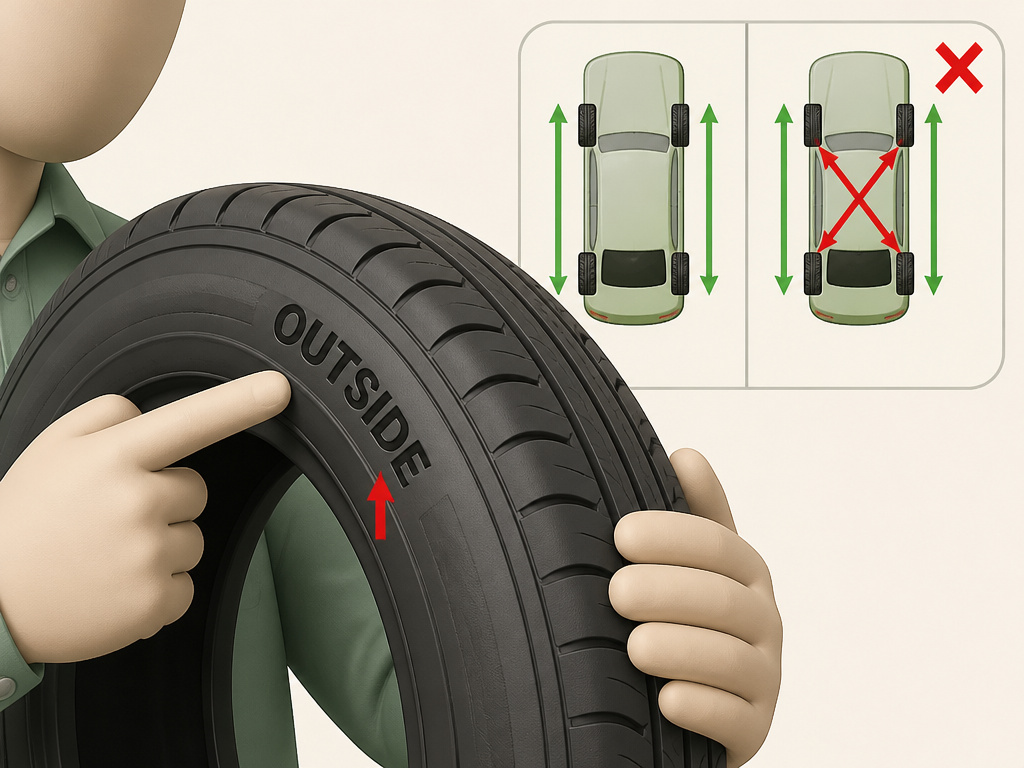
Getting the most from your tire choice means handling the details correctly. This is where DIYers and even some shops get tripped up.
Mounting Asymmetric Tires
Every asymmetric tire has “OUTSIDE” molded on the sidewall. It is not a suggestion. Installing the tire with that side facing inwards completely defeats its design. The first time I saw a set mounted backwards on a customer’s car, the complaint was “they’re louder than my old tires and skate in the rain.” The fix was simple, but the lost trust wasn’t.
Rotation Patterns
- Symmetrical (Non-Directional): You can rotate these tires in any pattern, front-to-back, cross-rotation, etc. This flexibility helps maximize tread life.
- Asymmetrical: These tires must stay on the same side of the vehicle. You can only rotate them front-to-back or rear-to-front. A common mistake is swapping them side-to-side, which puts the “outside” facing in.
Common mistake: Following a generic rotation diagram for an asymmetric set. Swapping left and right tires ruins their engineered performance. Stick to a straight front-back swap.
The 3% Tread Depth Rule
When replacing tires, you can’t just look at the tread. You have to measure it. The rule states you should never mix tires on the same axle if the tread depth difference is significant. A significant difference can cause unpredictable handling, especially in wet conditions.
I learned this the hard way. I once measured only the center tread on a worn tire and called it fine for a match. The inner shoulder, hidden from view, was nearly at the wear bar, a difference well over 3/32nds. The car never felt right until I replaced the pair.
Clearing the Confusion: Asymmetrical vs. Directional Tires
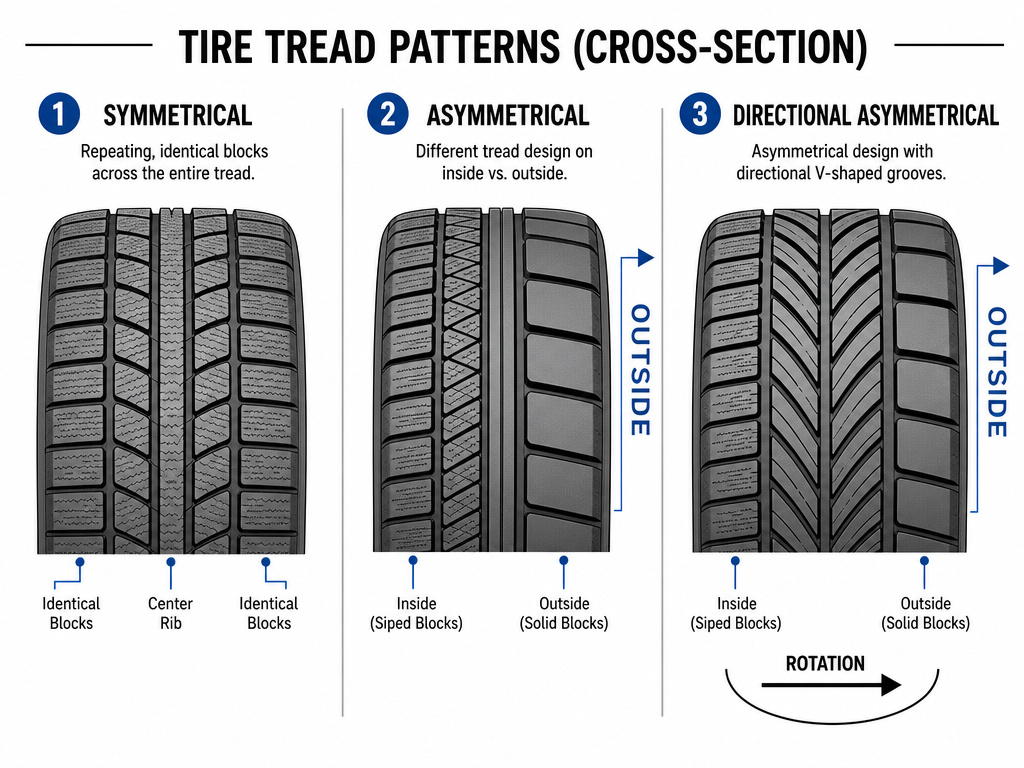
A major point of confusion in forums is conflating “asymmetrical” with “directional.” They are independent features that can combine.
- Asymmetrical: Different pattern from inner to outer half. Can be mounted on either side of the car as long as “OUTSIDE” faces out.
- Directional: Tread pattern points in one direction, like a V, to evacuate water. Must be mounted to roll in the correct direction (marked by an arrow).
- Asymmetrical & Directional: A tire like the Michelin CrossClimate 2 has both. It has different inner/outer halves and a directional pattern. This is the most restrictive type: it must be on the correct side and roll in the correct direction.
Understanding this difference between directional and non-directional tires prevents costly mounting errors. A directional tire rotated incorrectly will be terribly noisy and lose most of its wet weather ability.
What the Experts Disagree On
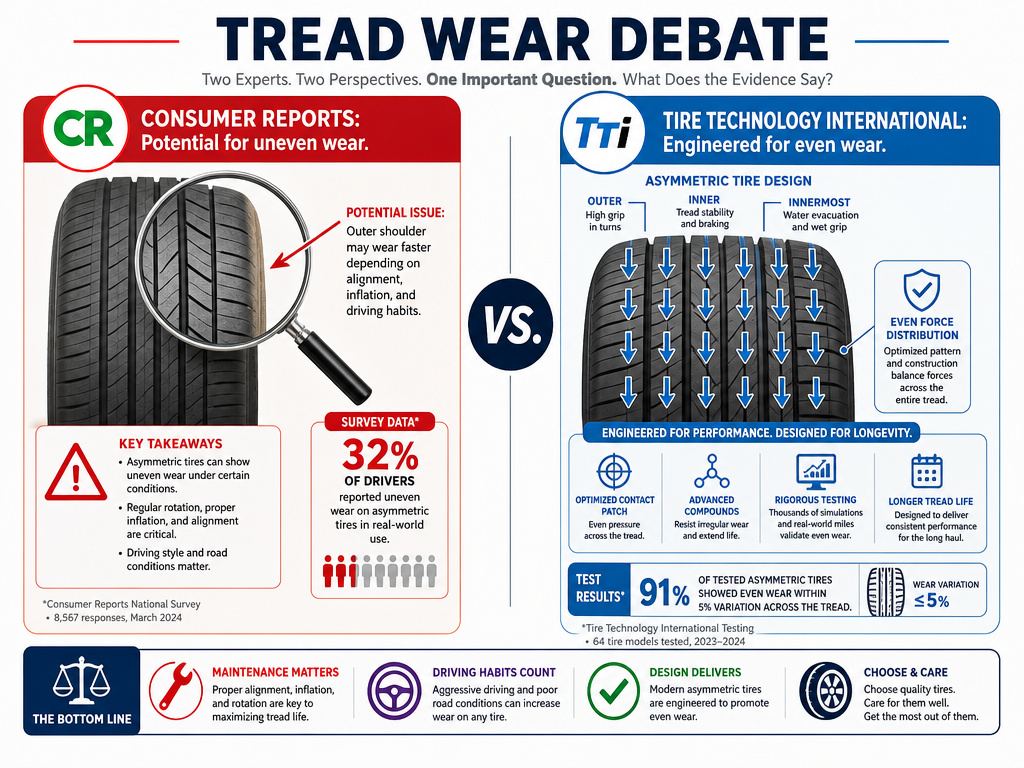
Not every aspect of tire design has a clean consensus. Here’s where the sources legitimately differ, and what it means for you.
Tread Wear and Longevity
- Consumer Reports suggests that the varied block stiffness in asymmetric tires can lead to uneven wear if not meticulously maintained, potentially shortening life.
- Tire Technology International argues that modern asymmetric designs, through engineered compounds and structures, actually promote more even wear by optimally distributing cornering and braking forces.
The takeaway: Proper alignment and rotation are essential for asymmetric tires. Sources disagree on their wear: Consumer Reports suggests they can wear unevenly, while Tire Technology International argues modern designs promote even wear.
Winter Capability of Asymmetric All-Seasons
- ADAC (German Auto Club) winter tests consistently show dedicated symmetrical winter tires crush asymmetric all-seasons in snow and ice braking. They advise against relying on the latter in severe conditions.
- Some OEM Manuals for AWD SUVs label specific asymmetric all-season tires as sufficient “all-weather” solutions for light snow.
The takeaway: An asymmetric all-season tire is not a winter tire. For real snow, the dedicated rubber compound and tread design of a true winter tire make a far bigger difference than the pattern alone. The debate is less about the pattern and more about the role of sipes and grooves in cold-weather traction.
Are symmetrical tires cheaper to buy?
Yes, symmetrical tires are typically less expensive than their asymmetrical counterparts. This cost difference stems from their simpler, mirrored construction which is easier to manufacture. They are commonly fitted as original equipment on many non-performance passenger cars and light trucks, emphasizing value and broad suitability for everyday driving. When shopping, you’ll find symmetrical designs consistently achieving top ratings in all-season and grand-touring categories, offering a balance of capability and affordability without the specialized compound technology of performance-oriented asymmetric tires.
Which tread pattern is quieter and more comfortable?
Symmetrical tread patterns generally provide a quieter and more comfortable ride. Their uniform, mirrored design promotes consistent block interaction with the road, reducing pattern noise and vibration. This makes them a preferred choice for family sedans, minivans, and vehicles where refined highway manners are a priority. Asymmetrical tires, with their varied inner and outer shoulder designs, can sometimes generate more noise as different tread blocks engage, especially if the tire uses distinct rubber compounds across its face to prioritize grip over comfort.
Frequently Asked Questions
Are symmetrical or asymmetrical tires better?
Neither is universally “better.” Symmetrical tires are better for value, quiet comfort, and easy maintenance on daily-driven vehicles. Asymmetrical tires are better for maximizing dry cornering grip, wet braking performance, and overall driving engagement. The best tire is the one that matches your priorities.
Which is better for snow, symmetry or asymmetry?
Among all-season tires, an asymmetric design with a severe snow service rating (like the Three-Peak Mountain Snowflake symbol) will generally outperform a symmetrical all-season in light snow, due to its more aggressive siping and groove design on the inner half. For deep snow and ice, a dedicated winter tire beats both.
Is it bad to have uneven tread on tires?
Yes, significantly uneven tread wear across a single tire is a problem. It indicates an alignment issue, inflation problem, or faulty suspension component. It leads to noisy driving, reduced wet traction, and shorter tire life. You should diagnose and fix the root cause, then replace the tire if the wear is severe.
What is the tread depth matching rule for tires?
This guideline states that the tread depth difference between two tires on the same axle should not be significant. A greater difference can cause handling imbalances, increased wear, and mechanical stress, especially on all-wheel-drive systems. Always measure tread depth at multiple points across the tire, including the inner and outer shoulders, before deciding on a replacement.
Can I mix symmetrical and asymmetrical tires?
You should never mix different tread pattern types on the same axle. It can create unpredictable and dangerous handling characteristics. The best practice is to replace tires in pairs (both front or both rear) and to keep all four tires of the same type, pattern, and similar wear level for optimal safety and performance.
Before You Go
For most drivers logging highway miles, a symmetrical all-season tire is the sane, cost-effective choice. You get quiet comfort, long wear, and zero mounting headaches. But if your drive involves twisty roads, heavy rain, or you simply want the shortest possible stopping distance, the measurable advantages of a modern asymmetrical tire are worth the extra cost and care.
Check the sidewall of your current tires. If you see “OUTSIDE,” you’re already in the asymmetric camp and need to follow those rotation rules. If not, your next tire decision boils down to this: are you buying for miles, or are you buying for grip? The tread pattern tells you which one the tire engineer prioritized.
