
Tire Speed Rating Explained: How to Find Yours
This post contains affiliate links. As an Amazon Associate, we earn from qualifying purchases.
A tire speed rating is a letter code, like T, H, or V, that indicates the maximum speed a tire can safely sustain under its maximum load in ideal, controlled lab conditions. It is not a recommended travel speed. For your safety, replacement tires must meet or exceed the speed rating specified by your vehicle’s manufacturer, which you’ll find on the driver’s door jamb placard or in the owner’s manual. A lower-rated tire isn’t designed to handle the heat buildup at sustained highway speeds, which can lead to a sudden failure.
That last point about heat is the whole game. The rating isn’t about whether the rubber can spin at 118 mph for a second. It’s a certification that the tire’s internal structure, the belts, the casing, the compound, can dissipate the intense, continuous heat generated at that speed without coming apart. Get that wrong, and nothing else about the tire matters. This is essentially a tire speed rating explained.
What follows is a breakdown of where the rating comes from, how to read yours, and the real-world rules that keep you safe, which is essentially a tire speed rating explained. This section explains the common letter codes, the main exception for winter tires, and the physical consequences of ignoring the specification.
Key Takeaways
- The speed rating is the final letter in your tire’s sidewall size code (e.g., the “V” in P205/55R16 91V).
- Always match or exceed your vehicle manufacturer’s specified rating when buying replacements.
- Speed ratings are void if the tire is damaged, under-inflated, overloaded, or repaired, a perfect “V” rated tire running 10 psi low is no longer a V-rated tire.
- For winter driving, you can sometimes use a lower-rated tire marked with the 3-Peak Mountain Snowflake (3PMSF) symbol, but you must then never exceed that tire’s lower speed limit.
- Physically, exceeding the rating causes excessive heat buildup that can lead to tread separation or a blowout; the lab test for a “T” (118 mph) tire involves running it for hours under load at that speed.
How to Find Your Tire’s Speed Rating
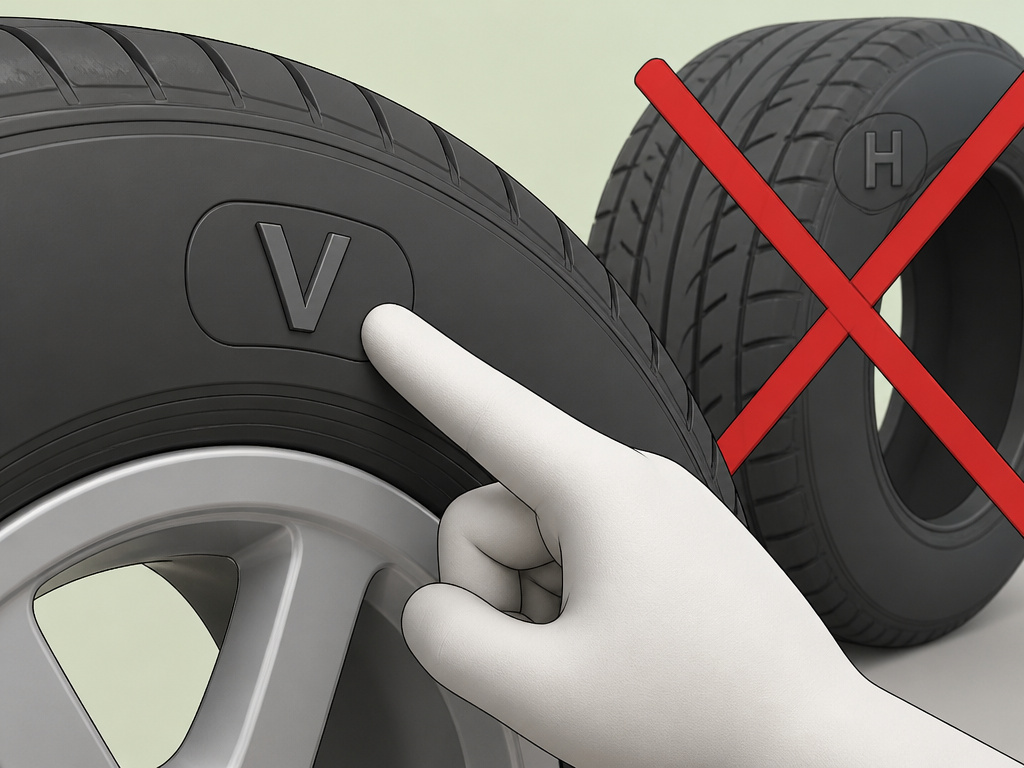
Look at your tire’s sidewall. Find the string of letters and numbers that looks something like “P205/55R16 91V”. The speed rating is the single letter at the very end of that sequence. In that example, it’s V.
Your vehicle needs a specific rating. Don’t guess. Find the manufacturer’s specification on the tire information placard, usually stuck inside the driver’s door jamb. It’ll list the exact tire size and speed rating your car was engineered for. You can also check your owner’s manual. This is the target you must hit or beat when buying new tires.
The speed rating is designated by a letter that indicates the maximum speed capability of a tire based on standardized laboratory tests under specific, controlled conditions. These ratings do not necessarily relate to actual tire performance on the road, but are instead intended to provide comparative performance measurements of tires with different ratings.
I learned to check this first, before even looking at the tread pattern or brand. A few years back, I nearly recommended a set of tires where the load index and size were perfect, but the speed symbol was one letter off from the placard. The details decide it. Skipping that check is how you end up with a tire that fits the rim but fails the car.
Common Speed Ratings and What They Mean
The most common ratings for passenger vehicles today fall in the S through Y range.
Here’s a quick reference for the ratings you’re most likely to encounter:
| Speed Symbol | Maximum Sustained Speed (mph) | Typical Vehicle Application |
|---|---|---|
| S | 112 | Family sedans, older models |
| T | 118 | Minivans, modern sedans |
| H | 130 | Sport sedans, coupes |
| V | 149 | Performance cars, sport trucks |
| W | 168 | High-performance sports cars |
| Y | 186 | Exotic supercars |
Where this goes sideways: Assuming a higher rating is always better. For a daily-driven commuter car, a W or Y-rated tire often has a stiffer, noisier ride and may wear faster than a T or H-rated tire designed for comfort. You’re paying for capability you’ll never use, and sacrificing the experience you actually feel every day. Match the tire to the driver, not the hype.
Why the Speed Rating Exists: The Lab Test
The rating isn’t a marketing term; it’s the result of a standardized laboratory endurance test for a tire speed rating explained. For a tire to earn a “T” rating (118 mph), it must pass a standardized laboratory endurance test that validates it can sustain that speed.
The official federal test for non-speed-restricted tires (per FMVSS 119) involves conditioning the tire to 95°F for three hours, then running it under 88% of its max load at 250 rpm for 2 hours. Tires that pass get their letter. Tires that show signs of failure, cord separation, blistering, rapid pressure loss, do not.
This means two things. First, the rating assumes the tire is in perfect, undamaged condition and properly inflated. Second, it defines sustained speed. The test doesn’t check for a quick burst to 130 mph; it validates that the tire can handle that speed continuously, which is where the destructive heat builds.
Can You Use a Tire With a Higher or Lower Speed Rating?
This is the question that fills forum threads. The official guidance from manufacturers like Michelin is clear.
Higher Rating: Yes, you can install a tire with a higher speed rating. A V-rated tire on a car that calls for H is generally safe. It’s often overkill, but it’s not dangerous from a speed-capability standpoint. The vehicle’s handling may feel slightly different due to the tire’s stiffer construction.
Lower Rating: This is where you must be careful. As a rule, using a tire with a lower speed rating is not recommended.
There is one common, legal exception: winter tires. Michelin states that a lower rating is acceptable if the tires are winter-capable, like Winter or All-Season tires marked with the 3-Peak Mountain Snowflake (3PMSF) symbol. The trade-off is explicit: you gain winter traction but must never drive faster than the new, lower maximum speed on those tires. If you mount S-rated (112 mph) snow tires, you become responsible for staying under that limit.
Common mistake: Downgrading a speed rating for a cheap all-season tire that isn’t a dedicated winter tire. The risks of a lower speed rating aren’t worth the savings on a daily driver.
The Critical Link: Speed Rating, Load, and Inflation
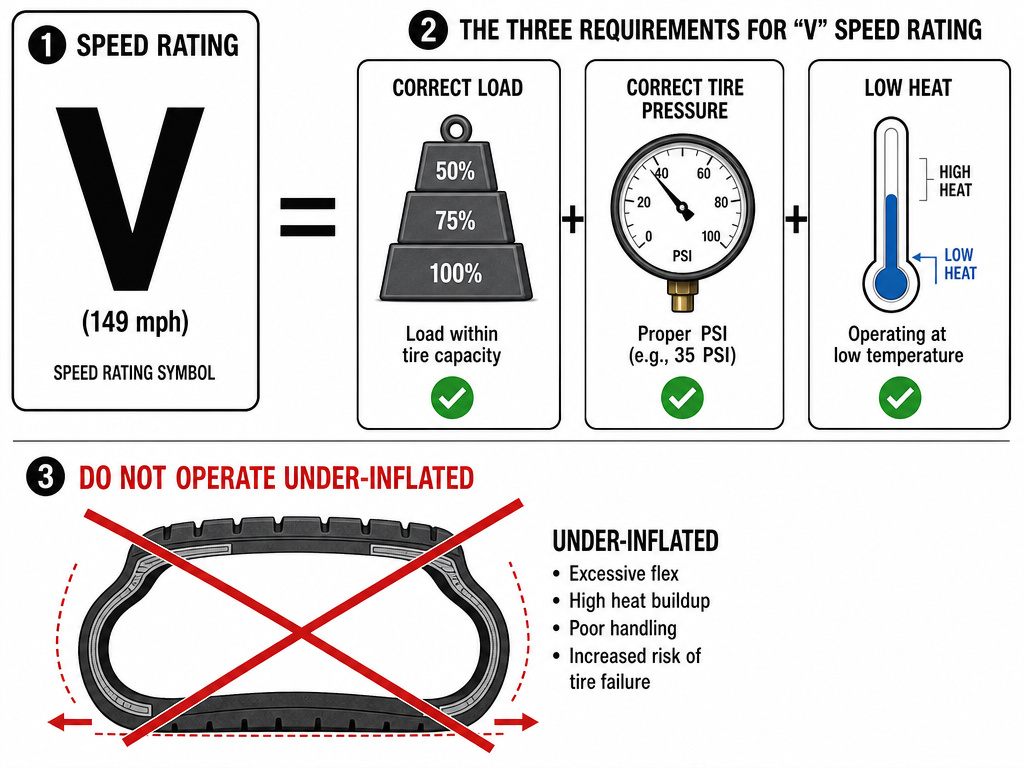
The speed rating is not a standalone promise. It’s a component of the tire’s “service description,” which is always paired with a load index number (e.g., 91V). That “91” is the load index. The speed rating letter only applies when the tire is carrying the load that corresponds to that index at its proper inflation pressure.
The industry manuals are blunt about this. Bridgestone and the NHTSA state that speed ratings do not apply to tires that have been damaged, altered, under-inflated, overloaded, or repaired.
Think of it this way: a tire’s load capacity and its speed capability are a package deal. An under-inflated or overloaded tire generates more internal flex and heat at any speed. A V-rated tire that’s 10 psi low might not safely handle 100 mph, let alone 149 mph. The rating is void. This is why checking your tire load index and maintaining proper pressure is as important as the speed letter itself.
What Happens If You Exceed the Tire Speed Rating?
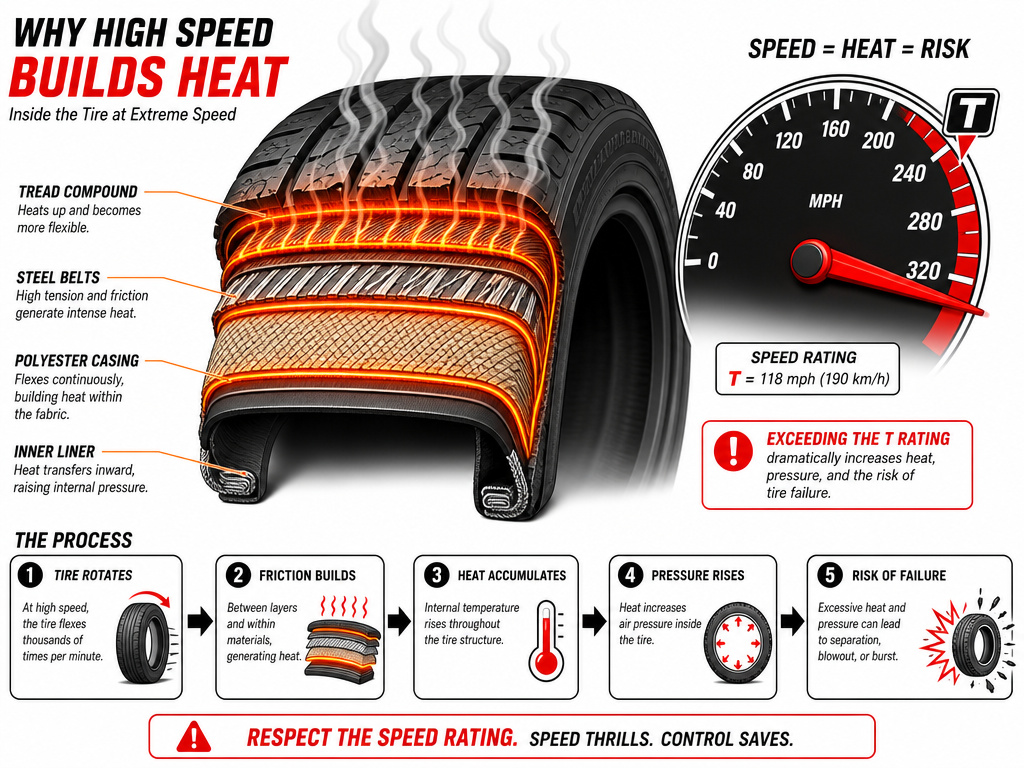
You generate more heat than the tire was designed to dissipate. At a sustained speed above its rating, the rubber and internal materials (steel belts, polyester casing) begin to overheat.
If you continue, the excessive heat can cause the bond between the tire’s layers to break down. This can lead to a tread separation, where the tread peels away from the body, or a sudden blowout. The failure might not happen instantly at the moment you hit 119 mph in a T-rated tire; the damage can accumulate and cause a failure miles later, or on your next drive.
This risk is why specialized “speed-restricted” commercial tires exist. For some vehicles, tires with a speed restriction of 55 mph or less must be marked “Max speed ____ mph” on the sidewall. An NHTSA interpretation letter cites a case where a competitor stated such tires could go 65 mph at lower loads, but NHTSA’s position is that a tire marketed for use over 55 mph would not be considered speed-restricted and must meet non-speed-restricted requirements.
Do All Four Tires Need the Same Speed Rating?
Yes. For predictable handling and safety, all four tires on your vehicle should have the same speed rating.
If you must mix due to an emergency spare or a staggered fitment (different sizes front and rear), the vehicle’s capability is limited by the lowest-rated tire on the car. If you have three V-rated tires and one T-rated tire, you should not exceed the T-rating’s 118 mph limit. This is why manufacturers stress a full matching set. Mismatched ratings can lead to uneven handling, especially at higher speeds, as one corner of the car may flex and heat up differently than the others. Before you consider mixing tires with different speed ratings, understand you’re accepting a compromise.
Special Cases: Winter Tires, Age, and Damaged Tires
A few scenarios break the standard “match the placard” rule.
Winter & Snow Tires: As noted, the 3PMSF symbol is your green light for a lower speed rating. The compound is designed for cold-weather grip, not high-speed endurance. Adjust your driving accordingly.
Tire Age: Speed capability degrades over time. The NHTSA recommends replacing tires more than 10 years old, while Kia recommends replacing tires over 6 years old. This disagreement means you should err on the side of caution. An old tire with plenty of tread may not have the structural integrity to handle its original speed rating, especially if it’s been exposed to ozone and weather.
Damaged or Repaired Tires: Any tire that has been punctured and repaired, has sidewall damage, or shows signs of impact (bulges, cracks) no longer carries its original speed rating. The repair or damage has altered its structural integrity. It should be considered a general-use tire only, driven well within legal speed limits.
Why is the H speed rating out of alphabetical order?
If you look at the sequence of common speed ratings, you’ll notice an odd jump. The letter U corresponds to a maximum speed of 124 mph. The next letter, V, corresponds to 149 mph. But in between them sits the H rating, which is for 130 mph. This breaks the alphabetical pattern because the system evolved over time. When first created, H was the highest rating available. As tire technology advanced to handle higher speeds, new letters like V, W, and Y were added above it. The original H rating was kept in its established place within the performance hierarchy, which is why it now appears between U and V when sorted by speed capability.
Frequently Asked Questions
Do all four tires need to be the same speed rating?
Yes, for optimal and predictable performance. If they differ, your vehicle’s safe maximum speed is limited by the tire with the lowest rating.
Is a 3/32 tread bad for tires?
Yes, it’s near the end of its safe life. The tire is legally worn out and dangerously low on wet traction. The NHTSA states a tire is dangerously worn and must be replaced immediately at 2/32 inch tread depth. Replace tires before they reach this point.
What is the maximum speed of a 95H speed rating tire?
The “H” denotes the speed rating. A tire with an H rating, like a 95H, has a maximum sustained speed capability of 130 mph. The “95” is the load index, a separate number indicating how much weight it can carry.
What happens if I go faster than my tire speed rating?
You risk overheating the tire, which can lead to a catastrophic failure like tread separation or a blowout. The tire’s internal structure is not designed to manage the heat generated at speeds above its rating, even if the tread looks fine.
Can I ignore the speed rating if I never drive fast?
No. The rating reflects overall structural integrity and heat resistance. A lower-rated tire may have a different handling character, wear faster, and could affect your vehicle’s electronic stability systems. It’s also a potential issue for insurance or warranty claims if an accident occurs.
The Bottom Line
Read the sidewall. Match the letter on your door jamb. That’s the core of it.
For most drivers, the takeaway is simple: buy tires that match the speed rating on your vehicle’s placard. The only time to deliberately go lower is for a dedicated winter tire, and that comes with a strict speed limit you must obey.
The system exists because the physics of heat are unforgiving. The lab test proves the tire can handle it. Your job is to keep the tire in a condition, properly inflated, undamaged, and not overloaded, so that promise is still valid when you need it.
