
Tire Temperature Ratings Explained: The a, B, and C Guide
This post contains affiliate links. As an Amazon Associate, we earn from qualifying purchases.
Tire temperature ratings are the A, B, and C grades found in the UTQG marking on a tire’s sidewall. They represent the tire’s resistance to heat generation and its ability to dissipate heat when tested under controlled conditions on a specific indoor laboratory test wheel. Grade C is the minimum legal standard all passenger car tires must meet; Grades B and A represent higher levels of performance on that test.
The test is brutal. A tire is mounted on a 67-inch steel drum, loaded to 88% of its maximum capacity, and run at increasing speeds until it fails or completes the sequence. The grade you see is the result. The sidewall doesn’t tell you that the grade only applies if the tire is properly inflated and not overloaded. Exceed those conditions, and even an A-rated tire can overheat and fail. This is why understanding tire temperature ratings explained is critical.
What follows is a breakdown of the federal test, what each grade means for your driving, and the specific scenarios where paying for a higher temperature rating is an essential safety upgrade.
Key Takeaways
- The A, B, and C grades are part of the UTQG system and measure a tire’s lab-tested heat resistance, not its speed rating.
- A Grade C tire fails to complete the 500 rpm stage of the federal endurance test and is the minimum legal standard for passenger cars.
- The rating assumes proper inflation and load. Underinflation or overloading causes heat buildup that can defeat any temperature grade.
- For towing, desert driving, or sustained high-speed travel, a Grade A tire is a worthwhile investment in safety margin.
- Check your tire’s date code. Heat accelerates aging, and manufacturer replacement recommendations (like Kia’s 6-year guideline) can be more conservative than the NHTSA’s 10-year general advice.
What the A, B, and C Temperature Grades Mean
Read the sidewall. Near the tread shoulder, you’ll find a block of text that says something like “TREADWEAR 420 TRACTION AA TEMPERATURE A”. That last letter is what we’re talking about. It’s not a suggestion. It’s a federally mandated grade.
The temperature grades are A (the highest), B and C, representing the tire’s resistance to the generation of heat and its ability to dissipate heat when tested under controlled conditions on a specified indoor laboratory test wheel. Grade C corresponds to a level of performance which all passenger car tires must meet under the Federal Motor Vehicle Safety Standard No. 109. Grades A and B represent higher levels of performance on the laboratory test wheel than the minimum required by law.
That’s the verbatim explanation from the DOT Consumer Tire Grading Guide. The key phrase is “on the laboratory test wheel.” This isn’t a road test. It’s a standardized torture test designed to simulate the effects of sustained high speed. Heat is the enemy of a tire. It breaks down the rubber compounds and the internal materials (steel belts, polyester plies) that hold everything together. A tire that can’t shed heat effectively will literally come apart.
Grade C is the baseline. It passed the test, but just barely. According to the CFR tire grading standards, a tire earns a C if it fails to complete the 500 rpm stage of the test procedure. You’ll find C grades on some budget all-season tires and many original equipment tires on basic economy cars. They’re legal, but they have the least margin for error if you push them.
Grade B is the common middle. Most mainstream all-season and touring tires from major brands like Michelin, Continental, and Bridgestone carry a B rating. It means the tire completed the more strenuous stages of the test, offering a better safety buffer for everyday driving, including highway commutes and the occasional loaded trip.
Grade A is the high-performance standard. This is the top mark. You’ll see it on many performance summer tires, ultra-high-performance all-seasons, and tires designed for sports cars and heavy vehicles. An A rating indicates the tire managed the test’s highest heat loads without failure, which translates to a greater reserve for aggressive driving, high ambient temperatures, and heavy loads.
The Federal Lab Test: How a Tire Earns Its Grade
The test demystifies the grade. It’s not arbitrary. The procedure for tire temperature ratings explained is spelled out in Uniform tire quality legal standard, and it’s designed to be repeatable and harsh.
First, the tire and rim assembly is conditioned to 95 °F for at least 3 hours. The ambient air around the test is also held at 95 °F. The tire is inflated to a set pressure (30, 34, or 38 psi for tires other than CT tires, depending on maximum permissible inflation pressure) and pressed against a giant, flat-faced steel drum that’s over 67 inches in diameter.
Then the punishment begins:
- The drum rolls, pressing a load equal to 88 percent of the tire’s maximum load rating into the tire.
- It spins at 250 rpm for 2 hours.
- The tire is allowed to cool back to 95 °F or for 2 hours, whichever takes longer.
- The test resumes, ramping up the speed every 30 minutes: 375 rpm, then 400 rpm, 425 rpm, and so on in 25 rpm increments.
- The test continues until the tire fails or has run at 575 rpm for 30 minutes.
A tire that cannot complete the 500 rpm stage earns a Grade C. The regulation defines performance criteria for higher grades, but the fact sheet does not specify the exact cutoffs for A and B. This is a test of endurance under heat and load, not a measure of how fast you can legally drive. That’s the job of the speed rating (H, V, W, etc.), a completely different marking.
Where the Rubber Meets the Road: When the Rating Actually Matters
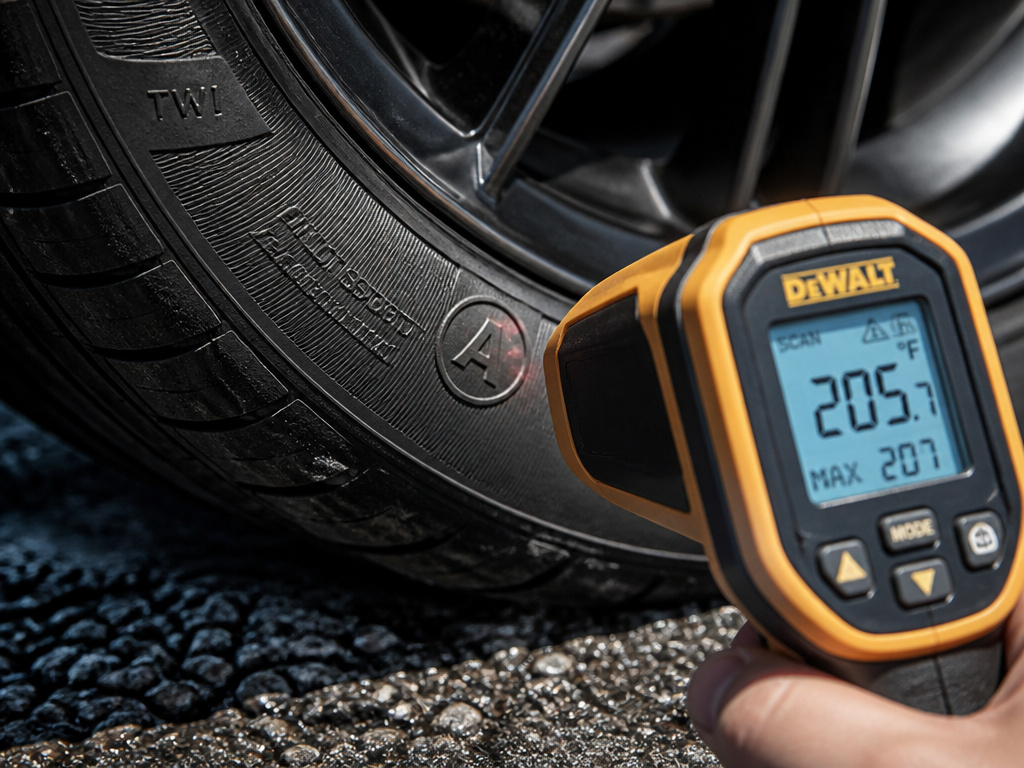
For a daily commute in a temperate climate with a lightly loaded car, a B-rated tire is perfectly sufficient. Millions of cars roll on them without issue. The tire temperature ratings explained becomes a critical purchase factor in specific, high-demand situations.
Where this goes sideways: Assuming a high temperature rating lets you ignore tire pressure. The grade is void if the tire is underinflated. Underinflation is the single fastest way to generate destructive heat, regardless of the letter on the sidewall.
Here’s when you should actively seek out a higher temperature grade:
You Tow or Haul Heavy Loads Frequently. A trailer or a full bed increases the tire’s workload dramatically. More flex in the sidewall and tread generates more heat. An A-rated tire has a compound and construction better suited to dissipating that extra thermal energy. This is one area where matching or exceeding the vehicle manufacturer’s original equipment rating is smart.
You Drive in Consistently Hot Climates. Ambient temperature is a huge factor. A tire running on 100°F asphalt is starting its workday already stressed. The tires in hot weather face accelerated wear and a higher baseline operating temperature. An A rating provides a larger safety cushion against heat-induced failure on long, hot highway trips.
You Enjoy Sustained High-Speed Driving. While the speed rating (like V for 149 mph) indicates the tire can handle the centrifugal forces at that speed, the temperature rating indicates it can handle the heat generated. For track days or extended autobahn runs, an A-rated tire paired with an appropriate speed rating is the correct combination.
| Use Case | Recommended Min. Temp Grade | Why It Matters |
|---|---|---|
| Daily Driving / Mild Climates | B | Adequate margin for normal heat buildup from highway speeds. |
| Frequent Towing / Max Loads | A | Handles extra heat from constant high sidewall flexion. |
| Desert/Hot Climate Living | A | Larger safety buffer against high ambient starting temperatures. |
| Performance/Sustained High Speed | A | Manages intense heat from aggressive cornering and braking. |
For everyone else? A B rating is the sweet spot. It offers a tangible safety improvement over the minimum C grade without pushing you into the premium cost often associated with A-rated performance tires.
The Critical Fine Print: What the Rating Does NOT Cover
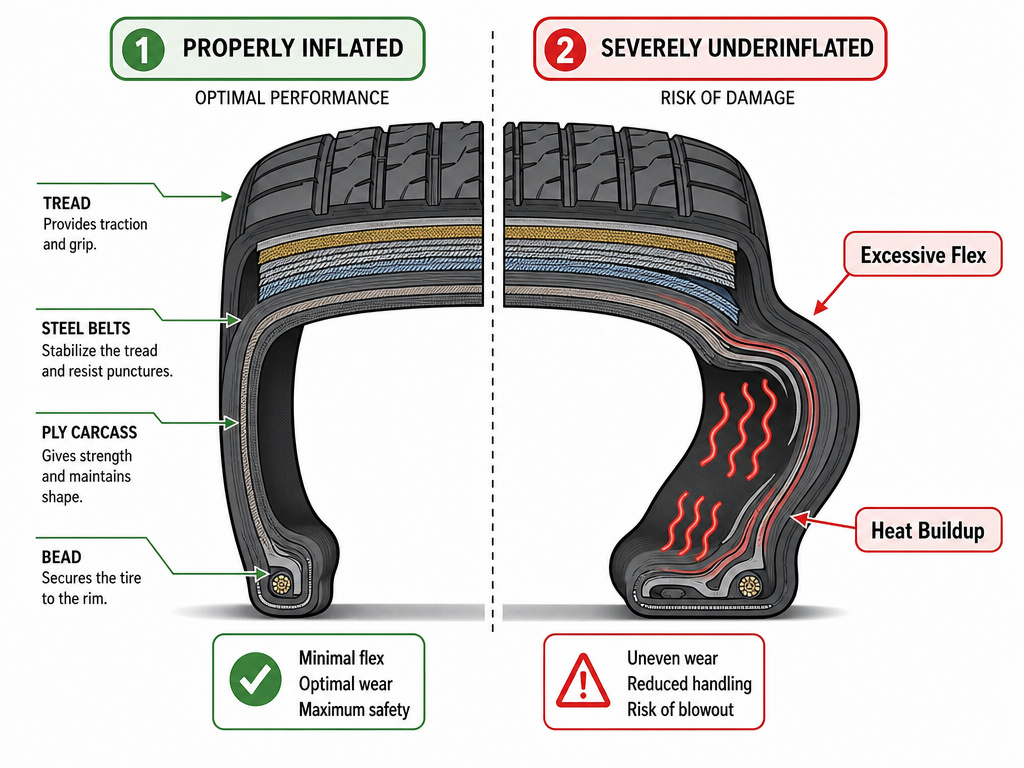
The rating has limits. The federal guide and the law are explicit about them. The temperature grade is established for a tire that is “properly inflated and not overloaded.” That’s a conditional warranty. Break those conditions, and you’re on your own.
Underinflation is a grade-killer. An underinflated tire flexes excessively as it rolls. This flexing generates internal friction, and heat, exponentially faster than normal. The USTMA Care and Service document states plainly: “Under inflation and/or over loading of a tire causes excessive heat build-up and internal structural damage.” This damage can lead to a failure weeks or months later. Your tire pressure is the most important factor in heat management, full stop.
Overloading has the same effect. Exceeding the tire’s maximum load rating (found on its sidewall) or your vehicle’s GVWR stresses the tire beyond its design parameters. The internal structures heat up and can separate. This is a primary cause of tire failures on RVs and overloaded trucks.
Age and Storage Matter. The tire compound degrades over time. Heat from climates or storage conditions accelerates this. The Kia owner’s manual advises replacing tires “after approximately 6 years of normal service,” noting heat accelerates aging. The NHTSA Tire Maintenance Manual recommends pulling tires over 10 years out of service. This is a point of disagreement among manufacturers and safety agencies. A six-year-old A-rated tire stored in a hot Arizona garage may be more compromised than a eight-year-old B-rated tire stored in a cool, dark basement. Inspect older tires for cracking, regardless of their original grade.
How to Check Your Tire’s Temperature Rating and Health
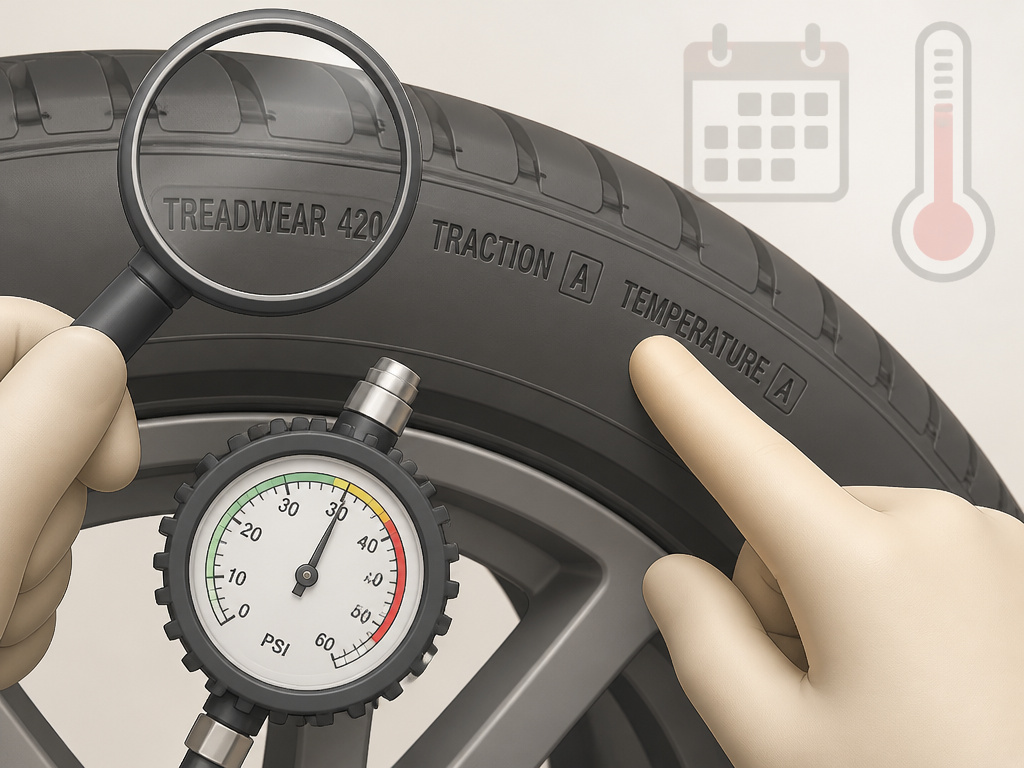
This takes two minutes. Walk to your car and look at the tire’s sidewall, between the tread and the wheel rim. Find the UTQG block. The temperature grade is a single letter (A, B, or C) next to the word “TEMPERATURE.”
While you’re there, do two more things:
- Check the Date Code. It’s the last four digits of the DOT number. “1626” means the 16th week of 2026. This tells you the tire’s true age.
- Check the Pressure. Use a gauge when the tires are cold (parked for at least 3 hours). Match the PSI to your vehicle’s placard (on the driver’s door jamb), not the “max press” on the tire sidewall.
Check inflation pressure at least once per month, before each trip, and each morning you drive during a trip. Check inflation pressure at least once per month, before each trip, and each morning you drive during a trip. And understand that how air temperature affects tire pressure is a real phenomenon; for example, a passenger or light truck tire used on an RV may lose 1 to 2 psi for every 10 °F temperature drop.
What Percentage of Tires are A, B, or C Rated?
The fact sheet provided does not contain specific market statistics on the distribution of temperature grades, such as what percentage of tires sold are A-rated. However, the grading standards themselves provide context. Grade C represents the minimum level of performance all passenger car tires must legally meet. Grades A and B represent higher levels of performance on the laboratory test wheel than this minimum legal requirement. In practical terms, this means that while a C grade is legally sufficient, many manufacturers aim for higher grades to offer better heat resistance and safety margins, especially for performance or touring tires. When shopping, you can check the sidewall to see the specific grade for any tire.
Frequently Asked Questions
Is a C temperature rating unsafe?
Not inherently. A Grade C tire meets the minimum federal safety standard. It is safe for use at legal highway speeds under normal loading and proper inflation. However, it offers the smallest safety margin. For drivers who often carry heavy loads, drive in very hot climates, or push their vehicles, moving to a B or A grade is a prudent way to increase that margin.
What’s the difference between temperature rating and speed rating?
They measure different things. The speed rating (H, V, W, Y) indicates the maximum speed a tire can sustain for a short period under its rated load. The temperature rating (A, B, C) indicates the tire’s ability to dissipate heat under a sustained, heavy load on a test wheel. A high-speed tire needs a high temperature rating to manage the heat generated at those speeds, but the ratings are assigned via separate tests.
Do winter/snow tires have temperature ratings?
Most do not. The UTQG grading system, which includes the temperature rating, does not apply to “deep tread, winter-type snow tires.” Their specialized soft compounds are designed for cold-weather flexibility, not high-speed heat dissipation, so they are exempt from this particular grade. They will have a speed rating.
Should I only buy A-rated tires?
For most drivers, no. A B rating provides an excellent balance of safety, performance, and cost for typical use. Insisting on an A rating might unnecessarily limit your choices or push you into a more expensive, shorter-wearing performance tire compound when a long-lasting touring tire with a B rating would be ideal. Match the tire, and its ratings, to your actual driving.
How does the temperature rating relate to the treadwear number?
They are separate grades within the UTQG system, and there’s often a trade-off. A tire with a high treadwear rating (e.g., 800) is often made with a harder, longer-lasting compound that may not dissipate heat as well as a softer, high-grip compound. Consequently, many high-mileage tires have a B temperature rating, while max-performance summer tires (with low treadwear) proudly carry an A. You rarely get the highest marks in both categories.
The Bottom Line
The temperature rating is a useful, standardized data point, but it’s not a standalone verdict. It tells you how a tire performed on a specific lab test under ideal conditions. Your job is to ensure those conditions, proper inflation and load, are met on the road.
For the vast majority of drivers, a B-rated tire is the correct choice. It surpasses the legal minimum by a clear margin. Upgrade to an A rating if your driving regularly includes towing, desert heat, or sustained high speeds. And never let a high rating lull you into neglecting the basics. The most important heat management tool is your tire gauge. Use it monthly.
Read the sidewall, know your driving, and keep the air in your tires. That combination beats any single letter grade.
