
Tire Tread Separation Causes: How to Spot and Replace
This post contains affiliate links. As an Amazon Associate, we earn from qualifying purchases.
Tire tread separation causes include design heat buildup and inadequate sulfur in the tread base compound. Underinflation, impact damage, and age also matter. NHTSA lists underinflation and overloading as major causes of tire failure. Recalls point to compound and design defects. Some separations start as a vibration that grows worse.
That vibration is the clue. A tire can hold air while the bond between the tread base and casing weakens, then the separation grows with each hot highway mile.
What follows: recall patterns, compound failures, and inspection steps. Age versus tread depth decides replacement.
Key Takeaways
- Check DOT weeks 4024 and 4124 on Continental and General tires.
- Replace at 1/16 inch tread depth; treat six years as a caution flag.
- Stop if you feel a growing vibration or see shoulder wear.
- Never repair a sidewall puncture; tread punctures need plug and patch.
- Keep recalled tires out of service; the Hankook/GM notice requires disablement within 24 hours.
What Tread Separation Looks Like Before It Fails
A tread separation is the tread or belt pulling away from the casing. The failure can start as a pocket between layers, then grow under heat and speed.
Tread separation means tread or belt layers detach from the casing. Failure can begin as a pocket between layers, then grow under heat and speed. Unlike a sidewall bubble, separation can start in the tread shoulder or belt edge. Unlike belt shift, separation can end with tread loss rather than a permanent bulge.
| Failure Type | Visible Clue | Practical Meaning |
|---|---|---|
| Tread separation | Shoulder wear, vibration | Bond failure, possible tread loss |
| Sidewall bubble | Local bulge | Internal damage, replace |
| Belt shift | Wavy shoulder or bulge | Handling change, not tread loss |
Tread separation vs. Belt shift vs. Sidewall bubble
Drivers confuse separation with a belt shift, but belt shift shows a bulge or wavy shoulder. A sidewall bubble is a bulge in the side, not a loss of tread. I treat any bulge as a replacement, not a wait.
Tire Tread Separation Causes: What the Recalls Show
What do the recall documents actually show? They show two different failure paths: a design that builds heat at the shoulder, and a compound that fails to bond.
A Springer peer-reviewed failure analysis describes catastrophic radial failure as tread and outer steel belt separating from the casing and inner steel belt. The NHTSA recall report on tread detachment states that Continental found an inadequate sulfur level in the tread base compound, which prevented proper adhesion. The tread base compound is the layer that bonds the tread to the casing.
The NHTSA tire delamination recall notice says a Hankook manufacturing irregularity can cause delamination, meaning the tread peels away, at high speeds. Yokohama’s 22T-024 chronology says two TY517 MC2 tires on a fleet vehicle triggered the claim.
The report covers General Grabber HTS 60 and Continental TerrainContact H/T sizes. It lists plant ID 1VY, size code 04, and optional code DEJJ. The M codes run 4024 to 4124. That report lists 5,362 potentially involved tires and a 10 percent estimated defect rate.
The 24T-009 chronology shows 4 returns through Dec 2023, then five additional tires were returned with suspected belt separations and one tire with a confirmed belt edge separation by Mar 2024. To date, Continental Tire the Americas (CTA) has identified thirty-nine tires with suspected tread/belt separation plus six tires with confirmed tread/belt separation.
Age and dry rot can crack the surface, but the recall defects here are bond failures.
- Continental ProContact GX AO: NHTSA’s 24T-009 report lists 146,568 tires and a 100 percent estimated defect rate.
- Yokohama RY023, TY517 MC2, and BluEarth 109L: low sulfur compound. The vibration grows until the tread separates.
- Hankook Kinergy GT H436: manufacturing irregularity, delamination at high speeds, and DOT 0521 as the target code.
Check the week.
Heat, Speed, and Pressure: The Stress Stack
Heat is the amplifier. Compound and design set the stage.
That recall says the design allowed higher flexing in the tread shoulder, causing heat buildup and belt edge separations. The NHTSA tire safety guide lists underinflation and overloading as a major cause of tire failure. It grades heat resistance as A, B, or C. It also warns that sustained high temperature can cause deterioration.
Some tire-failure analysts, such as in an expert report referenced in litigation, argue that underinflation and impact do not alone cause this type of tread-belt separation. However, NHTSA lists underinflated tires and overloaded vehicles as a major cause of tire failure.
A tread separation can feel like a tire blowout, yet the Hankook/GM notice says the tire likely will not deflate or burst. It starts as a thump through the floor, then a hum that grows.
Overinflation is not a defect listed in the recall reports. It can shrink the contact patch, the tread area touching the road, and wear the center. Use the vehicle placard pressure, not the tire sidewall maximum.
NHTSA also lists avoiding road hazards and observing load limits as prevention steps.
Potholes, Sidewalls, and the Inner-Liner Trap
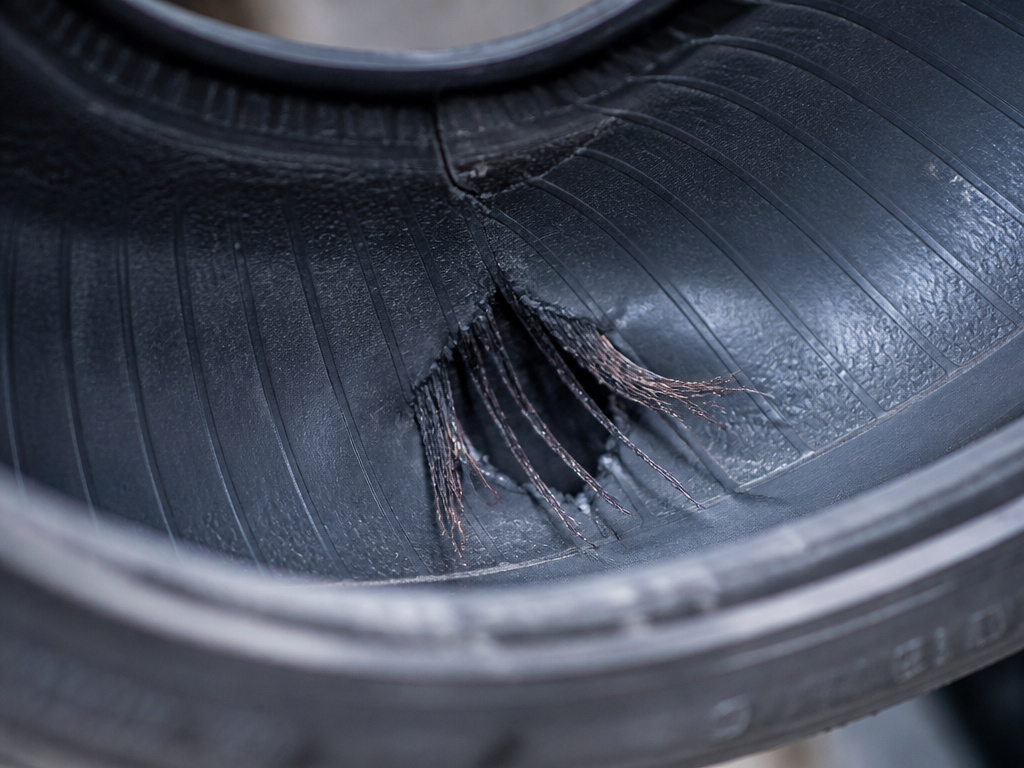
You hit a pothole. The pressure stays fine, but the ride starts thumping. That scene matters because impact damage can break inner cords before the outside looks bad.
Severe pothole damage can break inner cords even when the tire still holds pressure.
A tire inspection should include the inner liner, because impact damage can show inside first.
Emergency actions if a tire starts shaking or thumping
Grip the wheel firmly. Ease off the accelerator. Let speed drop before steering to the shoulder. Do not brake hard, because loss of control is the main risk.
Don’t drive on a growing vibration. Yokohama says it will increasingly grow worse until the tread separates.
The 5-Step Inspection That Catches a Separation Early
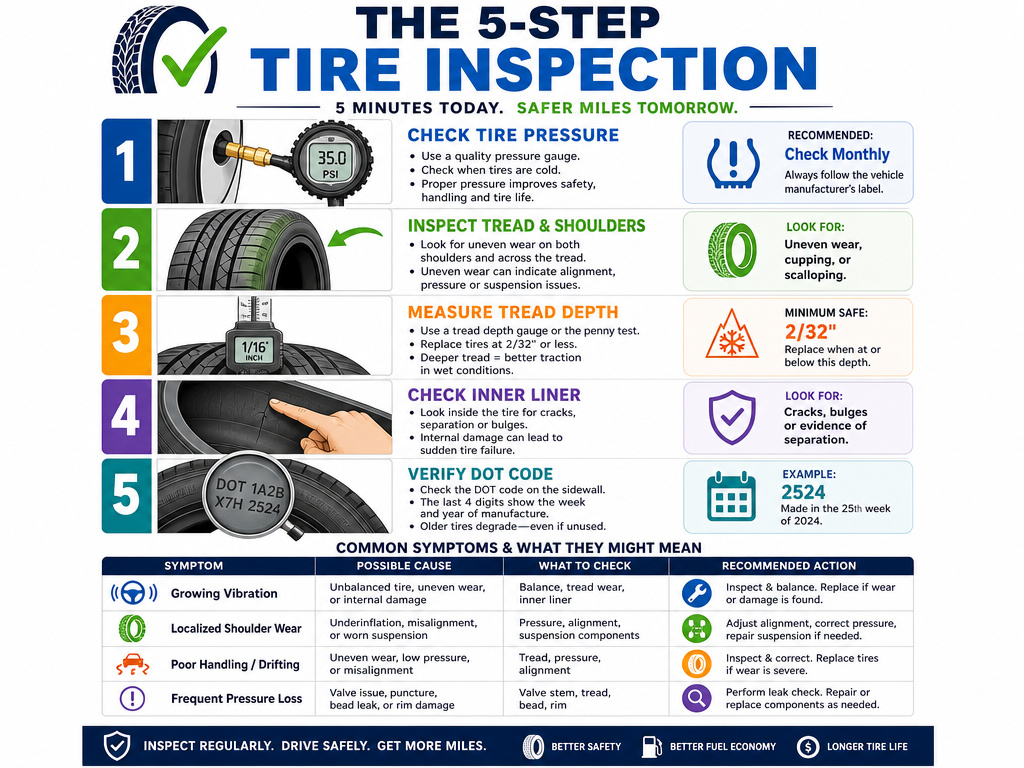
This inspection is quick. It won’t catch a hidden bond defect before it starts to show. But it can catch shoulder wear, vibration clues, and recall codes.
- Check pressure with a gauge. Wrong pressure adds heat and uneven wear.
- Spin the tire and look at the shoulder. Localized wear can mark a belt-edge defect.
- Check tread depth. Tires are not safe and should be replaced when the tread is worn down to 1/16 of an inch.
- Inspect the inner liner after a hard hit. Impact damage can show inside first.
- Read the TIN and DOT week. A mismatched batch is a recall target.
| Symptom | Likely Cause | Severity |
|---|---|---|
| Growing vibration | Bond weakening | Stop driving |
| Localized shoulder wear | Heat flexing defect | High |
| Thump after impact | Inner cord break | High |
| Cracking in grooves | Dry rot aging | Check age |
Tires have built-in treadwear indicators. When they look even with the tread, replace the tire.
Read the sidewall first. The TIN (tire identification number) and DOT (Department of Transportation) week live there.
Replace, Repair, or Report: The Decision Rules
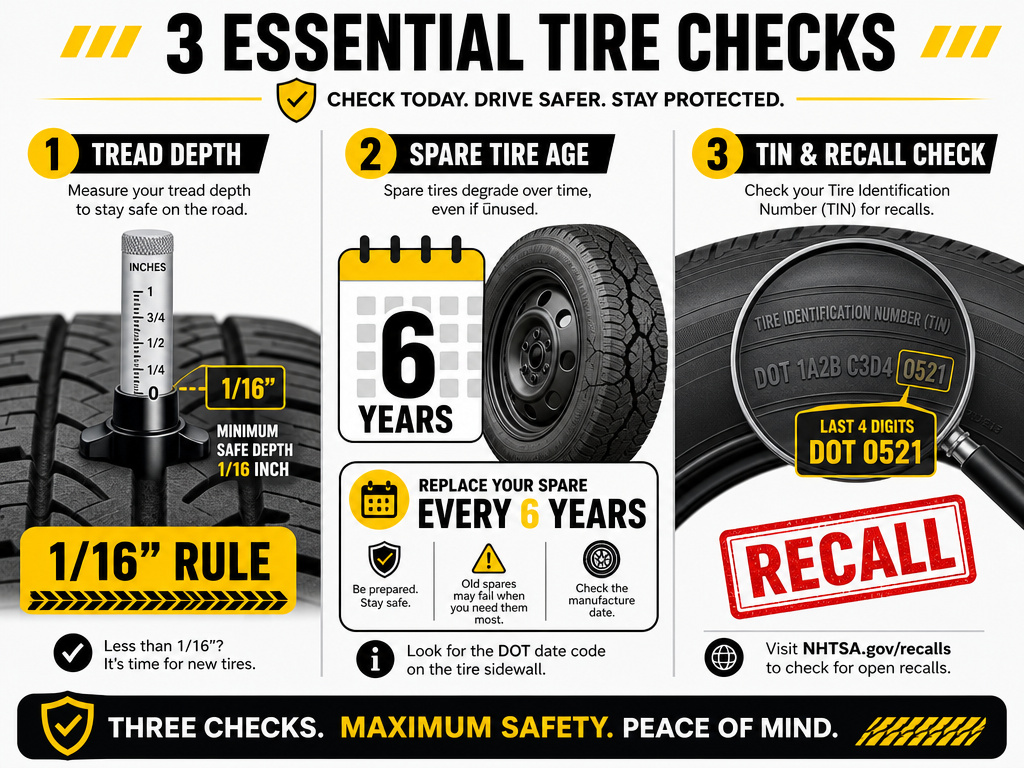
NHTSA and NTSB do not agree on every replacement trigger. NHTSA says tires are not safe when tread wears to 1/16 inch. The NTSB report cites NHTSA research and Ford’s recommendation that tires be replaced after six years regardless of treadwear, while tire manufacturers often condition replacement on inspection, not a fixed time interval.
The NTSB tire safety investigation report covers 55 recalls from 2009 to 2013 involving more than 3.2 million tires. Only about 44 percent of recalled tires were accounted for.
Spare tires degrade through thermo-oxidative aging, meaning heat and oxygen age the rubber, even without road use. The NTSB notes that spare tires degrade via thermo-oxidative aging even without road use and cites a recommendation that tires be replaced after six years.
People ask if they can replace just one tire. I say no when other tires have noticeably less tread.
If you are unsure when to replace tires, use the 1/16-inch rule and the six-year caution.
How to check a recall by TIN
Read the last four digits of the TIN. That is the DOT production week and year. Compare it with the recall notice.
If it matches, stop driving the tire.
Repair limits that protect you
NHTSA says a proper puncture repair needs a plug for the hole and a patch for the inside area around it. Tires must come off the rim for inspection. Sidewall punctures should not be repaired.
If you need a comparable replacement, verify the DOT week first, as the Hankook recall targets specific production.
The Hankook/GM notice targets DOT 0521. It requires disablement within 24 hours and calls for two 13mm holes in the sidewall.
Incorrect Tire Repair (patch/plug)
An improper repair is a known risk for tire integrity. The proper repair of a punctured tire requires a plug for the hole and a patch for the area inside the tire that surrounds the puncture hole. Punctures through the tread can be repaired if they are not too large, but punctures to the sidewall should not be repaired. Tires must be removed from the rim to be properly inspected before being plugged and patched. A repair that does not follow these guidelines can create a weak point, potentially leading to a separation.
Overinflation as a cause
While underinflation is a major cause of tire failure, overinflation also poses risks. Maintaining proper tire pressure is one of the most important things you can do to avoid tire failure, such as tread separation. Sustained high temperature can cause a tire to deteriorate, leading to blowouts and tread separation. Overinflation reduces the tire’s contact patch and can lead to excessive wear in the tread center, altering the tire’s flex characteristics and potentially contributing to heat buildup and structural stress over time.
Frequently Asked Questions
What is the most common cause of tire tread separation?
No single cause covers every case. Recall documents point to compound and design defects. NHTSA lists underinflation and overloading as a major cause of tire failure.
Can you drive on a tire with tread separation?
No. A separating tire can stay inflated, but it can compromise handling and cause a crash. A growing vibration is a stop-driving sign.
Can a separated tire be fixed?
No. Tread separation cannot be repaired. A tread puncture can be plugged and patched, but the tire must come off the rim for inspection.
Is tread separation a DOT violation?
Tread separation is a defect condition. The Hankook/GM recall notice requires recalled tires to be disabled within 24 hours of removal.
The Bottom Line
Tire tread separation causes hide in the sidewall, the shoulder, and the production week. If a vibration grows, stop driving. The tire can stay inflated while the bond fails.
Read the TIN first. Check the DOT week against the recall notice. Then check pressure, shoulder wear, and tread depth. These three checks take minutes, and they can save a wheel.
Fair warning. The six-year recommendation is not universal. The NTSB report cites NHTSA research and Ford’s recommendation that tires be replaced after six years regardless of treadwear, while tire manufacturers often condition replacement on inspection.
