
Tire Wear Patterns Explained: What They Mean
This post contains affiliate links. As an Amazon Associate, we earn from qualifying purchases.
Tire wear patterns explained start with checks for even or uneven tread, pressure, and rotation. Hyundai says replace before the tread is worn down to the wear indicator, which appears at 2/32 inch (1.6 mm), and check cold pressure at least once a month. GM says for some specific wear patterns, like outer shoulder wear on certain tires, it may be considered normal and not point to alignment or suspension repair.
The indicator only marks the low point. A tire can show shoulder wear, center wear, or cupping long before that band appears. Hyundai lists cupping as a wear pattern.
What follows: a self-check sequence, the pattern meanings from maker and federal sources, and cases where a shop should check wear before alignment.
Key Takeaways
- Check cold pressure monthly; a tire is cold after 3 hours or less than 1 mile driven.
- Use replace before indicator; Hyundai says don’t wait until the tread is level with the indicator.
- Age recommendations differ by source: Hyundai recommends a maximum of 6 years from new vehicle purchase, Toyo recommends replacement at 10 years or more from manufacture, and NHTSA notes some manufacturers recommend six to 10 years.
- Treat feathering as a rotation check first; GM says slight or mild feathering is a normal part of tire wear.
How Do You Check Tire Wear Patterns Yourself?
Park the car on level ground, then run your palm over the front tread. The surface feels different when the blocks are worn unevenly. Start with the tire.
Tread depth checks use a gauge across each tire at the outer shoulder, center, and inner shoulder. Different readings point to inflation, alignment, or rotation issues. Wear indicators appear at 2/32 inch (1.6 mm), but replacement should happen before the tread reaches that level. A cold pressure check follows the same monthly routine.
Before you start: A car can fall off a jack. Support it on jack stands before rolling under or near it. Do not check inflation on warm tires to the door placard, because Hyundai says pressure can rise 4-6 psi as tires warm.
- Measure tread across the outer shoulder, center, and inner shoulder with a tread depth gauge. Skip it, and you can miss shoulder wear. A single center reading hides it.
- Check cold pressure against the door placard (the sticker with the tire pressure specs). Hyundai says warm tires can gain 4-6 psi. Adjusting then can leave the tire underinflated later.
- Run your hand forward and backward over the tread. Heel-toe wear feels rough in one direction and smoother in the other. Skip it, and you can miss noise.
- Look up your rotation interval. Hyundai says rotate sooner if irregular wear develops. Skip it, and wear can become uneven.
The tire sidewall carries the DOT Tire Identification Number (TIN). NHTSA says the last four digits show the week and year of manufacture. I start with photographs and measurements before brand talk.
ASTM International maintains a standardized practice, ASTM F1426-20, for identifying wear patterns. Hyundai’s NHTSA Technical Service Bulletin gives the indicator threshold.
If your front and rear tires are different sizes, rotation may not be possible, so tire longevity depends on pressure and inspection.
What Does Center Wear Mean on a Tire?
Center wear points to over-inflation. Hyundai says wear concentrated in the center of the tread indicates it. A shiny, bald band down the middle is the visual cue.
Pressure is like heat in a sauce. Too high, and the center scorches first.
The center tire wear pattern starts with the placard pressure. I check the placard before blaming alignment.
What to check before replacing.
Hyundai says check and adjust cold tire inflation. Do not bleed a warm tire to the placard. The 4-6 psi rise is temporary.
Warm tires lie.
- Measure the center band with a gauge.
- Confirm the placard pressure on cold tires.
- Compare left and right front readings.
If the gauge shows center wear, fix pressure first. Then watch the next rotation interval.
What Does Edge Wear Mean on a Tire?
Look at the outside shoulder. A sloped edge points to the alignment angle. Hyundai says wear concentrated on the inner or outer tread indicates that the toe or camber alignment angle is out of specification.
Toe is the steering angle seen from above. Camber is the tilt seen from the front. I call it an alignment check first.
The outer tire wear and inner tire wear patterns share the same alignment angle check. When one edge looks worn, bad alignment is the first suspect.
The NHTSA TireWise safety portal also tells owners to check tread every month.
| Wear pattern | What the document says | First action |
|---|---|---|
| Both edges | Hyundai: under-inflation | Check cold pressure |
| Center | Hyundai: over-inflation | Check cold pressure |
| Inner or outer | Hyundai: toe or camber out of spec | Alignment check |
| Heel-toe | Hyundai: can cause noise | Rotate to opposite side |
| Slight feathering | GM: normal part of wear | Rotate if overdue |
Cupping and scalloping.
Hyundai lists scalloped wear as cupping or diagonal wear. Some sources link diagonal wear to alignment issues like excessive toe. GM’s Chevrolet Impala bulletin says abnormal outer or inner wear that isn’t uniform can indicate alignment, suspension component repair, or aggressive driving.
The cupping pattern can get blamed on the tire, but these bulletins point back to the vehicle. Ask for results from an alignment check before replacing tires for edge wear.
Is Feathering Always a Sign of Bad Alignment?
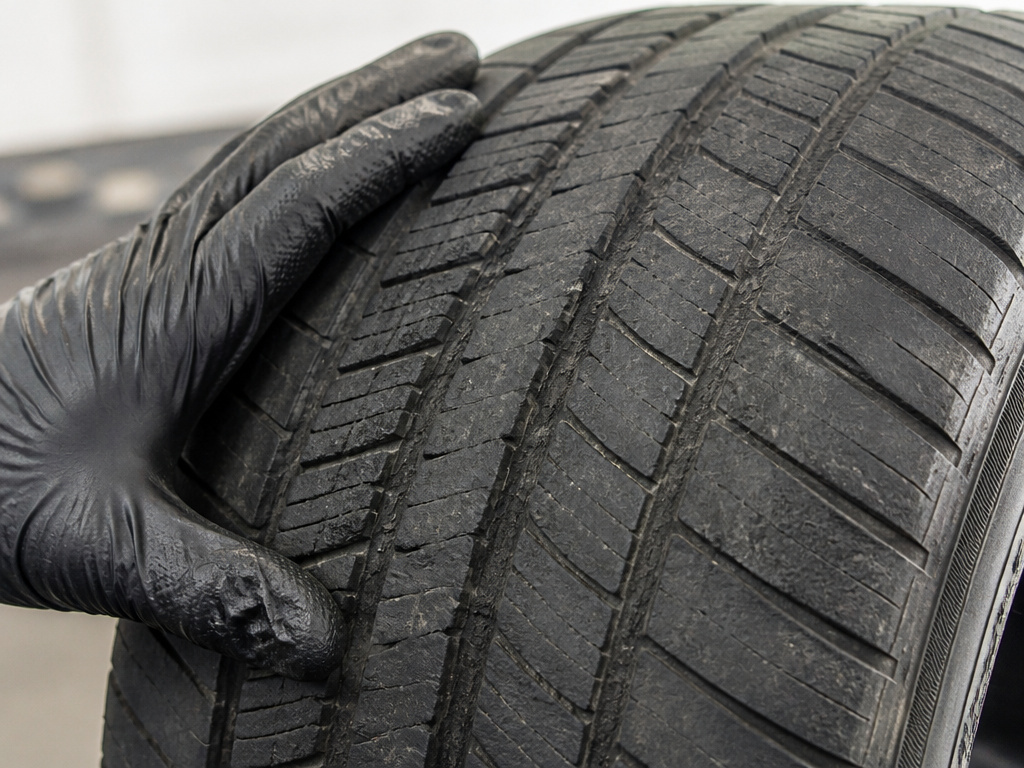
GM says slight or mild feathering is a normal part of tire wear. I have seen cupped and feathered wear patterns several times. The first instinct is to blame the tire. Some feathering is normal, and abnormal wear can point to alignment or suspension repair.
The heel-toe wear pattern shows up when you run your hand forward, then backward. Hyundai says heel-toe wear means the tread blocks wear unevenly from leading to trailing edge. It can cause noise, and rotation to the opposite side can minimize it.
For the broader pattern name, feathered wear is the term GM uses for slight or mild feathering.
I don’t send a car to the alignment machine for mild feathering alone. First check rotation history and pressure. GM says more frequent rotations may be desirable if signs of uneven wear occur, and rotation can help address feathering.
When rotation fixes it.
GM recommends a rotation interval of every 12,000 km (7,500 mi) for applicable GM vehicles, while Hyundai recommends every 7,500 miles or sooner, and NHTSA suggests 5,000 to 8,000 miles if recommended by the manufacturer. If rotation is overdue, rotate before alignment. Hyundai says moving the tire to the opposite side can minimize heel-toe noise.
GM says aggressive driving can make more frequent rotations desirable. Ford says cosmetic heel-toe, feathering, or scalloping with no performance issue isn’t warrantable. The uneven wear question gets harder when those definitions meet.
Tire Wear Patterns Explained: What Counts as Normal Wear?
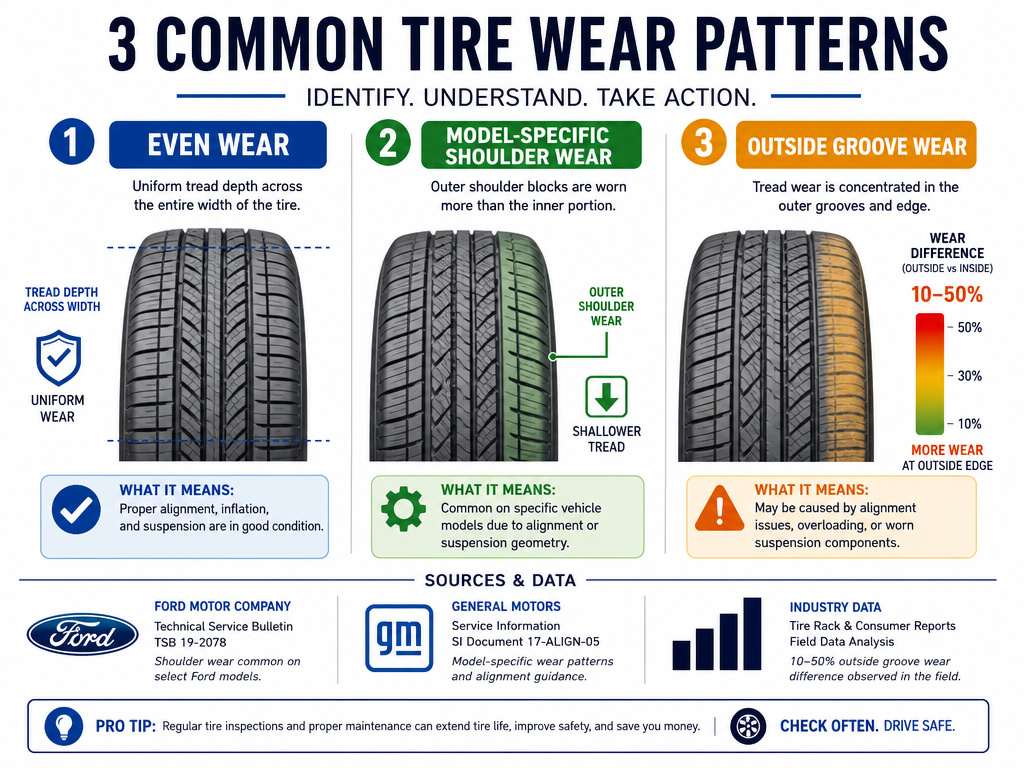
Normal wear has more than one definition. Ford’s guide identifies normal tire wear as even wear around and across the tread. Toyo tells consumers to look for uneven treadwear.
GM’s Chevrolet Impala bulletin says the 16 inch Goodyear Integrity tires have shoulder tread bars shallower than the center bars. That design limits the life expectancy of the outside tread blocks. The bulletin says the specific outer shoulder wear on these tires is considered normal.
Do you need to panic over a little shoulder wear? If your model bulletin says it is normal, it is normal.
A BTS tire tread wear analysis of UTQG data found outside grooves generally wear more than inside grooves. The report says the difference varied from approximately 10 percent to 50 percent. UTQG is the federal treadwear grading system.
I keep the model bulletin in mind before calling wear abnormal.
| Claim about normal wear | Who says | Practical read |
|---|---|---|
| Even around and across | Ford | Baseline |
| Outer shoulder on Goodyear Integrity | GM | Model-specific normal |
| Outside grooves wear more | BTS | Some unevenness is expected |
| Slight feathering | GM | Rotate before alignment |
Definitions differ by maker and agency. The groove data comes from UTQG tests. The long-term effect of groove variability on your own tire remains unclear.
When Should You Replace Tires Because of Wear or Age?
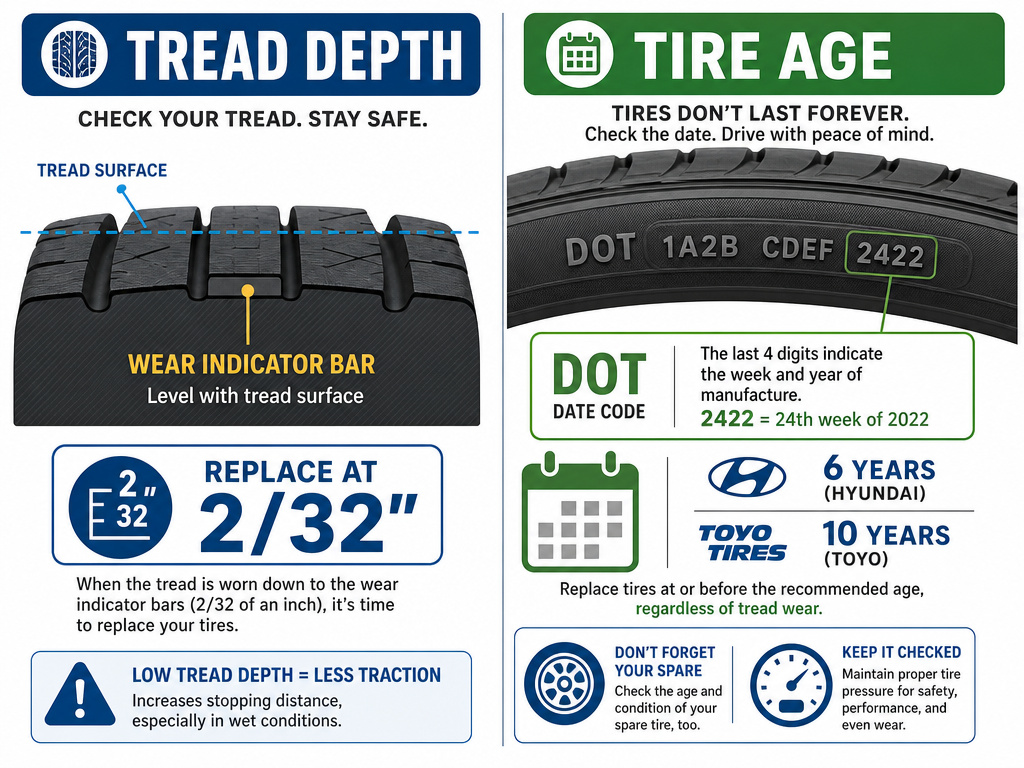
Hyundai shows the indicator at 2/32 inch (1.6 mm), but says replace before it. Hyundai says tires should be replaced before the tread is worn down to the wear indicator. Do not wait for the tread surface to become level with the indicator.
Age rules differ by maker and agency. Hyundai recommends a maximum tire service period of 6 years from the date of new vehicle purchase. After 6 years, Hyundai says replace regardless of wear.
Toyo recommends replacing any tires in service 10 years or more from the date of manufacture, including spares. NHTSA says some vehicle and tire manufacturers recommend replacing tires that are six to 10 years old, regardless of treadwear.
The NHTSA tire safety brochure is another federal consumer starting point for tire awareness. The tire replacement decision should use tread depth, age, and performance changes together.
Fair warning: age rules differ by maker and agency.
Age thresholds do not match.
- Check the DOT date on both sides before buying or storing.
- Check the spare for date and pressure.
- Note air loss, noise, or vibration, because Toyo says such changes can mean remove from service.
Can a tire fail before the age limit? Toyo says a recommendation sets no minimum service period, and a new tire can sustain damage. I check age and tread together.
How Do Staggered, Spare, and All-Four Cases Change the Rules?
Three cases change the usual advice: staggered tires, spares, and vehicles that need all four replaced. NHTSA says if front and rear tires are different sizes, rotation may not be possible. Hyundai says check spare inflation too, and the spare lacks a TPMS sensor (tire pressure monitoring sensor). Toyo says inspect all tires, including spares, at least once a month.
I had one reader with staggered tires, so rotation wasn’t possible. I checked pressure and wear patterns instead. Can you rotate a staggered setup? Check the owner’s manual.
Hyundai gives a storage rule for cars that sit more than 1 week. If you can’t use jack stands, drive the car weekly for at least 20 minutes at highway speeds. This prevents flat-spotting (a flat patch on the tread).
Audi’s Q7 bulletin gives a strict all-four example. It says replace all four tires if tread depth is above 6.5mm (8/32nds) and wear matches the specified pattern. The Audi bulletin specifies a replacement tire for that specific model; consult the bulletin or a tire professional for the correct replacement.
If you buy one tool, make it a tread depth gauge. It gives you numbers across the tire.
If your vehicle has all-wheel drive, follow the owner’s manual because one bulletin calls for all four tires.
- Check the owner’s manual for the rotation pattern.
- Check the spare tire for date and pressure.
- Check the storage rule if the car sits more than 1 week.
Suspension or Mechanical Issue Wear Patterns
Wear patterns like cupping or scalloping, which appear as dips or cups around the tire’s tread, often stem from suspension or mechanical problems. These issues can include worn shock absorbers, struts, or bushings that allow the tire to bounce and impact the road unevenly. While some sources state that slight feathering is a normal part of tire wear, pronounced scalloping is a visual cue for a mechanical inspection. If you observe this pattern, have a professional check your vehicle’s suspension components, as continued driving can accelerate tire wear and lead to performance issues.
Common Tire Wear Pattern Names and What They Look Like
Specific names help identify the cause of tread wear. Center wear shows more wear down the middle of the tread, while wear on both edges indicates under-inflation. Wear concentrated only on the inner or outer edge points to an alignment issue with toe or camber angles. Heel-toe wear creates a saw-tooth or feathered edge on individual tread blocks and can cause noise. Cupping or scalloping appears as random dips or cups around the tire. Some patterns, like specific outer shoulder wear on certain tire models, may be considered normal and not indicate a pressure or alignment problem.
How to Fix Different Tire Wear Patterns
Corrective action depends on the specific pattern observed. For center wear or wear on both edges, check and adjust the tire inflation pressure to the vehicle’s recommended cold pressure. For inner or outer edge wear, a professional wheel alignment is needed to correct the toe or camber angles. Heel-toe wear can often be minimized by moving the tire to the opposite side of the vehicle during a tire rotation. For cupping or scalloping, inspect and repair worn suspension components. Regular tire rotations, performed at intervals recommended by your vehicle manufacturer, help promote even wear and can prevent some patterns from developing or worsening.
Frequently Asked Questions
What do different tire wear patterns mean?
Patterns point to inflation, alignment, rotation, or age. Hyundai links center wear to over-inflation and edge wear to toe or camber. A gauge and cold pressure check come first.
Is a 3/32 tread bad for tires?
3/32 is above the 2/32 indicator level, so it is above the replacement threshold. Hyundai says replace before the indicator appears, so 3/32 is a prompt to measure more often.
What is the 7 7 rule for tires?
Hyundai and GM use 7,500 miles for rotation. NHTSA gives 5,000 to 8,000 miles when recommended. Follow your owner’s manual.
Can I rotate tires if front and rear sizes differ?
NHTSA says you may not be able to rotate them if front and rear tires are different sizes. Check the owner’s manual for the pattern your vehicle allows.
Do age limits override tread depth?
They add a separate check. Hyundai says 6 years from new vehicle purchase. Toyo says replace tires in service 10 years or more from manufacture.
NHTSA says some recommend six to 10 years. Inspect for damage and performance changes.
Before You Go
That is tire wear patterns explained at its best: read the evidence, then fix the cause.
If your gauge shows different readings at the outer shoulder, center, and inner shoulder, stop before buying tires. Get the alignment or suspension cause checked first.
Check the DOT date on both sides of each tire this week. I would rather see a gauge reading than a penny test. A simple tread depth check at a single spot can miss uneven wear.
