
Trailer Tire Pressure Guide: The Specs That Decide It
This post contains affiliate links. As an Amazon Associate, we earn from qualifying purchases.
Correct trailer tire pressure is the pressure listed on your trailer’s VIN or certification label (the placard), which must never exceed the maximum cold inflation pressure stamped on the tire’s sidewall. For most trailers, this means inflating to the placard’s listed PSI when the tires are cold. A 2017 NHTSA recall shows the stakes: Forest River had to recall Puma trailers because the placard stated 50 PSI for a ‘D’ range tire, but the installed ‘C’ range tires required 65 PSI.
That recall is the whole problem in one line. The placard can be wrong, and the sidewall max is a ceiling, not a target. The official guidance from trailer manufacturers and tire makers doesn’t always agree, leaving you with two numbers and a choice that affects whether your tires last five years or fail in five hundred miles. A clear trailer tire pressure guide can help resolve this conflict.
What follows: how to find your real pressure target, the physics of why underinflation destroys tires, the exact procedure for a cold check, and the one rule about age that overrules everything else.
Key Takeaways
- Inflate to the pressure on your trailer’s placard or VIN label, but verify it never exceeds the tire’s maximum sidewall pressure.
- Check pressure only when tires are cold — defined as sitting for at least three hours after a short drive.
- Underinflation is the top cause of failure; it creates abnormal flex and heat that can lead to a blowout.
- ST (Special Trailer) tires can lose roughly 7 PSI per month in storage; inflate to the sidewall max plus 5-7 PSI for long-term parking.
- Sources disagree on replacement age: Airstream/Goodyear recommend replacement at 5 years, while Hankook states tires must be replaced at 10 years or more from the date of manufacture.
The Placard vs. Sidewall Conflict
You have two numbers. The tire’s sidewall shows a maximum cold inflation pressure, like “80 PSI MAX.” The trailer’s certification label or placard, usually on the left front frame, shows a recommended pressure, like “65 PSI.” Sources disagree on the rule: many OEM manuals say to use the placard pressure (provided it does not exceed the sidewall max), but Airstream recommends inflating to the tire’s maximum pressure, not a lower placard value. But that rule has a documented crack.
Common mistake: Assuming the placard is always correct. In 2017, Forest River recalled Puma trailers because the placard listed 50 PSI for a tire that required 65 PSI. The incorrect label could lead to underinflation and premature failure.
The Towmaster service manual states the proper air pressure is on the certification label and “should never exceed the maximum cold inflation pressure stamped on the tire.” Big Tex and Highliner manuals say to inflate to the maximum shown on the VIN label. Yet, an NHTSA Technical Service Bulletin on tires for Airstream trailers contains a direct contradiction: “Airstream recommends inflating to the tire’s maximum pressure, not a lower placard value.”
So who wins? For safety and compliance, follow the placard-as-long-as-it’s-under-the-max rule. It’s the standard cited in most OEM manuals. But if you have an Airstream or are following that specific bulletin, the manufacturer explicitly tells you to ignore the placard and use the tire’s max. This is why you must verify both numbers. If they conflict wildly, check for a recall or contact the trailer manufacturer.
| Pressure Source | What It Says | When to Use It |
|---|---|---|
| Tire Sidewall | MAX COLD INFLATION PRESSURE (e.g., 80 PSI) | The absolute ceiling. Never exceed this number. |
| Trailer Placard / VIN Label | Recommended PSI for your specific trailer (e.g., 65 PSI) | The primary target for operation, as long as it’s ≤ sidewall max. |
| OEM Service Bulletin | Specific override (e.g., “use tire’s max pressure”) | When a manufacturer like Airstream issues a direct, documented exception. |
How to Check Pressure When Cold
A tire heats up within minutes of rolling, expanding the air inside and raising the pressure reading. Checking a warm tire gives you a false high number, leading you to underinflate. Big Tex’s manual defines it concretely: cold means allowing 3 hours cool down after driving as much as 1 mile at 40 mph.
The process is simple, but skipping the prep guarantees a wrong answer.
- Park the trailer overnight or for at least three hours. This is the only way to guarantee a true cold reading. Move it less than a mile to a level spot if you must.
- Use a quality tire pressure gauge.
- Check all tires, including the spare. Pressure can vary side-to-side, and a low spare is useless when you need it.
- Adjust to the placard pressure. Add air in short bursts, re-checking with your gauge. If you overfill, depress the valve stem core briefly to bleed off excess.
The most common symptom of a pressure check done wrong is a tire that looks fine in the morning but feels soft after an hour on the road. That’s the heat expansion masking the initial underinflation. Do it cold, first thing.
Why Underinflation Is a Blowout Waiting to Happen
Low pressure isn’t just a fuel economy issue. It’s a structural failure on a timer. The Towmaster manual puts it plainly: “Excessive loads and/or underinflation cause tire overloading and abnormal tire flexing, generating excessive heat that may lead to tire failure.”
Here’s the mechanism. A tire supports load through air pressure. Underinflate it, and the sidewalls flex excessively with each rotation. This flexing generates internal heat. Rubber and the internal cords break down under sustained high heat. The result is often a separation—the tread peeling from the carcass—followed by a rapid tire blowout. Sustained high heat from underinflation can damage the tire’s internal structure, leading to failure.
Where this goes sideways: Topping off a warm tire. You check pressure at a gas station after driving, see 60 PSI against a 65 PSI target, and add 5 PSI. When the tire cools, it’s now at 70 PSI—overinflated. Overinflation reduces the contact patch, leading to a harsh ride, uneven wear, and increased susceptibility to impact damage.
The fix is procedural, not complicated. Make a monthly cold check part of your routine, right after checking the oil in your tow vehicle. A significant pressure drop over a month can signal a slow leak or valve stem issue.
Calculating PSI for Your Actual Load
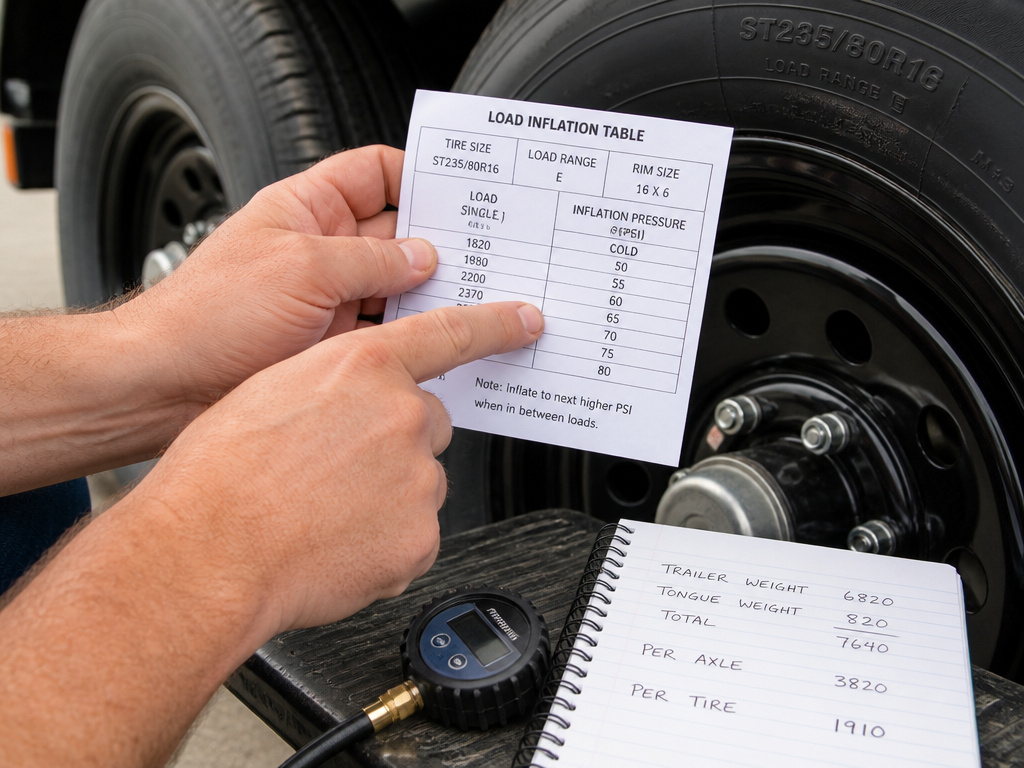
The placard pressure is calculated for the trailer’s maximum Gross Vehicle Weight Rating (GVWR). But what if you never load it that heavy? You can technically run a slightly lower pressure, but the margin for error shrinks to zero. I don’t recommend it for casual users. You can calculate pressure based on actual load, but you must use the tire’s Load Inflation Table.
For those who want the precise method, here it is. You’ll need to know your tire’s Load Inflation Table, which you can find in the manufacturer’s documentation or the appendix of guides like Hankook’s.
- Weigh your loaded trailer. Take it to a CAT scale to get the actual weight on each axle.
- Divide the axle weight by the number of tires on that axle to get the load per tire.
- Find your tire’s Load Inflation Table. Match your load per tire to the required pressure.
- Use that pressure, ensuring it’s still at or above the minimum required for your measured load and never above the sidewall max.
For trailers over 10,000 lbs GVWR, the Towmaster manual notes they may not have a placard. The cargo capacity is the GVWR (on the VIN label) minus the empty weight. For trailers over 10,000 lbs GVWR, the Towmaster manual notes cargo capacity is the GVWR minus the empty weight. It’s how commercial fleets dial in pressure to optimize wear and fuel use, and it’s a core function of advanced Automatic Tire Inflation Systems (ATIS).
Storage and Age: The Silent Killers
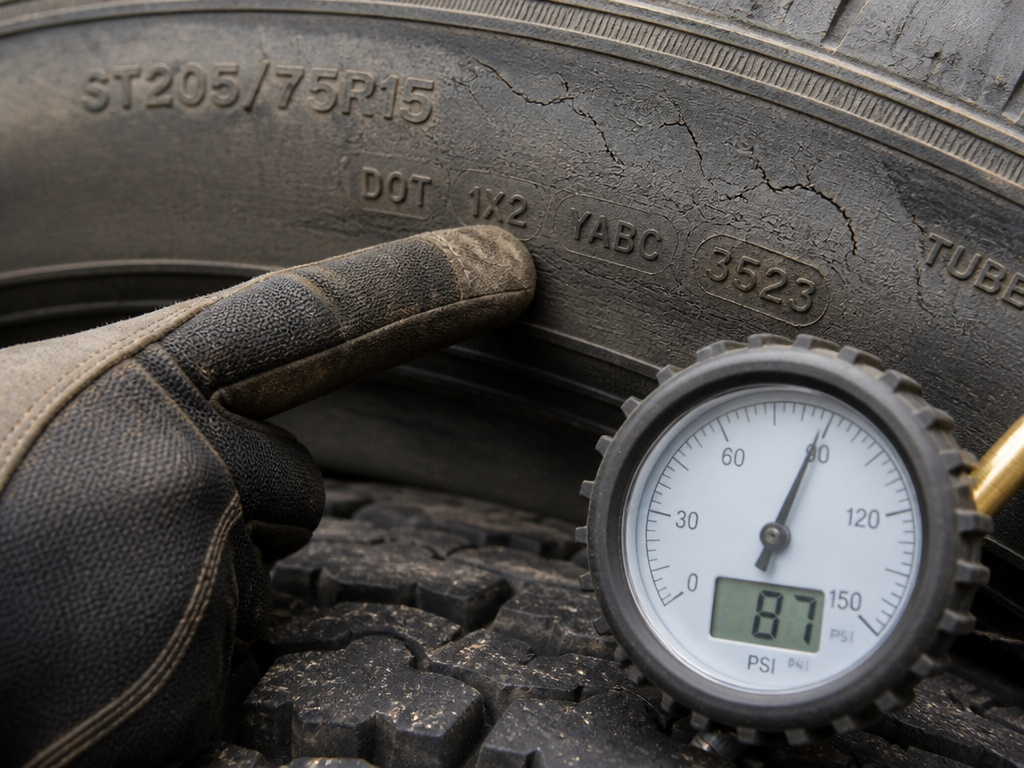
Trailer tires often die in the driveway, not on the highway. They sit for months, bearing the same spot on the tread, losing air, and baking in UV light. Hankook’s guide states ST tires can lose roughly 7 PSI per month during winter storage, which leads to flat-spotting.
The remedy for storage is different from operation. Hankook recommends: “Inflate tires to the maximum inflation pressure indicated on the sidewall and increase the recommended air pressure by 5 to 7 psi.” So if your sidewall says 80 PSI max, inflate to 85-87 PSI for storage. This extra pressure counters the natural seepage and helps maintain the tire’s shape. Also, park on jack stands to take the weight off the tires, and cover them to block UV rays.
Age is the unavoidable factor that causes failure. The rubber compounds oxidize and crack, losing elasticity and strength. The sources disagree on the timeline, which is critical.
- Airstream/Goodyear (per NHTSA TSB): “If a tire is five years old then it should be replaced.”
- Hankook: “Tires in service 10 years or more from the date of manufacture must be replaced even if never used.”
Hankook states tires over five years of age should be inspected at least twice a year. Tires showing visible cracks or damage should be replaced. Tires showing signs of cracking or weathering may need replacement. You can find the date code on the sidewall: a four-digit DOT number where the last two digits are the year (e.g., “3523” is the 35th week of 2023).
Special Cases and Regulatory Notes
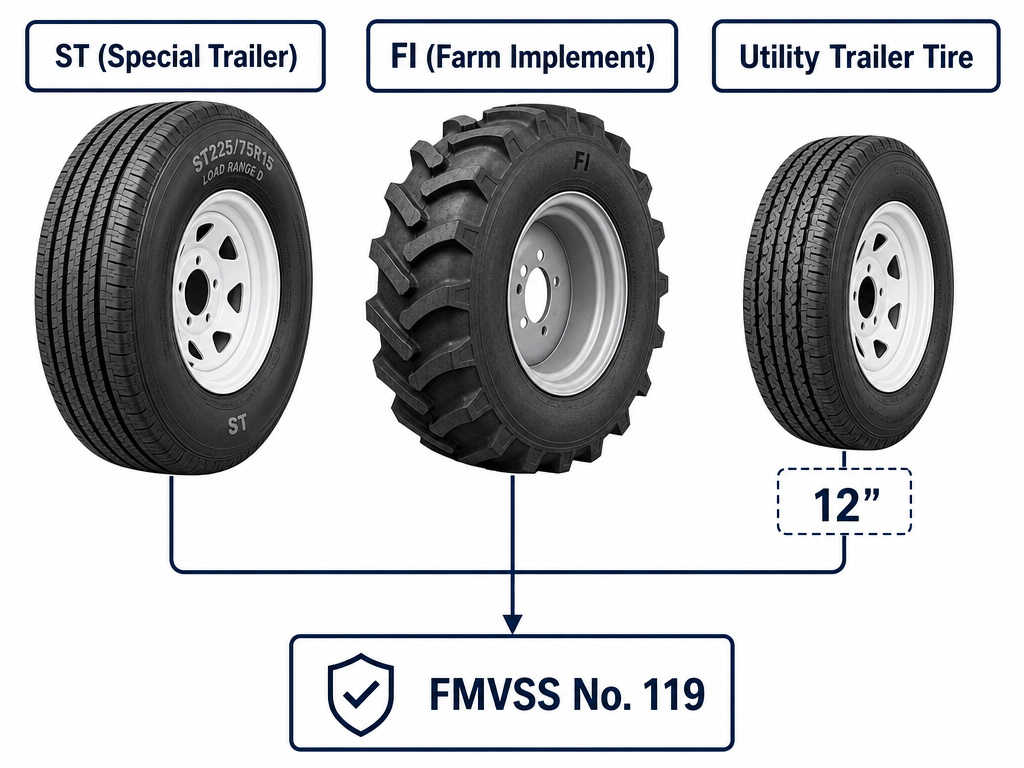
Not all trailer tires follow the same rulebook. The 2021 Federal Register rule RIN 2127-AL87 clarified that Special Trailer (ST) tires, Farm Implement (FI) tires, and tires with a rim diameter code of 12 or below are subject only to FMVSS No. 119, not the passenger car standard FMVSS No. 109. This matters for heavy-duty applications and confirms ST tires are built to a different, trailer-specific standard.
Other edge cases break the standard procedure:
- Plus-Sized Replacements: If you change tire sizes, the placard pressure no longer applies. Hankook states you must consult your dealer or the tire manufacturer for the new pressure.
- Automatic Tire Inflation Systems (ATIS): Systems like Hendrickson’s TIREMAAX PRO actively monitor and adjust pressure, making the “set and forget” monthly check obsolete. They are governed by commercial vehicle tire safety standards.
- Boat Trailers: The constant immersion and drying cycles are brutal. Specific boat trailer tire care includes rinsing off saltwater and checking for corrosion on the wheel rim that can cause slow leaks.
What PSI Should Trailer Tires Be?
There is no single universal PSI range for all trailer tires. The proper pressure is specific to your tire’s size and load range. For operation, the primary sources are the tire’s sidewall, which shows a maximum cold inflation pressure, and the trailer’s certification or VIN label, which shows a recommended pressure. Sources provide different guidance: some say use the placard pressure (provided it does not exceed the sidewall max), while others like Airstream recommend inflating to the tire’s maximum pressure. However, guidance varies, with some manufacturers recommending you inflate directly to the tire’s maximum sidewall pressure. You must check both sources. Hankook states that for plus-sized replacement tires, the placard pressure does not apply and you should consult your dealer or tire manufacturer.
What Happens If Trailer Tires Are Overinflated?
While under-inflation is cited as the most common cause of trailer tire trouble, overinflation also presents risks. Inflating a tire beyond its maximum rated pressure can create a harsh, uncomfortable ride because the tire cannot properly absorb road impacts. This can also reduce the tire’s contact patch with the road, potentially leading to a loss of traction, especially in wet conditions. More critically, consistently exceeding the maximum cold inflation pressure stamped on the sidewall stresses the tire’s structure beyond its design limits. Always use a reliable gauge and check pressure when tires are cold, before moving the trailer, to ensure accurate readings.
Is There a Trailer Tire Pressure Chart?
Official tire pressure charts by size and load range are not provided in the general fact sources. The correct pressure is determined by matching your specific tire to your trailer’s requirements. The tire’s sidewall displays its size, load range, and maximum cold inflation pressure. For example, a load range D tire has a different maximum pressure than a load range E tire. The trailer’s certification or VIN label provides the vehicle manufacturer’s pressure recommendation for the original tires. You should never use a generic chart, as an incorrect match between the tire’s load capacity and the placard’s pressure recommendation was the cause of a documented safety recall.
Frequently Asked Questions
How many PSI should I put in my trailer tires?
Use the PSI listed on your trailer’s certification label or tire placard, located on the left front frame. This number must not exceed the “MAX COLD INFLATION” pressure stamped on the tire’s sidewall. Always check and adjust when the tires are cold.
Is 50 PSI too high for trailer tires?
It depends entirely on the tire and the trailer. For example, a Goodyear Marathon 15″ ST225/75R15 Load Range D has a max pressure of 65 PSI. For example, a Goodyear Endurance 15″ ST225/75R15 Load Range E has a max pressure of 80 PSI. Always match the pressure to your specific placard and sidewall.
What is the recommended tire pressure for a trailer?
There is no universal “recommended” pressure. It is specific to your trailer’s weight rating and tire size. The only correct answer is the pressure listed on your trailer’s VIN/certification label, provided for that specific combination of trailer and tire.
Is 90 PSI a good pressure for a trailer tire?
90 PSI may be the maximum pressure for some high-load-range tires. It is only “good” if it matches the pressure on your trailer’s placard and does not exceed the maximum pressure on the tire’s sidewall. Never inflate to 90 PSI just because it sounds robust; use your specified number.
The Bottom Line
Find your placard. Check your sidewall max. Inflate to the placard number when the tires are stone cold. That’s the baseline procedure that covers 95% of trailers.
The conflict between the Airstream bulletin (use max pressure) and other OEM guidance (often referencing the placard pressure) is real. It means you cannot blindly trust one source. You have to read both your tire and your trailer’s label.
Finally, track the date code. Hankook states tires in service 10 years or more from the date of manufacture must be replaced. Start inspecting at year five. Cracking or weathering means it’s time, even if the tread looks new. The cost of a new set of boat trailer tires or ST radials is trivial compared to the damage and danger of a highway blowout. Check it, don’t assume it.
