
What to Do When a Tire Blows Out: The 4-Second Rule
This post contains affiliate links. As an Amazon Associate, we earn from qualifying purchases.
If a tire blows out, grip the steering wheel firmly, do not brake, let off the accelerator, and steer gently to the shoulder. The first moments decide whether you maintain control or spin out. A front tire blowout pulls the steering; a rear blowout causes fishtailing. The goal is to coast down without sudden inputs.
That pull or fishtail is physics, not panic. A deflated tire’s rolling radius changes instantly, and the vehicle’s weight shifts onto the rim. Braking or jerking the wheel multiplies that shift. You are correcting for a mechanical change, not a loss of control. Knowing what to do when a tire blows out is therefore critical.
What follows is the sequence for what to do when a tire blows out backed by driving instructors and crash data, the specifics of what makes a tire unrepairable after a blowout, and the one monthly check that catches most blowout causes before they happen.
Key Takeaways
- The first reaction is grip and steer, don’t brake, braking transfers weight onto the deflated tire and guarantees a loss of control.
- Coast to below 30 mph before gently applying the brakes; use your remaining tire’s traction to slow down, not the blown one.
- Runflat tires have strict limits, you must drive under 50 mph and for less than 100 miles after a pressure loss, or risk sudden destruction.
- Most blowout tires are scrap; industry repair standards prohibit fixing any damage in the sidewall or shoulder area.
- Check pressure monthly with a gauge; a TPMS warning light often activates only after a tire is significantly underinflated, which may already be in the damage zone.
The 4-Second Sequence to Control Your Car
A blowout isn’t a slow leak. It’s a rapid decompression that sounds like a gunshot followed by a loud flapping. The car will lurch. Your job in those first four seconds is to override every instinct to slam the brakes.
A front tire blowout causes a strong pull toward the side of the blowout. A rear blowout induces a fishtailing motion. In both cases, sudden braking increases the vertical load on the deflated tire, overwhelming its remaining sidewall strength and leading to rim contact and loss of steering.
Grip the wheel at 9 and 3. Focus on keeping the vehicle straight. Ease your foot completely off the accelerator. Let the engine braking and air resistance slow you down. Once your speed drops below 30 mph, you will feel the steering stabilize, you can apply the brake pedal with steady, light pressure. Signal and steer gradually to a flat, safe spot as far off the roadway as possible.
The sequence for what to do when a tire blows out works because it keeps the vehicle’s weight balanced. Braking shifts weight forward; if a front tire is gone, that weight has nowhere to go but into the pavement via the rim. If a rear tire is gone, the weight shift can snap the back end around. Coasting first allows the three good tires to handle the load.
What Not to Do (And Why)
The wrong move here isn’t just ineffective; it directly causes the crash. This is where the standard advice stops and the mechanics take over.
Don’t brake immediately. This is the most critical rule. As the USTMA notes, a tire run significantly underinflated has its internal cords damaged by excessive sidewall flex. When that tire blows, the sidewall is already compromised. Adding the massive load of braking can cause the remaining cords to fail in rapid succession, a zipper failure, where the sidewall splits violently open.
Don’t overcorrect the steering. The pull is strong, but it’s manageable with a firm, two-handed grip. Jerking the wheel to correct sends the car into a swerve that the flat tire cannot recover from. Small, deliberate inputs.
Don’t stop in a traffic lane. Even if the car seems drivable, a flat tire on the rim can shred in seconds, throwing debris. Get completely off the road. If you cannot reach a shoulder, stay in the car with your seatbelt on and call for help. A stationary vehicle in a lane is a supreme hazard.
After You’ve Stopped: Safety and Assessment
You’re off the road. Turn on your hazard lights. If it’s dark, use interior dome lights as well. Set out reflective triangles or flares if you have them, placing the first one a safe distance behind your car. This is not the time to assume other drivers see you.
Now, look at the tire. A true blowout often leaves the sidewall or tread shredded. If you have a runflat tire (marked “RF” or “RunFlat” on the sidewall), you might see less obvious damage. The rules change here.
Where this goes sideways: Attempting to drive a runflat tire beyond its limits. The USTMA mandates that runflat tires driven with low or zero pressure must not exceed 50 mph (80 km/h) or 100 miles of travel. Operation beyond these limits “could result in sudden tire destruction.”
If you have a conventional spare, this is the point you decide whether to change it yourself. If you’re on a busy highway, on a curve, or on any incline, changing the tire is often more dangerous than waiting for a tow. Your safety is the only metric that matters.
Can You Repair a Blown-Out Tire?
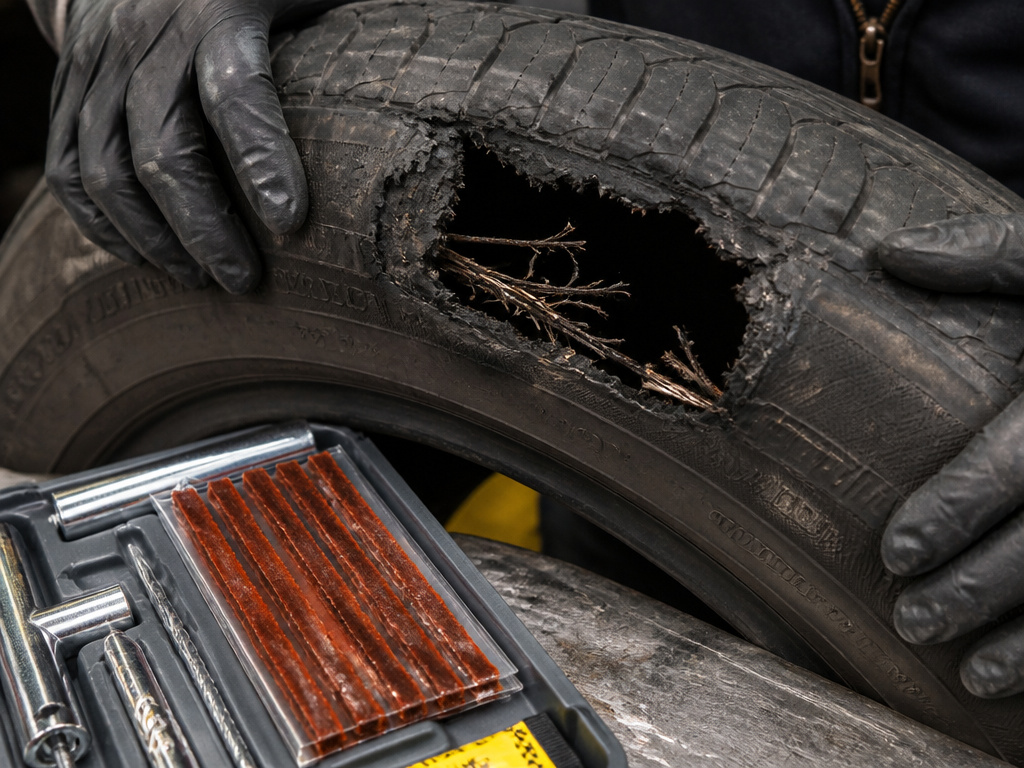
Almost certainly not. A blowout is a catastrophic failure, not a clean puncture. Industry repair standards are specific and strict for a reason.
| Damage Type | Repairable? | Industry Standard (USTMA) |
|---|---|---|
| Puncture in tread ≤ 1/4″ (6mm) | Yes, with plug/patch | Tire must be demounted, inspected inside. Plug alone is unacceptable. |
| Sidewall damage (cut, bulge, abrasion) | No | Repairs are limited to the tread area only. Sidewall flex damages internal cords. |
| Shoulder/belt edge damage | No | “DO NOT make repairs where the injury extends into the shoulder/belt edge area.” |
| Existing improper repair | No | “NEVER repair a tire that has an existing, improper repair; the tire must be scrapped.” |
| Runflat tire driven underinflated | Must be inspected | Requires demounting and internal inspection for hidden damage before any reinflation. |
The 1/4-inch rule is absolute. If the injury is larger, the structural belts are compromised. More importantly, the sidewall is off-limits. The sidewall flexes with every rotation; a patch cannot handle that movement. A repair in the shoulder, where the tread wraps toward the sidewall, is also prohibited because the flex forces are too high.
This is where shop practice and official standards clash. Many quick-service shops offer “on-the-wheel” string plug repairs as a common DIY/quick-service practice. However, the USTMA’s tire repair basics state clearly: “NEVER perform an outside-in tire repair or on-the-wheel repair.” A proper repair requires demounting the tire to inspect the inner liner for hidden damage, as per USTMA standards. If you’ve had a blowout, the tire has almost certainly exceeded the repairable criteria.
What Causes a Blowout? (And How to Prevent the Next One)
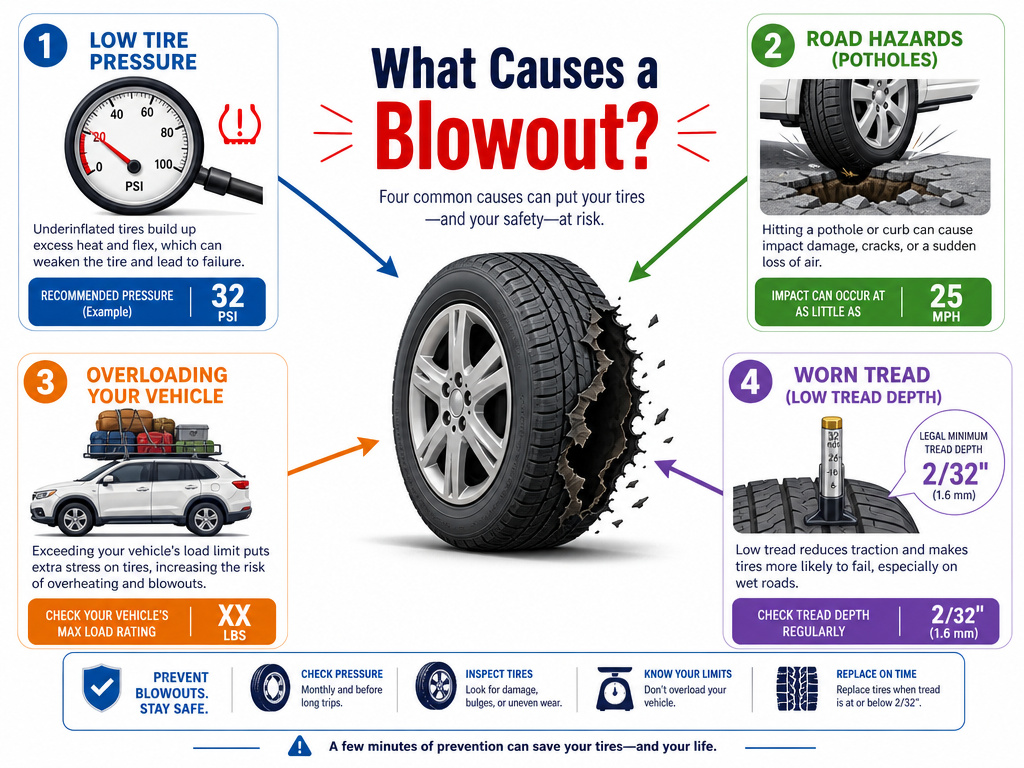
Blowouts are typically a final symptom, not a random event. They follow a chain of causes that are mostly preventable with a five-minute monthly ritual.
Underinflation is the leading cause. The UK’s Health and Safety Executive (HSE) notes that underinflation damage can occur below 80% of the recommended pressure. At this point, excessive sidewall flexing generates heat and damages the internal steel or textile cords. This damage is invisible from the outside until the tire is reinflated and the weakened area bulges, potentially leading to a zipper failure. A TPMS warning light usually triggers at a 25% pressure loss, by that point, you may already be in the damage zone. This is why a manual gauge check is essential.
Other major causes include:
- Impact Damage: Hitting a pothole or curb can bruise or cut the internal cords.
- Overloading: Exceeding the tire’s load rating (the number after the size on the sidewall) generates excess heat.
- Tread Wear: Worn tread is thinner, runs hotter, and is more easily punctured. Tires at the legal minimum tread depth have virtually no wet-weather safety margin.
- Age: Rubber deteriorates over time, regardless of tread depth. Check the four-digit DOT date code on the sidewall.
The single best prevention habit is the monthly pressure check with a reliable gauge, when tires are cold. Pair this with a visual inspection for cuts, cracks, or bulges. This simple monthly tire safety checklist catches the vast majority of issues that can cause a tire blowout.
The Runflat and Special Case Rules
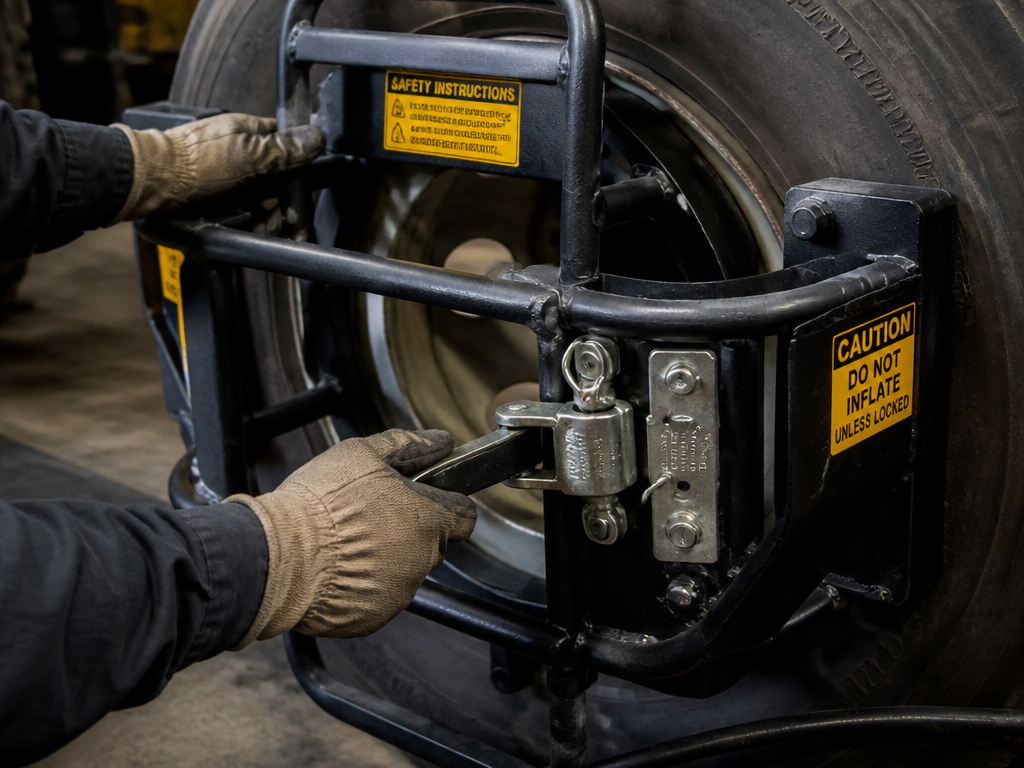
Runflat tires and large commercial vehicle tires operate under different safety protocols. Ignoring these turns a manageable event into a hazardous one.
Runflat Tires: These are designed to be driven a short distance after a pressure loss. The USTMA’s official tire care document states you must have a functioning TPMS with them. If you get a low-pressure warning, you must limit speed to 50 mph and distance to 100 miles. After that, the tire must be removed from the rim and inspected internally before any reinflation is attempted. The reinforced sidewalls can hide severe internal damage.
Large Vehicle Tires (OSHA Rules): The OSHA rim servicing standard applies to trucks, buses, and off-road machines. It requires specific safety measures most passenger car owners will never need, like inflation restraining devices capable of withstanding 150% of max pressure. However, one rule is universally wise: never stand in the trajectory of a tire being inflated. The force released in an explosion is immense.
For passenger cars, the HSE guidance is pragmatic: “Inflation inside a safety cage is not normally necessary for new car tyres or where you are confident that the replacement tyre has no hidden damage.” However, OSHA standards for large vehicles require a restraining device, barrier, or for the wheel to be bolted on the vehicle during inflation. The key phrase is “confident.” After any impact or underinflation event, confidence is gone.
Staying calm and gripping the wheel firmly
When a tire blows out, you will hear a loud bang and feel the vehicle pull sharply. Your immediate reaction must be to fight the urge to brake. Instead, focus on holding the steering wheel firmly with both hands to maintain a straight path. Do not make sudden steering corrections. Allow the vehicle to slow down naturally while you signal and look for a place to pull over off the road. Keeping a firm grip helps you control the vehicle’s direction as it decelerates. Once you have reduced speed significantly, you can gently apply the brakes to come to a complete stop off the road.
Difference between blowout and slow flat
A blowout is a sudden and catastrophic failure, often audible and accompanied by immediate vehicle instability. A slow flat, or gradual pressure loss, allows more time to respond. With a slow flat, you might notice a persistent low-pressure warning light, a change in handling, or a visible sag. Runflat tires are designed for gradual pressure loss, allowing continued operation within strict limits to reach a safe stopping place. However, operating any underinflated tire beyond its limits can lead to sudden failure. A tire that has been run severely underinflated must be removed and inspected before any attempt to re-inflate it.
Frequently Asked Questions
Is it okay to drive on a blown-out tire?
No. Driving on a fully deflated tire will destroy the sidewall in seconds as the rim cuts into the rubber. It will also likely damage the wheel rim itself. If you have a runflat tire, you may drive cautiously to safety under strict limits (under 50 mph, under 100 miles). Otherwise, stop as soon as it is safely possible.
How common is a tire blowout?
While modern tire construction has made them less frequent than decades ago, they are still a significant cause of highway accidents. Tire-related issues contribute to a significant number of crashes annually. Proper maintenance drastically reduces personal risk.
Will insurance cover a blown-out tire?
Full-coverage auto insurance usually pays for damage caused by a blowout (like body damage from a crash). However, the cost of replacing the blown tire itself is usually not covered unless the blowout was caused by a covered event like vandalism or hitting road debris. Roadside assistance coverage, if you have it, will generally cover the cost of a tow or tire change service. Check your specific policy.
What if I don’t have a spare tire?
Many newer cars omit a full-size spare, providing only a temporary tire repair kit (sealant and compressor). If you have a blowout, a sealant kit is useless for sidewall damage. Your options are to call for a tow or, if you have runflat tires, to drive cautiously to the nearest service center within the 50 mph/100-mile limits. This is a strong argument for knowing what equipment your car carries before you need it.
Can a brand-new tire blow out?
It’s rare, but possible. Manufacturing defects, damage during shipping or installation, or an immediate severe impact (like hitting a deep pothole) can cause a new tire to fail. This is why a thorough visual tire inspection during installation and careful driving when tires are new is recommended.
Before You Go
The difference between a controlled stop and a crash comes down to muscle memory. Now that you know the sequence, grip, coast, brake, steer, mentally rehearse it. The next time you hear that bang, your hands will do the right thing before your brain has time to panic.
Physically, your tire is likely done. The repair rules are black and white for a reason: the sidewall’s job is to flex, and once compromised, it cannot be made safe again. When in doubt, replace it.
Finally, make the gauge check a habit. The 35 PSI on your doorjamb isn’t a suggestion; it’s the engineering specification that keeps the sidewall from overheating and the cords from flexing to destruction. That monthly minute with a gauge is the cheapest insurance you will ever buy against that sudden, loud bang on the highway.
