
Where to Place a Jack When Changing a Tire: 3 Safe Steps
This post contains affiliate links. As an Amazon Associate, we earn from qualifying purchases.
Where to place a jack when changing a tire is at the reinforced lift point closest to the flat tire. Use the factory jack at the marked frame plate, body flange, or jack-up notch. Lift only until the tire clears the ground, about 1 in (30 mm).
Factory jack points are stamped, welded, or molded into the vehicle structure. A frame plate with tabs, a body flange under a triangular symbol, or a jack-up notch tells the jack where to carry load. If that mark is missed, the car can rock even at a low height.
What follows: three model-specific placement cues, the blocking wording that differs by manual, and the jack-thread check that keeps a lift from stalling.
Key Takeaways
- Use the factory jack point closest to the flat tire, not a random underside spot.
- Lift only until the tire clears the ground, about 1 in (30 mm).
- Block the diagonally opposite wheel before loosening lug nuts.
- Loosen lug nuts counterclockwise one turn while the tire is on the ground.
- Check the jack threads for smooth hand turning before lifting.
Where to Place a Jack When Changing a Tire?
The correct spot is the reinforced point closest to the tire being lifted. Kia, Jeep, and Mazda each mark that point differently. All three warn against jacking on other parts of the vehicle.
Designated jack points are reinforced vehicle locations, not random underside spots. A correct point has a raised tab, a notch, a welded plate, or a molded symbol. The jack head must sit squarely under that mark. A lifted tire needs only enough height to clear the ground, about 1 in (30 mm), before the wheel is removed.
A jack carries the car through a small, designed contact. A random frame rail, exhaust part, or soft rocker panel can bend or slip. Mazda’s manual says to use only recommended front and rear jacking positions. Jeep’s 2023 Grand Cherokee 4xe manual says to use only indicated positions.
The point can sit near the rocker panel or frame rail.
- Find the mark closest to the flat tire.
- Put the jack head squarely under it.
- Don’t improvise on a soft rocker panel or a hidden frame rail.
When you decide where to place a jack when changing a tire, start with the mark. The full sequence for a flat tire change begins at that point. When comparing best car jacks, remember the roadside rule. The jack must fit the point.
A shop jack is faster, but it doesn’t rewrite the vehicle manual. When comparing floor jacks for garage work, keep the factory lift points as the limit.
I check the mark before I touch the jack.
Which Jack Point Fits Kia, Jeep, or Mazda?
Kia uses two tabs and a raised dot. The 2022 Kia manual describes frame plates. Each plate has two tabs and a raised dot to line up with the jack.
Kia’s tabs and raised dot
Find the front or rear jacking position closest to the tire. Place the jack under the frame plate so the tabs and raised dot line up with the jack. The manual says to use only the jack provided with the vehicle in the correct jack position.
Jeep’s flange and tie-down slot
For the 2023 Jeep Grand Cherokee 4xe, the front jack point sits on the body flange just behind the front tire. The rear point sits in the slot on the rear tie-down bracket, just forward of the rear tire. Put the jack straight on with the handle facing outwards.
Mazda’s groove and notch
Mazda manuals tell owners to place the jack head squarely under the jack-up point. The CX-9 manual says to set the groove at a right angle. The front groove goes into the center of the guide projection closest to the vehicle front. The rear setting uses the groove between guide projections. The 2026 Mazda3 manual repeats the same rule.
| Vehicle | Jack point | Alignment cue |
|---|---|---|
| 2022 Kia | frame plate | two tabs and raised dot |
| 2023 Jeep Grand Cherokee 4xe | body flange or tie-down slot | triangular symbol or rear slot |
| Mazda CX-9 | jack-up guide projection | groove at right angle |
If rust hides the mark, clean it enough to see the tab, dot, or groove. Don’t guess.
If a shop uses low profile jacks, the same factory point still applies. A low saddle doesn’t turn a soft rocker panel into a lift point.
The same point applies.
The 1-Inch Lift Target That Stops Rocking
One inch (30 mm) is the lift target. Kia’s manual says to raise the vehicle until the tire just clears the ground.
Before you start: Park on firm, level ground. A car can roll even in Park, so block the diagonally opposite wheel. Set the parking brake and shift to Park. Keep everyone out of the car, because an occupant can shift weight and make the vehicle fall. Never put any body part under a jack, because it can slip.
That height is enough.
- Loosen the lug nuts counterclockwise one turn each while the tire is on the ground. If you skip this, the wheel can spin and the jack may be loaded sideways.
- Place the jack at the correct point closest to the flat tire. A wrong point can deform the body or let the car slip off the jack.
- Raise the vehicle until the tire clears the ground, about 1 in (30 mm). Lifting higher can make the car unstable.
- Remove the pre-loosened lug nuts by hand, then slide the wheel off. If the nuts weren’t loosened first, the wheel can bind on the hub.
- Seat the spare, hand-tighten the nuts, lower until the tire touches the ground, then tighten clockwise in a criss-cross pattern. Tightening in a circle can leave the wheel uneven against the hub.
A routine tire rotation job is the best way to learn each car’s lift points before an emergency. The more often you jack up the car, the more likely you’ll know where the tabs, dot, flange, or groove live.
Don’t jack higher than necessary. Mazda warns that it can make the vehicle unstable.
What to Block Before You Jack
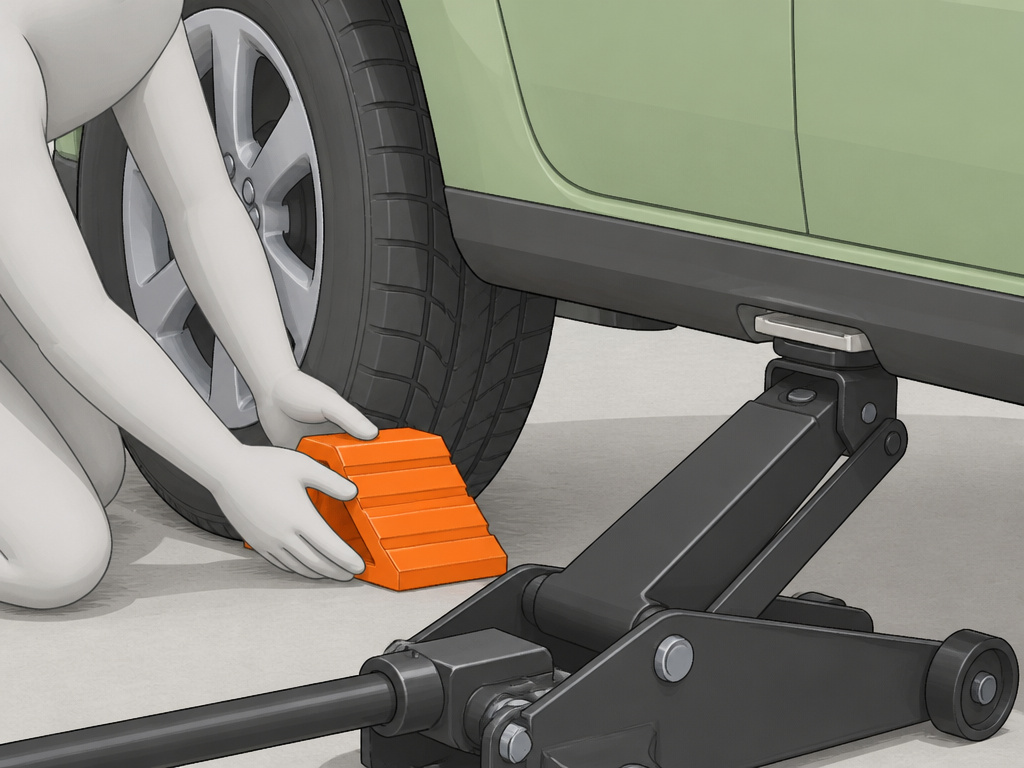
Blocks matter. Blocking wording differs by manual. Kia names the wheel diagonally opposite from the jack position. The Jeep Grand Cherokee 4xe manual says to block both front and rear of the wheel diagonally opposite. Mazda says to block the wheel diagonally opposite and place a tire block both in front and behind.
| Manual | Blocking wording | Practical reading |
|---|---|---|
| Kia | block opposite wheel | block that wheel securely |
| Jeep Grand Cherokee 4xe | block front and rear of opposite wheel | use blocks on both sides |
| Mazda | block opposite wheel with front and rear blocks | use blocks on both sides |
I don’t treat that difference as a small detail. If the manual is vague, I block the opposite wheel on both sides. A set of tire chocks can be used to block the wheels.
Where this goes sideways: If a manual says only “block the wheel” and you skip blocks, the car can roll when you loosen or tighten lug nuts.
Blocks matter.
The Jack Maintenance Check Owners Miss
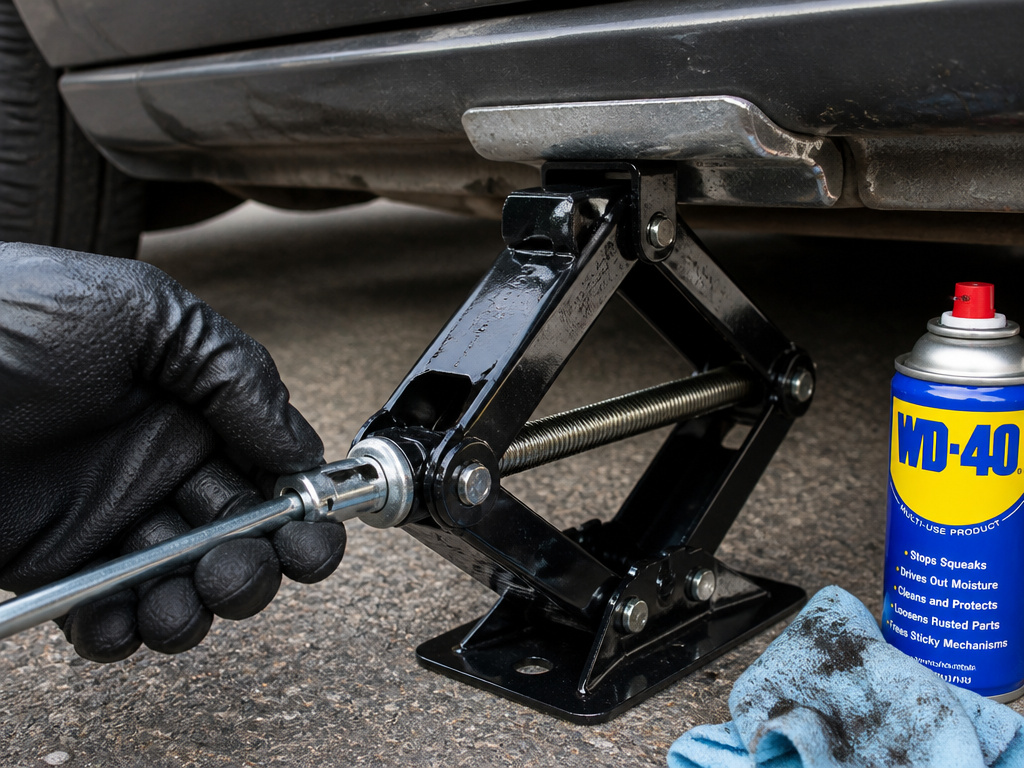
A dry jack screw feels gritty. Mazda’s service bulletin says the jack screw threads must be lubricated and easy to turn by hand. If you can’t turn the jack screw easily, remove dirt, debris, or corrosion from the threads, then lubricate them with WD-40 or equivalent.
Mazda’s official jack placement guidance says to make sure the jack screw threads are lubricated and the jack can be easily turned by hand. That makes the hand-turn test worth doing before a flat, not after.
Easy to miss: A scissor jack can feel fine when cold and gritty after sitting in a trunk for months. Check the screw before you need it.
- Turn the jack screw by hand before you need it.
- Wipe grit from the threads.
- Lubricate with WD-40 or equivalent if the screw feels stiff.
| Problem | Likely cause | Fix |
|---|---|---|
| Jack can’t turn smoothly | dry or dirty screw threads | clean threads and lubricate with WD-40 |
| Car rocks while lifting | jack not squarely under lift point | recheck tabs, dot, flange, or groove |
| Wheel binds after lowering | lug nuts tightened in a circle | tighten clockwise in a criss-cross pattern |
Mazda’s manual says not to install the temporary spare tire on the front wheels (driving wheels).
Check it by hand.
Using Jack Stands for Safety After Lifting
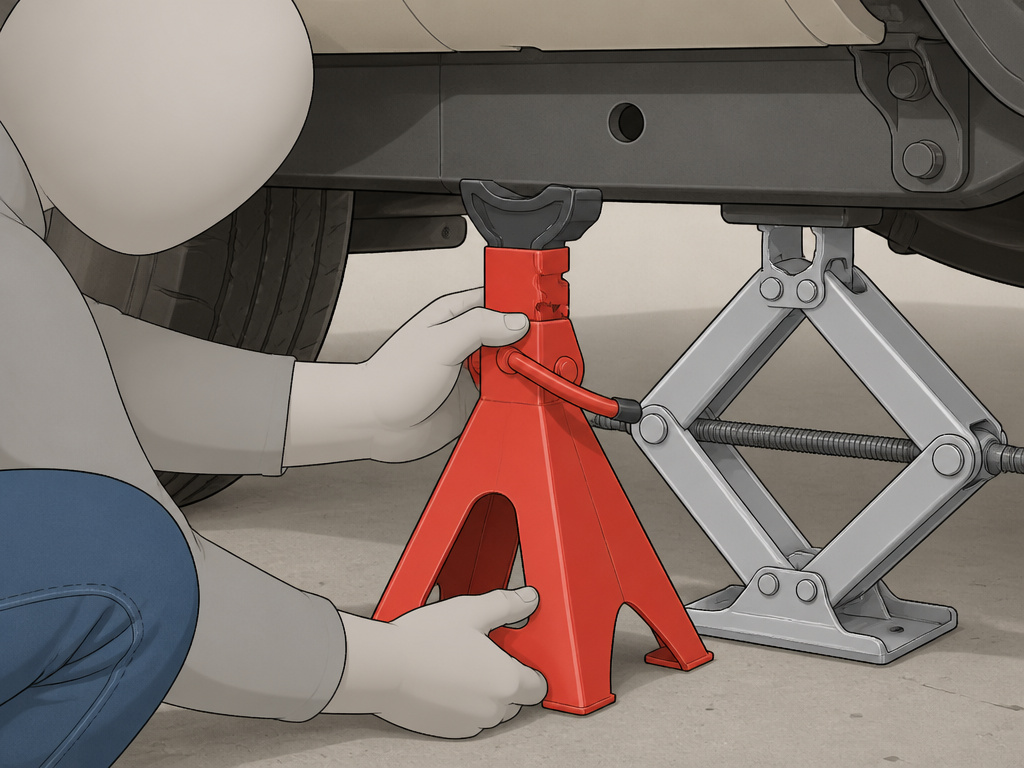
Once the vehicle is lifted with the jack, the jack alone should not be trusted to support it while you work. Vehicle manuals consistently warn against placing any part of your body under a vehicle supported only by a jack. The vehicle’s provided jack is designed for tire changes and, for Mazda, snow chain removal/installation. Never start the engine or shake the vehicle while it is on a jack, and no one should remain inside the vehicle.
Frequently Asked Questions
Where to place a jack when replacing a tire?
Use the reinforced jacking position closest to the tire being lifted. The exact mark varies by model, so check the owner’s manual before you jack.
Where not to put a jack on a car?
Don’t put the jack on the body side sill molding, soft rocker panel, exhaust parts, or suspension. Jeep’s manual warns against raising at locations other than indicated. Mazda’s manual says jacking outside the designated position can deform the body or cause a fall.
What is
Where to place a jack stand under the front of a car?
For a tire change, the manuals don’t ask you to use a jack stand. If you must work under a raised vehicle, take it to a service center where it can be raised on a lift. Mazda’s manual warns that no person should place any portion of their body under a vehicle that is supported by a jack.
Follow your vehicle’s specific manual: Kia says to block the wheel diagonally opposite from the jack position; Jeep Grand Cherokee 4xe says to block both front and rear of the wheel diagonally opposite; Mazda says to block the wheel diagonally opposite and place a tire block both in front and behind.
Before You Go
The answer to where to place a jack when changing a tire is the marked lift point, not a spot that looks strong. Find the tab, dot, flange, slot, or groove first. Then lift only enough for the tire to clear the ground.
Before you jack, do one hand-turn test. Run the jack screw by hand. If it grinds or sticks, clean and lubricate it before you need the lift. A spare that’s flat or aged turns a correct jack point into a bad roadside call.
