
Why Tires Vibrate at Highway Speeds: Causes and Fixes
This post contains affiliate links. As an Amazon Associate, we earn from qualifying purchases.
Why tires vibrate at highway speeds comes from tire-side causes: imbalance, out-of-round shape, and radial force variation. GM lists highway shake at 105-115 km/h (65-70 mph). Subaru links steering wheel shake to front tire radial forces or imbalance, and Chrysler requires road force checks with pressure set to the door label.
Those three causes sit inside the tire or wheel, not under the hood. A shop can separate them with balance weights, runout checks, and road force variation printouts. The first step is warm tires and placard pressure.
What follows: a process-of-elimination check, then the OEM numbers that decide a tire swap. It also tells you where the fix belongs.
Key Takeaways
- Set pressure to the door label before balancing; GM and Chrysler both make placard pressure a diagnostic step.
- Drive to warm the tires before measuring, because flat spots falsify radial force results.
- Rotate the tire to see if shake moves; a free test separates tire problems from brake, driveline, or suspension faults.
- Use road force variation data before replacing tires; Chrysler names the Hunter GSP9700 for this diagnosis.
- Steering wheel shake points to front tires, while whole-car shake points to rear tires, per Subaru.
Why Tires Vibrate at Highway Speeds: Three Tire-Side Causes
Three tire-side conditions cause smooth-road highway shake: imbalance, out-of-round, and tire force variation. GM lists three conditions that can cause smooth road highway shake: imbalance, out of round, and tire force variation.
Radial force variation is a periodic change in load in the radial direction as the tire rotates. Subaru calls radial force variation a primary contributor to vibration. A dynamic balancer displays R1H, R2H, and R3H. GM lists highway shake at 105-115 km/h (65-70 mph) as the common RFV concern when tire uniformity is suspect.
Imbalance is the simplest fix, so GM says address it first. Static and dynamic mass errors are covered in tire balancing. A shop needs to know the difference between static vs dynamic balancing, because Subaru prefers a well-maintained dual-plane dynamic balancer.
A perfectly balanced wheel can still be out of round. That is why balancing alone doesn’t solve every highway shake.
- Imbalance creates centrifugal force as the wheel rotates.
- Out-of-round shape creates a pulse even with perfect balance.
- Tire force variation creates load changes as the tire rolls.
Where Does the Shake Live: Steering Wheel, Seat, or Whole Car?
Subaru splits the complaint into two locations. Steering wheel vibration at constant speed points to front tire radial forces or imbalance. Vibration in the whole vehicle points to rear tire radial forces or imbalance.
I start by asking where the driver feels it. Subaru lists the seat, floor, footwell, pedals, and steering wheel as places the driver feels the vibration.
| Driver complaint | Source position | First check |
|---|---|---|
| Steering wheel at constant speed | Subaru front tires | Front balance and RFV |
| Whole vehicle | Subaru rear tires | Rear balance and RFV |
| Grows with light braking | Chrysler and GM | Brake rotor diagnosis |
Chrysler’s road test asks the driver to watch for steering wheel shaking at the designated speed. The symptoms of unbalanced tires start as a constant-speed shake. Chrysler also says lightly applying brakes can reveal a brake concern.
GM adds that increased steering-wheel pulsation with light brake apply points to brake-induced pulsation. If the vibration changes when you shift into neutral, Chrysler says look at the powertrain.
How to Warm the Tires and Set Pressure Before Any Measurement
A car that sat for a few hours can feel rough after a cold start. Subaru says temporary flat spots develop after a warm tire cools during a stationary period of a few hours. Chrysler says extended sitting can create flat spots that cause vibration. Order matters.
Before you start: Support the vehicle on a rated lift, keep hands clear of rotating wheels, and let brake rotors cool before touching them. A lifted car can crush, a hot rotor can burn, and a loose wheel can fly off.
The drive cycle matters
- Set pressure to the placard value. GM and Chrysler both require this before diagnosis. Subaru requires checking balance and RFV immediately after a test drive. Skipping this can increase radial force variation, per Subaru.
- Drive to warm the tires. GM requires a minimum of 24 km (15 mi) before GM-approved force variation equipment. GM also says drive 15 to 20 minutes before using PicoScope. Subaru says drive at least 12-15 miles at various speeds up to 62 mph. Chrysler says drive to warm tires after extended sitting. If you skip this, flat spots falsify RFV.
- Raise the vehicle immediately after the test drive. Subaru says check balance and RFV before the tires cool down again. If you wait, the tire can cool and flat spots can return.
- Calibrate the equipment. GM says approved force variation equipment must be calibrated prior to measuring for each vehicle. Chrysler says calibrate and maintain per equipment manufacturer specifications. If you skip this, the numbers are meaningless.
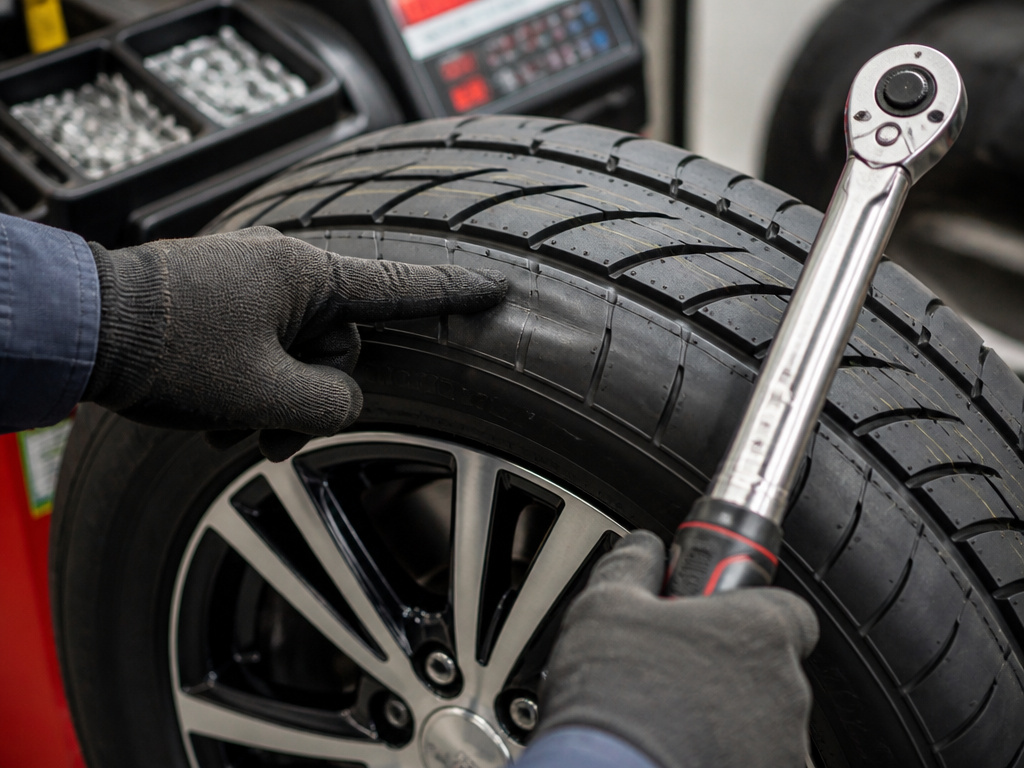
- Center the wheel on the hub. GM says loosen all wheel nuts, hand-tighten while shaking the wheel, then torque to specification with a torque wrench, not a torque stick. If the wheel sits off-center, the balancer or road test can report a false vibration.
- Road test the car on a smooth road. GM says use the PicoScope CH-51450, a vehicle scope tool, and drive within posted speed limits at 105-115 km/h (65-70 mph). Chrysler says road test at and near the designated speed where legal limits allow. If the road is rough, the test may hide the tire-side cause.
I make the shop print the numbers before any tire replacement.
If the shop has the PicoScope CH-51450, ask them to use it for the road test.
Which Numbers Decide Whether a Tire Needs Road Force Balancing
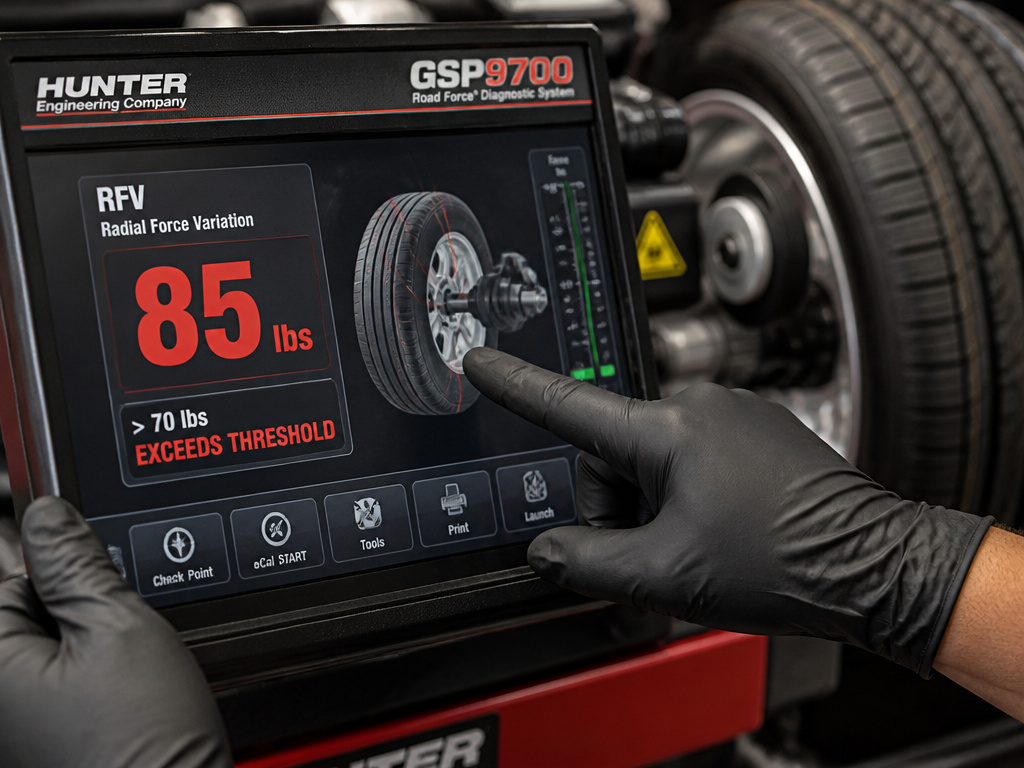
The Hunter GSP9700 Road Force Diagnostic System is the tool Chrysler names for steering wheel vibration at highway speeds. Chrysler’s procedure appears in the NHTSA steering wheel vibration bulletin. I reach for the Hunter GSP9700 Road Force Diagnostic System when balance alone doesn’t explain highway shake.
RFV thresholds are not one number
The sources don’t agree on one universal RFV number, so the shop needs to know which vehicle standard it is applying.
| Source | Passenger tire RFV threshold | Diagnostic use |
|---|---|---|
| Subaru | 8.0kg (18lbs 80N) or less | Warranty vibration repair needs RFV printouts |
| Toyota/Lexus | 8.0kg (18lbs 80N) or less | Balance weights should be 5g (0.18oz) or less |
| GM | Front tires less than 50 lbs | High spots clocked 180 degrees apart |
| GM | Assemblies above 75 lbs | Clocking may not reduce vibration enough |
road force balancing measures RFV and helps match the tire’s high spot to the wheel. Chrysler says place tires with greater RFV on the rear when assemblies are within specification. Chrysler also says mount the high spot at 12 o’clock with the Hunter GSP9700. If that tool isn’t available, mount the valve stem at 12 o’clock.
For front RFV less than 50 lbs and high-spot clocking, see NHTSA technical service bulletin 21-NA-270. GM says for wheel/tire assemblies above 75 lbs RFV, clocking the high spots 180 degrees may not provide enough reduction in vibration. GM says the front tires should have a RFV less than 50 lbs.
Toyota/Lexus says tire weights after adjustment should be 5g (0.18oz) or less. If an assembly can’t be adjusted within 5g, Toyota/Lexus says inspect for an improperly mounted tire, damage, or debris inside the tire. For adhesive weights, degrease the surface. For clip-on weights, confirm the 5mm (0.2in) clip size.
If the shop can’t warm tires, calibrate equipment, and print RFV, move to a shop with the Hunter GSP9700.
Common mistake: Balancing a cold, flat-spotted tire and trusting the result. Subaru says temporary flat spots falsify radial force fluctuation. A shop can reject a tire before the tire warms enough to show the real force.
What If the Balance Is Perfect and the Car Still Shakes?
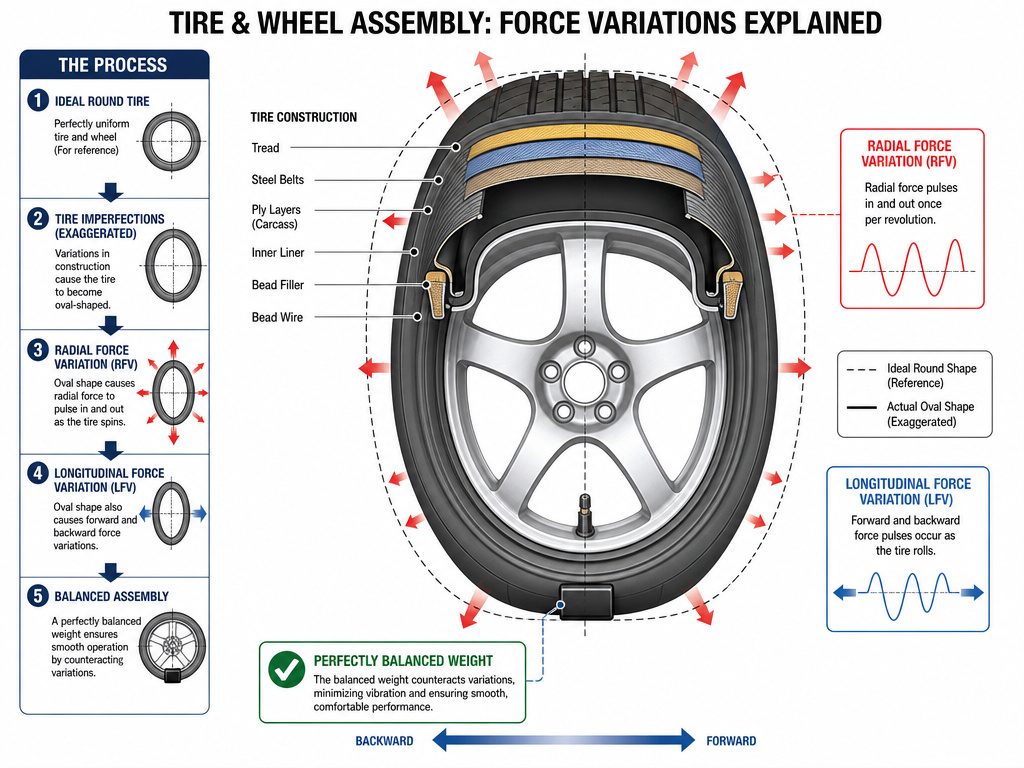
Ever had a wheel balance printout say perfect while the car still shakes? GM says a perfectly balanced tire/wheel assembly can still be oval shaped and cause a vibration. An out-of-round tire can create a pulse even after correct weights. A tire belt shift can make a tire feel rough even when the wheel is balanced.
Sources split on the primary cause of steering wheel vibration. Subaru points to front tire radial forces or imbalance. Toyota/Lexus states the first harmonic (R1H) is the primary cause of steering wheel or vehicle body vibrations at highway speeds in most cases, while a study in the Journal of Vibration and Control correlates steering wheel vibrations 70% with Longitudinal Force Variation (LFV) and 30% with Radial Force Variation (RFV).
The 2001 study in the Journal of Vibration and Control gives a different split. It says steering wheel vibrations correlate with longitudinal force variation (LFV) at 70 percent and radial force variation (RFV) at 30 percent.
Non-tire vibration sources
- Driveline:
- Brakes: Chrysler says lightly apply brakes at the designated speed; if vibration occurs or grows, look at the brake rotor diagnosis.
- Bearings: If tire, brake, and driveline checks are clean, a bearing check belongs in the elimination list.
- Suspension and steering: Worn components or alignment faults belong in the elimination list, because tire weights cannot fix them.
I put road force data before buying tires.
Easy to miss: A low boom noise points to the driveline. That means a road force printout is clean while the repair belongs to the driveline.
Should New Tires, Storage, or Repairs Change the Diagnosis?
Three events reset the diagnosis: new tires, storage, and repairs. New tires can arrive with temporary flat spots. Subaru says flat spots develop after a warm tire cools during a stationary period of a few hours.
If tires go out of balance after a repair, check mounting, weights, and debris before blaming the tire.
I once judged a tire by groove depth and recommended an aggressive pattern for a commuter. It turned out loud and hurt fuel economy. That mistake taught me to weigh pattern, compound, and noise together instead of trusting tread depth alone.
Chrysler says remove the tire if a sealant and inflator kit was used. Wipe all sealant with a water damped cloth before repair and balance. After a collision repair or wheel replacement, check for missing weights, bent rim flange, incomplete bead seating, or mud and ice build-up.
A tire rotation is a free test that can show whether the shake moves. I wouldn’t blame new tires until flat spots and mounting are checked.
Bent Rims and Out-of-Round Wheels
A bent rim or an out-of-round wheel assembly is a direct cause of tire force variation, which leads to highway speed shake. An out-of-round tire or wheel can create a consistent high spot that contributes to tire force variation, which is one of the conditions GM lists as causing highway speed shake. An out-of-round tire or wheel creates a consistent high spot that pounds against the road surface with each revolution. GM states its approved tire force variation measurement equipment must be calibrated prior to measuring for each vehicle. Before any measurement, the vehicle should be driven sufficiently to eliminate temporary flat spots that can form from sitting. GM recommends reinstalling tire pairs with the high spots clocked 180 degrees from each other, and Chrysler recommends mounting the high spot at the 12 o’clock position (or the valve stem if the Hunter GSP9700 is not available).
Worn Suspension and Steering Components
Worn suspension or steering parts like ball joints, tie rods, and shocks can amplify or mimic tire-induced vibrations. While the core vibration often originates from the tires, loose or damaged components allow that oscillation to travel more freely through the steering system and chassis. This wear can make a minor tire force variation feel much more severe. A diagnosis for highway speed shake at 105-115 km/h (65-70 mph) requires checking these components to rule them out as contributing factors. Ensure all parts are tight and in good condition before focusing on tire and wheel measurements. A road test on a known smooth road at highway speeds is a critical step to duplicate the vibration condition before any disassembly or measurement.
Wheel Alignment Problems
Improper wheel alignment typically causes tire wear or pulling, not a primary vibration. However, severe alignment issues can sometimes contribute to a shaking sensation, especially if they cause irregular tire wear that then leads to force variation. The primary sources of highway speed vibration are tire-related: imbalance, out-of-round conditions, and radial force variation. Before suspecting alignment, follow a diagnostic process that starts with the tires. Set all tire pressures to the vehicle’s specified placard values. Then, drive the vehicle to warm the tires and remove flat spots before any balancing or force variation measurement is attempted. This ensures the diagnosis focuses on the most common causes first.
Frequently Asked Questions
Why does my car vibrate only over 60 mph?
Subaru lists highway vibration from 55-80 mph (88-128 km/h). GM puts the common tire RFV concern at 105-115 km/h (65-70 mph). A speed band that starts around 60 mph points to tire-side forces.
Why did my steering wheel start shaking after new tires?
New tires can have temporary flat spots after storage. Subaru says drive 12-15 miles at various speeds up to 62 mph before checking balance and RFV. GM says remove aftermarket wheels and tires before diagnosing smooth road shake.
Can unbalanced tires damage the car?
Subaru states that vibration felt in the steering wheel is caused by increased radial forces or imbalance on the front tires.
How do I know if the vibration is from the tires or brakes?
Chrysler says lightly apply brakes at the designated speed. If vibration occurs or grows, the brake system is the likely source. GM says increased steering-wheel pulsation with light brake apply points to brake-induced pulsation.
Is road force balancing worth it?
Chrysler names the Hunter GSP9700 Road Force Diagnostic System for highway vibration diagnosis. Subaru and Toyota/Lexus require RFV measurements for warranty vibration work. I wouldn’t replace tires without RFV printouts when the balance is clean but the shake remains.
Before You Go
Why tires vibrate at highway speeds is a diagnosis problem. Warm tires, placard pressure, and printouts decide the next step. If the car sat for days, drive it long enough to warm the tires, then set pressure to the door label before any balance check. For passenger cars, I would make the shop print RFV and balance data before selling a new set of tires.
That one request saves money and keeps a bent rim, bad brake rotor, or driveline noise from getting hidden under a tire sale.
Fair warning: this passenger-car guidance is less reliable for heavy-duty trucks and extreme off-road setups. Load range, commercial data, and suspension wear change the answer.
If the vibration moves when you rotate tires, start with the tire side. If it stays with the car after a road force check, move to brakes, driveline, bearings, and suspension.
