
Wheel vs Rim Difference: The 3 Things That Actually Matter
This post contains affiliate links. As an Amazon Associate, we earn from qualifying purchases.
A wheel is the entire metal structure that bolts to your car’s hub. A rim is the outer hoop of that wheel where the tire’s bead seals. The difference is technical, but the U.S. Department of Transportation’s FMVSS 110 legally treats the terms as interchangeable for fitment, which is why the confusion persists.
The real divide is between engineering precision and regulatory language. SAE and ISO standards draw a clear line, but your car’s door placard blurs it. Understanding the wheel vs rim difference matters when you’re buying parts, describing damage, or reading a recall notice.
What follows: the three definitions from the bodies that write the rules, the specific failure modes each term points to, and a plain-English guide for when you need the right word.
Key Takeaways
- Legally, for fitment purposes on placards, ‘rim’ and ‘wheel’ are treated as the same. The U.S. DOT’s FMVSS 110 requires your car’s placard to list rim size, using the terms interchangeably, while ISO and SAE standards maintain a technical distinction.
- Engineers treat the rim as a component. Per SAE J328, the rim is the tire-mounting part of the complete wheel assembly, which includes the hub and spokes.
- Failures happen in specific zones. A cracked spoke is a wheel failure; a dented bead seat is a rim failure. The 2024 Hyundai Ioniq 5 recall for fracturing hub bolts is a wheel-end failure.
- Certification labels are for the whole wheel. Look for JWL/VIA marks on passenger wheels; they certify the complete assembly, not just the rim.
- Use ‘wheel’ when shopping, ‘rim’ for tire-fit. Search for alloy wheels or steel wheels. Use ETRTO rim-width tables only to check if a tire fits your wheel’s barrel.
The Technical Definitions (ISO vs. SAE vs. DOT)
Three organizations define these terms, and they don’t fully agree. You’re not wrong for being confused, the rulebooks are.
ISO 3911:2018 defines the wheel as the complete rotating assembly and the rim as the tire-bead-seating component. Separately, SAE J328 defines ‘wheel’ as ‘a rotating load-carrying member between the tire and the axle’ and ‘rim’ as ‘that part of the wheel on which the tire is mounted.’
The core engineering stance is that the wheel is the whole unit and the rim is a sub-section, though sources like SAE J128 and ISO 3911 differ on the precise scope of what the ‘rim’ includes. This matters for testing. Standards like SAE J2530 benchmark the complete passenger wheel, hub, spokes, and barrel, under cornering and impact loads. A pass means the entire assembly meets a durability threshold.
Now, read your car’s door jamb sticker. That’s where the U.S. National Highway Traffic Safety Administration (NHTSA) steps in. FMVSS 110 requires that placard to specify the “rim size designation.” Legally, for the purpose of telling you what fits your car, ‘rim’ means ‘wheel.’ The regulator’s language prioritizes clear consumer instruction over technical precision.
| Defining Body | ‘Wheel’ Definition | ‘Rim’ Definition | Primary Context |
|---|---|---|---|
| ISO / SAE (Engineering) | Complete assembly (hub, spokes, barrel) | Outer tire-bead-seating hoop | Design, testing, and failure analysis |
| U.S. DOT / NHTSA (Regulatory) | Used interchangeably with ‘rim’ on fitment placards | Used interchangeably with ‘wheel’ on fitment placards | Consumer safety and vehicle compliance |
This split on the wheel vs rim difference explains the daily confusion. A mechanic quoting a rim repair is talking about the barrel. Your car’s manual listing a rim size is telling you what whole wheel to buy.
Anatomy of a Wheel: Putting Names to the Parts
We will name the pieces. Knowing the anatomy turns a blur of metal into a specific checklist.
The center section is the hub. This is the area that bolts directly to your car, with the center bore and lug holes. It’s the load path to the axle. Spokes (or the disc) connect the hub to the barrel.
The barrel is the cylindrical section. Its width and diameter are the “rim size” you see on a placard, like 17×7.0. The very outer edges of the barrel are the rim flanges. These lips keep the tire bead from sliding off.
Between the flanges is the bead seat. This is the critical taper where the tire’s bead seals, especially in a tubeless setup. A dent here causes air leaks. The drop center is the deeper channel in the barrel used to pry a tire bead over the flange during mounting.
When you’re looking at different wheel types, this anatomy changes. A multi-piece wheel, like those from Forgeline, literally bolts separate rim halves (the barrels) to a center. Damage one barrel, you replace just that half. A classic steel wheel is often a welded single piece of stamped metal.
Why People Use ‘Rims’ and ‘Wheels’ Interchangeably
History and marketing flattened the terms. In decades past, wheels were often simple steel discs. The most visible, changeable part was the shiny outer rim lip. Customizing that lip, getting “new rims”, became slang for new wheels. The aftermarket industry ran with it.
Car culture cemented it. If you’re talking about the shiny 20-inch units on a sedan, you’re discussing the entire wheel construction. But you’re likely calling them rims. This isn’t a personal failing; it’s linguistic drift powered by a billion sales brochures.
The slang sticks because for many casual purposes, the wheel vs rim difference doesn’t matter. Telling a friend you “curbed a rim” communicates the problem. The shop knows you mean the outer barrel. The confusion spikes when you move from conversation to commerce, like searching online for a replacement.
When the Difference Matters: Shopping, Damage, and Safety
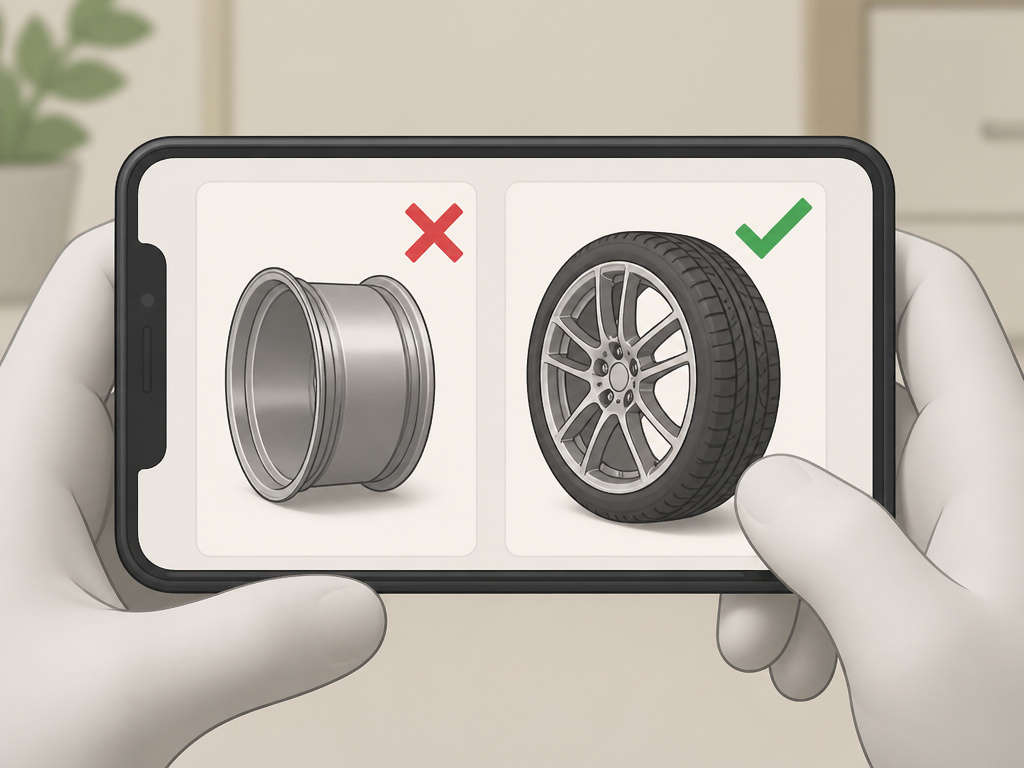
This is where precision pays. Using the wrong term can send you down the wrong product aisle, misdescribe a critical failure, or make you miss the point of a safety recall.
Shopping for Parts
Always search for “wheels.” Online retailers and tire shops categorize the complete assembly under “wheels.” Filter by your vehicle’s specs: bolt pattern, center bore, offset, and wheel size (e.g., 18×8). If you search for “rims,” you might find just the barrels for multi-piece wheels or get generic results.
Where this goes sideways: Buying a “rim” online expecting a full wheel. You could receive just a barrel with no center section, which is useless for a standard monoblock wheel.
The rim width is a sub-spec within the wheel listing. It’s crucial for matching tires to rims. A tire’s approved rim-width range, published in ETRTO tables, ensures the bead seals correctly. Too narrow or too wide, and you risk poor handling or a popped bead.
Describing Damage
Be specific. What you call it directs the repair.
- “I bent my rim.” This points to the barrel, likely a dent in the lip or bead seat from a pothole. A shop will check for bent rim symptoms like a vibration or air leak. Many alloy rim repairs are possible for minor bends.
- “I cracked my wheel.” This is serious. It indicates a fracture in the spoke, hub area, or barrel weld. This is often not repairable. The entire wheel assembly is compromised. This is why JWL/VIA certification for the complete wheel matters, it tests for this.
Understanding Safety Recalls
Read the details. The 2024 Hyundai Ioniq 5 recall cites “front wheel hub bolts” that may fracture. This is a wheel-end failure, not a rim issue. It involves the hardware that secures the entire wheel assembly to the car. The root cause was improper heat treatment of the bolts. Calling that a “rim problem” misses the scale and location of the risk.
For heavy trucks, the standard is FMVSS 120, which regulates the entire wheel end. A failure here is a direct vehicle-control hazard.
Wheel and Rim Standards: What the Certifications Mean
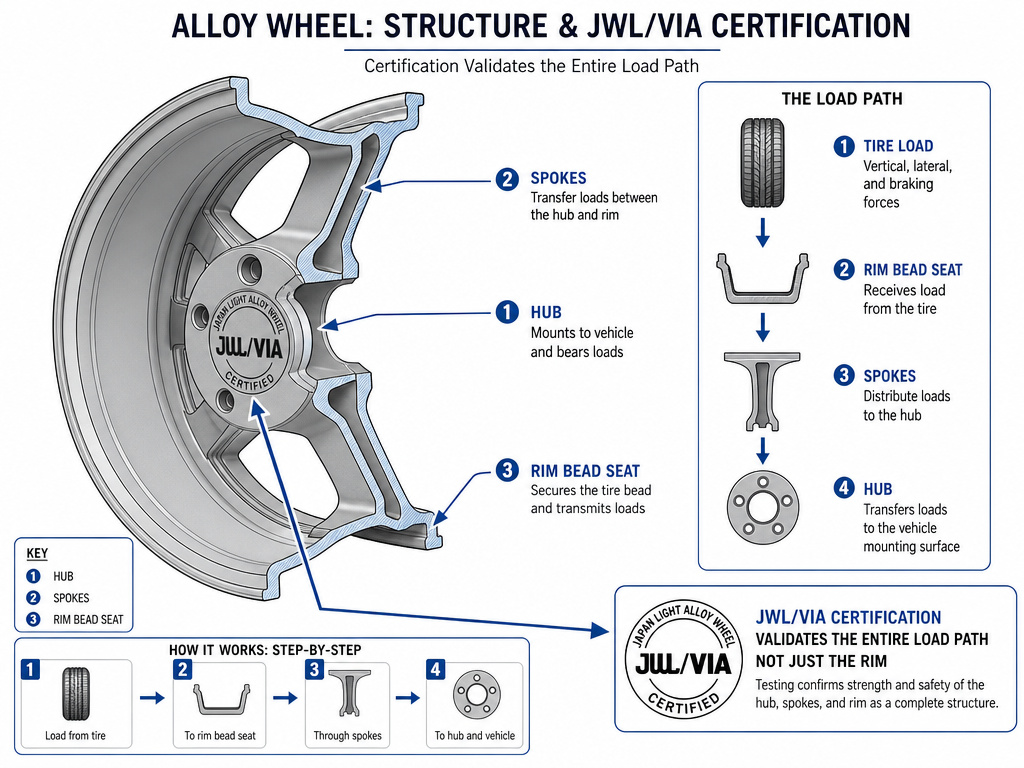
You don’t have to be an engineer, but you should recognize the marks that say a wheel is tested. These certifications are your guarantee.
For passenger cars, look for the JWL (Japan Light Alloy Wheel) or VIA (Vehicle Inspection Association) stamp on the wheel. This means the complete wheel, as a unit, has passed standardized fatigue and impact tests per SAE J2530/ISO 10130. It’s tested as a wheel, not just a rim.
The part nobody mentions: A wheel can have the correct rim dimensions but fail certification if its hub or spokes are weak. The stamp tests the whole.
Truck wheels have their own benchmark, SAE J2562. The takeaway is identical: the certification applies to the assembly. This is why, for severe service, the Tire Industry Association manual might recommend a steel disc wheel, the entire assembly’s repairability and impact tolerance are validated.
These standards exist because common failure zones are specific: the spoke-to-hub fillet, the bead seat, and the valve hole area. A standard tests the whole load path.
Tire, Hubcap, Center Cap, and Wheel Cover Definitions
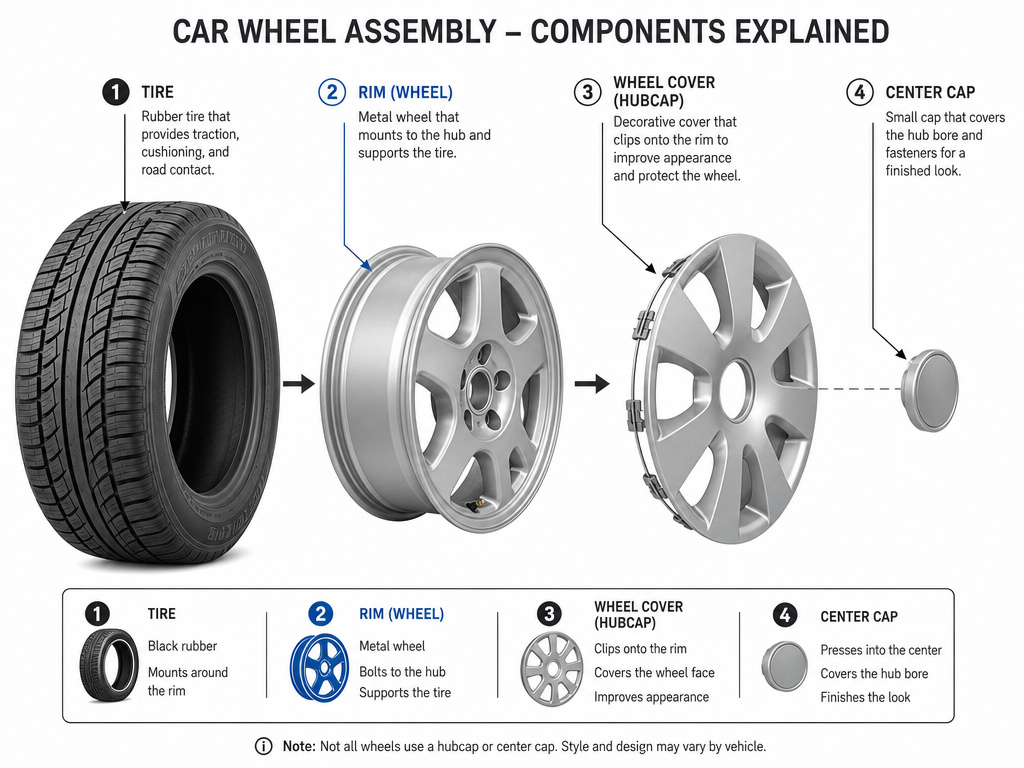
A tire is the rubber component mounted onto the rim. The rim is the outer cylindrical part of the wheel that provides the bead seats for the tire. A hubcap or wheel cover is a decorative disc that clips or bolts onto the outside of the wheel, often covering the entire face on steel wheels. A center cap is a smaller cover that fits into the center bore of the wheel, concealing the hub and lug nuts. For multi-piece wheels, the rim itself can consist of separate inner and outer barrel halves. These terms are distinct from the wheel, which is the complete load-carrying assembly between the tire and the axle.
Frequently Asked Questions
What is the difference between a rim and a wheel?
Technically, the rim is the outer part of the wheel that holds the tire. The wheel is the entire metal structure, including the center hub and spokes. Legally, on your car’s tire placard, the terms are used to mean the same thing: the complete unit you bolt on.
Why do people say rims instead of wheels?
It’s largely cultural slang that started with customizing the visible outer lip (the rim) of a wheel. The aftermarket industry adopted the term, and it stuck in common parlance, even though it’s not technically precise.
What are the three types of rims?
The term “rim types” usually refers to wheel construction methods: cast, forged, and multi-piece. Cast wheels are made from molten metal poured into a mold. Forged wheels are pressed from a solid block. Multi-piece wheels have a center bolted to separate rim halves.
How do I know if a tire is compatible with a rim?
Check the tire manufacturer’s specifications or ETRTO guidelines. Every tire has an approved rim-width range. Match your wheel’s rim width (e.g., 7.0 inches) to that range. Also, ensure the wheel’s diameter (e.g., 17 inches) matches the tire size.
The Bottom Line
Use “wheel” when you’re buying, selling, or discussing safety. That’s the term for the complete product and the one used in recalls and certifications. Use “rim” when you’re talking specifically about the tire-mounting area, its width, a dent in the bead seat, or its flange profile.
The three-second rule: if you’re pointing to the whole thing, it’s a wheel. If you’re tracing the line where the tire rubber meets the metal, that’s the rim. When in doubt, check for the JWL/VIA stamp, it’s the mark that says the entire assembly has been tested to hold together.
