
Nitrogen vs Air in Tires: Which Is Better?
This post contains affiliate links. As an Amazon Associate, we earn from qualifying purchases.
In nitrogen vs air in tires, air is enough for most drivers. Nitrogen holds pressure a little better because dry gas has less moisture, but the measured yearly gap is only about 1.3 psi, or pounds per square inch. Check tire pressure cold.
The 1.3 psi figure comes from Priority Tire, and it’s smaller than the error from checking a warm tire. That gap is small enough that regular checking with a gauge makes it negligible.
What follows: purity numbers, purge steps, tire pressure monitoring system effects, and the one monthly check that beats both gases.
Key Takeaways
- Nitrogen purity depends on equipment. Membrane systems make 95 to 98 percent. PSA, or pressure swing adsorption, systems make 98 to more than 99 percent.
- Priority Tire says a service converts a tire to about 93 to 95 percent nitrogen, while Modern Tire Dealer reports membrane systems produce 95-98% purity. Lower purity weakens the pressure claim.
- Air is safe for topping off a nitrogen tire. It dilutes purity, but it doesn’t harm the tire.
- Check pressure cold. A warm tire gives a higher pressure reading.
- Skip paid nitrogen if you won’t check monthly. The gas can’t replace the gauge.
Nitrogen vs Air in Tires: What the Tests Actually Show
I ran a nitrogen-filled set against plain-air tires. The nitrogen set lost less pressure, but the gap was small. That gap disappeared once I used a gauge.
Nitrogen inflation systems vary by method. Membrane generators produce 95 to 98 percent purity. PSA, or pressure swing adsorption, systems produce 98 to more than 99 percent. Liquid nitrogen delivers 99.998 percent. A good service converts a tire to about 93 to 95 percent nitrogen, according to Priority Tire. Modern Tire Dealer notes purity depends on equipment and purge method.
What the purity numbers mean
The number printed on the machine is a promise. The tire’s actual purity is a receipt. The tire starts with air. Air is about 78 percent nitrogen, 21 percent oxygen, and 1 percent other gases. A service fills, deflates, and refills to push the in-tire mix closer to nitrogen.
Nitrogen moves through rubber more slowly than oxygen. Marketing points to molecule size. The tests point to moisture and purity.
Priority Tire says a nitrogen tire service converts tires to about 93 to 95 percent nitrogen. Modern Tire Dealer reports membrane systems at 95 to 98 percent. PSA systems reach 98 to more than 99 percent. Liquid nitrogen reaches 99.998 percent. Air Products states that oxygen passes through rubber more quickly than nitrogen does.
A 2004 Ford Motor Company study found 99.9 percent nitrogen slowed or halted rubber property changes. The study also found one atmosphere of air in 96 percent nitrogen tires didn’t significantly affect results. Priority Tire nitrogen inflation guide and Modern Tire Dealer nitrogen purity FAQ both show purity is the variable that matters.
Where the tests disagree
Modern Tire Dealer cites three minimum purity thresholds. Ray Schmidt says close to 93 percent plus or minus 2 percent is sufficient. Jay Lighter says no less than 95 percent is necessary. Brian Brasch recommends 97.7 percent for a truck tire at 100 psi.
Top Tire Review ran a four-week test on a 2022 Perodua Axia. The nitrogen front tire ended 4 kilopascals higher. That’s 0.6 psi. The nitrogen rear tire ended 2 kilopascals higher. That’s 0.3 psi. Top Tire Review nitrogen experiment concluded the benefit was too small for the average driver.
| Question | What sources show | Practical read |
|---|---|---|
| Pressure retention | Nitrogen advantage 0.3 to 0.6 psi over 4 weeks | Small |
| Yearly gap | Air loses 1 to 2 psi monthly on average; Priority Tire says the yearly nitrogen advantage is about 1.3 psi. | Gauge beats gas |
| Thermal claim | Moisture absence helps; TV test showed nitrogen pressure rose more | Real purity matters |
| Mixing | Air topping off is safe but dilutes purity | No harm, less benefit |
I keep a dial-type gauge in the door pocket. A dial-type gauge costs less than a paid nitrogen fill and gives a real number.
That’s why checking tire pressure correctly matters more than gas choice. Modern Tire Dealer says topping off with plain air is no problem. Its purge rule also shows mixing lowers purity.
Do You Need to Purge Air Before Nitrogen?
The purge hose hisses as the tire drops to 3 psi. That sound tells you the shop is removing air. It’s a method check.
Before you start: Tire air is under pressure. Wear eye protection near the valve core, keep fingers clear of the purge hose, and check pressure only on a cold tire.
The purge sequence
Modern Tire Dealer says shops must purge existing air twice down to 3 psi, before refilling with nitrogen. I follow that rule because residual oxygen and moisture blunt the purity claim.
- Deflate the tire to 3 psi, then refill with nitrogen. Skipping this leaves air and lowers in-tire purity.
- Deflate to 3 psi again, then refill. Skipping this leaves oxygen and moisture in the tire.
- Set the final pressure to the vehicle’s recommended cold pressure. The door placard, the sticker inside the driver door, lists it. Use the owner’s manual too. The sidewall maximum, the pressure molded on the tire, is a load limit. Wrong pressure hurts grip and wears the center.
Most passenger cars use tubeless tires, so the valve core and bead seal matter more than gas type. If one tire keeps dropping, tire pressure loss causes are more likely than gas choice.
Which Gas Holds Pressure Better in Heat and Cold?
A four-week test showed a 0.3 to 0.6 psi advantage for nitrogen. That’s a small number, and temperature moves pressure more than that in a single season.
Heat, cold, and moisture
Modern Tire Dealer cites Air Products and says oxygen and nitrogen expand and contract in a similar way. The same article says Modern Tire Dealer says the absence of moisture helps tires maintain consistent pressure, while the same source cites Air Products stating oxygen and nitrogen expand and contract very similarly. American Tire Distributors, or ATD, says dry gas reduces internal corrosion. Firestone says proper pressure matters more than the inflation medium.
Fifth Gear, a TV program, tested a tire filled from a commercial nitrogen station at 80 C. The nitrogen-filled tire pressure rose more than the air-filled tire. The program linked that result to real-world nitrogen purity. That matters because Formula One teams use 100 percent pure nitrogen to remove water vapor effects. BlackCircles says racing and aircraft use nitrogen for specialized pressure control.
Dry nitrogen is like distilled water in coffee. It removes a variable. Your tire still needs the same pressure target. I check cold before the car moves. A warm gauge risks a high reading, and that error hides tire pressure temperature effects.
| Test or claim | Time frame | Measured difference |
|---|---|---|
| Air pressure loss | One month | 1 to 2 psi |
| Nitrogen advantage | Four weeks | 0.3 to 0.6 psi |
| Yearly difference | One year | About 1.3 psi |
| Truck tire purity | 100 psi | 97.7 percent recommended |
TPMS, or tire pressure monitoring system, alerts depend on effects of wrong tire pressure. Nitrogen as an inflation gas has no effect on TPMS sensors, according to Modern Tire Dealer. A slower leak doesn’t disable TPMS. The light still comes on at the set threshold.
I won’t pay for nitrogen if I won’t check pressure monthly. The gas can’t fix a missed check.
What Does Nitrogen Cost, and When Is It Worth It?
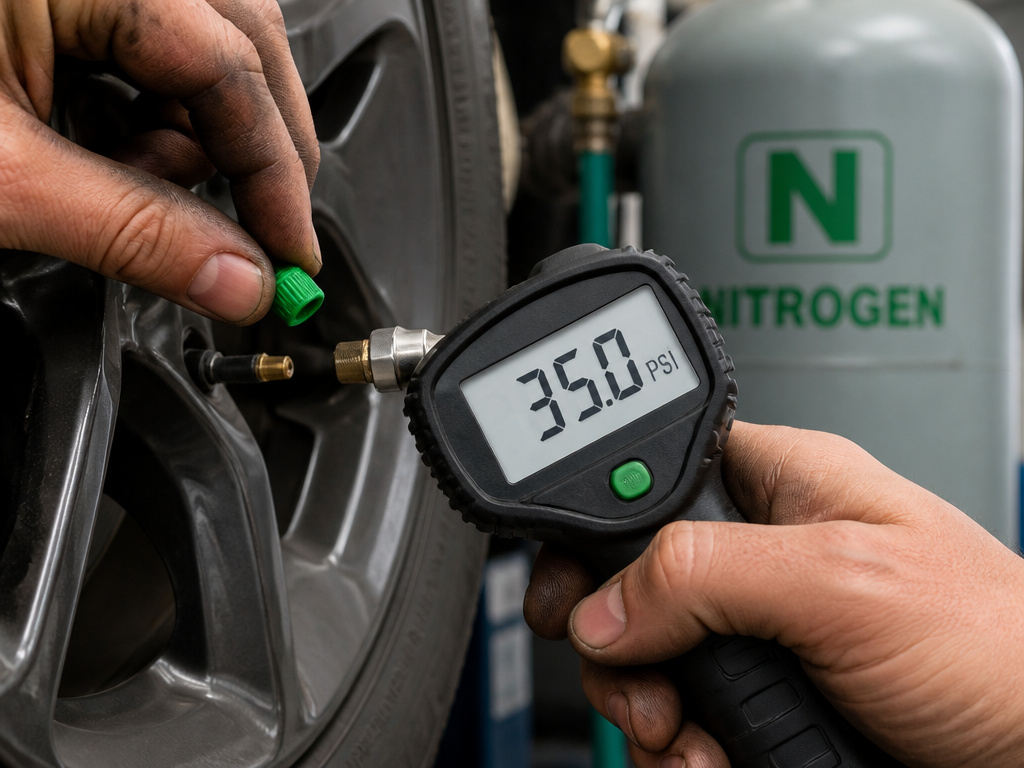
Nitrogen is a convenience gas. A tire upgrade needs grip, wear, and load data. The service costs extra, needs a shop with nitrogen equipment, and still requires monthly pressure checks.
When nitrogen makes sense
- You want dry gas and less moisture in the tire.
- You have a shop that does the purge sequence correctly, and the service is free or bundled.
- You run a truck tire at 100 psi and want the 97.7 percent purity level recommended by the Get Nitrogen Institute.
Air wins when:
- You check pressure monthly with a gauge.
- You want free or easy top-offs at a gas station.
- You have everyday passenger tires and no fleet-grade pressure control need.
Proper tire pressure is important for vehicle performance. Nitrogen only helps if it keeps that pressure. Traction Life says maintenance matters more than inflation medium. American Tire Distributors, or ATD, says regular air is sufficient for everyday drivers. Their ATD nitrogen vs air guide says the same.
If you want to avoid pressure checks entirely, airless tires are the real category. Nitrogen doesn’t turn a tire into run flat tires.
Easy to miss: Some new cars leave with green valve caps, but that doesn’t prove the tire stayed at high purity.
I saw green caps at a dealership and still asked the purity number. A green valve cap is a flag. The lab result is the purity number.
Use a dial-type gauge for a quick cold check. A digital gauge gives a faster read when you’re in a hurry. Shop-grade gauges offer high accuracy.
Does nitrogen prevent tire oxidation and corrosion?
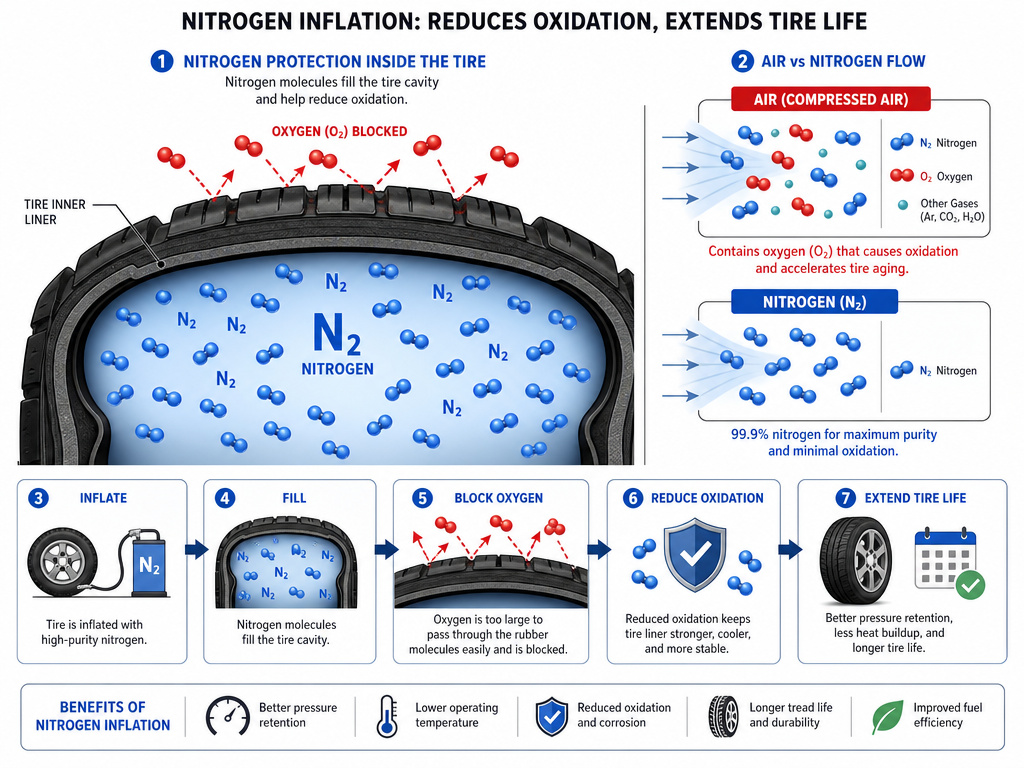
A 2004 Ford Motor Company study concluded that inflating tires to 99.9 percent nitrogen significantly slowed or halted changes in rubber properties compared to using regular air. The study also noted that the presence of one atmosphere of air in tires inflated to 96 percent nitrogen did not significantly affect the results. This suggests that very high nitrogen purity can reduce the oxidation process inside the tire, which is driven by the oxygen present in compressed air. For the average driver, the practical impact of this benefit depends heavily on achieving and maintaining a high level of nitrogen purity within the tire.
Frequently Asked Questions
Is it okay to mix nitrogen and air in tires?
Yes. Modern Tire Dealer cites the Get Nitrogen Institute and says topping off with plain air is no problem. Firestone says compressed air won’t harm tires that held nitrogen. It dilutes purity and reduces the benefit.
Which is better, nitrogen or air in tires?
For everyday drivers, air is sufficient. ATD says regularly checking and maintaining pressure with standard air is sufficient. Nitrogen helps a little with moisture and pressure stability, but the yearly gap is small.
Do dealerships actually put nitrogen in tires?
Some do. Green valve caps or stems signal nitrogen service, but the cap isn’t a purity certificate. Ask for the in-tire percentage and the purge method. A nitrogen tire service converts the tire to about 93 to 95 percent nitrogen.
What is the disadvantage of nitrogen-filled tires?
Cost and availability. The gas requires a shop with the right equipment, and a correct conversion needs purge cycles. If you skip monthly checks, the small pressure advantage disappears.
Does nitrogen affect TPMS sensors?
No. Modern Tire Dealer says nitrogen as an inflation gas has no effect on TPMS sensors. The sensors relay compressed air and nitrogen the same. The low pressure light still depends on correct tire pressure.
Before You Go
The nitrogen vs air in tires choice is a maintenance choice. Nitrogen reduces moisture and holds pressure a little better, but the measured yearly gap is only about 1.3 psi. A gauge and five minutes erase that gap.
If you want nitrogen, make sure the shop purges twice down to 3 psi and reports the in-tire percentage. If you use air, check cold pressure monthly and treat any one-tire drop as a leak.
Here is the catch. Nitrogen is fine if it’s free. Paying extra for gas while skipping pressure checks is the wrong order of priorities. Specs over slogans.
