Overinflated vs Underinflated Tires: Which Is Worse?
This post contains affiliate links. As an Amazon Associate, we earn from qualifying purchases.
Overinflated vs underinflated tires both pull the tire away from the placard pressure. Overinflation shrinks the contact patch and hardens the ride. Underinflation flexes sidewalls, builds heat, and raises failure risk. The door placard is the target; the sidewall maximum is a limit.
That contact patch changes braking, cornering, and tread wear the moment pressure moves off the placard. A cold gauge reading and the door sticker settle most arguments.
The next sections compare wear patterns and handling. They cover blowout risk, fuel effects, and the TPMS threshold. Then they walk through a monthly check.
Key Takeaways
- Check cold at least once a month and before long trips.
- Use the placard as the target; the sidewall maximum is a safety limit.
- TPMS warns at 25 percent below placard pressure, not at a small miss.
- Underinflation builds heat, while overinflation shrinks grip and wears the center.
- Some Subaru Outback forum users report running 2-4 psi above placard, but Subaru’s manual and NHTSA say to use the placard pressure.
Overinflated vs Underinflated Tires: What Each Does to Your Car
The door placard and the sidewall maximum answer two different questions. The placard is the vehicle’s operating target. The sidewall maximum is the tire’s upper safety limit. Mixing them is where forum advice goes wrong. FMVSS 138 is the federal rule for tire pressure monitoring systems, or TPMS.
Vehicle placard pressure is the operating target. Sidewall maximum pressure is a safety limit, not a setting. FMVSS 138 triggers a TPMS warning at 25 percent below placard pressure, so a 35 psi placard warns at 26.25 psi and a 33 psi placard warns at 24.75 psi. Cold readings matter because driving heats tires and raises pressure.
FMVSS 138 applies to passenger cars, minivans, SUVs, and light trucks with a GVWR ≤ 10,000 lb.
When pressure climbs above the placard, the tread bulges in the middle. The footprint shrinks. That smaller contact patch cuts grip, especially on wet pavement, and sends more road shock into the cabin. TireGrades says the max PSI is a safety limit, not a target. A stretched center rib is the classic sign of center tire wear.
When pressure falls below the placard, the sidewalls flex more. That flexing makes heat. Reifteil says underinflated tires burn up to 5 percent to 10 percent more fuel. The steering feels soft, and the tire wanders in crosswinds. If you want the warning signs, signs of low pressure separate a slow leak from a seasonal drop.
| Condition | What you feel | What it does |
|---|---|---|
| Overinflated | Harsh ride, quick steering | Center wear, less grip |
| Underinflated | Soft steering, wandering | Shoulder wear, heat |
| Placard target | Balanced grip and ride | Even wear, rated load |
The same pressure change also affects handling and braking. A smaller footprint means less rubber doing the work. I keep the placard number as the target.
That’s the whole tradeoff.
Which Is Worse, Overinflated or Underinflated?
NHTSA cites tire failures as involved in approximately 11,000 crashes, 200 deaths, and 8,000 injuries annually. Underinflation is the heat problem. Underinflated tires hitting curbs or potholes can cause sidewall damage. The tire flexes too much. The internal structure gives up. That can end in a sudden highway failure. That path is central to underinflation and blowouts.
Overinflation is the grip problem. EngineAuditor says it reduces traction, worsens braking, and raises blowout risk from impact. It also accelerates rubber aging and cracking. A tire set to sidewall max looks tough, but it has less rubber on the road.
NHTSA and EngineAuditor say both are unsafe. Underinflation has a clearer heat failure path. Overinflation has a clearer impact and traction path. Neither condition wins a safety contest.
Subaru Outback owners report running 2 to 4 psi above placard for slower air loss, better MPG, or shoulder wear balance. Subaru’s manual and NHTSA say use placard. That disagreement is real.
How Do Tread Wear Patterns Reveal Bad Pressure?
Bad pressure leaves a visible band in the tread. You crouch by a warm tire and run a gauge across the center and shoulders. The pattern tells you what the car has been doing. Reifteil gives a concrete check: if the center rib tread depth is significantly less than the shoulders, the tire is ballooning under excessive pressure.
- Center rib low: overinflation stretches the middle of the footprint.
- Shoulders low: underinflation puts the load on the edges and flexes the sidewall.
- One tire low: alignment, rotation, or a slow leak can mimic pressure issues. LastingCar says inspect for nails, punctures, or damaged valve stems.
A gauge helps, but a pattern helps faster. Tire wear patterns explain what each band means. If one corner eats tread, pressure isn’t the only suspect. A slow leak or alignment issue can mimic a tire pressure problem.
Match the pattern to the placard.
How to Check and Adjust Tire Pressure Step by Step
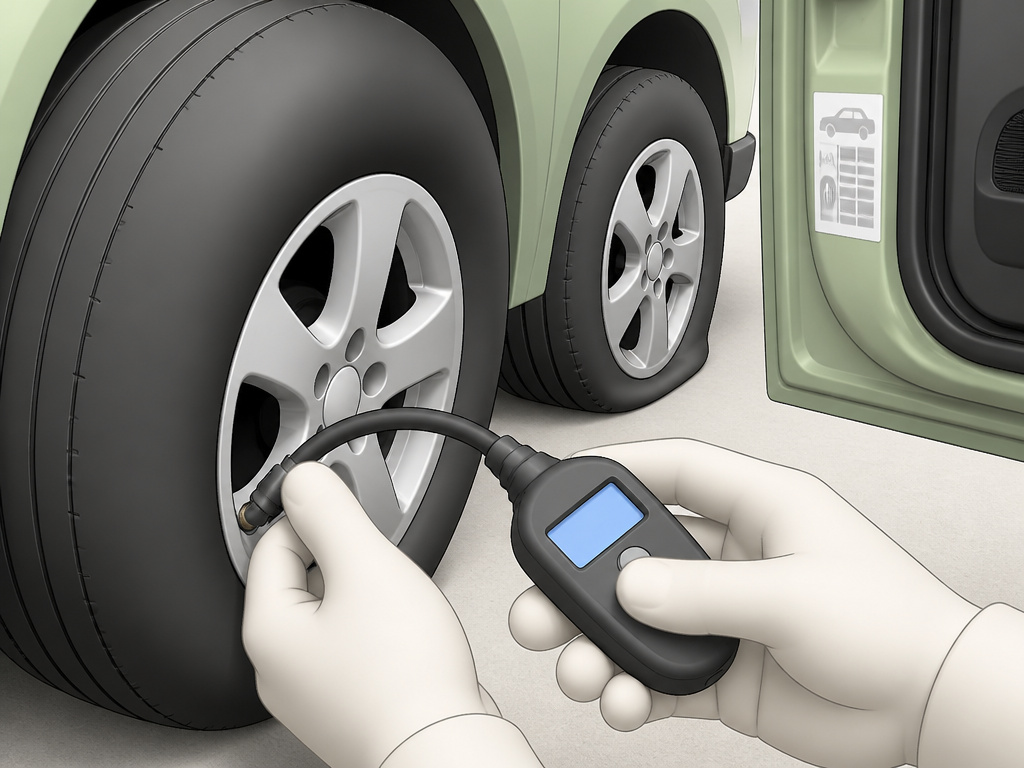
Cold tires first. The most accurate reading is first thing in the morning or after the car has been parked for at least three hours. LastingCar says that rule prevents hot-pressure guesswork. The rule for when to check pressure is the same cold standard. I check cold before I trust a gas station gauge.
Before you start: Park on level ground, set the parking brake, and check tires cold. A hot tire reads high, and letting air out of a hot tire can leave it underinflated on the road. Wear eye protection near the valve stem and replace every valve cap.
What You Need
- A calibrated tire pressure gauge.
- Air from a compressor or pump.
- The vehicle placard pressure from the driver door jamb or owner manual.
- A phone note if your tires drift differently.
The 6-Step Cold Check
- Read the placard. It’s the vehicle’s target. If you skip it, you’re guessing at a spec set for that vehicle’s weight and suspension.
- Check cold. First thing in the morning or after at least three hours parked. If you skip it, a hot reading makes you bleed air the tire needs.
- Measure all four tires. Don’t eyeball it. MyTires4Less warns that visual checks miss slow pressure loss. If you skip it, you miss a one-tire leak.
- Add air in short bursts. TireGrades says add a little air, then recheck. If you skip the recheck, you overshoot and create overinflation.
- Bleed overinflation slowly. Press the valve core briefly, then recheck. EngineAuditor says the fix for high pressure is letting air out, but you need a cold reading to know how much.
- Check the spare. LastingCar says it gets overlooked. If you skip it, you find it low when you need it.
Cold first.
When Does Mild Overinflation Make Sense?
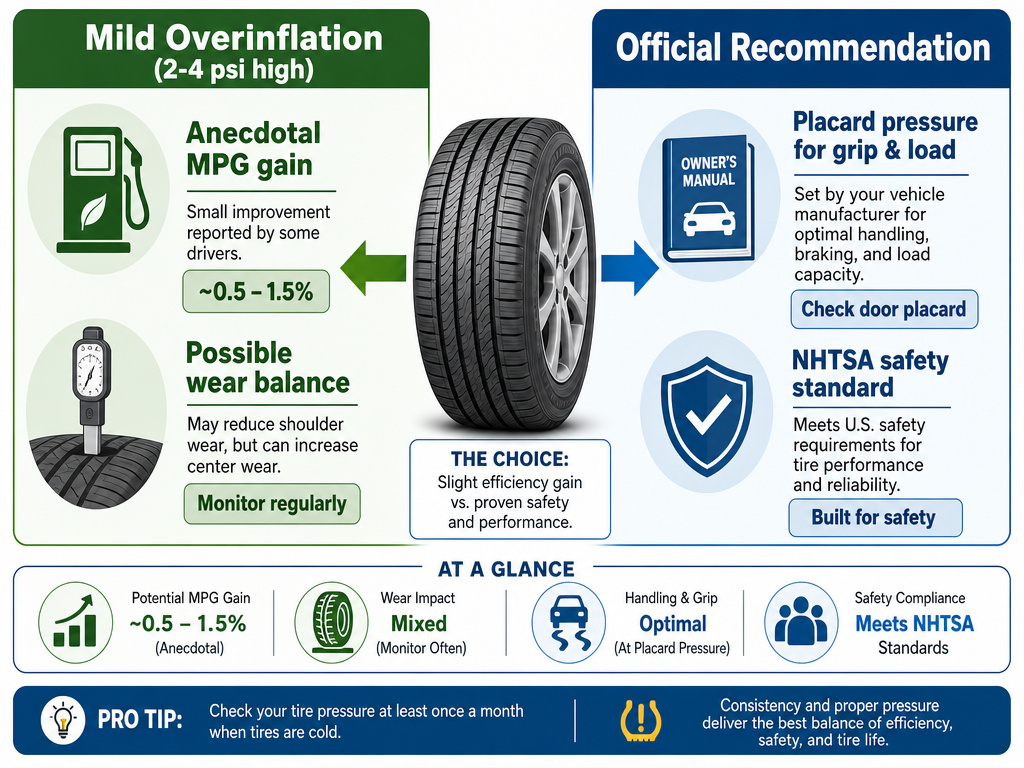
Should you run 2 psi above the placard? Owners report doing it. The spec doesn’t. Subaru Outback forum users say slight overinflation reduces topping-off, improves MPG, or balances shoulder wear. The owner’s manual and NHTSA say use the placard.
The fuel case is thin. The U.S. Department of Energy, via LastingCar, says proper inflation can improve gas mileage by up to 3 percent. Reifteil says underinflation burns up to 5 percent to 10 percent more fuel. Neither source proves a small overinflation gain. The link between fuel economy and pressure is strongest when you fix underinflation. I don’t treat a forum MPG report as a spec.
| Claim | Who says it | What it means |
|---|---|---|
| Use placard pressure | Subaru manual, NHTSA | Operating target for grip and load |
| Inflate to high end | The Tire Reviews | Consumer advice, not vehicle spec |
| Sidewall max is wrong target | EngineAuditor, TireNearMeHub | Max is a limit, not daily pressure |
| Owners run 2-4 psi high | Subaru Outback forum | Anecdotal MPG and wear tactic |
Track Use Is a Different Sport
UsedRacingTires says overinflated tires reduce rolling resistance and sharpen response on smooth dry tracks. It also says they are more prone to blowouts under high speed and heat. Underinflated tires give more grip on wet or slippery track surfaces, but generate excessive heat in long races. That’s a monitored setup tradeoff, not a street rule.
Street use, placard first.
What About Towing, Winter, and Heavy Loads?
Load changes the math. Use the loaded placard number if it exists. The Subaru 2023 Outback manual lists 35 psi front and 33 psi rear for common fitments. Placards split front and rear, and they list loaded states. If you tow or carry heavy cargo, use the loaded number if the placard gives one. If it doesn’t, don’t invent a pressure. Set cold tires to the placard target.
Easy to miss: A 35 psi placard doesn’t mean 35 psi all winter. Tire pressure drops 1 PSI for every 10 degrees F of ambient temperature loss.
TireGrades explains how temperature affects PSI. The same seasonal rule matters when you compare a warm garage reading with a cold-road reading; seasonal tire pressure covers the adjustment. Check again when the calendar flips.
Towing and Heavy Cargo
Load capacity is tied to inflation pressure. Lower pressure derates the tire, meaning it carries less weight. If you load the rear, check the rear placard number first. Don’t set every tire to one number just because it’s easier. A loaded axle can derate the tire before you reach the highway. The placard splits front and rear because weight shifts. Follow the loaded number.
Tire Models Change the Feel
Owner reports show the tire model changes how a pressure feels. One Subaru Outback user says a new Michelin Primacy Tour set felt right at 35 psi front and 33 psi rear. Another replacement felt overinflated at the back. Some owner reports suggest the tire model can change how a given pressure feels, but this is anecdotal, not a spec. That’s anecdotal, not a spec.
Frequently Asked Questions
Is 37 psi too high for a tire?
If the placard says 35 psi, 37 psi is above the target. If the sidewall max says 51 psi, 37 psi is below the tire’s safety limit. Subaru owners report 37 psi, but NHTSA and the manual point to the placard.
Can I inflate to 40 psi when the recommended pressure is 35 psi?
Only if the placard or manual gives a loaded 40 psi target. The sidewall max isn’t permission to run 40 psi. Sources disagree: The Tire Reviews suggests inflating to the higher end of a range, while EngineAuditor.com and TireNearMeHub.com state the correct pressure is the vehicle manufacturer’s recommendation, and using a range not specified for the vehicle is incorrect.
Is it better to have overinflated or underinflated tires?
Neither. Underinflation builds heat and raises failure risk. Overinflation shrinks grip and makes impact damage more likely. NHTSA and EngineAuditor treat both as unsafe.
Is 1 psi over or under a big deal?
1 psi miss won’t trip the TPMS warning if the placard is 35 psi and the tire stays above 26.25 psi. It still moves the tire off the specified contact patch. Check cold, then correct to the placard.
How often should I check tire pressure?
At least once a month and before long trips. MyTires4Less gives that rule. Also check after a sharp temperature drop, because pressure falls 1 PSI for every 10 degrees F of ambient loss.
The Bottom Line
If a 35 psi placard reads 26.25 psi or lower, the TPMS warning is the threshold. Treat that as a stop sign, not a reminder.
Start with one action this week: check all four tires cold. Write down the placard number, then compare it with your gauge before you drive.
The concession is just as plain. A track driver tunes pressure for grip, and some owners run 2 psi high for MPG. On public roads, the placard is the rule. Overinflated vs underinflated tires both move you away from the spec that keeps grip, heat, and wear in balance.
