
How to Find the Correct Tire Pressure for Your Car
This post contains affiliate links. As an Amazon Associate, we earn from qualifying purchases.
How to find the correct tire pressure for your car: read the placard, tire label, or owner’s manual. This recommended cold inflation pressure is your target. The number molded on the tire sidewall is a maximum, not the vehicle’s target.
That placard number is a cold target. The sidewall stamp is a tire limit, and seasonal temperature moves the reading before you start the engine.
What follows: the placard, the sidewall number, cold checks, seasonal changes, and the load cases that change the answer.
Key Takeaways
- Start at the door sticker. The vehicle manufacturer’s recommended cold pressure lives there, while the sidewall stamp is a maximum.
- Check before the one-mile warm-up. USTires and Goodyear define cold as parked at least 3 hours or driven less than 1 mile.
- Monthly is the federal check interval. 49 CFR 571.138 says each tire, including the spare, should be checked monthly when cold.
- Trust your gauge over the pump display. A reliable tire pressure gauge gives the reading you can use.
- Towing and GVWR can change the answer. GVWR, or Gross Vehicle Weight Rating, can raise the target. Tesla Cybertruck documentation says not to use the normal placard pressure when towing.
Where the Correct Pressure Lives: Placard, Label, or Manual
The tire information placard, the sticker with the vehicle’s pressure data, is the first place to look. It carries the vehicle manufacturer’s recommended cold inflation pressure for the original tire size. That number is the cold inflation pressure, the target measured before the tire heats up.
The recommended cold tire inflation pressure is the vehicle manufacturer’s target for the approved original equipment tire size. The value appears on the vehicle placard, tire inflation pressure label, or owner’s manual. The number molded on the tire sidewall is the tire’s maximum operating pressure, not the vehicle target for everyday driving.
The vehicle’s tire placard is the fastest answer for a stock tire size. The NHTSA tire safety guide lists the placard, label, and manual as the sources.
Placard, sidewall, and load tables
Think of the placard as the recipe and the sidewall as the pan’s heat limit. (The recipe tells you how the car should run; the pan limit tells you how hot the tire can get.)
| Source | Meaning | Use it |
|---|---|---|
| Door jamb placard | Recommended cold pressure | Stock passenger cars and light trucks |
| Owner’s manual | Same pressure with load notes | Faded or missing sticker |
| Tire sidewall | Tire maximum pressure | Not a normal target |
| Load and inflation tables | Pressure for changed sizes or loads | Changed tires, vans, heavy loads |
For most passenger cars, the placard wins. For vans and light trucks, some placards list only the maximum-load pressure. Goodyear’s tire inflation bulletin warns about Load Range D or E tires, heavy-duty tire groups. That can overinflate an unloaded van.
Use the owner’s manual or the Tire & Rim Association Yearbook for the actual load. Use load and inflation tables, published charts that match tire load to pressure. A VIN lookup can identify original tires, but it doesn’t replace the placard when the tires changed.
I don’t run heavy commercial fleets, so for Load Range D or E vans I lean on the published table instead of guessing.
SUVs, sedans, and front/rear numbers
A sedan can have one pressure for all four tires. An SUV or truck can list different front and rear numbers. USTires says the placard identifies front, rear, and spare cold pressures. Write down both numbers before you touch the valve stem.
Which Number Is the Real Tire Pressure Target?
One spec decides it: the sidewall number is a maximum. Goodyear says the sidewall pressure is the maximum operating pressure for the tire, not necessarily the correct pressure for the vehicle.
I stopped judging tire pressure by how the tire looks. A tire can be several psi low and look fine, so I use a gauge every time.
The sidewall, the molded face of the tire, can read 35, 36, 44, or 51 psi for Standard Load passenger tires. The psi value means pounds per square inch. USTires also lists Extra Load maximums of 41, 42, or 50 psi.
These are ceilings. The placard pressure is the load-carrying target the vehicle was designed around.
With underinflated tires, heat build-up can damage the tire. Overinflated tires can feel harsh and wear the center.
- Don’t bleed warm tires to match the cold number. Tesla says a hot tire at or below the cold target is dangerously under-inflated. Under-inflation can cause damage that shows up at a later date.
- Don’t treat the sidewall stamp as a target. Goodyear says it is a maximum, not necessarily the vehicle pressure.
- Don’t ignore front/rear differences. USTires says the placard can list separate front and rear cold pressures.
When Is a Tire Cold Enough to Check?
You pull into the garage, press the gauge, and the reading looks close. The placard says a different answer. That gap matters.
A monthly habit sounds slow. It’s the part that gets skipped. I watched a new driver with a first car build a monthly pressure habit. Within two weeks, that habit caught a slow leak that would have gone unnoticed. The federal rule says the same thing: check each tire, including the spare, monthly when cold.
The USTires tire care guide defines a cold check as parked at least 3 hours or driven less than 1 mile at moderate speed. Goodyear uses the same one-mile and three-hour test. Goodyear says tires can lose up to 2 or more psi per month. If a vehicle sits stored, USTires says move the tires every 3 months.
If you drove to a station, let the car sit. If you can’t wait, use the hot-tire rule below.
Make a habit to check pressure monthly, and use measuring when tires are cold as your reference point. The cold check is where the gauge earns its keep.
Easy to miss: Keep the valve cap on between checks. Goodyear says a sealing cap helps keep moisture and contaminants out of the valve core, the small part that holds the air seal.
How to Find the Correct Tire Pressure for Your Car in Six Steps
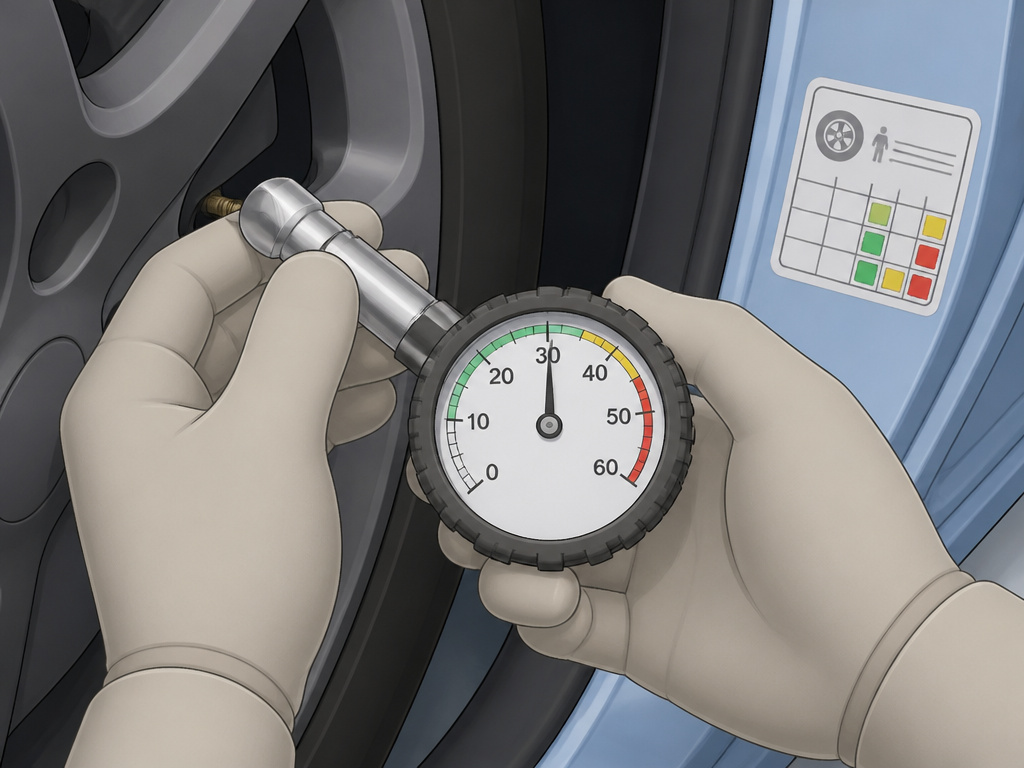
This is where sloppy habits show up. The steps are simple. Skipping the gauge isn’t.
Before you start: A tire can heat up after about one mile of driving, so let it cool before you press the valve stem. If the wheel, valve, or sidewall shows damage, stop and have it inspected. Keep the valve cap on between checks to keep moisture and dirt out of the valve core.
The TPMS, or Tire Pressure Monitoring System, is the dashboard warning system. Tesla Cybertruck documentation says drive at least 15 mph, or miles per hour, for some time to activate it.
Make using a tire pressure gauge the gauge referee. When you need air, follow how to inflate your tires, but recheck your own gauge.
- Read the placard first. Note front, rear, and spare pressures. If the sticker is faded, use the owner’s manual.
- Measure each tire with the gauge. Press the gauge straight onto the valve. A clean seal gives a short hiss and a steady needle. If the reading jumps, the gauge isn’t seating.
- Compare each tire with the cold target. Record the missing pounds of pressure. Add the missing pounds of pressure. If you skip this, you can add air blindly.
- Release air slowly if a tire is high. Release air slowly by pressing the valve stem core. If you release too fast, you can push the tire under the cold target.
- Add air in short bursts. Trust your gauge, not the pump display. If you rely on the pump, you can leave the station with the wrong pressure.
- Recheck and reset the system. After a change, drive at least 15 mph for some time to clear the low-pressure light. GM says relearn the sensors after tire rotation. If you don’t recheck, the warning may stay on and hide a real low tire.
Do you check before or after driving? Before, unless you use the hot-tire compensation.
Stop. Recheck.
What If the Sources Disagree About Hot, Cold, and Load?
What happens when your tire is warm, the sticker is faded, or the van is empty? The sources don’t all answer the same way.
The 49 CFR 571.138 standard says the TPMS telltale, the dashboard light, must illuminate within 20 minutes. The trigger is 25 percent below the recommended cold pressure or the table value, a minimum pressure floor, whichever is higher. It also says the driver must maintain pressure even if the light stays off.
GM says a sensor that fails to transmit can set a message. The light can blink, then stay on.
| Situation | Position | Takeaway |
|---|---|---|
| Warm tire | Goodyear says add 4 psi if checking hot. Tesla says don’t deflate warm tires. NHTSA says if you have been driving and think a tire is underinflated, fill it to the recommended cold inflation pressure. | Recheck cold as soon as possible |
| Indoor fill in extreme cold | GM TSB allows 3-4 psi over placard indoors, then recheck cold outdoors. | Don’t leave the indoor fill on. |
| Temperature swing | GM and Tesla: about 1 psi per 10 F drop. Goodyear: 1-2 psi. | Expect seasonal warnings |
| Van or light truck | USTires says follow placard. Goodyear says some placards list max-load pressure only. | Use load tables for the actual load. |
The GM tire pressure service bulletin says never set below the placard value. It also says set the placard pressure at the lowest seasonal temperature the vehicle will encounter. Read how temperature changes tire pressure before you chase a winter light.
Temperature and hot tires
The placard is the target, actually the cold target when the load matches the placard scenario. Don’t leave an indoor +3-4 psi fill on the tires after the car sits outside. GM says recheck and adjust to placard when the tires are cold outdoors.
Vans, light trucks, and towing
Here is the catch: the placard is a normal-load target. GVWR, or Gross Vehicle Weight Rating, is the vehicle’s maximum loaded weight. Tesla’s Cybertruck label is on the center door pillar. Tesla’s Cybertruck label assumes cargo in the front trunk and up to five passengers.
For a 20-inch All Terrain tire, normal load is 50 psi and GVWR load is 65 psi. The All Season sizes list 50 psi for both. For example, Tesla Cybertruck documentation lists 50 psi for normal and GVWR load on its 18″ All Season tires. If you tow, Tesla says don’t use that label; refer to the published towing pressures.
How to Use a Gas Station Air Pump Without Fooling Yourself
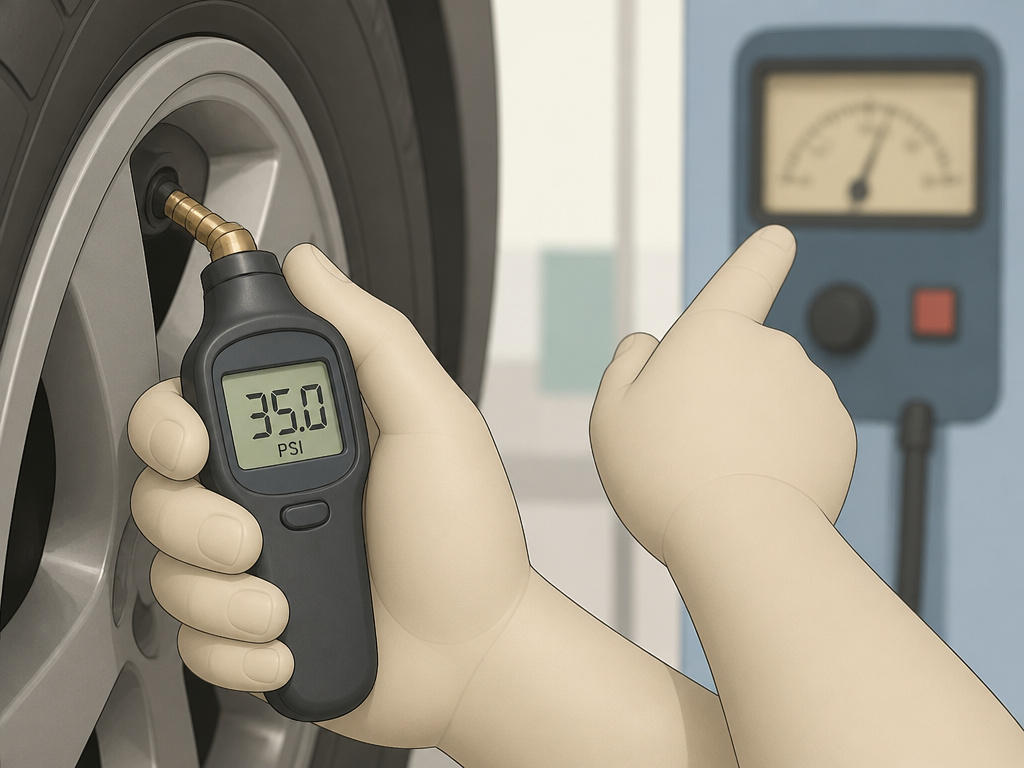
Every gas station pump tells you a number you shouldn’t trust. The best tire pressure gauges on your shelf are better than the machine’s readout. The gas station pump display is convenient, but the gauge on your wheel is the referee.
A working pump makes a short buzz, then the tire gets a little warmer to the touch. A failing pump shudders and stops before the reading settles. Do you set the pump to the placard number? Do that, then verify with your gauge.
- Set the target on the placard, not the sidewall.
- Add air in short bursts, then recheck cold or hot compensation.
- Put the valve cap back on. Goodyear says it helps keep moisture and dirt out of the valve core.
- Check your gauge for accuracy. Goodyear says this matters.
- Check the spare and inside duals, the tires mounted between paired outer tires, if your vehicle has them. USTires and Goodyear both say don’t forget them.
Where this goes sideways: If you use the pump display as proof, you leave the station with the wrong pressure. Recheck with an Accutire or Intercomp gauge before you drive away.
How to release air if overinflated
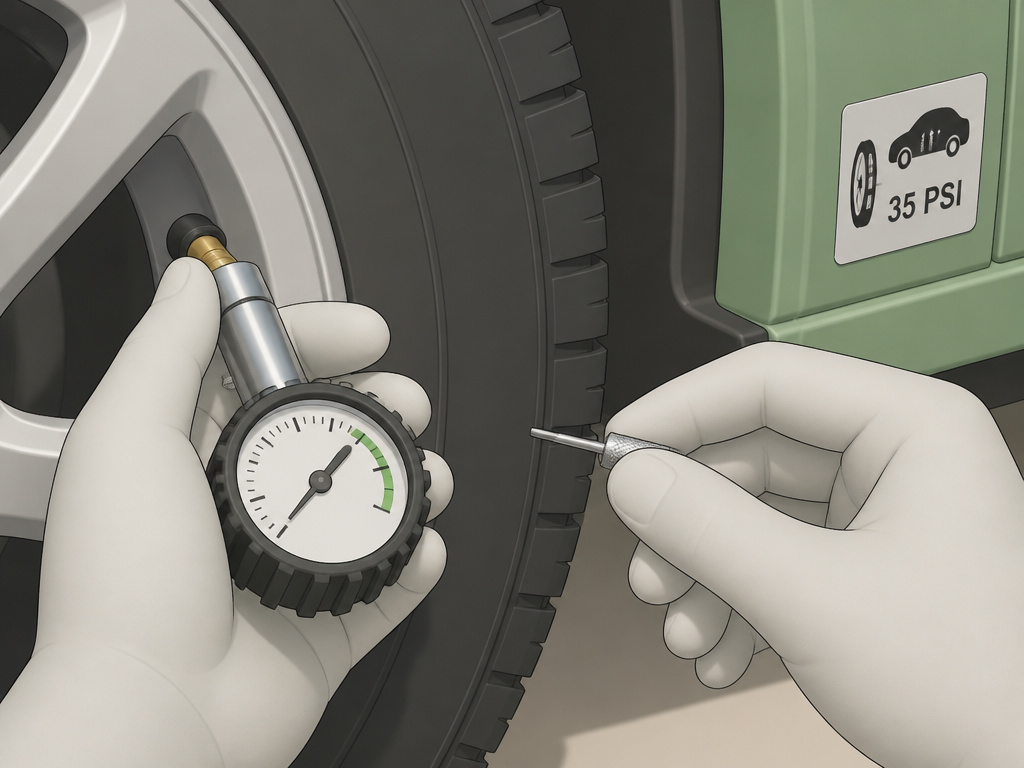
Check the pressure when the tires are cold, meaning the vehicle has been stationary for over three hours or driven less than one mile at moderate speed. Use a reliable gauge to compare the reading to the vehicle manufacturer’s recommended cold inflation pressure found on the placard or in the manual. If the tire is overinflated, press the center pin of the valve stem with a tool to release air in short bursts, checking the pressure frequently. Never deflate a warm tire to match the cold pressure recommendation, as a hot tire at or below that pressure is dangerously under-inflated. After adjusting, drive the vehicle at least 15 mph for a short time to allow the tire pressure monitoring system to update.
Frequently Asked Questions
How do I know the correct PSI for my tires?
Use the vehicle placard, tire inflation pressure label, or owner’s manual. NHTSA calls that number the recommended cold inflation pressure. The sidewall number is a maximum, so it isn’t your normal target.
If my tire sidewall says a maximum, what should I use?
Use the placard pressure for the vehicle, not the sidewall maximum. Goodyear says the sidewall pressure is the tire’s maximum operating pressure, not necessarily the correct vehicle pressure.
Is a gauge reading above the placard too high?
Compare the gauge reading with the placard pressure. If the placard is lower, the reading is over the cold target. If the placard is higher, the reading is under it.
Is 50 PSI too high for a tire?
The placard decides. USTires lists 50 psi as an Extra Load maximum for some passenger tires. Tesla Cybertruck lists 50 psi for normal load on several tire sizes. So 50 PSI is a maximum, a normal target, or too high for a different vehicle.
Do I need to check the spare tire?
Yes. The federal rule says each tire, including the spare if provided, should be checked monthly when cold. Goodyear and USTires both warn not to forget the spare and inside duals.
The Bottom Line
That is the whole answer to how to find the correct tire pressure for your car. Check the door sticker, use a gauge, and measure before the tire heats up.
If you want a trigger, treat a TPMS light as a stop-and-check signal. The federal rule says the telltale can come on within 20 minutes of a 25 percent low-pressure condition.
Do this week: measure all four tires plus the spare when cold, write down front and rear numbers, and compare them with the placard. If the placard is missing, use the owner’s manual.
One concession: if you tow, haul to GVWR, or run non-original tire sizes, the normal placard answer can miss this case. Use the published towing pressure or load table for that case. I’d rather see a driver check cold monthly than pay for nitrogen. Specs over slogans.
