
How Temperature Affects Tire Pressure: Winter Adjustments
This post contains affiliate links. As an Amazon Associate, we earn from qualifying purchases.
How temperature affects tire pressure is a simple air-volume problem. General Motors and Tesla state about 1 psi (pounds per square inch) change for every 10 degrees F drop. Goodyear gives a wider 1 to 2 psi range. Check the placard cold pressure, not the sidewall number, before a cold snap.
That 1 psi per 10 degrees F figure hides two practical traps. The first trap is the cold tire definition. The second is the hot tire correction.
What follows covers the placard target, the GM and Toyota cold-check rules, the tire pressure warning threshold, and the gauge habits that keep winter lights honest.
Key Takeaways
- Check pressure cold with a gauge you trust, then set it to the door placard value.
- Expect about 1 psi for every 10 degrees F drop, but Goodyear allows 1 to 2 psi.
- Do not inflate to the sidewall max because that number is a tire limit, not a vehicle target.
- A warning light in cold weather may turn off after driving, yet the tire still needs a cold placard reset.
- Relearn sensors after rotation when front and rear placard pressures differ, per GM.
How Temperature Affects Tire Pressure in Plain Numbers
The air inside a tire expands and contracts as temperature changes, so pressure moves even without a leak. A cold morning can lower the reading before the tire loses any air.
General Motors states tire pressure changes about 1 psi for every 10 degrees F temperature drop. Goodyear gives a range of 1 to 2 psi for the same change. Federal rule FMVSS 138 warns when pressure reaches 25 percent below placard cold pressure or Table 1, whichever is higher. A cold tire definition varies by source.
The 10 Degree F Question Has Two Answers
General Motors bulletin 07-03-16-004E gives about 1 psi per 10 degrees F. Tesla states about 1 psi per 10 degrees F. Goodyear states 1 to 2 psi per 10 degrees F.
| Claim | Source | Practical read |
|---|---|---|
| About 1 psi per 10 degrees F | GM and Tesla | Use this as the planning floor. |
| 1 to 2 psi per 10 degrees F | Goodyear | Treat 2 psi as possible in cold swings. |
| Warning at 25 percent below placard | FMVSS 138 | A light can come on after several cold nights. |
The disagreement matters. A 30 degrees F drop can mean 3 psi at GM’s figure, or up to 6 psi at Goodyear’s upper end.
Where the Placard Beats the Sidewall
The door placard gives the vehicle maker’s cold pressure target. Goodyear says the sidewall number is the tire’s maximum operating pressure, not necessarily the correct vehicle pressure. That difference is the core of overinflated versus underinflated tires, where the sidewall max is not the vehicle target. The 07-03-16-004E service document ties placard pressure to cold weather warnings.
A tire sidewall number is a limit. The placard number is the target.
Should You Check Tire Pressure Hot or Cold?
A tire can read high after one mile of driving, even with no leak. Tesla says it takes about one mile, or 1.6 km, to warm tires enough to affect pressure.
I set pressure after the car has sat outside overnight, not after a short loop to the shop.
The 3 Hour, 4 Hour, and Sunlight Problem
GM and Goodyear define a cold tire as one that has been sitting at least 3 hours or driven less than 1 mile, while Toyota requires at least 4 hours parked outdoors. Toyota asks for 4 hours outdoors. Tesla warns that direct sunlight or hot weather can affect pressure.
| Source | Cold tire rule | Why it matters |
|---|---|---|
| GM and Goodyear | At least 3 hours parked, or under 1 mile driven | Short trips can hide the true cold number. |
| Toyota | Not driven in past 4 hours and parked outdoors | Outdoor parking removes garage warmth bias. |
| Tesla | Stationary over 3 hours for the listed steps | Sunlight or hot weather can still move pressure. |
The deeper split is in should you check tire pressure hot or cold, because a warm tire can look compliant and still be low. The core habit is how to check tire pressure after the tires have cooled.
Before you start: Park on level ground, set the parking brake, and let tires cool. A hot tire can vent more air than intended, and a slipping gauge can scrape knuckles.
- Read the door placard first. If you skip it, you may chase the sidewall max and read the wrong target.
- Let tires sit 3 to 4 hours, or stay under 1 mile driven. Skipping this gives a warm reading.
- Remove the valve cap and press the gauge firmly. A loose gauge reads low and wastes air.
- Set to the placard cold pressure. GM says never set below the placard value.
- Recheck with the gauge. A second read catches gauge drift.
- Reinstall the valve cap. Goodyear says the cap keeps moisture and dirt out.
- Check the spare if provided. FMVSS includes the spare in the monthly check language.
- Drive enough to clear the tire pressure warning light. Tesla says at least 15 mph, or 25 km/h, for some time.
What Should Tire Pressure Be in 30 Degree Weather?
The first cold week of the year brings the same report: a tire pressure warning light on a car that was fine last week. A 20 degrees F drop can move pressure, using GM and Tesla’s figure of about 1 psi per 10 degrees F. The same pattern explains why the tire pressure light comes on after one cold night. FMVSS says check monthly, so how often to check tire pressure is not a vague question.
A 30 degrees F day does not get a new pressure number by itself. The target stays the placard cold pressure. If the temperature drops 30 degrees F, GM and Tesla math predicts about 3 psi loss. Goodyear’s range allows up to 6 psi loss.
That is the practical risk behind low pressure in winter. The pressure math is separate from tire compound behavior, a different topic in how cold is too cold for summer tires. A light that stays off does not mean the tire is right. GM lists poor handling as a result of improper inflation, and how tire pressure affects handling covers that effect.
Set for the Low or Set for Now?
This is where the sources part ways. GM says set placard pressure at lowest seasonal temperature. Toyota says consider the lowest ambient temperature expected in the next few weeks. Goodyear says use the vehicle maker’s recommended inflation.
On an extremely cold day, GM allows a temporary indoor correction: add 21 to 27 kPa, or 3 to 4 psi, above placard, then recheck when tires are cold outdoors. Goodyear says if you must check inflation when tires are hot, add 4 psi (27.8 kPa) to the recommended cold inflation pressure, while Tesla warns not to let air out of warm tires because a hot tire at or below the recommended cold pressure is dangerously under-inflated. Tesla says do not let air out of warm tires.
Easy to miss: A warm tire at placard pressure is already low. Let it cool before judging it.
- Set the gauge before breakfast. A cold morning read is easier to trust.
- Write the placard number down. The sidewall number will tempt you.
- Recheck after a 20 degrees F drop. A 2 psi swing can trigger a light.
Load changes the target. Tesla says a Cybertruck with 20 inch All Terrain tires needs 65 psi up to the Gross Vehicle Weight Rating, not the normal 50 psi. Tesla also says do not use the label pressure when towing; refer to published pressures.
How Do TPMS, Nitrogen, and Gauges Fit In?
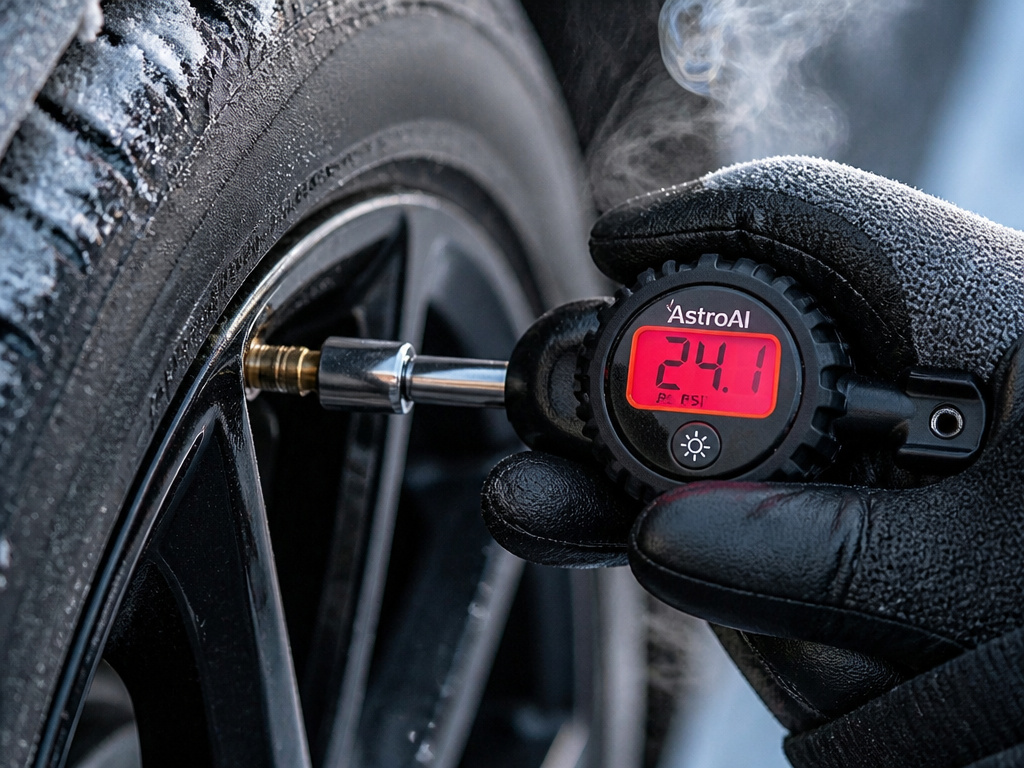
The federal rule gives a warning floor. A maintenance schedule is still your job. Federal Motor Vehicle Safety Standard 138 says the telltale must light within 20 minutes. The trigger is 25 percent below the placard cold pressure, or Table 1 pressure, whichever is higher. Read the 49 CFR 571.138 TPMS for the exact threshold.
GM notes the low tire pressure message may be intermittent during cold weather. If the light turns off after tires warm, GM says reset to placard pressure at cold temperature. Tesla says drive at least 15 mph, or 25 km/h, to activate the system after inflation. The heat side of this story is tire operating temperature, and it explains why one mile matters.
Nitrogen and Gauge Reality
General Motors says the TPM system works correctly with nitrogen. The broader inflation choice is nitrogen versus air in tires, and GM only answers the sensor question.
A stick gauge gives a shaky read when cold fingers fumble the valve. I reach for a digital gauge for the glovebox, a pneumatic chuck for the garage, and a repeatable gauge when needed. Goodyear says cover the valve stem with a sealing cap.
What the Warning Light Is Not Telling You
The telltale does not replace the monthly check. FMVSS says each tire, including the spare if provided, should be checked monthly when cold. GM says relearn TPM sensors and adjust after every tire rotation. A heavy trailer or GVWR load needs the right pressure.
What happens if my tires are underinflated?
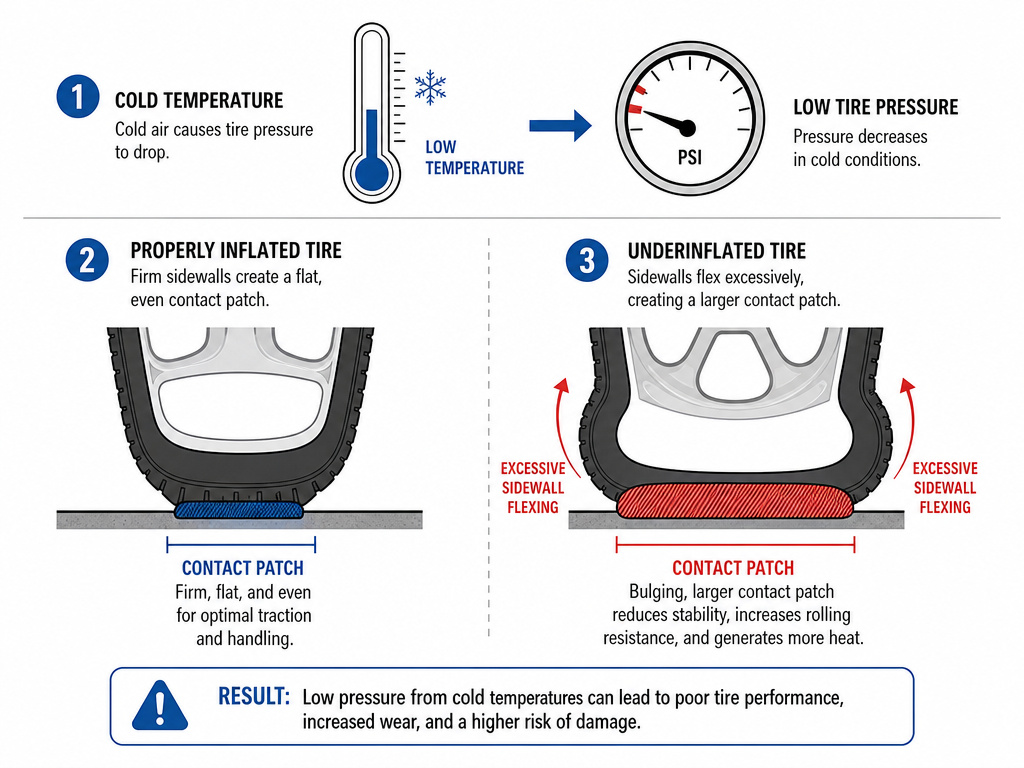
Running tires below the vehicle manufacturer’s recommended cold inflation pressure leads to several problems. Running tires below the vehicle manufacturer’s recommended cold inflation pressure leads to several problems. For safety, an underinflated tire has a less stable contact patch, reducing handling precision and braking performance. Your vehicle’s low tire pressure warning light is designed to illuminate when pressure drops significantly below the placard value, but you should not wait for it. Check pressures monthly when tires are cold to catch slow leaks and seasonal drops before they cause issues.
What happens if my tires are overinflated?
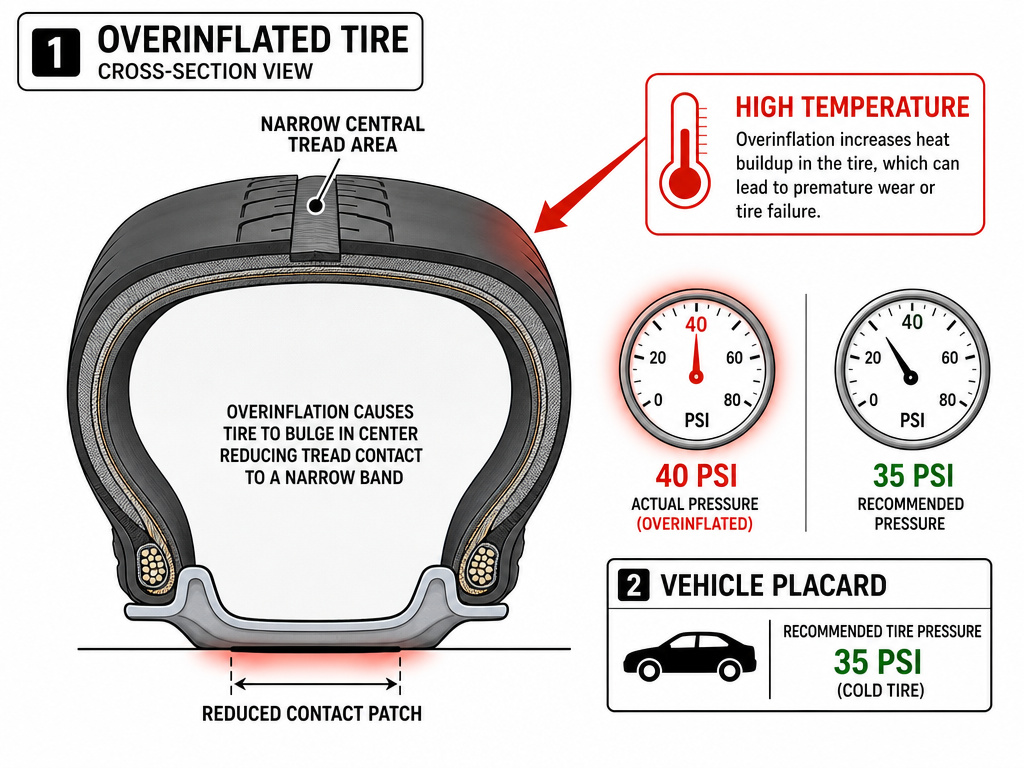
Overinflating tires above the vehicle’s placard value creates a different set of risks. Overinflating tires above the vehicle’s placard value creates a different set of risks. This reduces the tire’s overall lifespan. Never inflate to the maximum pressure listed on the tire sidewall; that number is for the tire’s capacity, not your vehicle’s specific requirements. Always use the cold pressure on the vehicle’s placard.
Frequently Asked Questions
How much does 10 degrees F change tire pressure?
General Motors and Tesla say about 1 psi. Goodyear says 1 to 2 psi. Use 1 psi as a planning floor, then check with a gauge.
What should tire pressure be in 30 degree weather?
Use the placard cold pressure. A 30 degrees F drop can mean about 3 psi loss by GM and Tesla math, or up to 6 psi by Goodyear’s upper range.
At what temperature do tires start to lose pressure?
They change with any temperature drop. There is no magic threshold in these sources. The federal warning threshold is 25 percent below placard cold pressure, or Table 1 pressure, whichever is higher.
Should I add air to warm tires?
Do not bleed warm tires. Tesla says a hot tire at or below cold placard pressure is dangerously under-inflated. Goodyear says add 4 psi if you must check hot. GM gives a 3 to 4 psi indoor correction only on extremely cold days, then recheck cold outdoors.
Does TPMS replace monthly checks?
No. FMVSS says check monthly when cold. GM says a cold light can turn off after warm-up, then reset to placard. Tesla says drive at least 15 mph to activate the system after inflation.
Before You Go
If your forecast drops 20 degrees F overnight, check pressure cold before the next drive. GM and Tesla math says expect about 2 psi loss. Goodyear’s range says up to 4 psi. The first step is simple: read the door placard and keep that number where you can see it.
Sources disagree on how much a 10 degrees F swing moves pressure. That disagreement is why a gauge and a cold check matter more than a rule of thumb.
Nitrogen does not fix temperature swings. GM only says the sensor works with nitrogen. The temperature effect stays.
When you understand how temperature affects tire pressure, the winter light becomes a predictable signal. Check the cold pressure first.
