
Why Does My Tire Keep Losing Air? Causes and Fixes
This post contains affiliate links. As an Amazon Associate, we earn from qualifying purchases.
“Why does my tire keep losing air” is answered by punctures, valve stem leaks, bead leaks, wheel damage, or normal monthly loss. NHTSA notes pressure can naturally drop 1.0 to 1.5 psi per month, while USTMA says 1 to 2 psi and Goodyear says up to 2 or more psi per month; seasonal cold can trigger a TPMS light. A pro checks the valve first.
Valve stem leaks hide under a cap and look like slow aging. A soap solution can show the leak before anyone removes the tire. The rest sorts normal pressure swings from real leaks.
What follows: cold pressure checks, the disagreement between published loss rates, TPMS light behavior, and the repair limit rules that decide fix versus replace.
Key Takeaways
- Monthly loss rates differ: USTMA says 1 to 2 psi, NHTSA says 1.0 to 1.5 psi, Goodyear says up to 2 or more psi.
- Temperature can mimic a leak: Goodyear says 1 to 2 psi per 10 F change, while NHTSA says about 0.8 psi per 10 F.
- Punctures have repair limits: USTMA says no repair above 1/4 inch, and sidewall punctures should not be repaired.
- TPMS lights have two meanings: steady means low pressure, flashing about one minute means system malfunction.
Why Does My Tire Keep Losing Air Without a Hole?
A tire loses air through tiny paths: the rubber innerliner, the valve, the bead, and the wheel edge. The NHTSA tire safety guide says most tires can naturally lose air over time. A method for finding a slow leak starts with soap solution on the valve and bead.
Tire pressure can change 3 to 5 psi between a cold reading and a reading taken after several miles. Cold readings form the baseline for placard pressure checks and service decisions.
I don’t treat one small pressure drop as proof of a puncture. A slow loss can come from the valve stem, the bead seal, a wheel surface, or normal air loss. The NHTSA pneumatic tire report is background material on tire construction, so I use it to keep the leak paths straight. Do you see a steady bubble at the valve, or only a morning warning light? A soapy valve stem shows a small steady bubble.
Normal Air Loss, Temperature Swings, and the Numbers That Disagree
Three published sources give different normal loss rates, so one number cannot settle every case. USTMA says tires can naturally lose 1 to 2 psi per month. NHTSA says pressure can naturally decrease by about 1.0 to 1.5 psi per month. Goodyear says tires can lose up to 2 or more psi per month.
| Source | Normal monthly loss | Pressure change per 10 F |
|---|---|---|
| USTMA | 1 to 2 psi | not stated in the source |
| NHTSA | 1.0 to 1.5 psi | about 0.8 psi |
| Goodyear | up to 2 or more psi | 1 to 2 psi |
Temperature can mimic a leak. Goodyear says pressure moves 1 to 2 psi for each 10 F change. NHTSA says about 0.8 psi for each 10 F change. A cold snap can turn on the warning light without a new puncture. The plain version of how temperature affects tire pressure can stop a needless repair kit purchase.
Goodyear says check inflation at least once a month, and before long trips, heavy loads, towing, or high speeds. That matches how often to check tire pressure for normal driving. I treat a drop faster than these monthly rates as a leak to chase.
Valve Stem, Bead, and Wheel Leaks: Where to Look First
The valve stem is the easiest leak to find. A missing cap allows moisture and dirt to get to the valve core. Goodyear says always cover the valve stem with a sealing cap. A loose core can make a thin hiss that stops when you press the cap. Do you hear that hiss?
Before you start: Do not drive on a visibly flat tire. Sidewall damage can fail suddenly. Do not pry on TPMS sensors. Irregular sealing surfaces can leak. Check pressure cold, because a hot reading can read 3 to 5 psi high.
- Check cold pressure against the placard (the sticker with recommended cold pressure). Skipping this makes a normal seasonal drop look like a leak.
- Put soap solution on the valve stem. Skipping this step allows a core leak to stay hidden under the cap.
- Move the foam along the bead. Skipping this misses a rim seal leak.
- Inspect the wheel sealing surface. Ignoring this can hide a bent or corroded edge.
- Demount for an inside inspection. A surface-only check can miss innerliner damage.
I would keep a shallow well air chuck and an air chuck with flexible hose for cold fills. NHTSA’s TPMS bulletin discusses tire pressure checks and adjustments. Check availability before you need them.
Valve stem and cap check
I would remove the cap, press the valve core gently, and watch for a steady leak. A soap solution is the first test. USTMA says a tire service professional should check the tire surface and the valve with water or soap before demounting. If the leak is at the tire valve stem, replace it and recheck cold pressure. Skipping this step can send a shop chasing the wrong bead leak.
Bead and wheel sealing surface
If the valve is dry, move to the bead. Dirt, rust, or corrosion can break the seal where the tire meets the wheel. USTMA provides guidance on tire care and service. For corroded alloy wheels, a professional can clean the sealing surface before deciding on a repair. If the edge is bent or cracked, the wheel needs replacement. A shop that only patches the tread and ignores a tire bead leak can leave the real cause intact.
When to stop DIY and demount
After striking anything unusual in the road, Bridgestone says a qualified professional should demount the tire and inspect it. A damaged tire can show no visible sign and fail later. I would not accept a quick plug without an inside look.
Punctures, Sealants, and the Repair Limit That Decides Replace
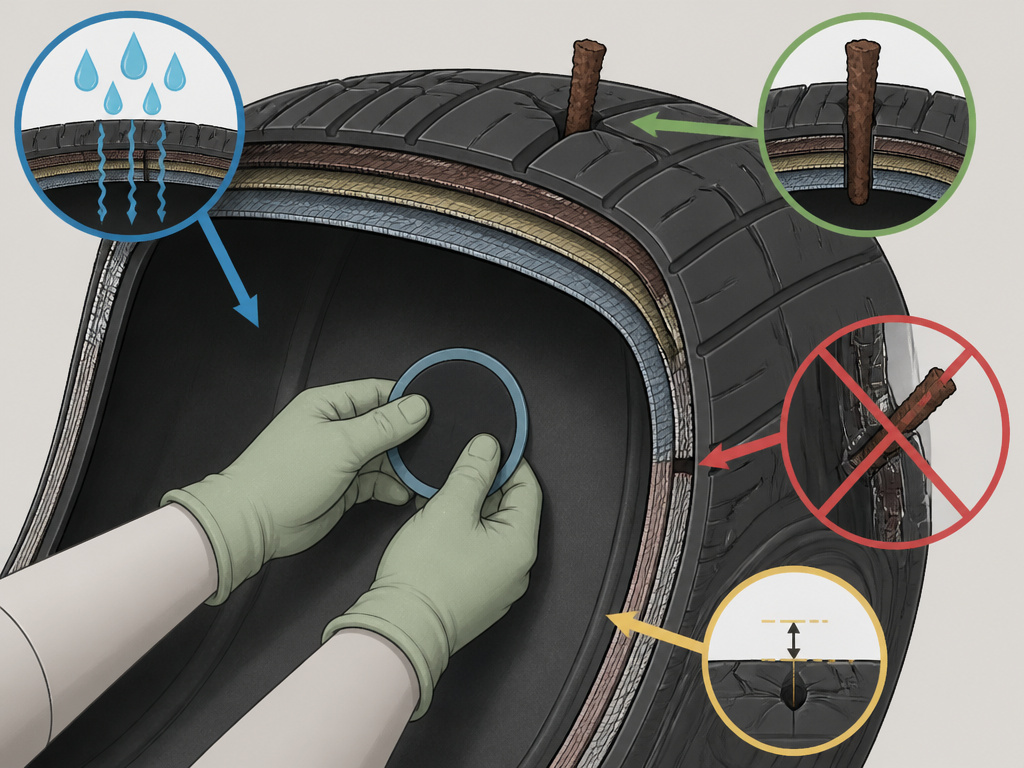
Plug-only repairs are half repairs. NHTSA says proper puncture repair needs a plug for the hole and a patch for the inside area around it. USTMA says puncture repairs are limited to the tread area. The USTMA tire care manual also says never repair an injury greater than 1/4 inch in diameter.
I would not accept a plug-only repair without a demounted inspection. NHTSA requires a plug and patch, and USTMA limits repair to the tread area.
Easy to miss: A plug from outside can seal the hole while moisture reaches the innerliner (the airtight layer inside the tire). Damage can appear a day, a week, or months later.
The plug-only mistake
A plug from outside can seal the hole while moisture reaches the innerliner. That is why I treat the inside patch as the repair. A shop that demounts, inspects, prepares the injury, fills it, and seals the innerliner follows the basic principle. Skipping the inside patch can leave a weak spot that fails later.
Sealants and TPMS risk
If you ask about the best tire sealant for a slow leak, NHTSA doesn’t recommend aftermarket sealants or aerosol repair kits. Some sealers and propellants can damage TPMS sensors. A sealant can also hide a leak and complicate a repair that uses a plug and a patch. I would use a roadside stopgap only to get to a shop, then insist on a demounted check. Do not confuse that stopgap with how to fix a flat tire done right.
I would keep a basic plug kit and a 12V compressor for temporary help to a shop.
Repair area and scrap limits
Use these limits as the go/no-go line.
- Tread area only: USTMA limits puncture repairs to the tread area.
- No sidewall repairs: NHTSA says sidewall punctures should not be repaired.
- No big holes: USTMA says never repair an injury greater than 1/4 inch in diameter.
- Shoulder damage ends it: any cut into the shoulder or belt edge means scrap.
Tires driven even a short distance while underinflated can suffer damage beyond repair. Adding air later doesn’t undo heat and flex damage.
TPMS Lights, Altitude, and Why the Gauge and Sensor Disagree
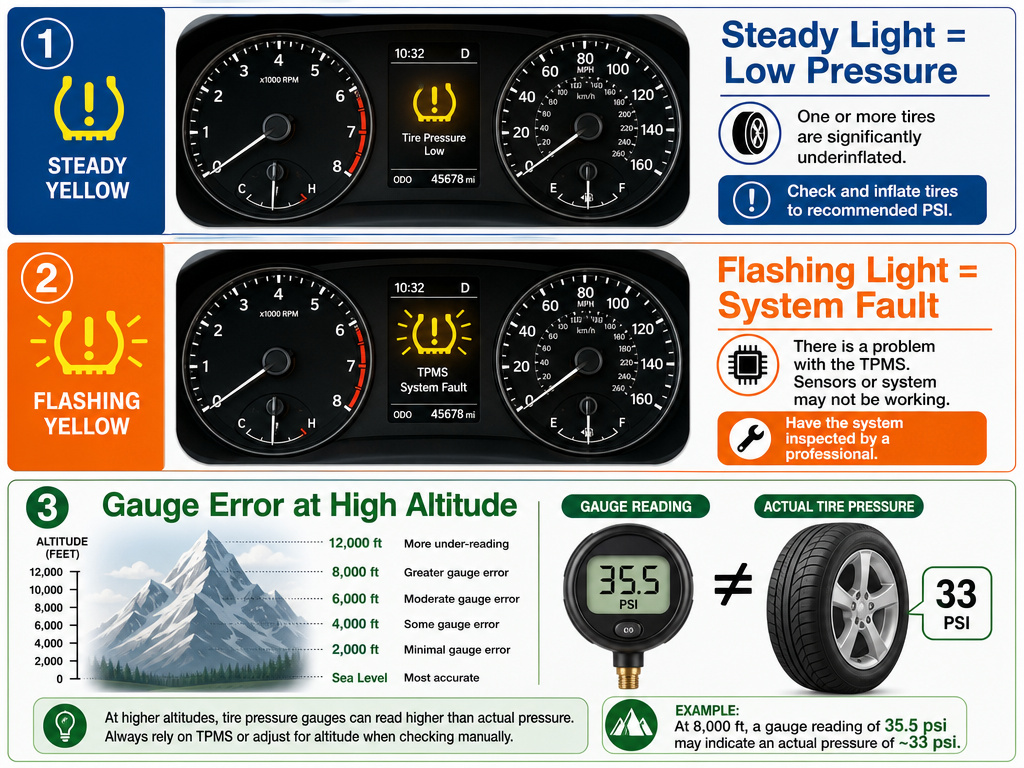
A steady TPMS light and a flashing TPMS light mean different things. NHTSA says a continuously illuminated light means the system detected low pressure. A light that flashes for about one minute means a TPMS or LTPWS malfunction. TPMS means tire pressure monitoring system, and LTPWS means low tire pressure warning system.
| Light behavior | Likely meaning | First action |
|---|---|---|
| Steady | low pressure detected | set cold pressure to placard |
| Flashing about one minute | TPMS or LTPWS malfunction | check codes and service manual |
| Gauge high, light still on at altitude | gauge altitude error | adjust reading for elevation |
Steady light versus flashing light
I treat a steady light as a pressure problem first. NHTSA says leave the ignition ON 2009 and newer models so the system can detect corrected pressure more quickly. If the light flashes, the sensor system itself needs diagnosis. Do you see a steady light after a cold snap, or a flashing light that lasts about one minute?
For TPMS work, wheel sensors must be registered each time wheels are rotated, swapped, or replaced. NHTSA states that TPMS/LTPWS wheel sensors must be registered each time the wheels are rotated, swapped or replaced, which may require specific tools. If a shop rotates wheels without re-registration, the dashboard can show the wrong tire. If you need such a tool, consult appropriate service resources.
High altitude gauge error
At high altitude, a standard gauge can read higher than the TPMS system. NHTSA says gauge readings increase about 1.0 psi for every 2,200 ft of altitude above sea level, up to 10,000 ft. The bulletin gives an example: at 5,280 ft, a placard pressure of 33 psi requires a gauge reading of 35.5 psi. A TPMS light can come on when the gauge says the tire is fine. I would account for altitude before blaming the sensor.
Repair, Replace, and the Storage Rule That Prevents Flat Spots
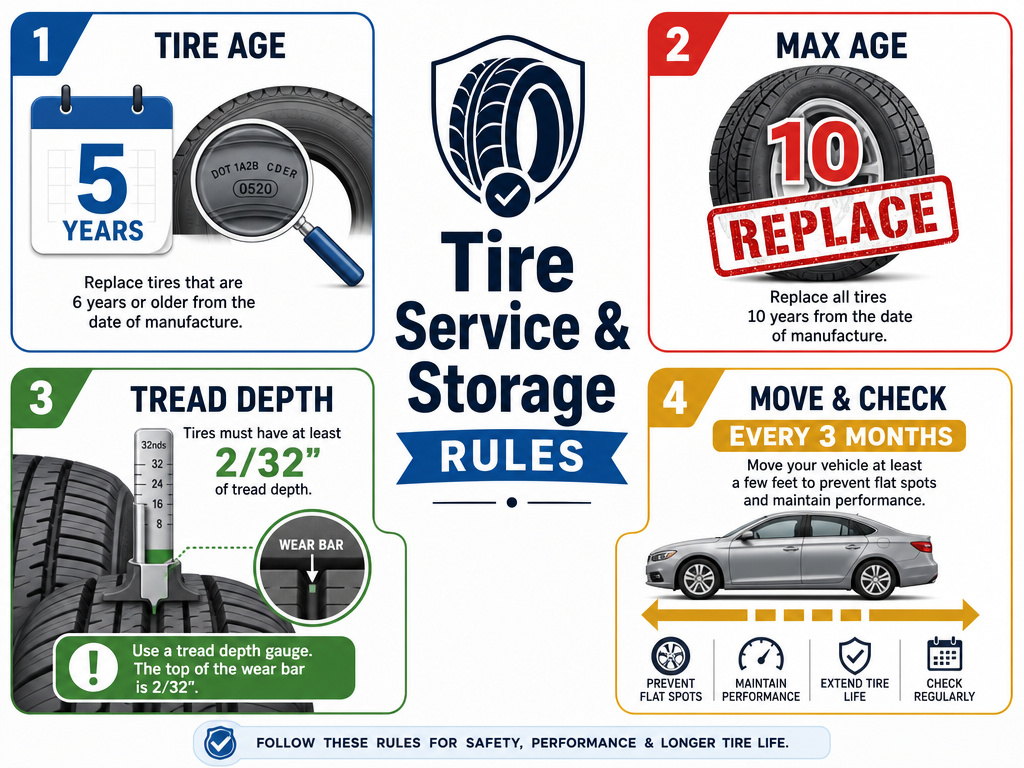
After 5 years, inspection matters more than tread depth alone. Bridgestone says make sure tires, including the spare, continue to be regularly inspected after 5 years of service. It also says tires more than 10 years old should be taken out of service and replaced. A spare over 10 years can look new and still be unsafe.
Impact damage and hidden failure
A tire that hits a curb or pothole can have internal damage with no visible bump. Bridgestone says after striking anything unusual in the roadway, have a qualified tire service professional demount the tire and inspect it for damage. I would have a professional demount any tire after an unusual strike. Do not wait for a flat to confirm damage.
Age and tread replacement triggers
Bridgestone says when the tire is worn to the built-in indicators at 2/32 inch (1.6 mm) or less tread groove depth, the tire is dangerously worn and must be replaced immediately. That is the wear limit. The 10 year rule is a service life check.
Storage and long idle periods
USTMA says for vehicles stored with weight on tires, move the vehicle every 3 months to change the tire flex area. Flat spots and sidewall stress can build when one contact patch sits for too long. For dual tires, USTMA says if one dual becomes significantly underinflated or flat, both tires should be inspected. For dual tire assemblies, if one tire becomes significantly underinflated or flat, both tires should be inspected by a tire service professional for damage.
- 5 year check: inspect tires after 5 years of service.
- 10 year replace: replace tires more than 10 years old.
- 2/32 inch wear: replace at the tread wear indicators.
- 3 month move: move stored vehicles to change the flex area.
I would start with a cold gauge check, then soap the valve and bead. If the leak is at the valve, that is the simplest fix. If the leak is at the wheel or innerliner, a demounted inspection is the right next step.
Wheel/rim damage (bent, corroded, cracked)
A damaged wheel can prevent a seal with the tire, leading to a persistent air leak. Irregular sealing surfaces or contamination can allow air to escape between the wheel and the tire bead or even at the TPMS sensor mounting point. If you suspect a leak from this area, a tire service professional should inspect it. They will check for the source of the leak using water or a soap solution. If the wheel is the issue, the proper fix is to repair the wheel or replace the seal as needed, not to replace the sensor assembly. For a complete inspection, especially after hitting a curb or pothole, the tire may need to be demounted from the wheel.
Small punctures (nails, screws) causing slow leaks
A nail or screw embedded in the tread is a classic cause of a slow leak. The object itself can partially plug the hole, allowing air to escape gradually. Not all punctures can be safely repaired. Repairs are limited to the tread area only; punctures to the sidewall should not be fixed. USTMA says never repair a tire with an injury that is greater than 1⁄4 inch (6 mm) in diameter. NHTSA says a repair requires a plug for the hole and a patch for the area inside the tire, while USTMA and Bridgestone emphasize professional inspection, which may involve demounting. This process involves demounting the tire from the wheel for a complete internal and external inspection. Do not use aftermarket sealants, as they can damage tire pressure monitoring sensors.
How to find the leak (soapy water test, submersion)
To locate a slow leak, a tire service professional will typically use a water or soap solution. They spray or brush the mixture over the inflated tire, valve stem, and wheel rim, looking for the formation of steady bubbles that indicate escaping air. This check is done prior to demounting the tire. For a thorough inspection, especially after striking road debris, the proper procedure includes demounting the tire from the wheel to examine it completely, inside and out. This ensures no hidden damage is missed. For dual tire assemblies, if one tire is significantly underinflated, both tires should be inspected by a professional.
Frequently Asked Questions
Is it safe to drive on a tire that keeps losing air?
No. Goodyear says underinflation can lead to excessive heat buildup, which can result in early removal from service or tire failure. If pressure drops quickly or the tire looks low, stop and check cold pressure before driving.
How to fix a tire that keeps losing air?
Find the leak first. Soap solution on the valve and bead can show the source. A puncture repair needs a plug and inside patch after demounting.
Why does my tire keep losing air but there’s no hole?
Air can leak through the valve, bead seal, wheel surface, or normal air loss. Seasonal temperature drops also reduce pressure without a puncture.
Is it normal to lose 2 psi in a day?
The sources give monthly rates, not daily rates. A 2 psi drop in one day is faster than the published monthly loss, so it deserves a leak check.
Do tire sealants fix a slow leak?
NHTSA doesn’t recommend aftermarket sealants or aerosol repair kits. Some can damage TPMS sensors and hide the leak.
Before You Go
If you ask “why does my tire keep losing air” again next month, make the answer measurable. Put a cold gauge reading for each tire in your phone notes, then recheck after one week. A drop beyond the published monthly rates deserves a soap test at the valve and bead.
One rule I would not skip: any tire that has been driven underinflated needs an inside inspection. Adding air fixes the pressure number, while heat and flex damage stay.
Fair warning: if the car sits in a garage for months, move it every 3 months. A flat spot can turn a slow leak hunt into a new set of complaints.
