
10 Best Commercial Wheel Balancers in 2026
This post contains affiliate links. As an Amazon Associate, we earn from qualifying purchases.
The XK 988-690 Tire Changer and Wheel Balancer Combo is our best overall pick for professional shops needing a stationary, high-capacity station. For large trucks, the KATRAX KT-B795 excels, while the BILT HARD combo offers great value. Selecting the right commercial wheel balancer hinges on matching its capacity, speed, and features to your shop’s specific workflow and the types of vehicles you service most often.
A mismatch can lead to inefficiency, callbacks, or damage to customer wheels. This guide compares ten leading machines based on manufacturer specifications and patterns in professional feedback to help you invest confidently.
Top 10 Commercial Wheel Balancers in the Market

Certain content that appears on this site comes from Amazon. This content is provided "as is" and is subject to change or removal at any time.
The Best Commercial Wheel Balancers, Reviewed
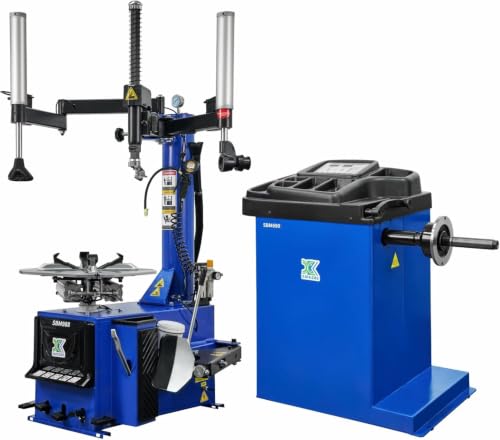
XK 988-690 Tire Changer and Wheel Balancer Combo
What We Like
- Combines a tire changer and balancer in one unit.
- Handles large commercial rims up to 44 inches.
- Fast 4-7 second balancing cycle improves shop throughput.
- Includes multiple balancing modes for different wheel types.
Trade-offs
- Total weight of 840 pounds requires a permanent, reinforced installation.
- Tire changer's 12-inch minimum inside clamping may not suit small passenger rims.
- Requires both 6-8 bar air pressure and 110V electrical supply to operate.
With a maximum wheel diameter of 44 inches and a capacity for wheels weighing up to 155 pounds, this combo can service a wide spectrum of wheel sizes. Its 2.0 horsepower motor and built-in air bead blaster supply the power to handle tough mounting and demounting tasks. A balancing cycle time of four to seven seconds helps maintain a steady workflow in a busy service environment.
The major trade-off is its substantial 840-pound footprint, which demands dedicated floor space and a solid foundation, this isn’t a portable unit you can roll around. Compared to a dedicated heavy-duty machine like the KATRAX KT-B795, which is built for 51-inch rims, the XK combo has a lower maximum rim capacity. For a shop specializing exclusively in large commercial truck tires, that higher limit might be necessary, but for a general service center, the XK’s broad range is more practical.
Product photos
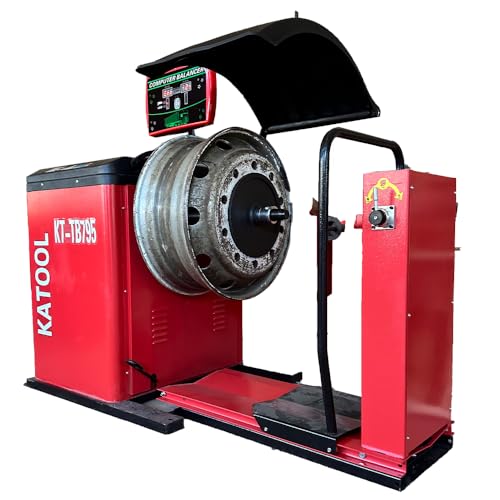
KATRAX KT-B795 Heavy Duty Truck Wheel Balancer
What We Like
- Handles rims up to 51 inches for large vehicles.
- Fast 8-second measurement cycle improves shop throughput.
- Integrated laser positioning for accurate weight placement.
- Large HD screen with intuitive controls for ease of use.
Trade-offs
- Weighs 485 pounds, requiring a permanent, sturdy shop location.
- Requires a dedicated 220V power outlet for operation.
- Designed for large tires, making it overkill for standard passenger cars.
A maximum rim capacity of 51 inches means this balancer can handle the largest truck and bus tires a commercial shop will encounter. That core spec, combined with an 8-second measurement cycle, makes it a dedicated workhorse for high-volume operations focused on heavy-duty vehicles. It’s built for the technician who needs to process large commercial wheels quickly and reliably, with features like precision positioning lasers to reduce errors during busy shifts.
Weighing 485 pounds and requiring a 220V outlet, this balancer is a permanent workshop installation, not a machine you can easily relocate. It is engineered for large vehicles with a maximum rim capacity of 51 inches, so it excels in a niche where handling the biggest truck and bus tires is the daily priority. The machine achieves a fast measurement cycle in just 8 seconds, prioritizing speed and strength for these heavy-duty applications.
Product photos
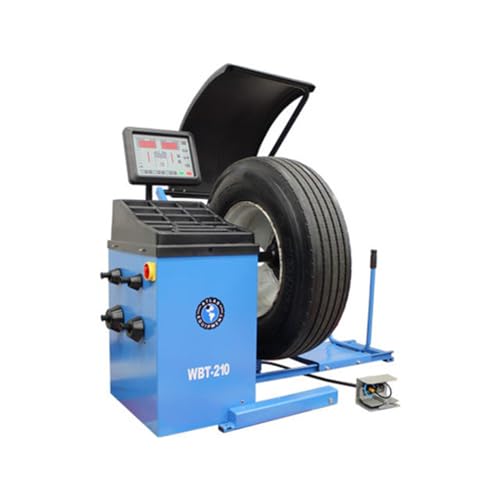
ATLAS WBT-210 Heavy Duty Wheel Balancer
What We Like
- Handles semi-truck tires up to 300 pounds.
- Self-diagnosis displays error codes for in-house adjustments.
- Automatic start/stop linked to hood position.
- Includes comprehensive accessory kit for various wheel types.
Trade-offs
- Its 52-inch footprint demands significant dedicated floor space.
- The broad capability may be excessive for shops focusing only on passenger cars.
A 300-pound tire capacity and a 40 mm shaft let this balancer tackle the heaviest semi-truck wheels without strain. This makes it ideal for shops that service everything from passenger cars to heavy duty trucks. Self-diagnosis capabilities display error codes, allowing in-house adjustments instead of waiting for a technician. The included cone sets and accessory kit mean it can handle car wheels, light trucks, and BUDD style rims immediately.
The trade-off for that brute strength is a substantial physical footprint. It needs a dedicated, level station. For a shop that only occasionally sees large truck tires, a model like the ATLAS WB49-2, which handles 150-pound wheels in a more compact package, might be a more space-efficient choice. The WBT-210 justifies its size and weight only if your daily workflow demands its maximum capacity.
ATLAS WB49-2 Automatic Wheel Balancer

What We Like
- Automatic 2D data entry for offset and diameter
- Split-weight function hides weights behind spokes
- Self-diagnosing system reduces service downtime
- Includes comprehensive tool set with cones and pliers
Trade-offs
- 150 lb wheel limit excludes heavy truck and bus tires
- One-year parts-only warranty offers limited coverage
The ATLAS WB49-2 uses automatic 2D data entry, where an inner measuring gauge inputs offset and diameter for precision and convenience. It handles wheels up to 32 inches in diameter and 150 pounds in weight, supporting both static and dynamic balancing modes. A split-weight function helps hide weights behind spokes, and an automatic LED light illuminates the rim’s interior for accurate placement. Its self-diagnosing system displays error codes for easy in-shop adjustments, which can eliminate the need for service technician visits.
While it handles a broad range, the 150-pound wheel capacity is its defining boundary. This balancer isn’t built for the heaviest commercial truck or bus tires. For those, you’d need a machine engineered for that scale, such as the KATRAX KT-B795. The WB49-2’s 400-pound own weight also means you need a solid, permanent installation spot. It’s a premium tool designed for precision and efficiency in a professional auto shop, not for occasional or mobile use where its size and heft become a limitation.
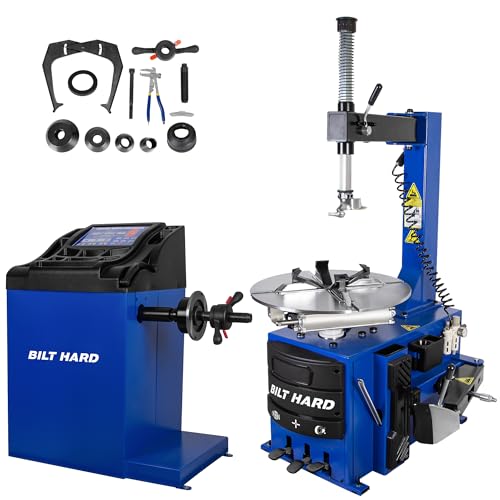
BILT HARD Tire Changer and Balancer Combo
What We Like
- Protected mount head prevents rim scratches
- Hands-free pedal system for tire changing
- Manual input of A and D values for precision
Trade-offs
- 1.0-inch dimensions listing appears to be a data error
- Balancer operates at 70dB, which is not whisper-quiet
A 2.0HP motor delivers 10 Bar of bead-breaking force to handle stubborn truck and SUV tires. The balancer’s manual input for A and D values gives a technician direct control over calibration. This combo plugs into a standard 110V outlet, creating a practical, all-in-one station. It’s suitable for a mid-volume shop or a serious DIY garage that needs to switch between passenger cars and light trucks without swapping machines. The protected mount head and four ALU modes are thoughtful touches that keep alloy wheels looking new.
This wide compatibility and shop-ready power require dedicated floor space due to the machine’s physical footprint and weight. It is not as compact as some single-purpose units. When you need to balance wheels wider than 18 inches or service the heaviest commercial vehicles, a machine designed for that duty, such as the ATLAS WBT-210, is the necessary step up. For general automotive service, however, this BILT HARD package bundles capable changing and precise balancing into one accessible setup.
Product photos
Mayflower Products 800 Commercial Wheel Balancer

What We Like
- Includes a dedicated Motorcycle Mode
- Wide compatibility from 10" to 24" rims
- Pre-set to American Standard measurements
- Offers a full one-year warranty
Trade-offs
- Maximum 24" rim capacity excludes large commercial truck tires
- Maximum 24-inch rim capacity excludes large commercial truck tires
Motorcycle Mode is included, so shops that handle both cars and bikes can use one machine. Rim capacity runs from 10 to 24 inches, and it comes preset to American standard measurements. A one-year warranty is provided, which the brand calls the best available on Amazon for this type of equipment. Standard dynamic, static, and multiple aluminum wheel modes are listed among its operating functions.
The 24-inch maximum rim diameter means it cannot handle large commercial truck or bus tires. A model like the KATRAX KT-B795, which accommodates 51-inch rims, is designed for that segment. For passenger vehicles, motorcycles, and light trucks within its size range, the Mayflower 800 offers several standard balancing modes. Its capacity does not extend to the heavy-duty commercial fleet segment requiring larger equipment.
VEVOR Tire Changer and Balancer Combo
What We Like
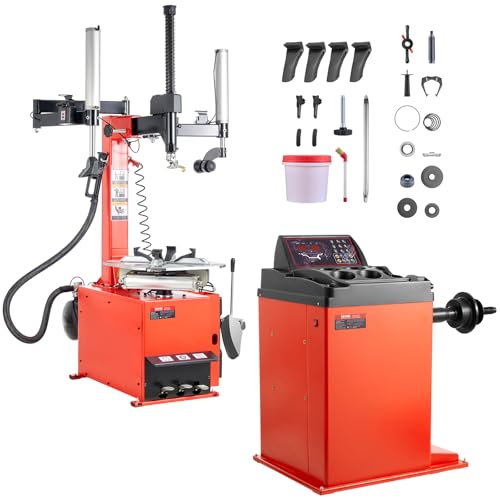
- 2.0HP motor provides powerful tire mounting performance
- Universal clamping jaws fit rim diameters from 12 to 24.4 inches
- Multi-function assist arm handles tire installation and removal
- Balancer uses sealed sensor for ±1g precision calibration
Trade-offs
- 37.8-inch maximum tire diameter excludes some commercial truck applications
- 155-pound maximum tire weight limits use with heaviest commercial truck tires
A 2.0HP motor gives this combo unit the muscle to handle the larger, heavier tires common on SUVs and pickups without straining. The universal clamping system accommodates rim sizes from 12 to 24.4 inches, covering the range from passenger cars up to one-ton trucks. That versatility makes it a solid single-station solution for shops that see a mix of vehicles but frequently service light trucks. The integrated balancer’s ±1g accuracy ensures smooth results on the highway, which is critical for those larger tire and wheel assemblies.
The 720.9-pound total weight means this is a permanent shop fixture, not something you’ll move around. Its 155-pound tire weight capacity and 37.8-inch diameter limit are sufficient for most SUVs and pickups, but they fall short for the biggest commercial truck tires. The VEVOR combo is designed for the lighter end of the commercial spectrum, unlike a model like the KATRAX KT-B795 that handles 51-inch rims. It consolidates two essential machines into one footprint, trading some ultimate capacity for broad utility in a general service bay.
Product photos
HPDMC Tire Changer and Balancer Combo

What We Like
- Automatic rim size input improves balancing accuracy.
- Professional double assist arms handle run-flat tires.
- Self-calibrating balancer reduces setup and maintenance time.
- Heavy-duty construction suits continuous commercial shop use.
Trade-offs
- Balancer cycle time of 8 seconds is slower than some dedicated commercial units.
- Maximum rim width of 20 inches limits some heavy-duty truck applications.
- 154 lb total weight requires a dedicated, stable shop floor space.
A 45-inch maximum tire diameter and a ±1g balancing accuracy mean this combo can handle most passenger and light truck tires with the precision a shop needs. The automatic rim measurement and self-calibration features cut down on manual input errors and keep the balancer running true with minimal fuss. For a garage looking to add both core services without a huge investment, this package delivers the essential specs. It’s built for daily use, and the two-year warranty suggests the manufacturer stands behind its commercial durability.
A balancer that completes its cycle in just eight seconds helps a busy shop move through standard passenger and light truck tires quickly. Its ability to handle rims up to 20 inches wide covers most common vehicles on the road. It doesn’t match the capacity of a model like the ATLAS WBT-210, which is engineered for wider commercial rims. The value here is in pairing a capable tire changer with a fast, automated balancer to handle a high daily volume of typical work.
Product photos
CHERY INDUSTRIAL.COM T835+B700 Commercial Wheel Balancer
What We Like
- Carburized alloy steel jaw for durability
- Stainless steel mounting head protects rims
- Closed-body design for long-term protection
- 2.0HP motor for powerful tire changes
Trade-offs
- Weighs 440.9 pounds, requiring a forklift for delivery
The 2.0HP motor and alloy steel jaw with carburization treatment mean this machine is built to handle daily shop abuse without wearing down. That closed-body design and stainless mounting head directly translate to fewer scratched wheels and less downtime for repairs, making it a solid fit for a busy garage prioritizing tool longevity over the latest digital features. It’s for the shop owner who wants equipment that just works, year after year.
The major practical consideration is the 440.9-pound weight and the explicit need for a forklift to unload it. This isn’t a machine you can maneuver into a corner with a pallet jack. You trade some balancer specialization and easier placement for the simplicity of an all-in-one tire service station.
Product photos
WEIZE Tire Changer and Balancer Combo
What We Like
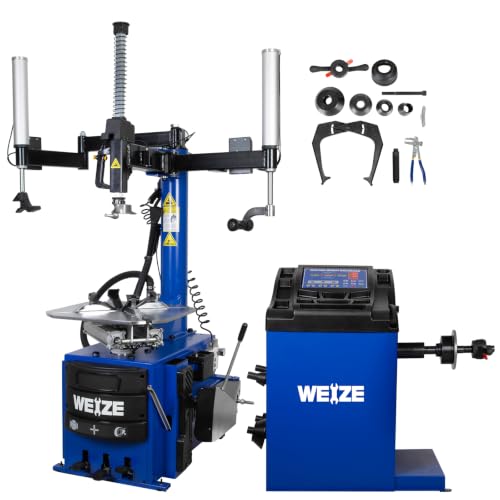
- Dual assist arms for mounting run-flat and low-profile tires.
- Integrated air bead blaster with 2700 kg break-force.
- Quiet balancer operation under 70 dB.
- Corrosion-resistant coatings and sealed bearings for durability.
Trade-offs
- Weighs 794.8 pounds, requiring substantial shop floor space and a stable foundation.
- Maximum tire width of 16 inches excludes some commercial truck applications.
The dual assist arms are the standout feature, acting like a second pair of hands to press the bead down during mounting. This makes a tangible difference on stubborn run-flat and low-profile tires by preventing roll-back and cutting down installation time. For a shop that handles a daily mix of passenger cars and light trucks, this combo delivers reliable, high-torque performance from its 2 HP motor. The integrated air bead blaster, with its 2700 kg of break-force, reliably seats tough beads, which is essential for efficiency in a busy service bay.
This capability comes with a substantial footprint and weight. At nearly 800 pounds, this isn’t a portable unit; it demands a permanent, level installation. While its 41-inch tire diameter capacity is generous, the 16-inch width limit means it’s not suited for the widest commercial truck tires. The WEIZE combo is better viewed as a sturdy generalist for a garage that prioritizes passenger and light commercial work. It is not intended for the heaviest truck servicing, a role filled by a model like the KATRAX KT-B795 that accommodates 51-inch rims.
How We Evaluated Commercial Wheel Balancers
This overview is based on manufacturer specifications, documented capabilities, and patterns in professional user feedback. The comparison focuses on key metrics such as maximum rim diameter and weight capacity, balancing cycle speed, and included features like automatic data entry or specialized modes.
We prioritized machines built for continuous commercial use, focusing on durability, accuracy, and how well a model’s strengths align with specific shop needs, from high-volume passenger car service to heavy-duty truck fleets. This research-led approach provides a strong comparative analysis but cannot replicate the long-term durability insights gained from years of daily shop use.
What To Look For In Commercial Wheel Balancers
The right commercial wheel balancer is an investment in shop efficiency and customer satisfaction. It must handle your typical workload while offering the precision to prevent costly callbacks.
Focus on the maximum rim diameter and weight capacity your shop requires. Consider balancing speed for throughput and features like automatic measurement or specialized modes for alloy or motorcycle wheels. Power requirements and physical footprint are critical for shop planning.
Capacity and Compatibility
The machine’s physical limits are the first filter. Check the maximum rim diameter it can accept; our list includes units ranging from 24 inches for motorcycle shops to 51 inches for large trucks. Equally important is the maximum wheel weight capacity, which varies from 150 pounds for advanced passenger car units to 300 pounds for heavy-duty models. Ensure the balancer includes the necessary cones and adapters for the wheel types you service most, as missing accessories can halt work.
Speed and Features
Cycle time directly impacts shop throughput. Faster commercial balancers can complete a measurement in 4 to 8 seconds. Features that reduce manual input, like automatic diameter and offset measurement, minimize human error and speed up the process. For shops working with custom wheels, look for functions like split-weight or hidden weight placement behind spokes. Some advanced wheel balancers also include self-diagnostic systems to reduce downtime.
Shop Integration
A balancer must fit your shop’s physical and operational layout. Note its weight and footprint; heavy units over 400 pounds require a permanent, reinforced installation. Verify power needs: some require a standard 110V outlet, while heavy-duty models may need 220V. Also, consider noise levels if shop comfort is a priority, and whether you need a standalone balancer or a combined tire changer and balancer to save space.
- Confirm the available balancing modes (e.g., static, dynamic, alloy, motorcycle) match your services.
- Check warranty terms, as commercial use demands reliable support.
- Ensure the user interface is intuitive for all technicians to minimize training time.
The most capable machine is useless if it doesn’t fit your shop’s space, power, or typical vehicle mix.
Commercial Wheel Balancers Compared
The table below provides a quick comparison of key specifications to help you narrow your search.
| Product | Max Wheel Diameter | Balancing Modes | Power Supply |
|---|---|---|---|
| XK 988-690 Tire Changer and Wheel Balancer Combo | 44" (balancer) | dynamic mode, static mode, alu 1-3 mode, motorcycle mode | 110/220V (balancer) |
| KATRAX KT-B795 Heavy Duty Truck Wheel Balancer | 51 inches | N/A | 220V industrial-grade |
| ATLAS WBT-210 Heavy Duty Wheel Balancer | N/A | Static and dynamic balancing | N/A |
| ATLAS WB49-2 Automatic Wheel Balancer | 32 inches | Static and dynamic | N/A |
| BILT HARD Tire Changer and Balancer Combo | N/A | Dynamic, static, 4 ALU modes | Standard 110V/60Hz outlets |
| Mayflower Products 800 Commercial Wheel Balancer | N/A | Dynamic, Static, ALU 1-3, Motorcycle | N/A |
| VEVOR Tire Changer and Balancer Combo | 37.8 in | N/A | N/A |
| HPDMC Tire Changer and Balancer Combo | 45 inches | N/A | 110V/60HZ |
| CHERY INDUSTRIAL.COM T835+B700 Commercial Wheel Balancer | N/A | N/A | 120V Single-Phase |
| WEIZE Tire Changer and Balancer Combo | 41 inches | N/A | 110V |
Frequently Asked Questions
What is the best wheel balancer on the market?
The “best” depends entirely on your shop’s needs. For a high-capacity, all-in-one solution, our best overall is the XK 988-690 combo. For shops specializing in large trucks, the KATRAX KT-B795 is the top choice due to its 51-inch rim capacity. Reviewing our list of top balancer models by intended use is the best starting point.
Which tire balancing machine is the best?
The best machine balances accuracy, speed, and durability for your specific application. The ATLAS WB49-2 is excellent for shops needing advanced features like automatic data entry for passenger and light truck wheels. For basic, reliable service on a budget, the HPDMC combo offers strong value. Researching professional tire balancer reviews can provide deeper insights.
What type of tire balancer provides the best ride quality?
Dynamic balancing, which corrects imbalance in two planes, is the standard for providing the smoothest ride on modern vehicles. All machines in our guide perform dynamic balancing. Some, like the Mayflower Products 800, also include a static mode, which is useful for certain narrow wheels. Understanding the difference between static and dynamic balancing helps explain why dynamic is preferred for most applications.
Do Centramatic balancers really work?
Centramatic balancers are a different product category, continuously self-adjusting hub-mounted rings, not the shop equipment we review. Our focus is on stationary shop-grade wheel balancing machines used for precise initial balancing during tire service.
How often should wheels be rebalanced?
Wheels should be balanced whenever new tires are mounted, if a wheel weight is lost, or if a vehicle develops a vibration at certain speeds. Regular rebalancing is not typically a scheduled maintenance item but may be needed if unusual tire wear suggests an imbalance issue.
The Bottom Line
For most shops seeking a powerful, all-in-one station, the XK 988-690 Tire Changer and Wheel Balancer Combo is the best overall choice, ideal for high-volume service on a broad range of wheel sizes. Budget-conscious shops should look at the BILT HARD or HPDMC combos, while those specializing in large trucks need the dedicated capacity of the KATRAX KT-B795. Ultimately, the most important factor is ensuring the machine’s maximum rim diameter and weight capacity comfortably exceed what your shop services daily, guaranteeing a reliable and efficient workflow for years.
