
How to Rotate Tires on an Electric Car: Step-by-Step
This post contains affiliate links. As an Amazon Associate, we earn from qualifying purchases.
To learn how to rotate tires on an electric car, check the fitment first: same-size non-directional, same-size directional, or staggered. Tesla says rotate every 6,250 miles or when tread depth differs by 2/32 inch. Rivian says 7,500 miles for square fitments. Reset TPMS after.
That fitment check is where DIY rotation goes wrong. Directional arrows and staggered front and rear sizes change the allowed pattern. A wrong cross pattern can cost grip or trigger a TPMS mismatch.
What follows: the OEM intervals, the three pattern choices, the lifting checks, and the reset steps that make the job repeatable.
Key Takeaways
- Check sidewall arrows first. Directional tires rotate front to rear only. Do not cross them left to right.
- Staggered sizes block front-to-rear swaps. If the front and rear sizes differ, rotate side to side only when non-directional.
- Tesla sets 6,250 miles. Rotate sooner if tread depth differs by 2/32 inch or more.
- Rivian sets 7,500 miles for square fitments. Its guide also caps left-right tread difference at 2/32 inch.
- Reset the service counter after the swap. Tesla uses Controls>Service>Reset, and Rivian needs up to 10 minutes of driving for TPMS updates.
How Often Should You Rotate EV Tires?
6,250 miles is Tesla’s rotation rhythm, and 2/32 inch of tread difference is the override. Rivian sets 7,500 miles for square fitments. Lucid gives no rotation interval in the source material, but it ties replacement to wear indicators and age.
Tesla and Rivian tie rotation intervals to tread depth, not just mileage. Tesla uses a 6,250 mile interval or a 2/32 inch tread difference, whichever comes first. Rivian uses a 7,500 mile interval for square fitments and warns that left-right tread differences above 2/32 inch can force paired axle replacement.
Measured tread difference between axles shrinks noticeably. The extra shop visits are the cheapest wear fix I know. The rotation interval is less important than the measurement that proves it.
| OEM | Rotation interval | Tread depth trigger |
|---|---|---|
| Tesla | 6,250 mi (10,000 km) | 2/32 in (1.5 mm) difference |
| Rivian | 7,500 mi (12,000 km), square fitments | 2/32 in (1.6 mm) left-right difference |
| Lucid | Not stated in source | 2/32 in (1.6 mm) wear indicator flush |
Tesla’s manuals state 1.5 mm. Rivian and Lucid state 1.6 mm. The 2/32 inch trigger is the same. The Tesla Model Y tire rotation procedure states the 6,250 mile rule. The point of making EV tires last longer is to keep tread depth inside that window.
What Rotation Pattern Fits My EV Tires?
You crouch at the front wheel and see a molded arrow on the sidewall. That arrow changes the pattern. A raised arrow is a physical cue, not a decoration.
I check the sidewall arrow before I touch the lug wrench. If the arrow points the wrong way, the tire is running backward, and handling changes.
| Setup | Allowed pattern | If skipped |
|---|---|---|
| Same-size non-directional | Cross per the OEM manual | Uneven wear persists |
| Same-size directional | Front to rear, same side | Tire runs backward |
| Staggered non-directional | Side to side only | Handling is affected |
Same-Size Non-Directional Tires
Tesla’s Model S manual and the Cybertruck or Model Y manuals describe opposite cross directions for same-size non-directional tires. The Tesla Model S wheels and tires procedure says move the rear wheels to the same positions on the front, then cross the front tires left to right in the rear. The Tesla Model Y tire rotation procedure says move front tires to the opposite side in the rear, then move rear tires only to the front. Rivian’s R1 tire service guide uses a forward-cross pattern: rear tires to the same sides on the front, front tires to the opposite sides on the rear.
This is a real disagreement. Follow your model. Many EVs are AWD, so AWD tire rotation rules can affect the cross pattern.
Same-Size Directional Tires
Directional tires have a rotation arrow molded into the sidewall. The arrow feels raised under a thumb. Tesla says to move front tires to the rear and rear tires to the front on the same side. Do not move them left to right.
If you need to rotate directional tires, mark each corner before you pull the wheel. Label left front and right front. Label left rear and right rear. That mark saves you from guessing which tire came from which corner.
Staggered or Different-Size Tires
Some EVs run different front and rear sizes. Tesla says Model S Performance Plus cannot rotate front to rear. If the tires are non-directional, rotate left to right. The Cybertruck and Model Y manuals give the same rule: move left to right, do not move front to rear.
Lucid is stricter. The Lucid Air tire care and maintenance manual says different-size tires should not be rotated because it will severely affect vehicle handling. If your front and rear sizes match, Lucid allows rotation between axles.
Before You Lift: EV Weight, Jack Points, and Pressure
This is where an EV punishes a casual lift. Rivian’s guide says service only on flat, firm, high-friction ground. Do not jack over a grate, manhole, or soft terrain. Do not place supports such as wooden blocks under the tire jack. Keep passengers away while lifting.
Before you start: Park on flat, firm, high-friction ground. Do not jack over a grate, manhole, or soft terrain. Do not place wooden blocks under the jack. Keep passengers away from the vehicle while lifting.
Check EV tire pressure before you lift. Lucid defines a cold tire as one that has been stationary for over 3 hours, or driven for less than 1 mile. Use the door-jamb pressure, not the maximum molded on the sidewall, for normal driving.
- Check for cuts, bulges, or exposed cord.
- Do not drive with worn, damaged, or incorrect pressure.
- Keep brake fluid and solvents off the tire.
Track why EV tires wear faster by measuring tread, not by guessing. A tread gauge probe gives a small click when it bottoms out in the groove. Measure outer, center, and inner. Do not set the probe on molded wear indicators. Tesla recommends replacement if tread depth is 4/32 in (3 mm) or less.
How to Rotate Tires on an Electric Car Step by Step?
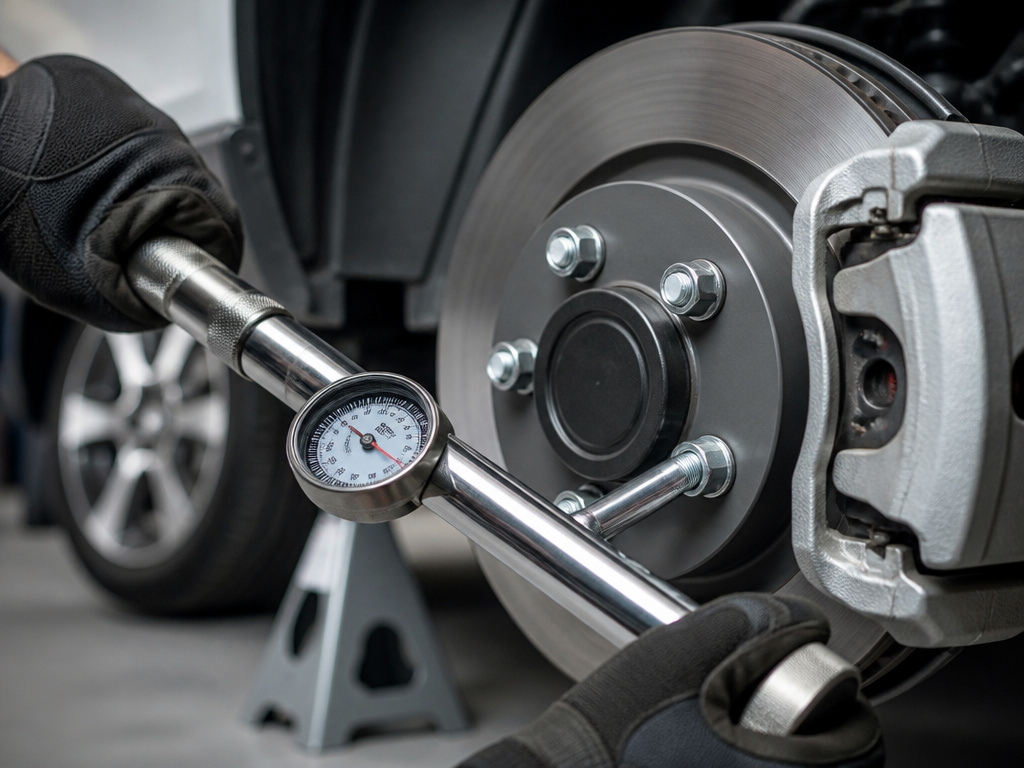
Three things decide the job: the pattern, the torque spec, and the reset. Do not guess the torque spec. Use the value in the owner’s manual.
- Record tread depth at each corner. Measure outer, center, and inner. Write the numbers down. A 2/32 inch gap is the trigger that decides if the next rotation can wait. Skip it, and you cannot prove the wear gap.
- Remove all 4 wheels. Use jack stands rated for the vehicle. If you have a Rivian, do not use the Rivian Tire Service Kit for routine rotation; Rivian limits it to roadside emergencies. Skip stands, and the vehicle can fall.
- Check the sidewall. Find the arrow. If the tire is directional, mark each corner before moving wheels. Skip marks, and a directional tire can run backward.
- Reinstall with the correct pattern. Same-size non-directional tires follow the OEM cross pattern. Directional tires move front to rear on the same side. Staggered non-directional tires move left to right only. Use the wrong pattern, and handling suffers.
- Torque the lug nuts to the manual spec. Do not let an impact wrench finish the job without a torque wrench check. Guess torque, and the wheel can loosen.
- Reset the service counter. Tesla says to exit Service Mode if it is on, then use Controls>Service>Reset. After reset, the tire service mileage should show less than 500 km ago. A drive may be required for the TPMS to update. Rivian says drive up to 10 minutes for TPMS updates. Skip reset, and the service reminder keeps nagging.
- Follow the vehicle’s specific reset procedure as outlined in the manual. Skip the door close, and the manual step is incomplete.
I still measure twice. A 2/32 inch difference can hide in the inner shoulder if you only check the center. The TPMS reset is the last step people forget, and that is how a normal drive turns into a warning light.
Should You DIY or Use Tesla Mobile Service?
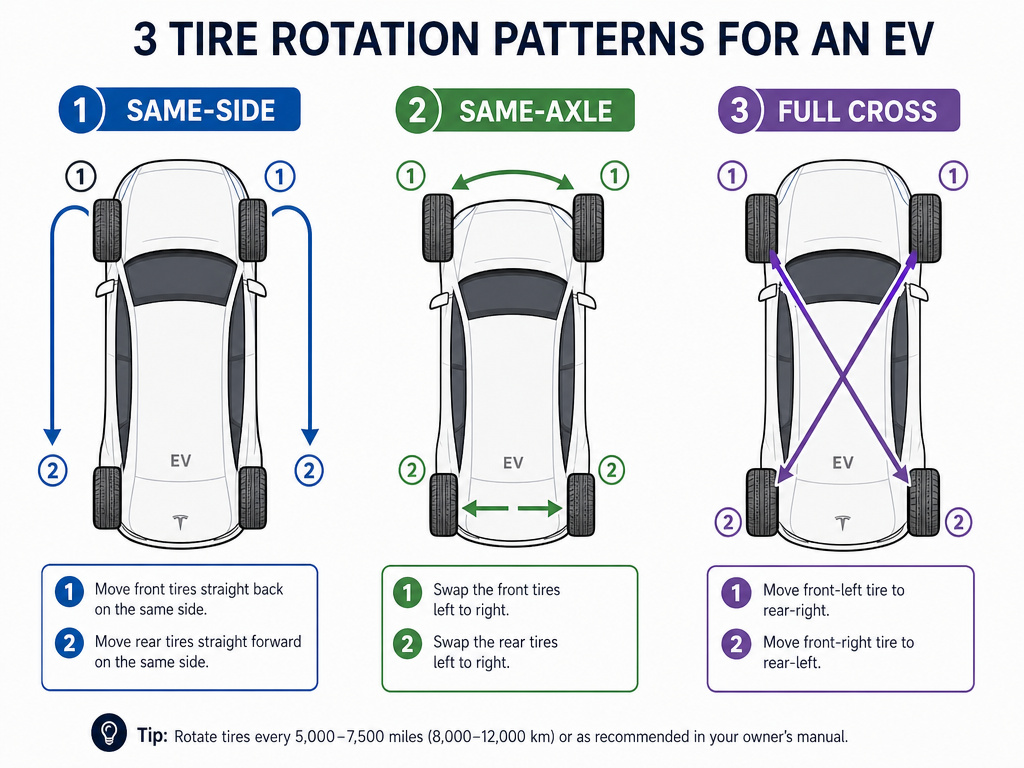
Your model and your lift decide it. Tesla’s mobile service manuals restrict mobile technicians to same-side or same-axle rotations when front and rear tires are the same size. That is narrower than the shop procedure. If you DIY, you can follow the full cross pattern only when your manual allows it.
Rivian’s guide says contact Rivian for other types of service or repair. The Rivian Tire Service Kit is for roadside emergencies, not routine rotation. For a non-Rivian EV, I’d compare Michelin, Continental, and Pirelli options that match the door-jamb size and load index. For a daily driver, use a tire that meets the vehicle’s specifications, including load index. It must meet the load index. Do not use a low-profile summer tire if you see potholes.
- If the car is a Tesla and a mobile tech will rotate, expect a same-side or same-axle pattern.
- If you DIY, confirm your manual allows the cross pattern.
- If you replace, match the tire model across the axle, and ideally all four wheels.
I cannot point to a tested range number for every tire. The differences between EV and regular tires can affect range and handling. They can also affect traction. Using tires that meet the vehicle’s specifications is important for performance and safety.
Checking tire pressure
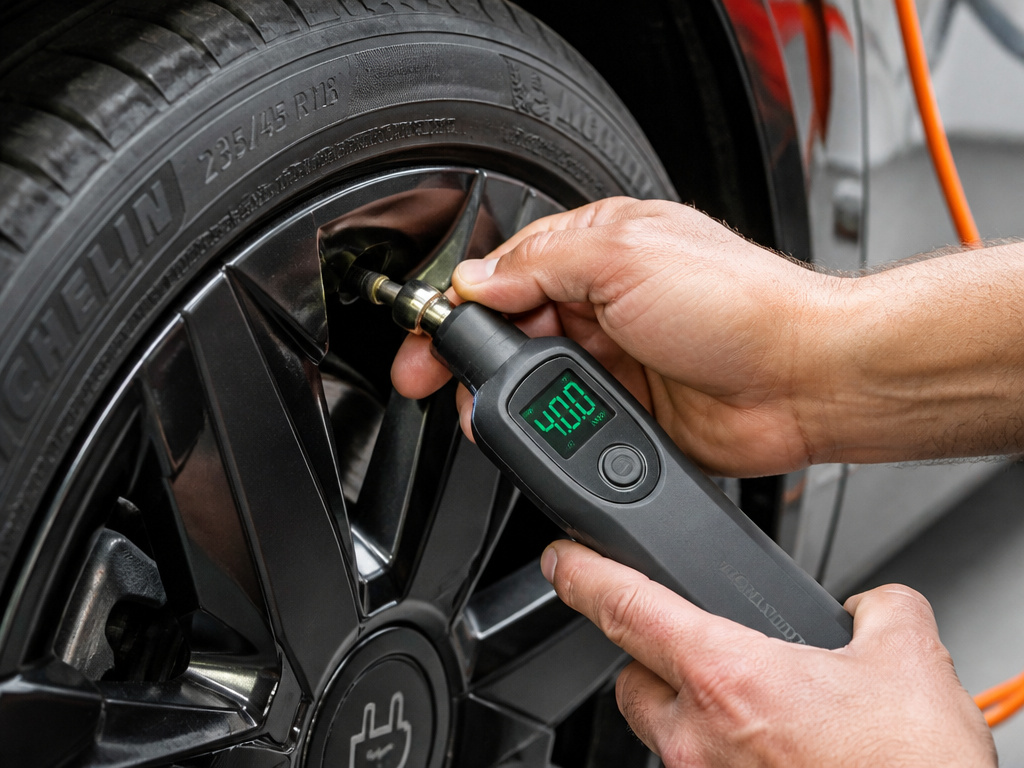
Check your tire pressure when the tires are cold. A cold tire is one that has been stationary for over three hours or driven for less than one mile. After adjusting the pressure, you may need to drive for a short time to allow the vehicle’s tire pressure monitoring system to update and display the new values. Never drive on tires that are inflated to an incorrect pressure, as this can affect handling and safety.
General tire inspection
Before rotating, inspect each tire for damage, punctures, or excessive wear. Look for any cuts, bulges, or objects embedded in the tread. Avoid contaminating tires with fluids like brake fluid or solvents. If your tires have built-in wear indicators, they become flush with the tread surface when the tread is very low, signaling the tire needs replacement. Tires should be replaced if they are worn, damaged, or have been punctured.
Tire wear patterns
Uneven wear patterns are a key reason to rotate tires. Check the tread depth across each tire and compare the depth between tires on the same axle. If the tread depth difference between the left and right tires on an axle reaches the threshold specified by your vehicle’s manufacturer (e.g., 2/32 in), rotation is needed to promote even wear. Consistent monitoring of these patterns helps you decide when to rotate, which can extend the overall life of your tire set.
Frequently Asked Questions
Can I rotate the tires on my Tesla myself?
Yes, if you have a safe lift, jack stands, and the correct pattern for your tires. Tesla’s mobile technician rule is narrower than the shop rule. If your model uses staggered sizes, do not rotate front to rear.
How often should I rotate EV tires?
Tesla says every 6,250 miles or when tread depth differs by 2/32 inch. Rivian says every 7,500 miles for square fitments. Lucid does not give a rotation interval in the source material.
Do tires really need to be rotated every 5,000 miles?
No universal rule. Tesla and Rivian use different intervals. I rotate near 5,000 miles on heavy EVs because measured wear gaps shrink, but the OEM manual and tread depth matter more.
What happens if I rotate staggered tires front to rear?
The vehicle can handle badly. Lucid says different-size tires should not be rotated because it will severely affect handling. Tesla allows side-to-side rotation for staggered non-directional tires.
Will rotation affect range?
Tire condition can affect range. Rivian says tire requirements can change ride and handling. They can also change traction and range. Use the recommended tire model and keep pressures correct.
The Bottom Line
If you do only one thing this week, measure tread depth on each corner and write the numbers down. A 2/32 inch gap is the trigger that decides if the next rotation can wait. If your front and rear sizes differ, stop before the lift and check the manual. That is the first step in how to rotate tires on an electric car without guessing.
Same-size non-directional tires follow the OEM cross pattern. Directional tires stay on their side. Staggered tires stay on their axle unless the manual says side-to-side.
