
How Long Do Trailer Tires Last: Key Factors and Timelines
This post contains affiliate links. As an Amazon Associate, we earn from qualifying purchases.
Manufacturer guidelines for maximum trailer tire service life vary, with Michelin recommending replacement at 10 years from manufacture, Goodyear at 6 years in service, and Airstream recommending inspection and likely replacement at 5 years. The lifespan is cut short by age, not mileage, because the rubber compounds degrade from sun, heat, and sitting still, which is why a tire with perfect tread can still be a failure risk.
That gap between manufacturer guidance and real-world advice is where the confusion lives. One source says six years, another says ten, a third says five. The numbers aren’t arbitrary, they represent different risk calculations based on use and liability. A common question is how long do trailer tires last.
What follows is a breakdown of the three official timelines, the legal tread depth you can’t ignore, and a checklist to decide when your specific tires are done.
Key Takeaways
- Goodyear and Hankook recommend replacing tires older than six years from their manufacture date, while Michelin recommends replacement at 10 years and Airstream recommends inspection and likely replacement at 5 years.
- Inspect tires over five years old annually for cracking, as recommended by Airstream and other OEMs; failure often starts with invisible sidewall damage.
- For heavy trailers over 10,000 lbs, federal law requires removing front tires at 4/32” tread depth, not the standard 2/32”.
- Monthly pressure checks are essential; a tire can lose pressure in storage, and underinflation is the fastest route to a blowout.
- Storage kills tires faster than driving. A tire sitting under load for months degrades internally; use jack stands and covers.
The 6-Year vs. 10-Year vs. 5-Year Rule
You’ll find three different numbers for trailer tire age. They’re all correct, but they serve different masters.
Goodyear is the clearest. In a federal tire safety bulletin, they state any tire in service six years or more should be replaced, even if it looks fine. Hankook’s warranty applies if the tire is within 6 years from the date of manufacture or 6 years from the date of purchase. Goodyear, however, recommends replacing any tire in service six years or more.
Michelin takes a longer view. Their technical bulletin says tires that have been in use for five years or more should get an annual specialist inspection. They recommend replacement “as a simple precaution” at 10 years from the date of manufacture. This is the most conservative manufacturer stance, but it assumes perfect storage and regular professional checks most owners skip.
Then there are the people who build the trailers. Airstream states plainly: “Trailer tires over five years old should be inspected by a tire expert for cracking and replaced even if it has no apparent tread wear.” For them, five years is the trigger for a serious professional look, with replacement likely. Other OEMs and community groups may cite shorter windows, especially for tires that sit for months.
Where this goes sideways: Choosing the longest timeline (10 years) because the tread looks new. The rubber’s internal strength degrades from heat cycles and ozone exposure long before the tread wears down. A blowout from aged rubber happens without warning.
| Source | Recommended Action | Key Condition |
|---|---|---|
| Goodyear / Hankook | Replace at 6 years | From date of manufacture or first service |
| Michelin | Annual inspection after 5 yrs; replace at 10 yrs | From date of manufacture |
| Airstream / OEMs | Inspect at 5 yrs; likely replace | Regardless of tread condition |
The practical takeaway? If you don’t know your tire’s service history, use the six-year mark from the DOT date as your absolute deadline for how long do trailer tires last. If you’re meticulous about storage and get annual pro checks, you might stretch toward ten with a Michelin. But for most owners, planning a swap between years five and six is the safe, sane move.
How to Read a Tire’s Age and Specs
The tire tells you everything you need to know. You just have to know where to look.
Find the DOT code on the sidewall. It starts with “DOT” and ends with a four-digit number. The last two digits are the year of manufacture. The first two are the week. A code ending in “1523” was made in the 15th week of 2023. That’s it. Any tire shop, selling you a “new” tire with a date code over a year old, is selling you aged rubber. Check it, don’t assume it.
Next to that, you’ll see the tire’s size and type. For trailers, look for “ST” (Special Trailer). One example of a trailer tire size is ST 225/75R15.
- ST: Special Trailer (never use on a car)
- 225: Section width in millimeters
- 75: Aspect ratio (sidewall height is 75% of width)
- R: Radial construction
- 15: Wheel diameter in inches
Then, find the Load Range (e.g., C, D, E) and the Max PSI. This is critical. For example, a Goodyear Marathon ST215/75R14 Load Range C tire has a max of 50 PSI. A Goodyear Endurance ST215/75R14 is Load Range D and has a max of 65 PSI. More PSI means a higher load capacity. Never assume the PSI on your old tire’s sidewall is correct for a new one, always match the spec of the exact tire you bought.
Tread Depth: The Legal Minimum Isn’t Safe for Trailers
For your car, the standard replacement threshold is 2/32” of tread. For trailers, that’s often too late.
The USTMA commercial tire care guide makes a crucial distinction. For vehicles over 10,000 lbs GVWR, federal regulation (49 CFR 570.62) requires removal of front axle tires at 4/32” tread depth. The general guideline for all other tires is 2/32”. If you’re towing a heavy equipment, horse, or large RV trailer, you’re likely in that over-10,000-lb category. Wearing a tire down to 2/32” on a heavy rig is both risky and illegal.
Tires used on RVs are typically subjected to a greater variety of service conditions than automobiles… Often at or near maximum loads and during hot weather. – Goodyear Product Service Bulletin
Why the stricter rule? Trailer tires run hotter and under more consistent load than car tires. Shallower tread can’t dissipate heat as effectively, leading to faster rubber breakdown and increased risk of a trailer tire blowout. Use a tread depth gauge. If you’re approaching the legal minimum tread depth, start planning the replacement. At 4/32” on a heavy trailer, it’s time.
The Silent Killer: How Storage and Environment Shorten Life
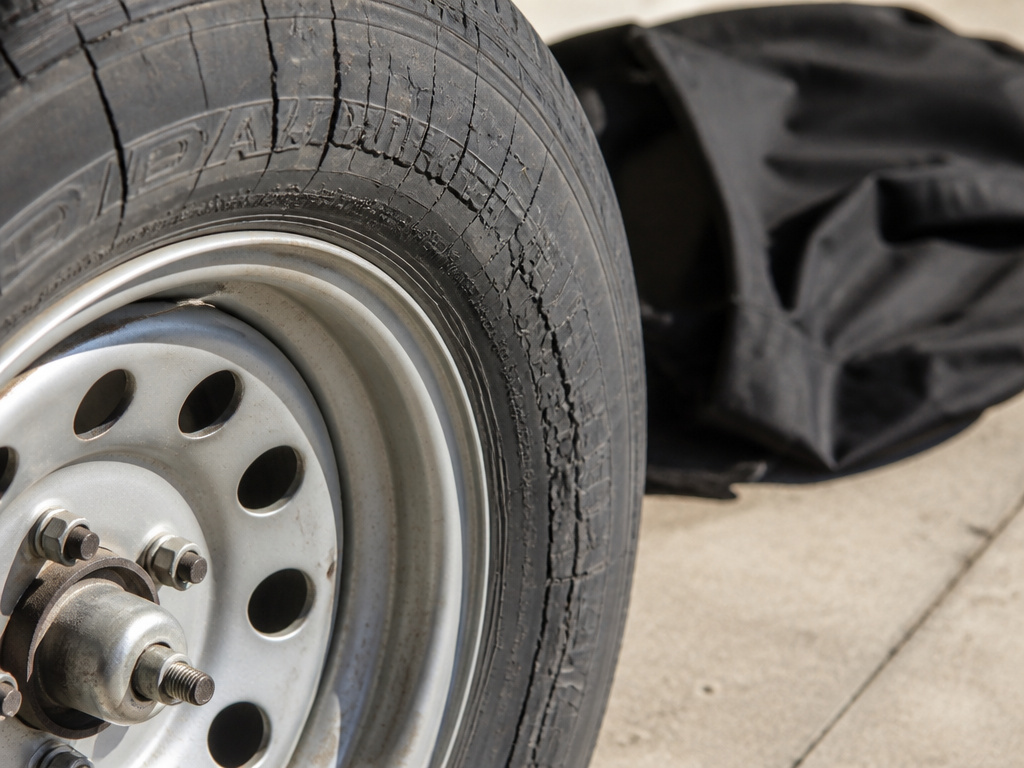
A trailer tire would rather be driven than parked. Sitting still is the worst thing for it.
Hankook’s warranty guide notes that a mounted tire under load but not regularly used will “prematurely age.” The weight creates a constant deformation point. The rubber doesn’t get the flexing that brings protective oils to the surface. The solution requires both proper inflation and lifting the load. For long-term storage, put the trailer on jack stands to take the weight off the tires.
Environment matters just as much. Ultraviolet light from the sun breaks down rubber, causing dry rot and sidewall cracking. Ozone, emitted by electric motors and generators, accelerates this chemical aging. Hankook explicitly warns against storing tires near “electric generators or transformers.”
Common mistake: Storing a trailer for the winter without tire covers or a pressure check. A tire can lose roughly 7 PSI per month in storage. By spring, it’s severely underinflated, and the sidewalls are sun-damaged.
For storage, consult your tire manufacturer’s recommendations for proper inflation. Use breathable, light-colored tire covers. A little proactive trailer tire care here adds years. Neglect steals them.
Step-by-Step Pre-Trip Inspection Checklist
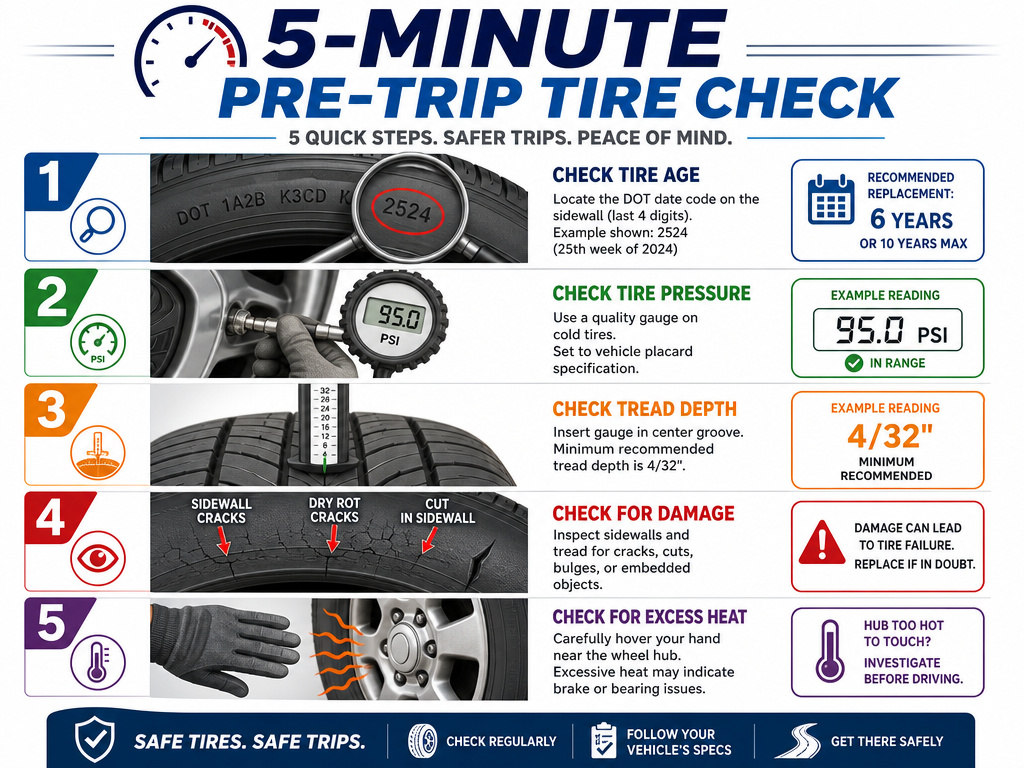
Don’t just kick the tires. Follow this 5-minute drill before any long haul.
- Check the Date. Find the DOT code. If it’s past six years, factor in a replacement stop soon. This is the single biggest predictor of failure.
- Gauge the Pressure. Use a dial gauge, not the tow vehicle’s TPMS. Check when tires are cold. Inflate to the maximum cold PSI on the sidewall, not the placard on the trailer. Airstream recommends this max for a reason, it provides the rated load capacity.
- Measure the Tread. Use a depth gauge in the center groove. For heavy trailers, note if you’re at or below 4/32”. For lighter ones, the 2/32” line is your absolute floor.
- Scan for Damage. Look for cuts, cracks (especially in the sidewall grooves), bulges, or any signs of uneven tire wear. Cracks mean the rubber is dying.
- Feel for Heat. After driving for an hour, safely feel the wheel hubs. One significantly hotter tire points to a dragging brake or bad bearing.
This checklist helps catch most common problems. The other 5% are internal separations you can’t see, which is why the age rule is your final backstop.
When to Replace: A Decision Matrix
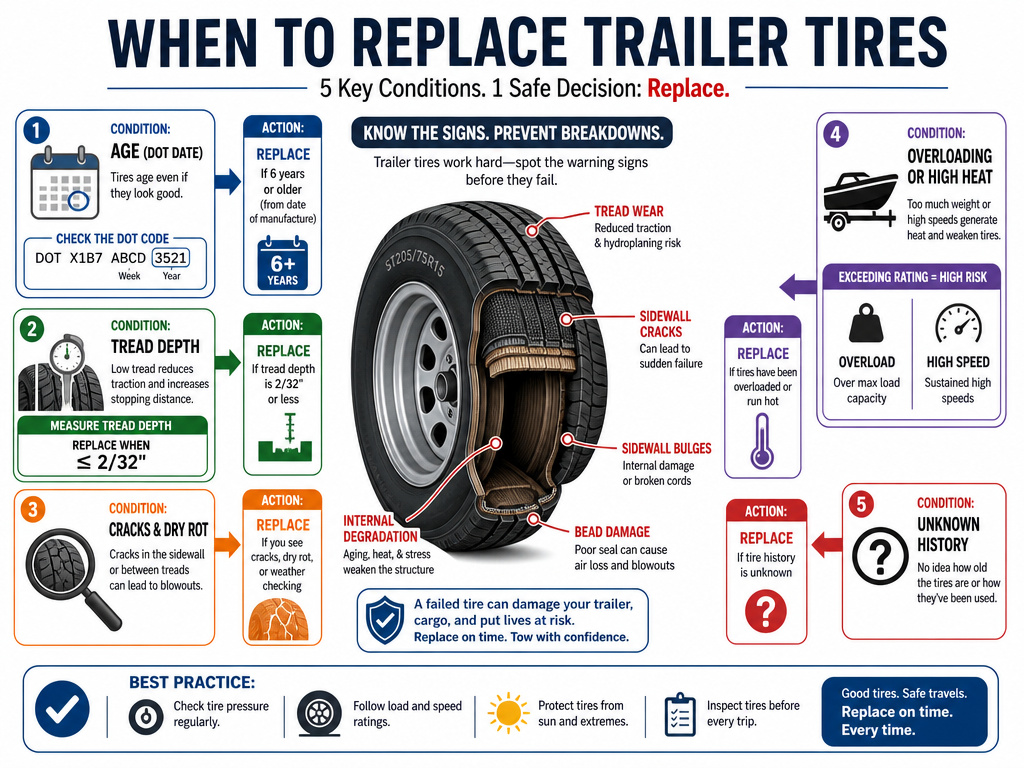
So, when do you actually buy new tires? It’s not one thing; it’s the first thing that hits a limit.
| Condition | Action | Why |
|---|---|---|
| DOT age ≥ 6 years | Replace immediately. | Rubber degradation is advanced; failure risk spikes. |
| Tread ≤ 4/32” (heavy) or ≤ 2/32” (light) | Replace before next trip. | Insufficient tread for heat dissipation and wet stopping. |
| Visible sidewall cracking | Replace immediately. | Structural integrity of the rubber is compromised. |
| 5+ years old with heavy use/storage | Plan replacement this season. | You’re in the high-risk window for age-related failure. |
| Unknown age or history | Replace if over 5 years from DOT date. | You cannot assess the hidden service life. |
This matrix simplifies the official guidance on how long do trailer tires last. Your tires might have great tread at seven years. Replace them. They might be only three years old but covered in deep sidewall cracks from the Arizona sun. Replace them. Age and condition work together, but age is the senior partner. For a deeper dive on when to replace tires in general, the same principles apply with even stricter timelines.
Why Trailer Tires Age Out Before They Wear Out
The physics are simple. A car tire rotates constantly, flexing evenly and staying cooler. A trailer tire on the same axle does the same job but carries a static, heavy load with less airflow. It runs hotter.
Heat accelerates the chemical aging of the rubber compounds and the breakdown of the internal steel or fabric belts. Also, trailer tires often sit for months, allowing ozone to attack the rubber and the weight to create a permanent flat spot. This combination of thermal stress and environmental attack degrades the tire’s structure long before the tread is worn away. This is why the typical lifespan of tires on a daily driver is measured in miles, but for trailers, it’s measured in years.
Worth knowing before you start: The “one-third strength loss in three years” claim from some community groups is controversial. Hankook states there’s “no hard and fast rule to measure service life,” as degradation varies too widely, disagreeing with that specific metric.
Frequently Asked Questions
Are 7 year old trailer tires safe?
According to Goodyear and Hankook, no. Their guidance is to replace any tire in service six years or more. A seven-year-old tire is past this recommended service life, even if the tread looks new. The risk of internal aging and sudden failure increases significantly.
How can I tell when my trailer tires are bad?
Look for three things: a DOT date code over six years old, visible cracking in the sidewall (dry rot), and tread depth at or below 4/32” for heavy trailers (2/32” for lighter ones). Any one of these conditions means the tire is bad and needs replacement.
Should I replace all trailer tires at once?
Yes. Mixing tires with significantly different ages or tread depths can cause uneven load distribution and handling issues. When one tire fails the age or wear test, plan to replace the entire axle set at minimum, if not all four.
Does tire pressure really matter that much?
Absolutely. Underinflation is the leading cause of premature trailer tire failure. It causes excessive flexing, heat buildup, and can lead to a blowout. Check pressure monthly with a gauge and always inflate to the tire’s sidewall max PSI when cold, as per the trailer tire pressure guide.
The Bottom Line
Here’s the short version: find your tire’s DOT date. If that number is six or more years ago, budget for new trailer tires now. Don’t wait for the tread to wear or for a crack to appear. The replacement cost is a fraction of the damage a blowout can cause to your trailer, your cargo, and your safety on the road.
Everything else, the pressure checks, the storage covers, the load calculations, is just a way to extend tire life within that fixed 5-to-6-year window. Trailer tires are an expiration-date item, not a wear item. Mark your calendar from the day they’re made, not the day you start using them.
