
Semi Truck Tire Pressure Guide: A Step-by-Step Check
This post contains affiliate links. As an Amazon Associate, we earn from qualifying purchases.
The correct pressure for a semi truck tire is not on the sidewall; it is the cold inflation pressure listed in the manufacturer’s load/inflation table for your specific axle load. A common steer tire like a 295/75R22.5 might show a max of 110 psi, but the required operating pressure depends on the actual load using load/inflation tables. Check pressure when tires are at ambient temperature, after sitting for at least three hours, using a calibrated gauge. Never bleed air from a hot tire.
That “cold” part is the whole game. Heat from driving expands the air inside, raising pressure and giving you a false reading. Adjusting based on a hot reading guarantees the tire will be underinflated when it cools down, which is where the real damage starts. The industry manuals, like any good semi truck tire pressure guide, are unanimous on this, but the practice in a busy yard often cuts the corner.
What follows: how to find your specific number using load tables, the exact procedure for a reliable cold check (especially on duals), what to do when pressure keeps dropping, and the one temperature rule that decides every seasonal adjustment.
Key Takeaways
- Use load/inflation tables, not the sidewall max. The maximum pressure stamped on the tire is a safety limit, not an operating recommendation. Your actual pressure comes from the manufacturer’s table matching your tire size and measured axle load.
- Check and adjust pressure only when tires are cold. The Technology & Maintenance Council (TMC) states a vehicle should be parked for 3-4 hours before adjusting. If you must move it, drive less than one mile.
- The TMC states any tire at 80% or less of recommended pressure should be treated as a flat, removed, demounted, and inspected by a technician. Michelin advises that if a tire repeatedly loses pressure, the cause should be identified rather than continually adding air.
- Pressure drops 2-4 psi for every 10°F temperature drop. This isn’t a leak; it’s physics. The USTMA commercial tire care manual notes this seasonal swing means your summer settings will be dangerously low by mid-winter if left unchanged.
- Investigate recurring pressure loss immediately. Adding air to a tire that is always low is a temporary fix. The cause is usually a failing valve stem, a corroded rim, or a damaged O-ring.
Why “Cold” Pressure Is the Only Number That Matters
Drive a truck and the tire’s internal air temperature can rise significantly from heat generated by operation. That heat makes the air expand.
Inflation pressure can rise 10-15 percent as a result of normal operation. This is considered hot inflation pressure. In some cases the actual hot inflation pressure could be higher than the maximum inflation pressure marked on the sidewall. This is not a safety issue. Tires are designed to withstand this normal pressure buildup. . Technology & Maintenance Council RP 235A(T)
If you check a hot tire at 115 psi and think it’s fine, you’ve been fooled. When it cools back to ambient temperature, that pressure will drop. If you check a hot tire, the reading will be higher than the cold target. Adjusting based on a hot reading guarantees the tire will be underinflated when it cools down. You’re now running 5 psi underinflated, and you’d never know by checking after a run.
The fix is simple but essential. Park the truck for at least three hours before you check. Let the tires return to the temperature of the surrounding air. This gives you a stable, repeatable baseline, the cold inflation pressure. Every load table, every fleet specification, and every meaningful tire pressure check is based on this number.
I used to judge pressure by looking at the tire or pressing it with my thumb. Tires can look fine while sitting several PSI low. Now a gauge comes out every time, because looking tells you almost nothing.
How to Find Your Exact Tire Pressure: It’s Not on the Sidewall
The sidewall shows the tire’s maximum load capacity at its maximum cold inflation pressure. It is a safety limit, not an instruction.
The maximum pressure marked on a tire should not automatically be treated as the appropriate operating pressure for every application. Pressure must be set based on actual load using load/inflation tables. . Michelin Truck Business Tips
Your actual working pressure is almost always lower. You find it in three steps.
First, know your tire’s exact size and load index (e.g., 295/75R22.5 Load Range G 144/141L). This is stamped on the sidewall. Second, you must know the actual weight on each axle. Guessing here makes the whole exercise pointless. Weigh the truck loaded as it normally runs. Third, take that axle load and your tire details to the official load and inflation tables.
These tables are published by tire manufacturers like Michelin, Goodyear, and Double Coin. The values are based on ISO and TRA (Tire and Rim Association) standards. As Double Coin notes, these standards can change, so always use the current chart from the manufacturer’s data book or the latest TRA Year Book.
| Tire Size & Load Index | Configuration | Example Load per Tire | Required Cold Pressure | Source |
|---|---|---|---|---|
| 295/75R22.5 144/141L | Single (Steer Axle) | 2800 kg (6175 lbs) | 760 kPa (110 psi) | USTMA Manual |
| 295/80R22.5 152/148 | Dual (Drive Axle) | 2740 kg | 105 psi | Goodyear Air Pressure Table |
| 295/80R22.5 152/148 | Single (Trailer) | 2730 kg | 90 psi | Goodyear Air Pressure Table |
The table shows how dramatically pressure changes with configuration. The same tire size needs 110 psi as a single but only 105 psi in a dual setup for a similar load. This is why understanding steer vs drive tires and their positions is critical, the wrong pressure for the position wastes the tire.
The Step-by-Step Cold Pressure Check
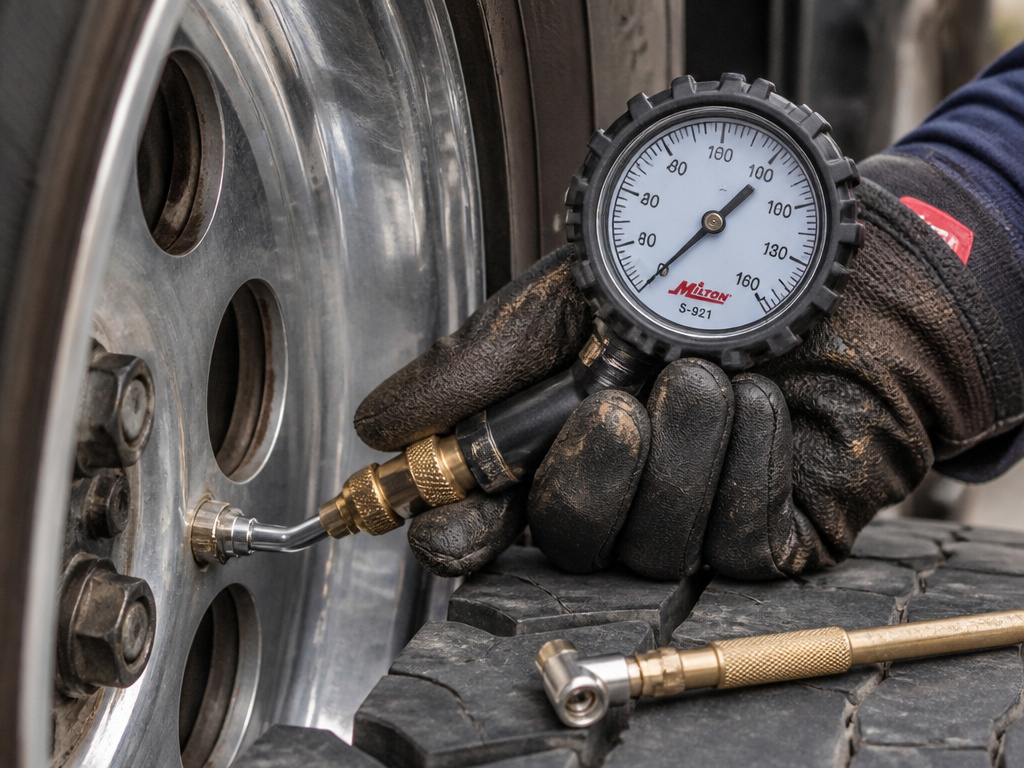
For a reading you can trust, you need a process. This is especially true for inner dual tires, which are easy to miss.
Tools You Need:
- A calibrated, heavy-duty tire pressure gauge. The pencil-style gauges from the gas station aren’t accurate enough.
- A valve stem extension tool for reaching inner duals.
- A notebook or app to log pressures for each tire position.
The Procedure:
- Park for 3-4 hours. This is the TMC’s guideline to ensure tires are cold. If the truck was just moved, limit that movement to less than one mile.
- Remove the valve cap. Check the valve core for damage or debris. A quick spray of soapy water can reveal a leaking core with tiny bubbles.
- Use the extension on inner duals. Seat it firmly to get a clean seal.
- Press the gauge on straight and hard. You should hear a short hiss of air. Read the gauge at eye level.
- Compare to your target pressure. Your target comes from the load/inflation table for that specific tire and its axle’s load.
- Adjust if needed. Use a reliable heavy-duty inflator to add air in short bursts, checking frequently. Never exceed the sidewall maximum or the wheel manufacturer’s limit.
- Re-check and replace the valve cap. The cap keeps dirt and moisture out of the valve core.
Log every reading. A pattern of loss on one tire that exceeds normal permeation is a red flag. The USTMA states normal permeation loss is 2-4 psi per month, but consistent loss beyond that means trouble.
What is the 4 PSI Rule for Truck Tires?
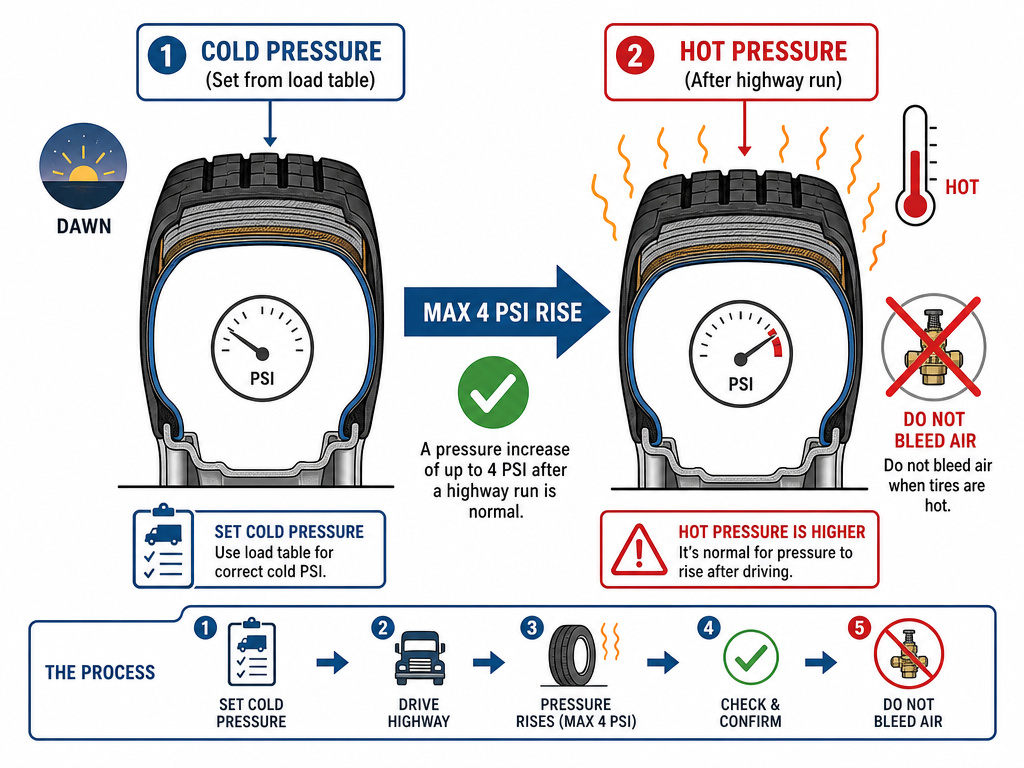
The “4 PSI rule” is a field guideline for safe operation, not a maintenance rule. It addresses the normal pressure rise from heat.
After a tire has been running at highway speed and is fully warmed up, check its pressure. Then compare that “hot” pressure to the established “cold” pressure you set. If the hot pressure is no more than 4 psi above the cold pressure, the tire is likely properly inflated for its load. If the hot pressure is more than 4 psi above the cold pressure, the tire may be underinflated for its load, causing excess flex and heat buildup.
Where this goes sideways: Using the 4 PSI rule to set pressure. It’s a diagnostic check for on-road conditions, not a substitute for the cold-pressure setting from the load table. Never bleed air from a hot tire to try and meet this rule.
How Often Should You Check Semi Truck Tire Pressure?
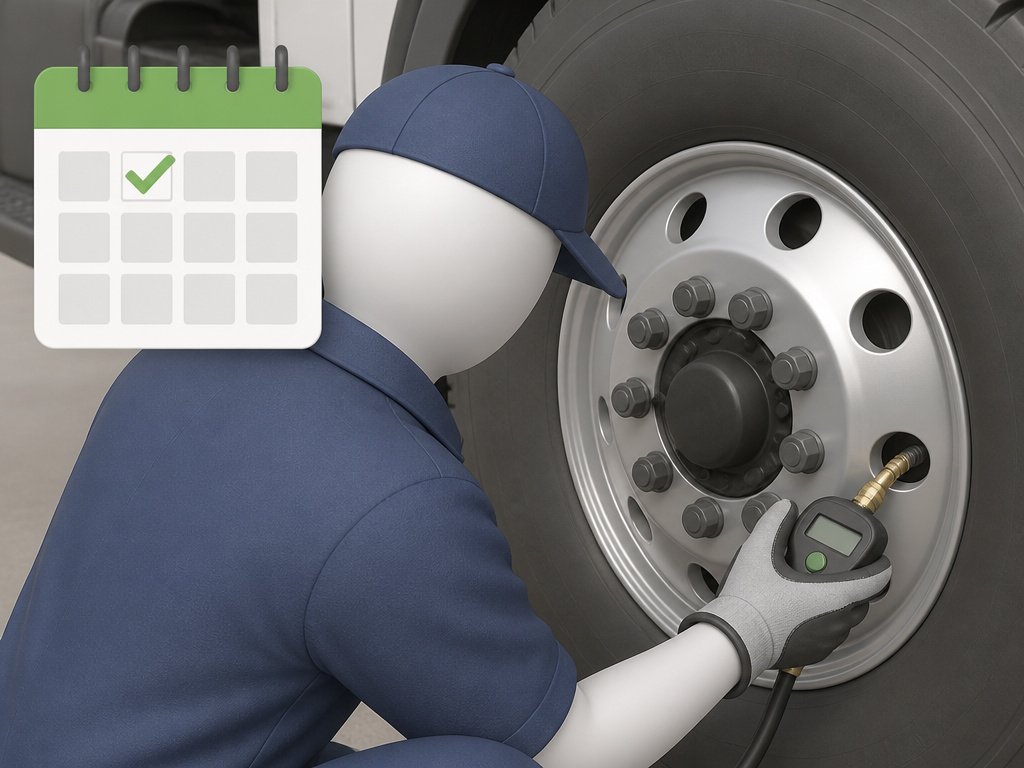
Sources disagree on the ideal interval, which tells you to err on the side of caution.
- USTMA/TMC: Recommend checking “frequently, such as daily during continuous service” as part of a pre-trip inspection.
- TMC/Michelin: Also state “most tire companies recommend… Once a week” if daily is not possible.
- Caterpillar: Advises to “Check air pressure at least once a week.”
For a fleet, the best practice is daily visual inspections (looking for obvious bulges or severe underinflation) and a weekly gauge check when the truck is cold, ideally at the same time each week. More frequent regular pressure checks are the cheapest form of tire insurance you can buy.
Troubleshooting Recurring Pressure Loss
If a tire repeatedly loses pressure, identify the cause rather than continually adding air. . Michelin Truck Business Tips
A tire that’s always low has a problem. Topping it up is a waste of time and air. Here’s where to look, in order of likelihood:
- Valve Stem & Core: The rubber stem can crack with age, and the tiny valve core inside can get grit in it or simply fail. Replace the core and the valve stem assembly if there’s any doubt.
- Valve O-Ring (Tubeless tires): Michelin’s manual is explicit: “When fitting tubeless tyres, change the valve O-ring each time you change a tyre.” A hardened, cracked O-ring is a prime leak source.
- Rim Corrosion or Damage: Where the tire bead seals against the rim, rust, dents, or pitting can break the air-tight seal. This often requires professional demounting and cleaning or rim replacement.
- Leaking Inner Tube (Tube-type tires): For tires with tubes, the tube itself can be punctured or the flap (which protects the tube from the rim) can be damaged. The rule here is absolute: “When fitting tyres with inner tubes, always fit a new tube and flap in a new tyre.”
- Puncture or Tire Damage: A slow leak from a nail or a small crack in the tire casing.
Common mistake: Ignoring a slow leak because “it holds air for a week.” A tire that consistently loses pressure over time can cross the critical 80% threshold that calls for removal and inspection.
Seasonal and Temperature Adjustments
Tire pressure is directly tied to ambient air temperature. As temperature drops, air molecules contract, and pressure decreases.
The USTMA quantifies it: truck tires may lose 2-4 psi for every 10°F drop in temperature. This isn’t a leak; it’s a predictable physical law.
This has major implications for seasonal maintenance. Your perfectly set pressure in summer will read lower on a colder morning in fall due to the predictable pressure drop with temperature. That’s an 8% drop, pushing the tire toward underinflation. You must add air in the fall to compensate for the colder weather, and you may need to bleed a little air in the spring as temperatures rise. Understanding these temperature effects is key to year-round pressure stability.
The Dangers of Wrong Pressure: Overinflation vs. Underinflation
Both extremes cost money and create safety risks, but underinflation is the more common and destructive problem.
Underinflation causes the sidewall to flex excessively. This flexing generates internal heat. The TMC warns that continuous operation above 230°F damages the tire as the rubber begins to revert and lose strength. The excessive flex also strains the casing, leading to premature sidewall failure (often a “zipper” rupture). Tread wear accelerates at the shoulders, and rolling resistance increases, burning more fuel.
Overinflation makes the tire too rigid. The center of the tread bulges out, wearing down faster than the shoulders. The tire also becomes more susceptible to impact damage from potholes or road debris, as it can’t flex to absorb the blow. While overinflation is less common, it’s just as hard on your equipment and wallet.
For a detailed breakdown of the symptoms and costs, see our guide on the effects of wrong pressure.
Tools and Technology for Pressure Maintenance
The baseline tool is a quality, calibrated gauge. For fleets, technology can automate the most error-prone part: the human check.
- Tire Pressure Monitoring Systems (TPMS): These systems use sensors on each wheel to report real-time pressure and temperature to the driver. The industry standard for heavy vehicles is defined in SAE J2848-1-2023, which ensures system reliability and interoperability. A TPMS meeting the SAE J2848-1-2023 standard is an early-warning system, not a replacement for manual checks.
- Automatic Tire Inflation Systems (ATIS): These systems constantly maintain pressure while the vehicle is moving, using onboard air to top up any tire that drops below a set threshold. They are excellent for preserving casing life on trailers and preventing slow-leak-related failures.
Whether you use a simple gauge or a full ATIS, the goal is the same: keep every tire at its specified cold pressure, every day. This discipline has a direct, measurable impact on your vehicle’s handling and braking, fuel bills, and repair costs.
Frequently Asked Questions
What is the proper PSI for semi truck tires?
There is no single PSI. The proper pressure is the cold inflation pressure found in the manufacturer’s load/inflation table for your specific tire size and the actual weight on that axle. For a common 295/75R22.5 steer tire, it could be 110 psi at max load, but the required operating pressure depends on the actual load using load/inflation tables.
What is the 4 PSI rule on tires?
It’s a rule of thumb for en-route checks. After the tires are fully warmed up from driving, the hot pressure should be no more than 4 psi above the established cold pressure. A difference greater than 4 psi suggests the tire may be underinflated for its load. Never use this rule to set pressure.
How much air do you put in a 22.5 tire?
It depends entirely on the tire’s load index and its load. For example, a Goodyear 295/80R22.5 with a load index of 152/148 requires 105 psi when mounted in a dual configuration carrying 2,740 kg per tire, but only 90 psi when mounted singly carrying 2,730 kg. You must consult the table.
How often should I check the pressure on my semi tires?
At a minimum, perform a gauge check weekly when the tires are cold. Daily visual inspections for obvious issues are also recommended. During extreme temperature swings or if a tire has a history of leakage, increase check frequency.
Before You Go
One rule cuts through all the complexity: pressure is set by scale weight, not by a guess or the sidewall. If you don’t know what your axles weigh, you are guessing your tire pressure. Getting that weight is the single most important step everyone wants to skip.
Everything else, the cold check, the weekly log, the investigation of leaks, flows from that number. The systems like TPMS help you monitor, but they don’t replace the foundational act of looking up the right pressure in the tire load tables and checking it with an appropriate, calibrated pressure gauge. Specs first, opinions second. That discipline turns tire pressure from a mysterious chore into a direct lever on your bottom line.
