
How to Calculate Tire Diameter: The Official Formulas
This post contains affiliate links. As an Amazon Associate, we earn from qualifying purchases.
To calculate tire diameter, use the official formula: Rim Diameter + (2 x Section Height). For a P225/65R17 tire, convert the rim (17 inches) to millimeters (431.8mm), find the section height (225mm x 0.65 = 146.25mm), then add: 431.8 + (2 x 146.25) = 724.3mm (about 28.5 inches). This is the nominal design diameter per international standards, but real tires can vary by ±4%.
That number is a starting point, not a guarantee. The official standards from the UN and ISO define it as a design dimension, and they publish separate tables for the maximum and minimum diameters a finished tire can actually have. Your calculated 28.5 inches is what the engineers aimed for; the tire on your car could be 28.4 or 28.8 and still pass inspection. This is why it’s important to know how to calculate tire diameter correctly.
What follows: a walk through the two formulas that matter (one for the label, one for the factory), the built-in tolerances that explain why tires from different brands never match exactly, and how to measure what’s actually on your car when clearance is tight.
Key Takeaways
- A common formula is Rim Diameter + (2 x Section Height), with section height as (Nominal Width x Aspect Ratio / 100). However, standards like ISO 7867-1 first calculate a design section width adjusted for the measuring rim width before deriving the section height and overall diameter.
- Real tires have a manufacturing tolerance of ±3-4% on diameter; a calculated 28.5″ tire can legally measure between 27.7″ and 29.6″.
- Always measure your actual tire with a tape or caliper for critical fitment; the sidewall number is a design goal, not a physical spec.
- A change in overall diameter will affect your speedometer reading; the magnitude of the error depends on the percentage change relative to the original tire diameter.
- For specialty tires like flotation sizes (e.g., 31×10.50R15), use the inch-based width and diameter listed; the metric formula does not apply.
The Core Formula for Passenger Tires
You see P225/65R17 on the sidewall. The “17” is the wheel diameter in inches. The “225” is the section width in millimeters. The “65” is the aspect ratio, a percentage.
The math is straightforward. Convert the wheel diameter to millimeters first. One inch equals 25.4 millimeters. So, a 17-inch wheel is 17 x 25.4 = 431.8 mm.
Next, find the section height. This is the height of the tire’s sidewall from the rim to the tread. You get it by multiplying the section width by the aspect ratio (as a decimal). For our example: 225 mm x 0.65 = 146.25 mm.
The overall diameter is the wheel diameter plus two sidewall heights (one at the top, one at the bottom). So: 431.8 mm + (2 x 146.25 mm) = 724.3 mm.
To convert back to inches: 724.3 mm / 25.4 = about 28.52 inches.
This calculation yields the theoretical design diameter as defined in documents like the UNECE tire technical regulation. It’s the standardized reference point from which all manufacturing tolerances are measured.
That’s the universal method for a metric tire size when you need to know how to calculate tire diameter. It works for any P-metric or European size. The letter at the beginning (“P” for passenger, “LT” for light truck) doesn’t change the math. The “R” just means radial construction.
Where this goes sideways: Assuming the calculated number is the exact size of the tire on the shelf. It’s not. It’s the design target. The rubber that comes out of the mold is allowed to be a bit bigger or smaller, which is why two different brands of “P225/65R17” can have slightly different real diameters. The calculation tells you the center of the range.
Tolerances and Real-World Variation
The spec sheet gives a target. The factory makes a tire. The difference between them is governed by international tolerance rules.
For passenger car radials, UN Regulation No. 117 sets the limits using these coefficients. Other standards, like ISO 3739-1 for industrial tires, use different coefficients (e.g., 1.05 for radial industrial tires).
We’ll use our P225/65R17 example again. We calculated a section height (H) of 146.25 mm.
- Minimum Diameter = 431.8 mm + (2 x 146.25 x 0.97) = 431.8 + 283.7 = 715.5 mm (28.17 in)
- Maximum Diameter = 431.8 mm + (2 x 146.25 x 1.04) = 431.8 + 304.2 = 736.0 mm (28.98 in)
Our theoretical design diameter was 724.3 mm (28.52 in). The rule says a real, certified tire can be as small as 715.5 mm or as large as 736.0 mm and still be sold as a P225/65R17. That’s a spread of over 20 mm, or about 0.8 inches.
| Dimension | Calculation | Result (mm) | Result (inches) |
|---|---|---|---|
| Theoretical Design | Rim + (2 x Section Height) | 724.3 | 28.52 |
| Minimum Allowed | Rim + (2 x H x 0.97) | 715.5 | 28.17 |
| Maximum Allowed | Rim + (2 x H x 1.04) | 736.0 | 28.98 |
This tolerance exists for manufacturing reasons, slight variations in rubber compounds, molding, and belts. It’s why you can’t assume perfect fitment from a calculation alone. A tire at the maximum tolerance might rub on a fender liner where one at the minimum tolerance wouldn’t.
For other vehicle types, the coefficients change. The ISO standard for industrial tires uses a coefficient of 1.05 for radial industrial tires with nominal aspect ratios from 50 to 95 to define the maximum diameter in service. The point is the same: the number on the sidewall is the name of the size category, not a precise measurement from a how to calculate tire diameter formula.
How to Measure Actual Tire Diameter
When the fit is tight, like with lifted trucks, lowered cars, or plus-sizing, you need the physical truth, not the theoretical one. You need to measure.
The best tool is a large caliper or a rigid tape measure. With the tire properly inflated and on the vehicle (supporting its weight), measure from the ground straight up to the center of the wheel hub. Double that number. That’s your loaded radius diameter. It’s slightly less than the tire’s true diameter because the weight of the car flattens the bottom.
For the true unloaded diameter, you need the tire off the ground. Jack up the axle so the tire spins freely. Use a tape measure straight across the center of the tread from one sidewall to the other. Get someone to help hold the tape perpendicular. Do this in a few spots and average the result, as tires are rarely perfectly round.
Common mistake: Measuring just the tread. The overall diameter is the total height from the top of the tread to the bottom, through the center of the hole. A quick check is to make a mark on the tread, roll the tire one full revolution on the ground, and measure the distance traveled. Divide that by 3.1416 (pi). That’s your rolling circumference, which you can convert back to diameter.
Why go through the trouble? Because this real number is what determines speedometer accuracy. If your actual diameter is 1% larger than the original tire, your speedometer will read about 1% slow. At an indicated 60 mph, you’d actually be going 60.6 mph. For a 3% difference, the speedometer error would be approximately 3% of the indicated speed.
Handling Non-Standard and Flotation Sizes
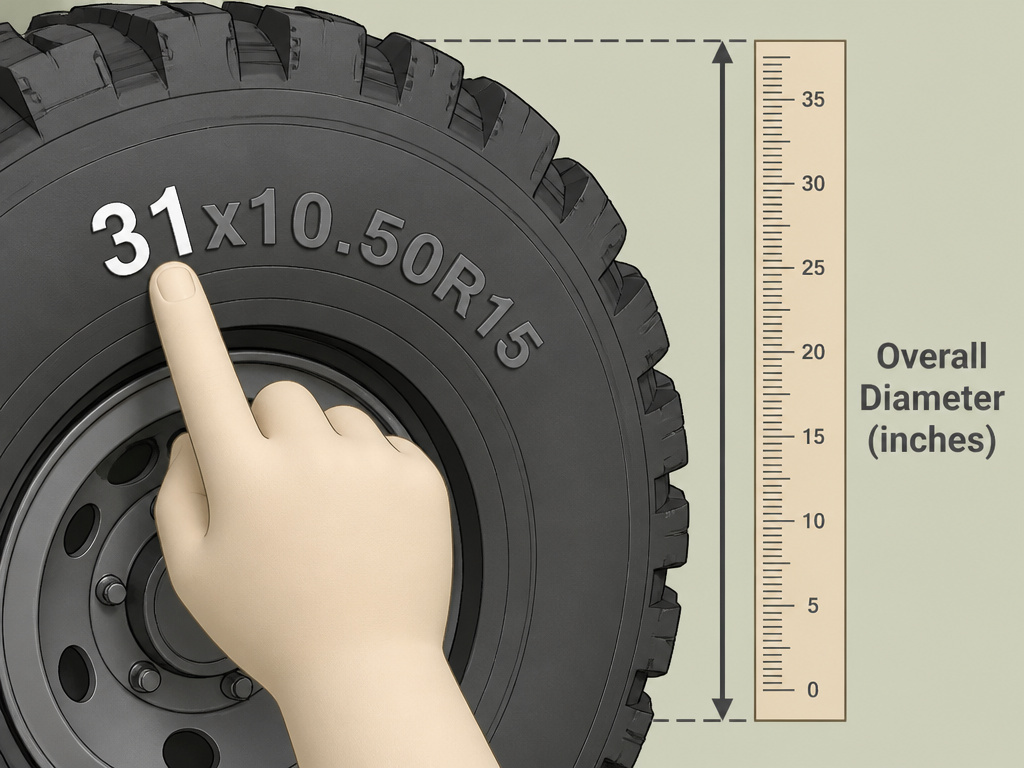
The P225/65R17 formula fails completely for tires like 31×10.50R15 or 33×12.50R20. These are “flotation” or “inch-metric” sizes, common on trucks and SUVs. The good news: the math is simpler.
The first number (31, 33) is the overall diameter in inches. The second number (10.50, 12.50) is the section width in inches. The “R15” or “R20” is the wheel diameter, just like before.
For a 31×10.50R15 tire, the diameter is right there: 31 inches. No calculation needed. The width is 10.5 inches. To understand how this compares to a metric size, you do some conversion. A 31-inch tire is roughly 787 mm tall. If it’s on a 15-inch wheel (381 mm), then the total sidewall height is (787 – 381) / 2 = 203 mm per sidewall.
You can work backwards to find a metric 33-inch tire equivalent, but it’s an approximation due to the tolerances we covered. This is why using a dedicated tire size calculator is so useful for cross-referencing these types.
The Impact of Diameter on Your Vehicle
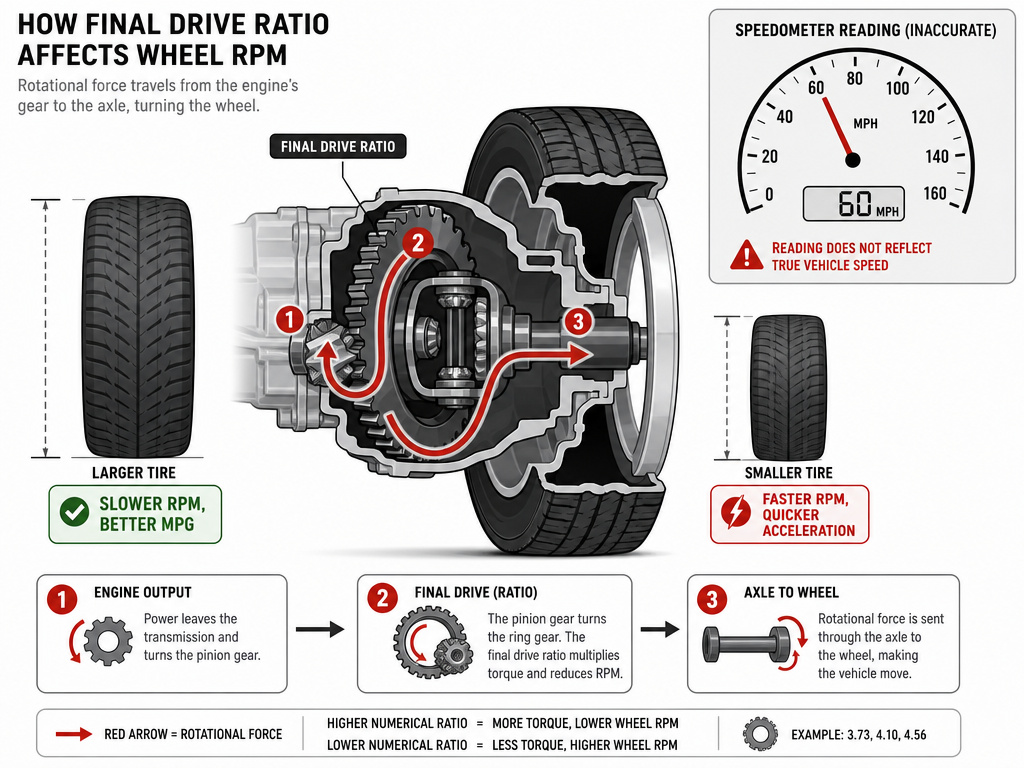
Changing tire diameter changes more than just looks. It alters the final drive ratio, which affects how the engine feels, fuel economy, and instrument readings.
A larger diameter tire is like putting a taller gear in the transmission. The engine turns slower for a given road speed. This can improve highway fuel economy slightly but may make the vehicle feel sluggish from a stop. A smaller diameter tire does the opposite, more engine RPMs, quicker acceleration feel, worse fuel economy, and higher engine noise.
Changing tire diameter affects the number of wheel revolutions per mile, which can impact the accuracy of speedometer and odometer readings calibrated for the original tire size.
If your new tire’s diameter differs significantly from the original, you may want to look into speedometer recalibration.
The other critical check is physical clearance. A taller or wider tire can rub against the strut, fender liner, or frame at full lock or over bumps. This is where your actual measured diameter and width, plus a test fit, are essential. The math gets you close, but the tape measure and a wrench decide it.
Difference between tire types (P-metric, LT, etc.)
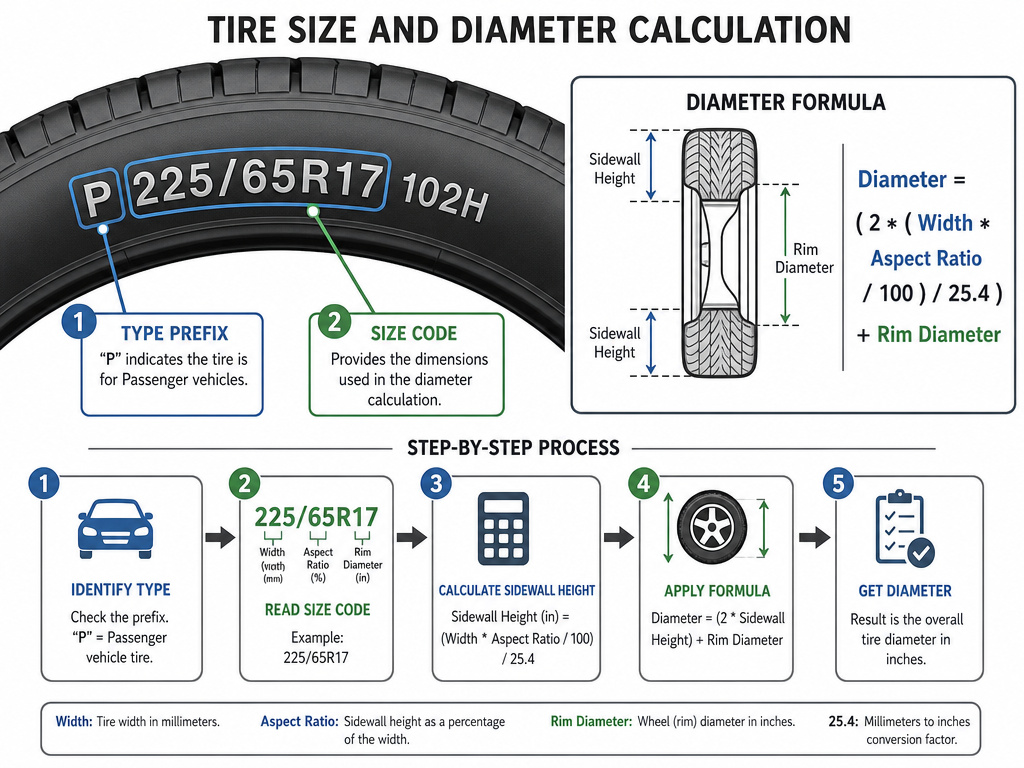
The prefix on a tire’s size indicates its intended service type. Tires marked with a “P” are for passenger vehicles. Other common designations exist for light trucks or different vehicle classes. These type prefixes are part of the standardized size marking needed for selecting replacements. While the core formula for calculating a theoretical diameter from the numeric size is consistent, different tire types can be subject to specific dimensional rules and tolerances. For instance, international standards define separate maximum diameter coefficients for radial versus diagonal industrial tires. Always check the sidewall marking to know your tire’s type.
Frequently Asked Questions
How do I calculate the diameter of a tire?
Take the wheel diameter in inches, convert it to millimeters (multiply by 25.4). Calculate the sidewall height by multiplying the tire’s section width (in mm) by its aspect ratio (as a decimal). Add the wheel diameter to twice the sidewall height. That’s the design diameter in mm; divide by 25.4 to get inches.
What size is a 31-inch tire in metric?
31-inch tire” refers to its approximate overall diameter. Common metric equivalents for a 31-inch tire include sizes like 265/70R17, 275/70R16, or 255/75R17. The exact metric match depends on the wheel diameter and available equivalent tire sizes.
Does R17 mean 17 inches?
Yes. The “R” stands for radial ply construction. The number following it is the nominal rim diameter code in inches. So “R17” means the tire is designed for a 17-inch diameter wheel.
Why do two same-size tires from different brands have different actual diameters?
Manufacturing tolerances. International standards allow a finished tire’s diameter to vary by ±3-4% from its theoretical design dimension. Different brands’ molding processes, rubber compounds, and tread designs can place them at different points within that allowed range.
The Bottom Line
The formula is simple arithmetic. In practice, there is a range. Your P225/65R17 is a 28.5-inch tire, give or take almost an inch. That tolerance isn’t a defect; it’s baked into the global manufacturing rules.
So use the calculation to compare sizes, to plan an upgrade, or to decode tire size markings. It’s the correct starting point. But when the fit is critical, when you’re safely upsizing tires for off-road use or squeezing a wider performance tire into a stock wheel well, put the calculator down. Pick up a tape measure, check the actual mounted dimensions, and test fit before you commit. The sidewall gives you the name of the game. Your tools tell you how it actually plays out.
