
Staggered Tire Setup Pros and Cons: The Real Trade-Offs
This post contains affiliate links. As an Amazon Associate, we earn from qualifying purchases.
A staggered tire setup uses wider tires on the rear axle than the front, a common factory specification for performance rear-wheel-drive cars. The pros are better rear traction and a sportier handling balance; the cons are higher long-term cost, the inability to rotate tires front-to-rear, and potential drivetrain strain on all-wheel-drive vehicles. Understanding the full list of staggered tire setup pros and cons is key for owners.
That last point about rotation isn’t just an inconvenience, it’s a financial line item. Manufacturers like Toyo Tires explicitly cut their treadwear warranty in half for the rear tires on a staggered car because they can’t be rotated to even out wear. The choice between staggered and square (identical tires all around) isn’t about looks. It’s a math problem when you compare a staggered tire setup pros and cons, with traction on one side and tire longevity on the other.
What follows breaks down each advantage and disadvantage, analyzing the staggered tire setup pros and cons with the numbers from tire company manuals and federal guidelines. This section explains why you might want a staggered setup, what it costs over the long term, and the one situation where it’s a genuinely bad idea.
Key Takeaways
- Staggered setups cannot be rotated front-to-rear, which leads to faster rear tire wear and voids half of Toyo’s treadwear warranty for the rear axle.
- The primary benefit is improved rear traction on RWD cars; the wider contact patch puts more power down before the tires spin.
- All-wheel-drive vehicles risk drivetrain damage with aftermarket stagger unless the front and rear tire rolling circumferences are precisely matched.
- You will replace rear tires more often than fronts, turning a standard four-tire purchase into a series of more expensive pair replacements, as reflected in Toyo Tires’ warranty which covers rear tires on staggered setups for only 50% of the warranted miles.
- According to the USTMA, citing federal regulations (49 CFR 570.62 and 49 CFR 393.75(b)), tires on the front axle of vehicles with a GVWR over 10,000 lbs must be removed at 4/32″ tread depth, a stricter rule than the common 2/32″ minimum for passenger cars.
The Traction and Handling Argument
A wider rear tire puts more rubber on the road where a rear-wheel-drive car needs it most: under acceleration. The physics are simple, a larger contact patch increases grip. You feel it as a more planted launch and better resistance to the rear end stepping out in a hard corner. Factory engineers use this to tune a car’s balance. A Porsche 911, with its engine hanging over the rear wheels, needs significantly more rear tire to manage its weight distribution and power.
The staggered layout lets each axle be optimized for its role. The rear gets width for traction and lateral grip, while the front stays narrower for quicker steering response and less rolling resistance.
That tuned balance is why retrofitting a staggered setup onto a car that came square from the factory is risky. The suspension geometry, spring rates, and anti-roll bars were calibrated for equal grip front and rear. Adding a wider rear can shift the balance toward understeer (a plowing feeling in corners) in a way that feels unnatural and requires alignment or suspension tweaks to correct. The factory got it right on cars like the BMW M3 or Chevrolet Corvette. Aftermarket choices need more homework.
The Tire Rotation Problem
This is the single biggest practical downside. Standard tire rotation moves tires between axles to promote even wear. With different size tires on the front and rear, that swap is physically impossible. The only option is a side-to-side swap on the same axle, which does nothing to relieve the accelerated wear on the driven rear tires.
The consequence is black and white in the fine print. Toyo Tires’ warranty states that for vehicles with staggered fitments, tires mounted on the rear axle are only covered for 50% of the warranted miles. Their reasoning is direct: without rotation, those rear tires will wear out twice as fast, so prorating a full warranty is unfair. It’s a rare admission from a manufacturer that quantifies the cost of the setup.
| Rotation Capability | Square Setup | Staggered Setup |
|---|---|---|
| Front-to-Rear | Yes, all standard patterns | No, sizes are different |
| Side-to-Side | Yes | Only if tires are non-directional |
| Impact on Wear | Even wear across all four tires | Rear tires wear significantly faster |
| Warranty Impact | Full treadwear warranty applies | Toyo warrants rear tires at 50% of miles |
If your staggered setup uses directional tires (marked with a rotation arrow on the sidewall), even the side-to-side swap is off the table without dismounting and remounting the tire. You’re left with no rotation options at all. This makes checking tread depth on the rears a mandatory every-other-month task.
Cost Considerations: The Long-Term Math
The purchase price for two different tire sizes is only the start. The long-term cost compounds because you replace tires in pairs, not in sets of four. On a powerful RWD car, you will get fewer miles from a set of rear tires than from the fronts. You then buy a new pair of rears, restarting the cycle. Over 60,000 miles, you could buy three pairs of rear tires and only one pair of fronts.
For example, a rear tire often costs more than a front tire.
- Square Setup (4 identical tires): Replace all four at the end of their service life.
- Staggered Setup: Replace rears more frequently than fronts, leading to a different replacement schedule and total cost.
Wait, the total is the same? Not quite. In the real world, you must buy the first pair of rears at mile 30, a $250 outlay years before the square driver spends a dime. You also lose the ability to shop sales for a full set of four, and you’re locked into two specific, often less common, tire sizes that may carry a price premium. The cash flow and convenience favor the square setup.
Where this goes sideways: Buying a staggered setup for the looks without budgeting for pair replacements. The second tire bill always arrives sooner than you expect, and the total cost over time is often higher than a square setup.
Drivetrain Compatibility: RWD, AWD, and FWD
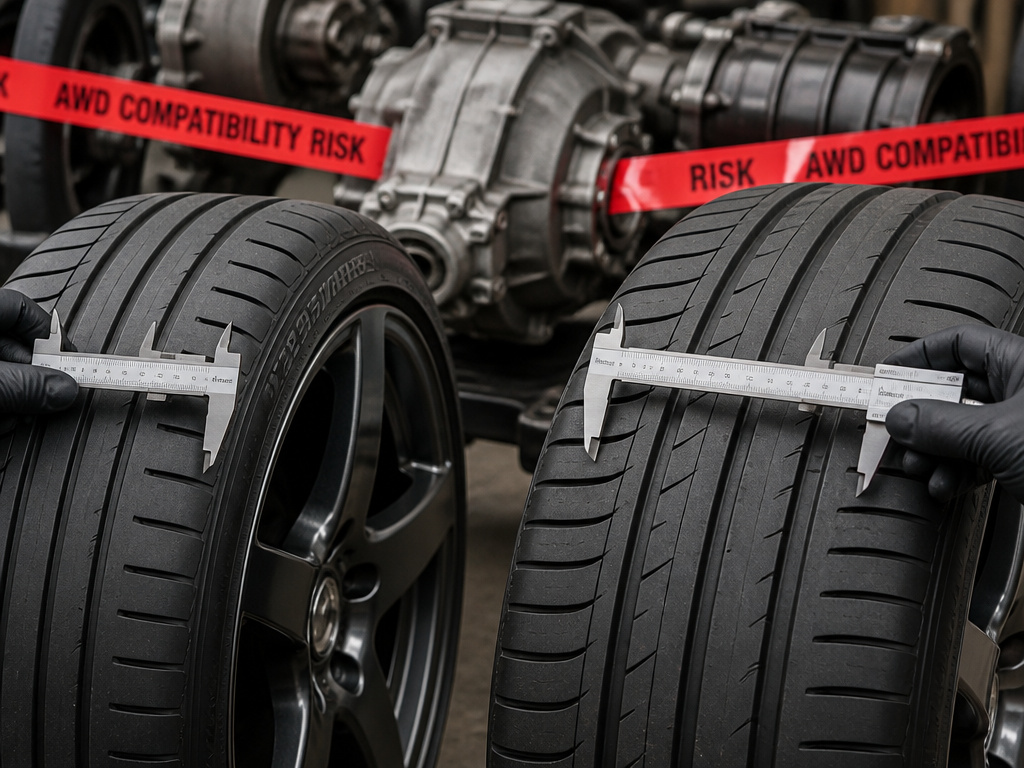
Staggered setups have a natural home on rear-wheel-drive platforms. The driven wheels get the extra grip, and the wear imbalance is a predictable trade-off. Front-wheel-drive cars gain almost nothing from a staggered setup, as the driven and steered wheels are at the front. A wider front tire would mostly add steering effort and cost.
All-wheel-drive is the critical case. The drivetrain is designed for all wheels to turn at nearly the same speed. A significant difference in rolling diameter between the front and rear axles, caused by different tire sizes or even uneven wear, forces the center differential to work constantly to compensate. This creates heat, wear, and a real risk of expensive damage.
Staggered setups are generally not recommended for AWD vehicles unless the rolling circumference is precisely matched. A square setup is the simplest and safest option.
Some AWD performance vehicles, like the Rivian R1S with its Super Sport package, come with a factory-staggered setup (275/50R22 front, 305/45R22 rear). In these cases, the engineers have precisely matched the overall diameters and calibrated the drivetrain software to accommodate the difference. Copying this with an aftermarket setup on a different AWD vehicle is asking for trouble without expert calculation and verification.
Wear, Warranty, and Safety Rules
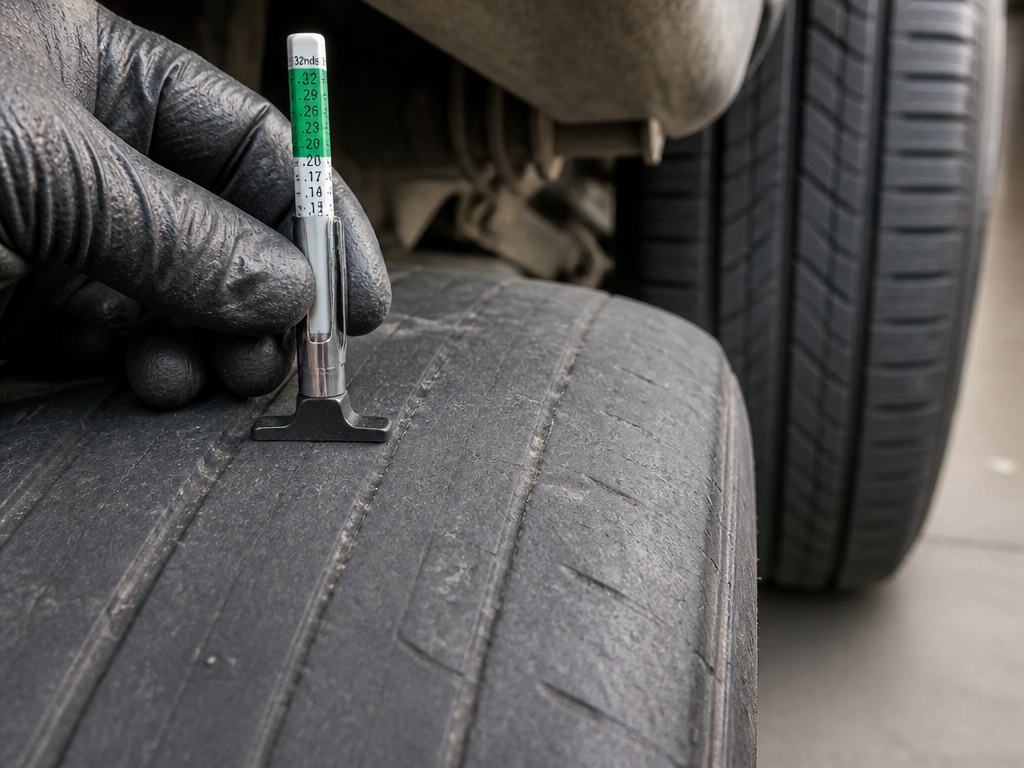
The accelerated rear wear on a staggered setup brings you to the minimum tread depth faster. The universal safe minimum is 2/32 of an inch. The NHTSA tire maintenance manual states that at this depth, wet-weather traction is severely compromised and the tire is dangerously worn. Most tires have built-in wear bars that become flush with the tread at this depth.
There’s an important exception in the USTMA tire care guide, which cites federal regulations (49 CFR 570.62 and 393.75(b)). For vehicles with a Gross Vehicle Weight Rating over 10,000 lbs, think heavy-duty pickups or large SUVs, tires on the front axle must be removed at 4/32 of an inch. This stricter rule highlights the greater safety risk of shallow tread on a heavy, hard-to-stop vehicle. If you’re running a staggered setup on a 3/4-ton truck, this rule applies to your front tires specifically.
Tire age is the other silent factor. Both the NHTSA and Bridgestone recommend replacing tires that are 10 years old from their manufacture date, regardless of tread depth. The rubber compounds degrade and lose elasticity over time. On a staggered car where the fronts may last a decade, checking the DOT date code on the sidewall becomes a safety imperative, not just a maintenance note.
Making the Decision: Square vs. Staggered
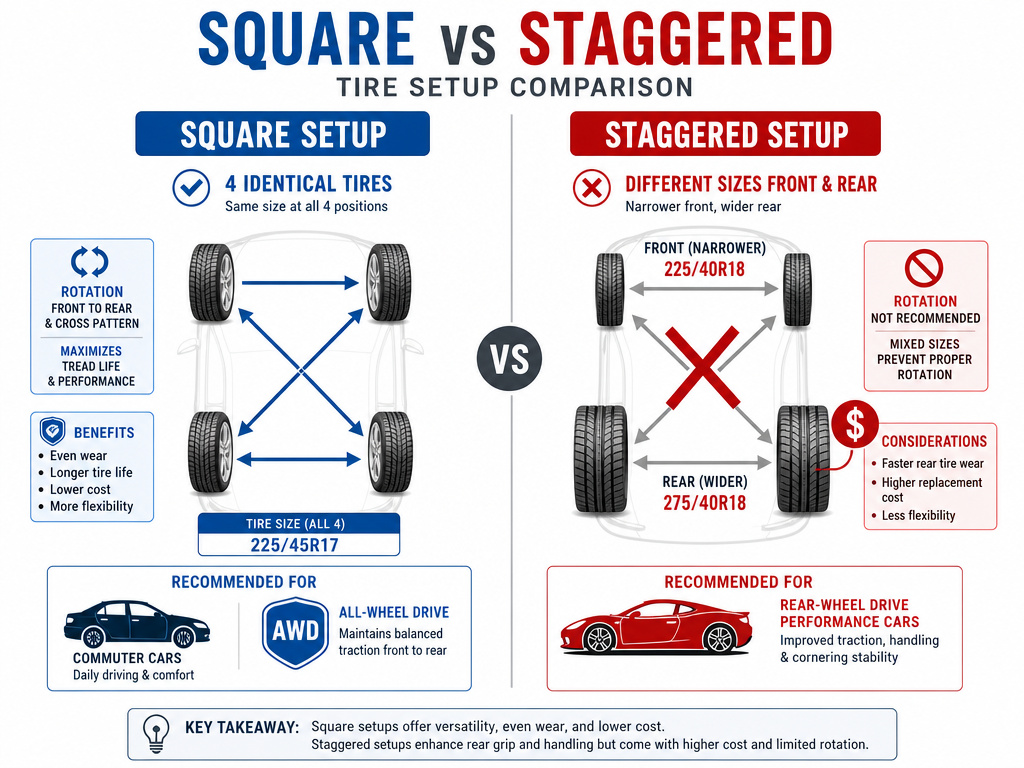
Your driving habits and wallet decide this. Start with your vehicle’s drivetrain.
- For RWD Performance Cars: If your car came staggered from the factory, stick with it. The handling balance was engineered around it. Just budget for rear tire replacements and check tread depth every 5,000 miles. If you have a square setup and want more rear grip for track days or spirited driving, moving to a mild stagger can be rewarding, but be prepared for the rotation and cost trade-offs.
- For AWD Vehicles: Stay square. The risk to the drivetrain and the complexity aren’t worth it. If you crave a more aggressive look, use wheel spacers (with proper research on load and fitment) to push the wheels out slightly, rather than changing tire sizes.
- For Daily Drivers & Commuters: Choose a square setup every time. The benefits of performance tires in a staggered configuration are lost in daily traffic, while the costs and hassles are very real. A high-quality set of identical all-season or touring tires will deliver better tread life, a quieter ride, and the ability to rotate tires in a full pattern, maximizing your investment.
The spec sheet for a Porsche 911 GT3 RS (265/35R20 front, 325/30R21 rear) is exciting. For the person who drives one, the associated costs are part of the experience. For the rest of us, matching the tire setup to our actual driving, not the brochure, is the smarter path.
Pros: Aggressive/sporty appearance
A staggered setup immediately signals a performance-oriented vehicle. The wider rear tires fill out the wheel wells, giving the car a planted, muscular stance that suggests power is sent to the back wheels. This look is common on high-performance sports cars and is even offered from the factory on some modern electric vehicles. The visual difference between the front and rear axles is a clear styling cue that separates a standard commuter car from one designed for more dynamic driving. It’s an aesthetic choice that communicates intent before the car even moves.
Cons: Reduced wet weather performance/hydroplaning risk
Wider tires, especially on the rear, can increase the risk of hydroplaning in wet conditions. This reduces grip when driving through standing water. Since tires must be replaced when the tread is worn to a dangerously low depth, maintaining sufficient tread is critical for safety in the rain. Staggered setups complicate this, as the rear tires often wear faster but cannot be rotated to the front to even out wear, potentially leaving you with less effective wet-weather tires on a critical axle sooner.
Winter driving practicality concerns
Staggered setups present significant challenges for winter driving. The primary issue is the inability to perform a standard tire rotation, which is a key part of tire maintenance. This means you cannot swap tires to promote even wear, which is especially problematic when using dedicated winter tires. For all-wheel-drive vehicles, a staggered setup is generally not recommended unless the rolling circumference is precisely matched between axles to avoid damaging the drivetrain. For winter conditions, where control and predictability are paramount, the simplest and safest option for an AWD vehicle is often a square setup with identical tires on all four corners.
Frequently Asked Questions
What are the downsides of staggered tires?
The main downsides are the inability to rotate tires front-to-rear (leading to much faster rear tire wear), higher long-term replacement costs, and potential compatibility issues with all-wheel-drive systems. Manufacturer treadwear warranties may also be reduced for the rear tires.
Is a staggered setup better for handling?
It can be, but only on rear-wheel-drive cars engineered for it. A staggered setup improves rear traction and can create a more neutral cornering balance. On a car designed for a square setup, adding stagger can unpredictably change the handling, often inducing more understeer.
What tires should I put on a staggered set?
Always match the exact size specifications for your vehicle’s front and rear axles as listed in the owner’s manual or on the driver’s side door jamb placard. The tires should also share similar performance characteristics (e.g., don’t mix a summer tire on the rear with an all-season on the front).
Can you rotate staggered tires?
You cannot perform a standard front-to-rear rotation. The only possible rotation is side-to-side on the same axle, and that is only allowed if the tires are non-directional. If they have a rotation arrow, even a side-to-side swap is prohibited without dismounting the tire from the wheel.
The Bottom Line
If your car was born staggered, keep it that way and just plan your budget around replacing the rears. The engineers chose it for a reason. If you’re choosing for yourself, the math is straightforward: choose a staggered setup only if you drive a RWD car hard enough to regularly use the extra rear grip, and you’re willing to pay for that privilege with more frequent tire purchases and the loss of rotation.
For everyone else, especially those with AWD or who prioritize tire longevity and predictable costs, a square setup is the objectively better choice. It offers more tire options, better value over time, and zero risk to your drivetrain. The right tire setup is the one that fits your driving, not the one that looks best in a parking lot photo.
