
Can You Rotate Staggered Tires? What the Manuals Say
This post contains affiliate links. As an Amazon Associate, we earn from qualifying purchases.
You can rotate staggered tires side to side only if they are non-directional and the same size on each axle. Tesla’s Model S Performance Plus manual says front and rear sizes differ, so front-to-rear rotation isn’t possible, and directional tires cannot be rotated.
That side-to-side limit comes from two physical constraints: the tire size on each axle and the direction the tread is meant to roll. Miss either one, and a rotation can turn a maintenance habit into a handling problem.
What follows covers the sidewall check, the rotation intervals from Tesla, Hyundai, Kia, Subaru, and General Motors, the tread-depth thresholds that disagree, and a safe side-to-side routine.
Key Takeaways
- Tesla recommends rotation every 6,250 miles, while Hyundai and GM point to 7,500 miles; Subaru recommends either 6,000 or 7,500 miles depending on the schedule.
- Directional tires cannot be rotated on a staggered setup.
- Kia’s AWD bulletin sets a 10mm circumference limit.
- Tesla recommends replacement if tread depth is 4/32 inch or less, while Hyundai says tires should be replaced before the tread is worn down to the wear indicator at 2/32 inch.
- Check the door jamb placard before assuming front and rear sizes.
Different Sizes Block the Front-to-Rear Move
A staggered setup means the front and rear tires have different sizes. That blocks the usual front-to-rear rotation pattern.
Staggered tires have different front and rear sizes. Rotation is limited to side-to-side moves on the same axle when tires are non-directional. Directional tires cannot be rotated. Vehicle manuals and service bulletins set the pattern, interval, and tread-depth limits for each setup. Tread depth, circumference, and tire type decide whether a rotation helps or harms handling.
| Rotation Move | Allowed When | Not Allowed When |
|---|---|---|
| Front-to-rear | four matching non-directional tires | staggered sizes differ |
| Side-to-side | same-axle tires match and are non-directional | tires are directional |
| No rotation | setup fails size or direction rules | owner assumes all rotations are safe |
The basic pattern for rotating tires assumes four matching tires. A staggered setup breaks that assumption. If your truck has dually tires, the rotation question changes again.
Because front and rear sizes differ, replacement often means matched pairs instead of one tire. Hyundai’s bulletin says not to replace just one tire. For staggered setups, placing new tires only on the rear may not be possible.
The most common email I get starts with a staggered setup. The writer wants to move the fronts to the rears because they have done it for years. That plan fails when the sizes differ.
I treat rotation patterns as a safety check first. If the manual says side-to-side only, that’s the rule.
Run a hand over the tread. A rough shoulder feels different from smooth center wear. That check matters more on staggered setups because the tires do not share work front to rear.
Can You Rotate Staggered Tires If They Are Directional?
No, if the sidewall has an arrow. Tesla’s Model S manual says directional tires cannot be rotated. If you need to consider rotating directional tires, stop first; staggered and directional together means no rotation.
Reading the sidewall arrow
The arrow points the intended roll direction. It is a visible marking on the sidewall, not a marketing symbol.
- Arrow present: the tire is directional. Do not move it left to right.
- No arrow: the tire may be non-directional, but the manual still decides.
- Different front and rear sizes: side-to-side only, if non-directional.
Tesla also says many Model S tires are same size and non-directional, so the rule depends on your setup. That is why the manual and placard matter more than a generic chart from a shop wall.
Here is the catch. A directional tire can look matched on the car. The arrow still controls the move.
How Often Should You Rotate a Staggered Setup?
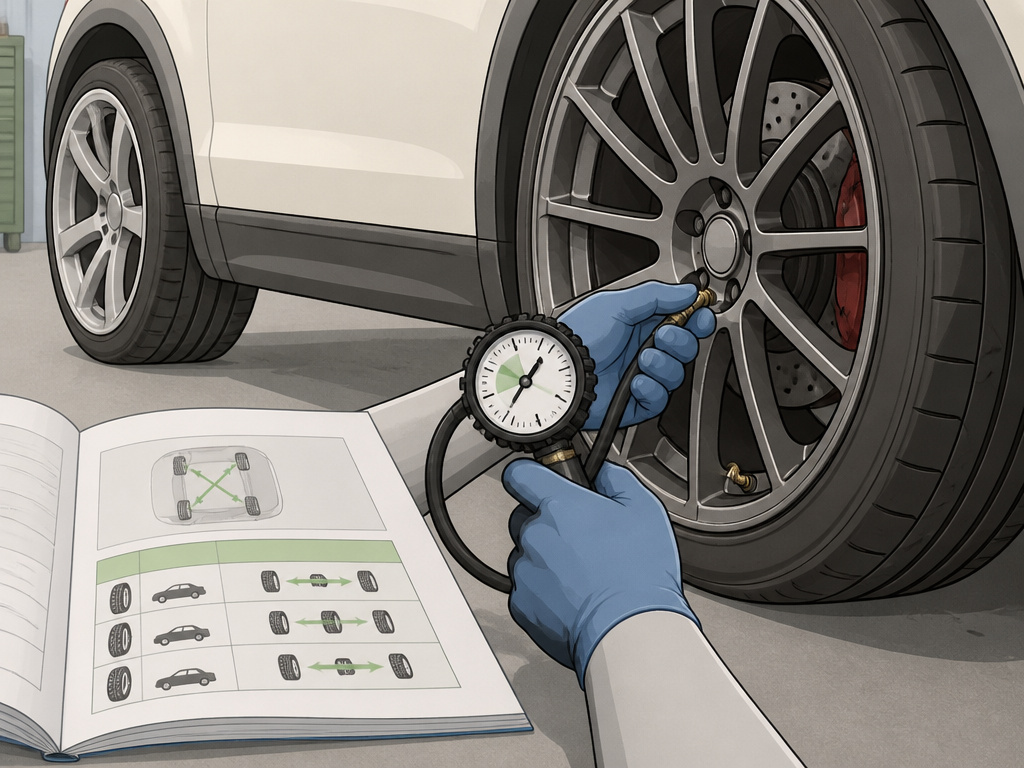
7,500 miles is a common interval, but it isn’t universal. The interval changes by brand and setup.
| Source | Rotation Interval | Note |
|---|---|---|
| Tesla | 6,250 mi (10,000 km) | Model S manual |
| Hyundai | 7,500 miles | most models, or sooner if irregular wear develops |
| GM | 7,500 mi (12,000 km) | when rotation is possible or recommended |
| Subaru | 6,000 or 7,500 miles | depends on the maintenance schedule |
Hyundai’s official tire maintenance bulletin says most models have a 7,500-mile interval, or sooner if irregular wear develops. A NHTSA service bulletin SB-10089222 says tires should be rotated every 7,500 miles, or 12,000 km, when rotation is possible.
Subaru’s bulletin says 6,000 miles, or 9,600 km, or 7,500 miles, or 12,000 km, as the maintenance schedule recommends. Tesla recommends 6,250 miles, or 10,000 km. A Tesla Model S is an electric car whose manual sets that interval.
If you rotate tires often, you’ll see the interval matters more than the pattern. A skipped interval costs more than a slightly wrong pattern.
Pressure checks belong on the same schedule. Hyundai says check cold tire pressure at least once a month. A cold tire has not been driven for at least 3 hours, or has been driven for less than 1 mile in that time. Driving can raise pressure by 4-6 psi. Hyundai says do not adjust warm tires to the placard.
The 10mm Rule and Two Tread Thresholds
Tesla and Hyundai use different replacement thresholds. The sources disagree, so the article should show both.
Tesla recommends replacement if tread depth is 4/32 inch, or 3 mm, or less. Hyundai says the wear indicator appears at 2/32 inch, or 1.6 mm, and tires should be replaced before reaching it.
The 10mm circumference rule
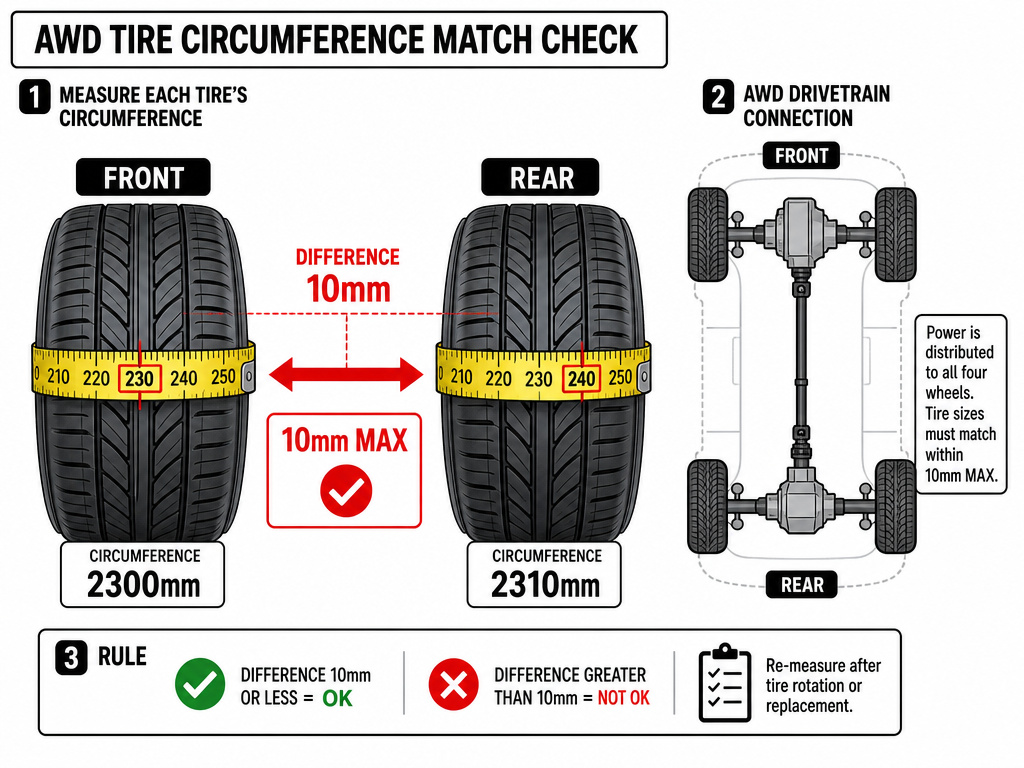
The Kia tire rotation bulletin sets a 10mm circumference limit for all-wheel-drive (AWD) vehicles. Circumference is the distance around a tire. If a variance over 10mm is found, all four tires need replacement.
The bulletin also warns that some AWD vehicles have staggered sizes, so check the door jamb placard. On those setups, front-to-rear rotation may not be possible, but the tread matching concern still matters.
Inner or outer shoulder wear points to a toe or camber alignment angle out of spec. A shop with a professional alignment machine can measure it. If the alignment is out, a rotation may spread the wear to another axle without fixing the cause.
Run your hand over the tread in one direction, then the other. Hyundai describes heel-toe wear this way. It feels bumpy one way and smoother the other. I record outer, center, and inner depths because one number misses shoulder wear.
Easy to miss: A staggered AWD vehicle can feel normal until a circumference gap over 10mm causes drivetrain chatter or component failure.
How Do You Rotate a Staggered Setup Safely?
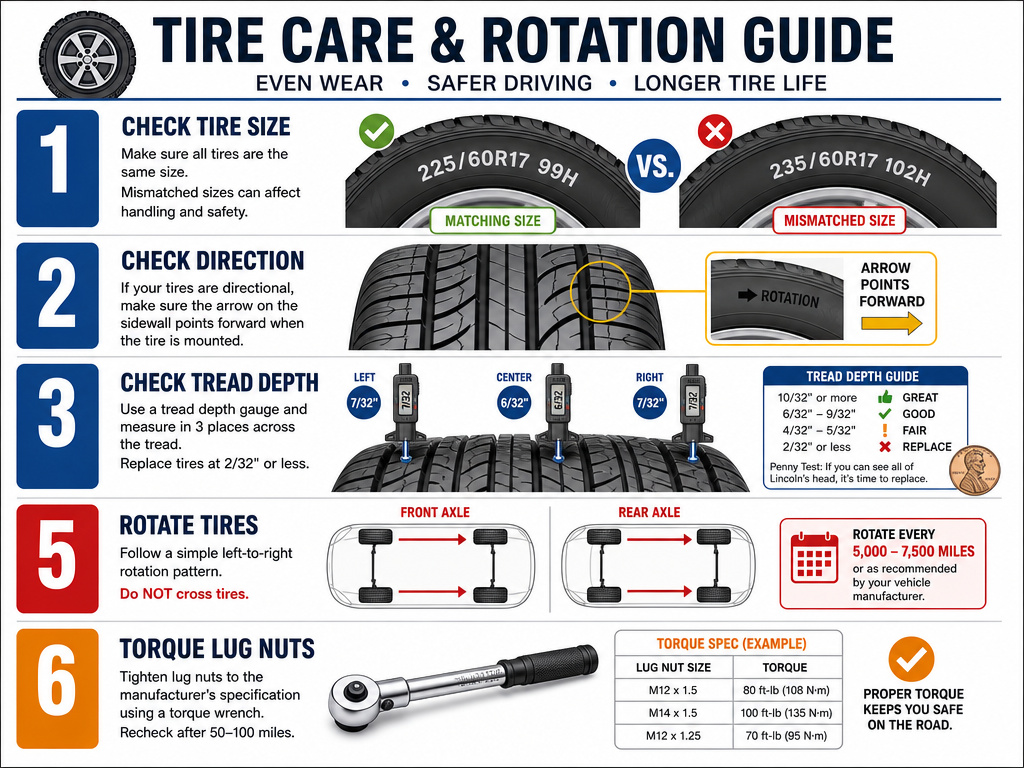
Three checks decide the move: size, direction, and torque.
Before you start: A raised vehicle can fall within seconds if the jack slips, so use jack stands before removing wheels. A loose wheel can roll away, so chock the opposite side. Overtightened lug nuts can damage the hub or stud, so use the vehicle’s specified torque value with a calibrated wrench.
If you do it yourself, a floor jack and jack stands are the baseline. Use a calibrated torque wrench for the lug nuts.
Step-by-step routine
- Read the placard and sidewall sizes. If front and rear sizes differ, stop before a front-to-rear move. The tires won’t fit the other axle.
- Check the sidewall arrow. If an arrow is present, the tire is directional. Side-to-side movement reverses its roll direction.
- Measure outer, center, and inner tread. If one zone is at the manual’s replacement threshold, rotate that tire. A single tread number can miss shoulder wear.
- Chock the wheels and support the vehicle. If the jack slips, the car falls within seconds. Use jack stands before removing wheels.
- Move only left to side on the same axle. If the tires are non-directional, this keeps each tire on its correct size and roll direction.
- Torque the lug nuts to the vehicle spec. Use a calibrated torque wrench. If you guess, you can damage studs and hubs.
- Reset the service record. Tesla says to reset learned tire estimates and mileage since the last service. Subaru says to re-register tires for the tire pressure monitoring system (TPMS) on models that require it. If you skip this, the pressure warning may point to the wrong wheel.
Tesla’s mobile service rule is strict: only same-side or same-axle rotations are permitted. That is the default for any staggered setup.
The side-to-side routine is simple, but the sidewall check can take longer than the wrench work.
Can you remount directional tires to rotate them?
Directional tires are designed to roll in one specific direction. According to vehicle service manuals, directional tires cannot be rotated in the traditional sense. The rotation pattern for directional tires does not change. For a vehicle with staggered tires that are also directional, this restriction eliminates any front-to-rear or side-to-side rotation. The only potential method would involve dismounting the tire from the wheel, flipping it, and remounting it to change its direction, but this is not a standard or recommended practice for rotation and is not addressed in the manufacturer guidance provided. With staggered directional tires, you typically cannot rotate them at all.
How does AWD vs RWD affect staggered tire rotation?
The primary concern for all-wheel-drive vehicles with staggered tires is maintaining a very close match in tire circumference. Manufacturer bulletins state the circumference between all four tires should be within a specific, small tolerance. A variance beyond this limit can cause damage to the drivetrain. For staggered setups, where front and rear sizes are different, this means you cannot rotate tires front-to-rear. Some AWD vehicles may be equipped with these staggered sizes. For rear-wheel-drive vehicles with staggered tires, the same front-to-rear rotation restriction applies, but the tolerance for circumference mismatch may be less critical than for AWD systems, though it still affects handling and wear.
Frequently Asked Questions
Is it worth rotating staggered tires?
Yes, if the tires are non-directional and the same size on each axle. Tesla says periodic rotation increases tire service life. Hyundai says rotation helps maximize tread life and uniform wear.
Can I rotate my tires if they are staggered?
You can rotate them side to side only if the tires are non-directional. If front and rear sizes differ, front-to-rear rotation is blocked. Check the placard and the manual before moving any wheel.
What are the downsides of staggered tires?
The main downside is rotation limits. Front and rear sizes differ, so the usual cross pattern does not apply. Replacement also becomes less flexible because you cannot always put two new tires on the rear.
Do rotating tires ruin alignment?
Rotation does not set alignment. But inner or outer wear can point to a toe or camber angle out of spec. If the wear is one-sided, check alignment before blaming the rotation pattern.
How do I know if my tires are directional?
Look for an arrow on the sidewall. Tesla says directional tires are identified with an arrow showing the rotation direction. If the arrow is present, the tire cannot be rotated side to side.
Before You Go
The first step is to read the sidewall size and arrow before touching a wrench. If the arrow is present, stop. If the sizes differ, plan on side-to-side only. If your all-wheel-drive vehicle has a 10mm circumference limit, treat tread matching as a system check, not a cosmetic one.
Before you search can you rotate staggered tires again, write down four numbers: front size, rear size, tread depth, and the manual’s interval. That record makes the next decision easy. If the arrow is there, the rotation is over before it starts.
