
How to Check Tire Manufacture Date: Step-by-Step
This post contains affiliate links. As an Amazon Associate, we earn from qualifying purchases.
To check a tire’s manufacture date, locate the DOT (Department of Transportation) code on the sidewall. The final four digits are the date code: the first two numbers are the week of the year (using ’01’ for the first full calendar week), and the last two are the year. For example, ‘0109’ means the tire was manufactured in the first full calendar week of 2009 (week beginning Sunday, January 4, 2009). The full DOT code, including this date, is only required on one sidewall, so you may need to check the inner-facing side.
That week-and-year format is a federal mandate, not a manufacturer suggestion. The 49 CFR § 574.5 regulation defines it down to the calendar week running Sunday through Saturday. The law exists so you can verify the tire’s age against conflicting safety recommendations from carmakers and tire makers. Knowing how to check tire manufacture date is therefore essential.
What follows is how to find the code when it’s hidden, how to decode pre-2000 three-digit formats, and the real-world disagreement on when that date means you should replace the tire, which starts with knowing how to check tire manufacture date. You’ll also see the upcoming change that pushes all DOT codes to 13 characters.
Key Takeaways
- Look for the four-digit date code at the end of the DOT serial number on the tire’s sidewall.
- The full DOT code is only on one sidewall; check the inner side if the date isn’t visible.
- For tires made before 2000, the date code is three digits, creating decade ambiguity, a triangle symbol may indicate the 1990s.
- Replacement age guidelines conflict: Kia says over 6 years, while NHTSA and Nitto Tire recommend after 10 years; Nitto adds that you should follow your vehicle manufacturer’s advice if it differs.
- All tires made after April 13, 2025 must have a 13-character DOT TIN.
How to Find the DOT Code on Your Tire
You need to see the sidewall. Park on level ground, set the parking brake, and get a flashlight.
Start with the outer sidewall, the part facing away from the vehicle. Look for the letters “DOT” followed by a series of up to 13 letters and numbers. Run your fingers over the rubber; the code is molded in, not printed on. It’s often tucked near the wheel rim, not out in the middle of the sidewall. Clean off any built-up brake dust or road grime with a damp cloth.
Where this goes sideways: Assuming the date code is on the outside. The NHTSA manual states the full TIN is required on only one sidewall. If you don’t see a four-digit number after “DOT,” the date code is on the inward-facing side.
If the date code isn’t on the outside, you’ll have to look at the inner sidewall. For the front tires, turn the steering wheel all the way to one side to create a gap. For the rear tires, you may need to safely lift the vehicle and support it on a jack stand to get a clear view and a proper angle for a tire inspection. This is the most common physical hurdle, and it’s why many people miss the true age of their tires.
Decoding the 4-Digit Date Code (2000-Present)
Find the last four digits of the DOT serial number. That’s your date code.
The federal rule defines the first full calendar week of the year as “01,” and a week runs from Sunday through Saturday. The last two digits are the year. A code of 1626 breaks down as the 16th week of 2026.
The date code, consisting of four numerical symbols, is the final group. The first and second symbols identify the week of the year using “01” for the first full calendar week. The third and fourth symbols identify the last two digits of the year of manufacture. – 49 CFR § 574.5
Don’t overthink the week. If you see “01,” it means the first full week of the year, which could start in early January. This precise dating matters for registering your tires and is critical during an investigation of a tire recall.
Handling Pre-2000 Tires and 3-Digit Codes
Tires made before the year 2000 use a three-digit date code. The first two digits are still the week, but the last single digit is the year of the decade. This creates a problem.
A code like 529 means the 52nd week of a year ending in ‘9’. Was that 1989 or 1999? Without more information, you can’t tell from the code alone. This is a critical gap most guides gloss over.
Some tires from the 1990s have a clue. Manufacturers like Nitto used a triangle symbol (◄) molded next to the DOT number, pointing to the last digit. That triangle specifically indicates the 1990s decade. If you see “529◄”, the tire is from the 52nd week of 1999. No triangle means it’s likely from 1989, but it’s not a guarantee, it could be older. When in doubt with a three-digit code, the safest move is to assume the tire is past its service life and replace it. This ambiguity is a strong reason for the federal shift to the four-digit system, detailed in 49 CFR § 574.5.
Why the Tire Date Code Matters More Than You Think
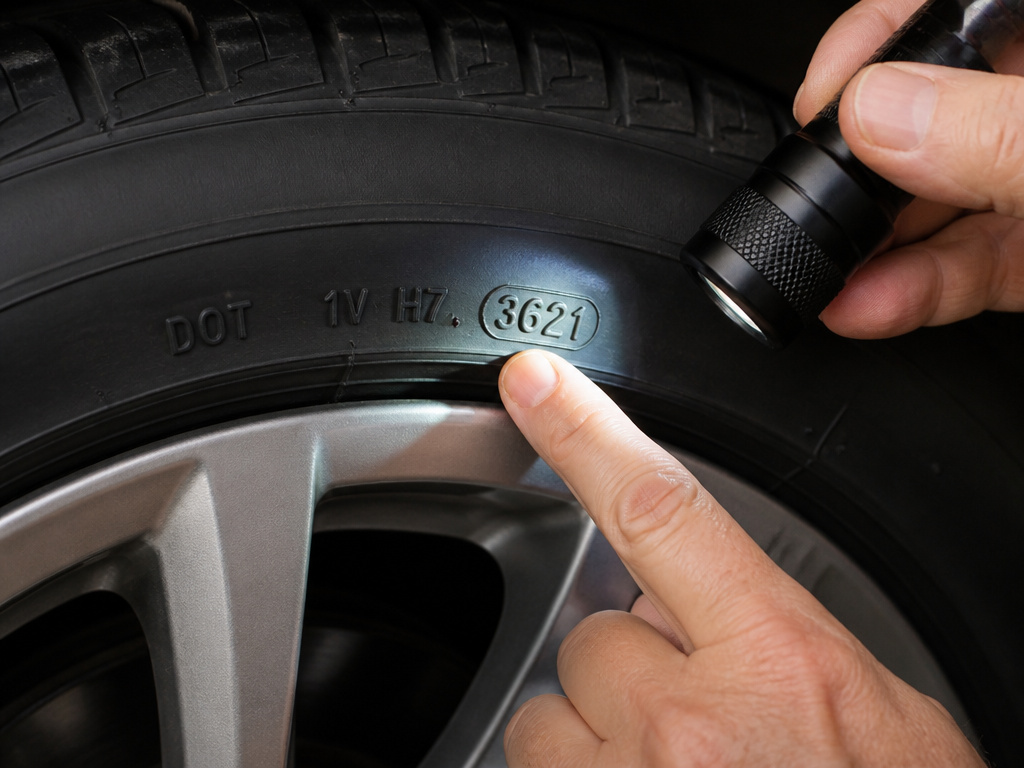
The date code is the tire’s birth certificate, which you find by learning how to check tire manufacture date. It’s the only way to know its true age, which is separate from tread depth or visible condition.
Rubber compounds degrade over time through a process called oxidation, even on a tire that’s never been used. The oils and antioxidants that keep the rubber flexible slowly evaporate or break down. The tire gets hard and brittle. You can’t always see this happening, but it drastically reduces grip and increases the risk of a sudden failure. This is why checking the date is a core part of any routine for monthly tire safety.
The code is also your key for registrations and recalls. When you buy new tires, the shop uses the full DOT number to register them with the manufacturer. If a defect is found later, that registration is how the company contacts you. If you buy used tires or a used car, checking the date code immediately tells you if you’re inheriting an aging problem.
The 6-Year vs. 10-Year Replacement Rule (And Who to Believe)
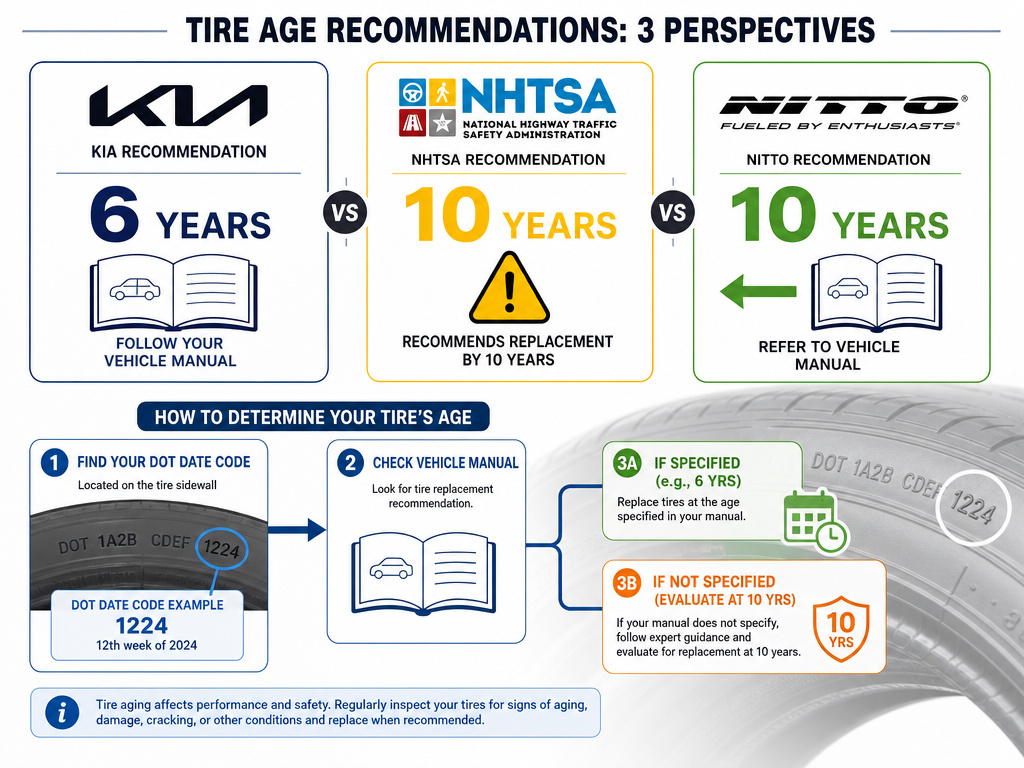
Here’s where sources directly disagree. There is no single federal law mandating tire replacement at a specific age. Instead, you have competing recommendations from vehicle manufacturers and tire manufacturers.
Kia’s official position is clear. Their owner’s manual states: “Any tires that are over 6 years old, based on the manufacturing date, should be replaced with new ones.” They cite heat and high loading as factors that accelerate aging.
In contrast, tire maker Nitto recommends “any tires in service 10 years or more from the date of manufacture” be replaced. The NHTSA’s tire safety and warranty guide also recommends tires more than 10 years old be taken out of service.
So who wins? Nitto adds a crucial clause: if the vehicle manufacturer’s recommendation differs, the owner should follow the vehicle maker’s advice. Your car’s manual overrules the generic tire guideline.
| Source | Recommended Max Age | Key Note |
|---|---|---|
| Kia (Vehicle Manufacturer) | Over 6 years | Based on manufacturing date; found in the owner’s manual. |
| NHTSA (Safety Agency) | More than 10 years | A recommendation, noting 10 years is not a guarantee of service life. |
| Nitto Tire (Tire Manufacturer) | 10 years or more | States to follow the vehicle manufacturer’s advice if it differs. |
This conflict means you must check your own vehicle’s manual. A six-year-old tire on a Kia is due for replacement. That same tire on a vehicle with no specified interval should be evaluated based on its condition and the NHTSA recommendation for tires more than 10 years old, provided it passes a thorough tire damage inspection. The lack of a universal rule is frustrating, but it makes checking the date code yourself essential.
The New 13-Character DOT TIN (What Changes in 2025)
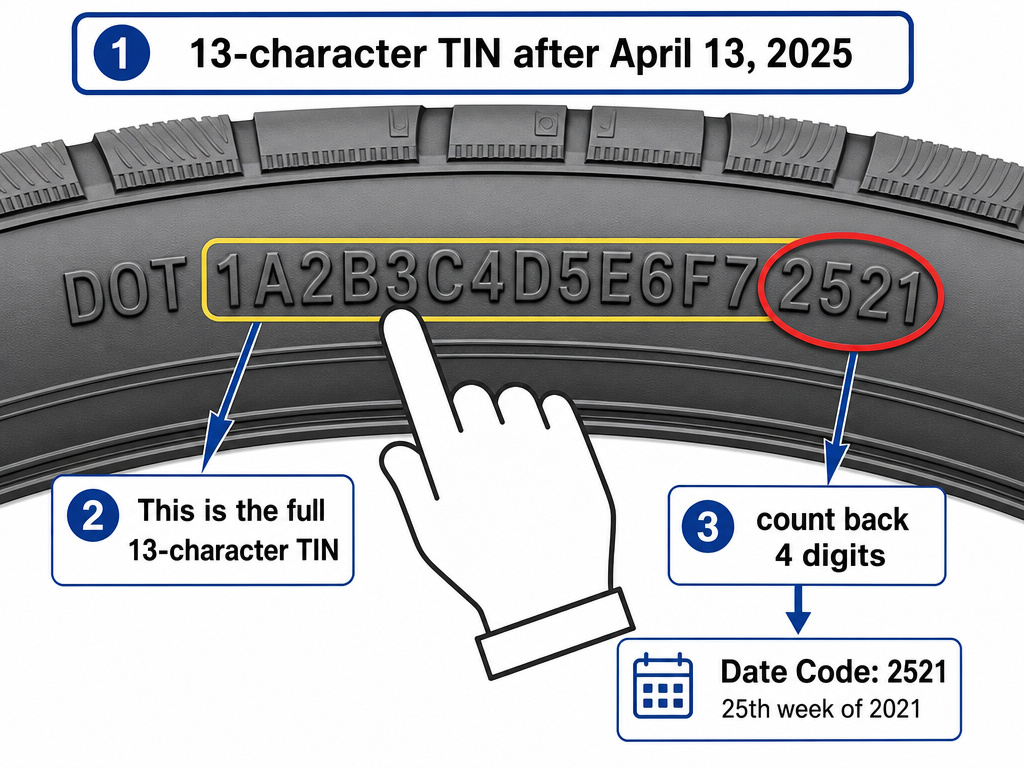
The DOT code is getting longer. A recent update to the federal tire recordkeeping rules phases out two-symbol plant codes.
A recent update to federal tire recordkeeping rules requires a longer TIN for tires made after April 13, 2025. All tires manufactured after April 13, 2025, must comply with the thirteen-character TIN requirement. All tires manufactured after that date must have a 13-character TIN.
What does this mean for you? The date code is still the last four digits. The only difference is that the code string before it will be one character longer. When you’re looking at a tire made after April 13, 2025, don’t be surprised to see a longer sequence. The method for finding the date remains the same: find “DOT” and count back four digits. This update is part of the broader NHTSA tire identification requirements designed to improve tracking.
What to Do After You Find the Date
Knowing the date is step one. Now you need context.
First, compare the date to your vehicle manufacturer’s recommendation in the owner’s manual. That’s your primary guide. Second, perform a physical inspection regardless of age. The NHTSA advises having tires evaluated by a professional after five years of service to see if they can continue.
Look for these signs of aging that trump any date:
- Tread Depth: Use a gauge or the penny test. The tire is dangerously worn and must be replaced immediately when worn to the built-in indicators at 2/32 inch (1.6 mm) or less tread depth.
- Dry Rot & Cracking: Inspect the sidewalls and tread grooves for a network of fine cracks. This is weather checking or dry rot, a sign the rubber is breaking down.
- Bulges or Deformities: A bulge in the sidewall indicates internal damage from an impact. Replace the tire immediately.
- Pressure Loss: Tires that consistently lose pressure may have a slow leak or damage and should be checked.
A tire can fail from damage long before it reaches an age limit. The date code tells you the starting point; your eyes and a pressure gauge tell you the current condition. Combine both for a complete tire safety check.
What other information is in the DOT TIN?
The full Tire Identification Number (TIN) after the ‘DOT’ letters gives more than just the manufacture date. The first few symbols identify the factory where the tire was made, known as the plant code. Following that, codes can specify the tire size and other characteristics chosen by the manufacturer. The four-digit date code is only the final group of this sequence. Remember, the full TIN is required on only one sidewall, so you may need to check the inward-facing side to see the entire number, including the date.
How does storage affect a tire’s life?
How you store tires directly impacts how long they last before aging out. Environmental factors are critical. Tires should be kept in a cool, dry, and dark place away from sources of ozone, like electric motors. Sunlight and heat can accelerate the aging process of the rubber compounds. Avoid storing tires near fuels, oils, or solvents. Proper storage helps preserve a tire’s structural integrity, allowing it to reach its intended service life before the date code suggests replacement is necessary.
Frequently Asked Questions
How do you tell the manufacture date on a tire?
Look for the letters “DOT” on the tire’s sidewall. The last four digits of that code are the date. The first two numbers are the week of the year (01-52), and the last two are the year. If you only see a three-digit number at the end, the tire was made before 2000.
Are 10 year old tires still ok?
According to the NHTSA and several tire manufacturers, tires more than 10 years old should be taken out of service and replaced, even if they look fine. However, some vehicle manufacturers, like Kia, recommend replacement at 6 years. Always check your vehicle’s owner’s manual first.
How long are tires good after the manufacturing date?
There’s no universal expiration date. Service life depends on storage conditions, climate, use, and maintenance. Rubber degrades over time due to oxidation. Most industry and safety recommendations suggest a maximum service life between 6 and 10 years from the date of manufacture, with the NHTSA recommending inspection after 5 years of service.
Is it okay to use 7 year old tires?
It depends on the tire’s condition and your vehicle manufacturer’s rule. For a Kia, a 7-year-old tire is past its recommended service life. For a vehicle with no specified interval, the tire might be okay if it has ample tread, no cracking (also called weather checking), and hasn’t been damaged. A professional inspection is advised.
What if the date code is worn off or illegible?
If the date code is completely worn away, the tire has seen significant wear or weathering. You cannot verify its age. The safest course of action is to replace it. A missing date code also means the tire cannot be identified in a recall.
Before You Go
The rule is simple: find the DOT code and read the last four numbers. That date is your baseline for every other decision about the tire’s safety and service life.
If your vehicle’s manual specifies a replacement age, like six years, honor that date first. If it doesn’t, use the ten-year guideline from the NHTSA as your outer limit, with a hard stop for any signs of cracking or damage. And remember, a tire’s age has nothing to do with its tread depth; you need to check both.
One last thing. That confusion between the 6-year and 10-year advice? It means you can’t outsource this. You have to look at the sidewall yourself, decode the number, and then open your glovebox to check what your car’s maker says. The difference is four years of aging rubber. The date code gives you the facts; the manual tells you what to do with them.
