
Dangers of Driving on Bald Tires
This post contains affiliate links. As an Amazon Associate, we earn from qualifying purchases.
Driving on bald tires is dangerous because the tread, which provides grip and channels water, is worn down to or below the legal minimum of 2/32 of an inch. At this point, federal data shows the risk of a tire disablement is about 10 times that of a new tire, wet-weather traction collapses, and the chance of a blowout or loss of control increases sharply. The danger is physical, not theoretical, and it’s measured in inches.
That 2/32″ number marks the point where the safety features engineered into the tire, the grooves, the sipes, the tread compound’s ability to flex, stop working as designed. A tire at 2/32″ has lost its margin for error. A puddle becomes a skating rink. A piece of road debris becomes a potential puncture. The vehicle’s ability to stop and steer predictably, which you rely on every second you’re moving, is compromised. This illustrates the clear dangers of driving on bald tires.
What follows is a breakdown of the mechanics behind those failures, the federal studies that quantified the risk, and the specific signs that your tires have crossed the line from worn to dangerous. By the end, you’ll know exactly what to look for and why waiting for a “feel” or a vibration is waiting too long.
Key Takeaways
- A tire is legally “bald” and must be replaced at 2/32 of an inch of tread depth, the point where the rubber wear bars become flush with the tread.
- Government research calculates the risk of a tire disablement at 2/32″ is about 10 times higher than for a new tire.
- Bald tires cannot evacuate water, leading to hydroplaning where the tire rides on a film of water and steering input does nothing.
- If you find one bald tire, check the others immediately; studies show 58% of cars with one bald tire have at least one more in the same condition.
- For vehicles over 10,000 lbs GVWR, federal regulations cited by USTMA require tires on the front axle to be removed at 4/32″. For passenger vehicles and light trucks, NHTSA and USTMA set the minimum at 2/32″.
What Does ‘Bald’ Actually Mean? The 2/32″ Threshold
Forget the shiny dome look. In tire safety, “bald” has a precise, measurable definition. It’s the point where the average tread depth across the tire’s main grooves reaches 2/32 of an inch (1.6 mm). That’s it. This is embedded in federal law, not merely an industry guideline or best practice.
The Federal Motor Vehicle Safety Standard (FMVSS) No. 139 requires that all passenger tires sold in the U.S. Have built-in treadwear indicators. These are small bars of rubber molded at the base of the tread grooves. When the tread wears down to 2/32″, these bars become flush with the surrounding tread ribs. They’re a visual and tactile fail-safe: if you see a continuous band of rubber across your tread, or feel no groove depth in multiple spots, the tire is legally worn out. The U.S. Tire Manufacturers Association (USTMA) states plainly: “Tires with a tread depth of 2/32” or less at any point on the tire are worn out.”
This 2/32″ minimum is the replacement threshold per NHTSA and USTMA. FMVSS No. 139 requires treadwear indicators (wear bars) to become flush at this depth.
The National Highway Traffic Safety Administration (NHTSA) records tread depth to the nearest 1/32″ in its crash data, using the shallowest groove measurement. That precision matters because tires wear unevenly. You must check multiple spots, especially the inner and outer shoulders, which often wear faster due to alignment or cornering forces. A single spot at 2/32″ means the whole tire is done.
The Heavy-Duty Exception: When 2/32″ Isn’t Enough
The 2/32″ rule applies to passenger vehicles and light trucks. The calculus changes for heavier rigs. For vehicles with a Gross Vehicle Weight Rating (GVWR) over 10,000 lbs (4,536 kg), federal regulations cited by the USTMA require tires on the front axle to be removed at 4/32″ (3.2 mm).
The front tires on a heavy pickup, van, or SUV in this class carry more load and are critical for steering. Letting them wear to the passenger-car minimum is illegal and unsafe. If your vehicle’s door jamb sticker shows a GVWR over 10,000 lbs, the front tires need replacing earlier.
| Vehicle Type | Legal Minimum Tread Depth | Governing Standard / Note |
|---|---|---|
| Passenger Cars & Light Trucks (GVWR ≤ 10,000 lbs) | 2/32″ (1.6 mm) | FMVSS No. 139; USTMA “worn out” definition |
| Vehicles > 10,000 lbs GVWR (Front Axle Tires) | 4/32″ (3.2 mm) | USTMA citing 49 CFR 570.62 & 393.75(b) |
The 10x Failure Risk: What the Data Says
The 2/32″ limit marks where the failure curve turns vertical. A 1970s-era National Institute of Standards and Technology (NIST) report cited a foundational study by Baker and Mcllraith, which analyzed tire disablements on the Illinois Tollway. Their conclusion was stark: “the risk of disablement for a tire having 2/32-inch of tread depth remaining is about 10 times that for a new tire.”
Think about that multiplier. A tire at the wear bars is an order of magnitude more likely to have a problem. The remaining rubber is so thin that it offers minimal protection against punctures, heat buildup, and internal damage from road impacts. This is the mathematical outcome of running a consumable safety component down to its absolute endpoint.
That same NIST report highlighted another critical pattern: bald tires rarely travel alone. Baker and Mcllraith found that “when the disabled tires were bald, 58 percent of the cars had one or more other tires in the same condition.” In an earlier survey, they noted approximately 2 out of 3 cars with one bad tire also had a second. Tires wear as a set. If you discover one is bald during a monthly tire check, you are almost certainly looking at a full replacement job.
Where this goes sideways: Assuming one new tire can pair with three old ones. The tread depth difference can upset vehicle stability and is a hallmark of deferred maintenance that likely means other tires are also near the limit.
How Bald Tires Compromise Safety, One System at a Time
A tire is your car’s only contact with the road. When the tread vanishes, every driving dynamic suffers. The risks aren’t equal, they compound on each other.
Hydroplaning: The Loss of All Control
This is the most dramatic failure mode. Tread grooves are water channels. At highway speed in rain, a tire must evacuate thousands of gallons of water per second to maintain contact with the pavement. A bald tire has no channels left. The water has nowhere to go, so the tire rides on top of a thin film. This is hydroplaning.
When it happens, steering input does nothing. The brakes do nothing. You are a passenger until the tire slows enough to cut through the water or you leave the wet patch. An NHTSA study on tire-related pre-crash factors confirms that vehicles are more likely to experience tire problems when running on “inadequate tread depth,” especially in adverse conditions.
Traction and Braking: Longer Stopping Distances
Dry traction suffers, too. The tread rubber is designed to flex and conform to road imperfections, creating grip. Worn rubber is harder and has less surface area in contact with the road. Your braking distance increases directly as a result. Bridgestone’s safety materials note that “bald tires compromise your brakes’ ability to stop by providing reduced traction.”
In an emergency stop, those extra feet can be the difference between a scare and a crash. This effect is magnified in cold weather, where the hardened, worn compound provides even less grip.
Punctures and Blowouts: The Sudden Catastrophe
The tread is a sacrificial layer. Its thickness protects the tire’s internal structure, the belts and the body plies, from nails, glass, and sharp rocks. At 2/32″, that cushion is almost gone. A piece of debris that might embed harmlessly in a new tire can now pierce through to the air chamber.
This leads directly to rapid air loss or a tire blowout. A blowout at speed can cause a violent loss of control, as the sudden drop in one corner of the vehicle pulls the steering wheel and can induce a rollover, especially in taller vehicles like SUVs. The thin, weakened sidewalls of a worn tire are also more susceptible to heat-induced failure from underinflation, a common companion issue.
The Signs You’re Already Driving on Bald Tires
You shouldn’t wait for a problem to announce itself. These are the indicators that your tires have reached or passed the danger zone.
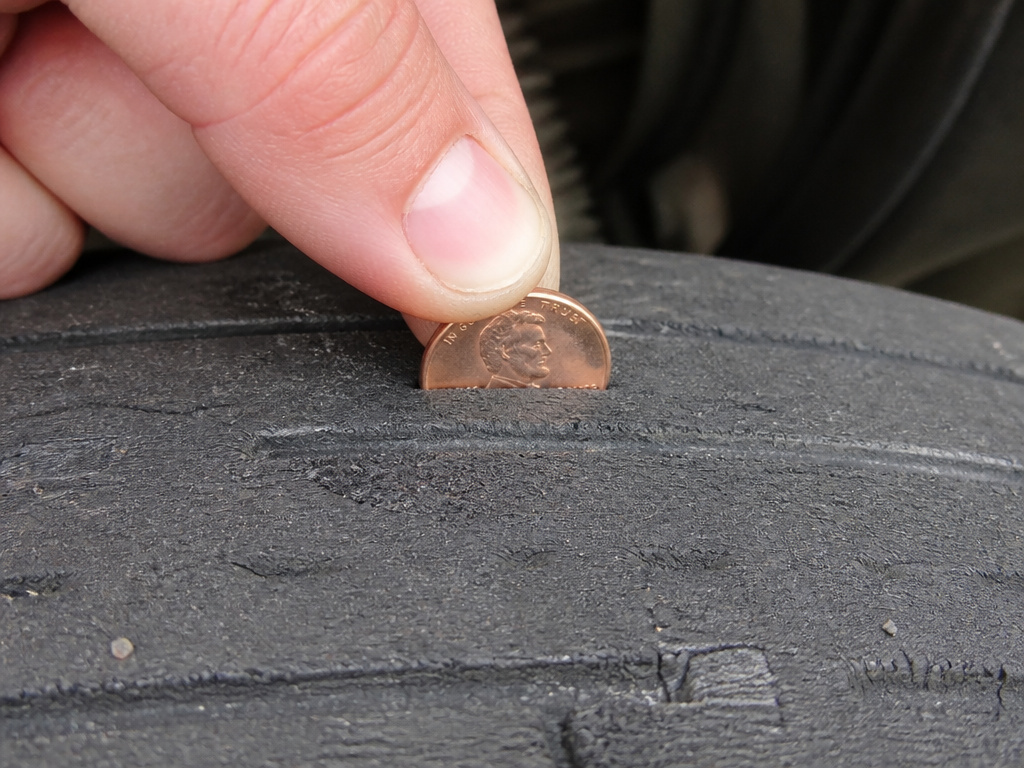
The Penny Test (The Basic Check): Insert a penny into the tread groove with Lincoln’s head upside down. If you can see the top of his head, the tread is at or below 2/32″. This is a pass/fail test for the legal minimum. It’s not a gauge of optimal safety.
The Wear Bars (The Definitive Sign): Look across the tread grooves for the built-in rubber bars. If they are flush with the tread ribs anywhere, the tire is bald. This is the manufacturer’s own “replace now” signal.
Visual and Physical Cues:
- Uneven wear patterns: Saw-toothed edges on tread blocks, excessive wear on one shoulder. This often points to alignment issues or skipping tire rotations, but it makes baldness happen faster.
- Vibration or humming: Especially at higher speeds, which can indicate tread separation beginning or severe uneven wear.
- Difficulty in wet weather: The car feels floaty, slides during gentle cornering, or the anti-lock brakes activate more easily during moderate stops.
A proper visual tire inspection should look for these signs, plus cracks, bulges, and any object lodged in the tread.
What to Do If Your Tires Are Bald
You’ve checked, and they’re at or below 2/32″. Here’s the sequence.
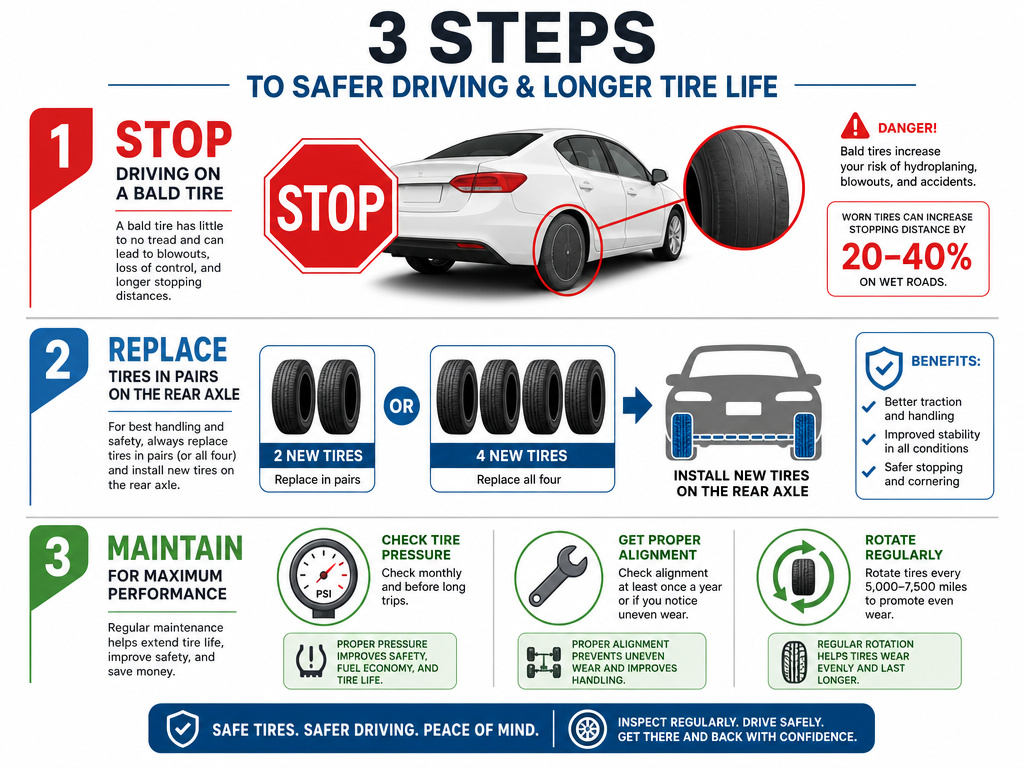
- Stop driving on them immediately for anything other than a direct trip to the tire shop. The 10x failure risk describes a current condition, not a figure for future planning.
- Replace at least two tires, and preferably all four. As the NIST data shows, one bald tire usually means others are close behind. Mismatched tread depths can affect handling and stability, especially on all-wheel-drive vehicles. For the safest, most predictable handling, mount the tires with the deepest tread on the rear axle, regardless of which axle drives the car. This helps prevent oversteer (the rear end sliding out) in wet conditions.
- Address the root cause. Baldness is the symptom. Why did it happen?
- Underinflation: The number one cause of premature wear. Check pressure monthly with a gauge; don’t rely on the TPMS light. Learn the signs of underinflation.
- Misalignment or worn suspension: Get an alignment check with your new tire installation.
- Lack of rotation: Tires should be rotated regularly according to the vehicle manufacturer’s recommendations to promote even wear.
Common mistake: Replacing only the tire that looks worst. Wear happens as a set. A significant tread depth difference between axles can alter vehicle balance and is a clue that other tires are also at the end of their service life.
Does driving on bald tires use more gas?
While the fact sheet does not contain specific data on bald tires and fuel economy, the principle is straightforward. Tires with inadequate tread depth provide reduced traction, which means the engine must work harder to propel the vehicle forward, especially during acceleration. This increased rolling resistance directly translates to higher fuel consumption. Maintaining tires with sufficient tread is a basic part of vehicle efficiency. Worn tires are a sign of overall neglect that often coincides with other issues like improper inflation, which also hurts fuel economy.
What causes tires to wear out too fast?
Premature tread wear is rarely just bad luck; it’s usually a sign of a correctable problem. The most common causes are chronic underinflation and improper wheel alignment. With radial tires, you usually cannot determine underinflation by visual inspection alone, so regular pressure checks are essential. Misalignment causes the tires to scrub against the road at an angle instead of rolling straight, wearing one edge rapidly. Other factors include failing to rotate tires regularly, overloading the vehicle, and aggressive driving habits. A sizeable fraction of tires in service show uneven wear patterns from these issues.
Frequently Asked Questions
How long can I drive on a bald tire?
You can’t plan a distance. A tire at 2/32″ has exhausted its safety margin. Every mile is high-risk. The only acceptable drive is a slow, careful trip directly to a facility to have them replaced. Think about blocks, not miles.
Is the penny test accurate?
It’s accurate for determining if tread is at or below 2/32″, which is the legal minimum. However, it’s a binary test. It doesn’t tell you if your tread is at 4/32″ or 5/32″. For that, you need a tread depth gauge. More importantly, wet-weather performance degrades significantly as tread depth decreases.
Can bald tires cause a blowout?
Yes, absolutely. Bald tires are more susceptible to punctures that can cause rapid air loss. They are also more vulnerable to heat buildup from underinflation or overloading, which can lead to a structural failure of the tire’s internal belts, a classic blowout. The thin remaining rubber provides little protection.
Are bald tires illegal?
Yes. Driving with tires at or below 2/32″ tread depth is illegal in all states, as it violates vehicle equipment safety standards.
Do I need to replace all four tires if only one is bald?
You must replace the bald tire. However, you should almost always replace at least its pair (both fronts or both rears) to maintain even handling. If the other tires are also near the wear bars (which is likely), replacing all four is the safest, most economical long-term decision. Installing one new tire with three worn ones is a mechanical mismatch.
The Bottom Line
The dangers of driving on bald tires are measured in thirty-seconds of an inch. At 2/32″, the engineering failsafes are gone, and the statistics from government tire use analysis take over: a 10x greater chance of leaving you stranded, or worse.
The action is simple, mechanical, and mandatory. Get a tread depth gauge, they cost less than a coffee. Check your tires monthly, focusing on the shallowest groove. If any spot hits 2/32″, your tire replacement decision is already made for you. Don’t wait for a vibration, a wet-weather slide, or a loud bang. The data shows that by then, you’ve been driving on borrowed time.
Understanding the dangers of driving on bald tires is critical because your tires are the final layer in every command you give your car. When the tread is gone, those commands start to go unanswered. Keep enough rubber between you and the road to keep the conversation going.
