
How to Find the Right Tire Size for Your Car: Step-by-Step
This post contains affiliate links. As an Amazon Associate, we earn from qualifying purchases.
To find the correct tire size for your car, check three places in this order: the tire information placard on the driver’s side door jamb, the specifications in your vehicle’s owner’s manual, and the sidewall of your current tires. You must match the size exactly, including width, aspect ratio, rim diameter, load index, and speed rating. Mixing sizes or types can cause your anti-lock brakes and stability control to work inconsistently.
That last point about electronic systems is where most generic advice stops. The Honda manual is explicit: using a different size or construction affects wheel speed sensors, which can make the ABS and Vehicle Stability Assist (VSA) activate when it shouldn’t or fail when you need it. This is why it’s critical to know how to find the correct tire size for your car. This isn’t about a rough ride; it’s about the systems that keep you from skidding.
What follows is a walk through the three sources, a translation of the sidewall code, and the rules for when you can, and absolutely cannot, deviate from the factory spec.
Key Takeaways
- Your car’s definitive tire size is on the door jamb placard or in the owner’s manual, not just the current tires.
- The load index and speed rating are essential safety specifications; a mismatched load index can lead to tire failure under weight.
- Mixing radial and bias-ply tires reduces braking, traction, and steering accuracy according to Honda’s safety warning.
- Kia recommends tires be replaced after approximately six years of normal service, regardless of tread depth, while other manufacturers may focus on tread wear, damage, and pressure.
- Changing the overall tire diameter from what is fitted at the factory may cause your speedometer to read incorrectly.
The Three Places to Look for Your Car’s Correct Tire Size
Start with the source that hasn’t been changed by a previous owner or a quick tire shop swap. The placard on the driver’s side door jamb typically lists the factory tire size and correct inflation pressure. If the sticker is missing or faded, your owner’s manual is the backup. It will have a section, often titled “Wheel and Tire Specifications,” with the exact OEM combinations.
Where this goes sideways: Relying only on the tires currently on the car. A used vehicle might have the wrong size installed. The placard and manual tell you what the car was designed for; the sidewall tells you what someone put on it.
The third place is the tire sidewall itself. You need this to verify what’s installed or to get the full code if the placard only lists a primary size and you have a staggered setup (different front and rear sizes). All three sources should agree. If they don’t, the placard and manual win. Cross-reference these numbers with a reliable guide on how to read tire size to confirm you’re reading them correctly.
Decoding the Tire Sidewall: What P215/65R17 108T Actually Means
The string of numbers and letters on the sidewall is a precise spec sheet. Here’s the breakdown, using the common P-metric system.
| Code Section | Example (P215/65R17 108T) | What It Means | Why It Matters |
|---|---|---|---|
| Type | P | P-metric, for passenger vehicles. May be LT (Light Truck) or absent (Euro-metric). | Determines load capacity formula and inflation pressure tables. |
| Width | 215 | Section width in millimeters. | Affects grip, steering response, and potential fender clearance. |
| Aspect Ratio | 65 | Sidewall height as a percentage of the width (65% of 215mm). | Influences ride comfort and the overall tire diameter. |
| Construction | R | Radial ply construction. Could be D (diagonal/bias) or B (belted-bias). | Radial is standard; mixing with bias-ply tires is dangerous. |
| Rim Diameter | 17 | Wheel diameter in inches that the tire is designed to fit. | Must match your wheel’s diameter exactly. |
| Load Index | 108 | Numerical code for maximum load capacity (108 = 2,205 lbs). | Non-negotiable. Must meet or exceed the vehicle’s requirement. |
| Speed Rating | T | Maximum sustained speed capability (T = 118 mph). | Must meet or exceed the vehicle’s top speed capability. |
The load index is critical. As the Kia manual states, when replacing tires, “always use a tire that has the same load rating as the factory installed tire.” Going lower risks a blowout under load. The speed rating is part of the official NHTSA tire safety standard for a reason, it certifies the tire’s structure can handle the heat generated at speed.
You’ll also find the DOT serial number, ending in a four-digit date code like “1622” for the 16th week of 2022. Kia recommends replacement after about six years, as the compound degrades. That date is your starting point for any tire age concern.
How to Use Your Vehicle’s Make, Model, Year, and Trim
Online tire finder tools are convenient for finding the correct tire size, but they are only as good as the information you provide. The “trim” level (e.g., LX, Touring, Z71) is often the key. Different trims can have different wheel sizes, brake caliper sizes, and performance packages that affect fitment.
Easy to miss: A base Honda Accord LX might come with 16-inch wheels, while the Sport trim has 19s. Entering just “2023 Honda Accord” might give you a default size that doesn’t match your specific car.
If you don’t know your trim, your VIN (Vehicle Identification Number) is the definitive key. You can decode it using free online tools or call a dealership parts department with the VIN to get the exact factory tire and wheel specifications. This is the most reliable method for used cars or if the door placard is missing. It eliminates the guesswork that comes from using license plate look-up services, which can be inaccurate.
The Rules for Changing Tire Size (The 3% Rule)
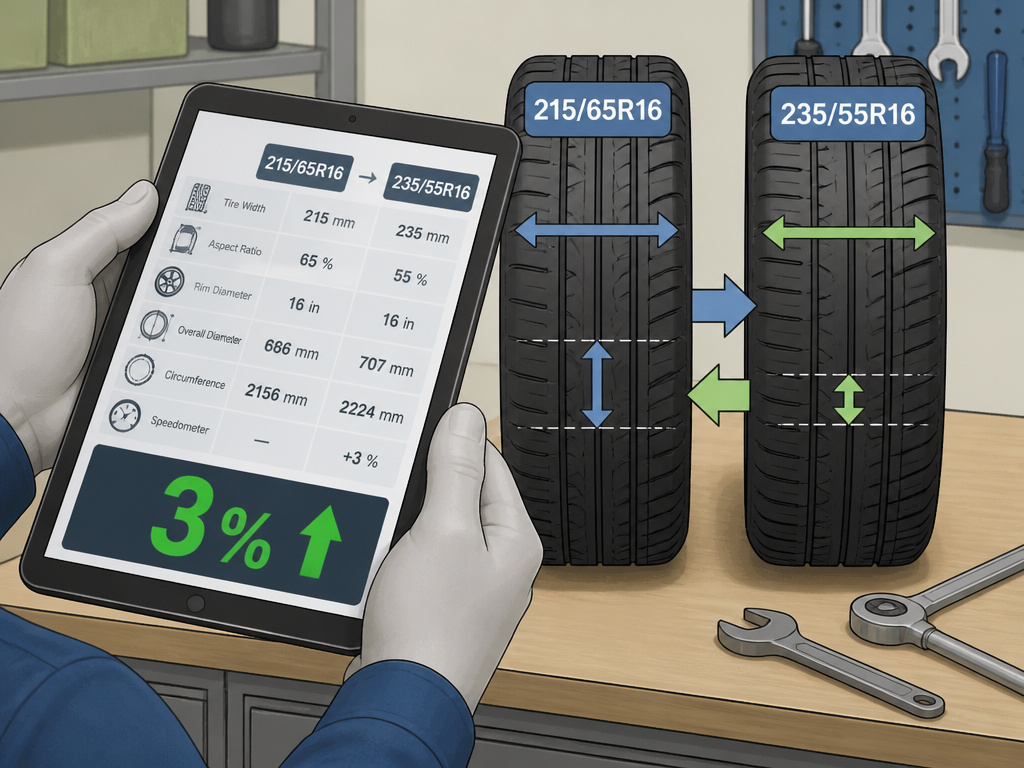
Sometimes you want a different size, for looks, performance, or availability. The universal rule is to keep the change in overall diameter under 3%. A larger change will throw your speedometer and odometer off, and as the Ford manual warns, it can cause the ABS to miscalculate wheel speed.
You can’t just swap one dimension. A wider tire (e.g., going from 215 to 235) usually requires a lower aspect ratio (e.g., from 65 to 55) to keep the overall diameter similar. This is where a good tire calculator is essential. You input your original size and your proposed new size, and it shows the diameter difference, speedometer error, and clearance changes.
The rule exists for safety, not to limit options. A change within 3% is generally considered acceptable by the industry and won’t confuse your car’s computer. Beyond that, you’re altering the final drive ratio and the calibration of every system that uses wheel speed.
Load Index and Speed Rating: The Non-Negotiable Specs
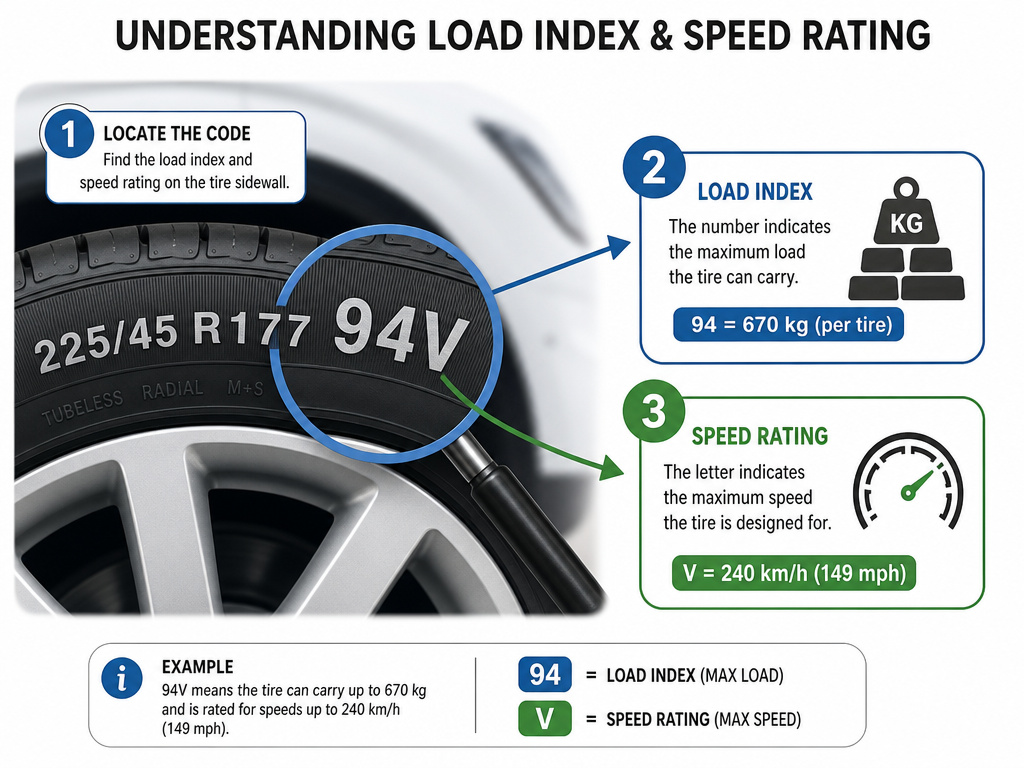
These two numbers are the tire’s safety credentials. The load index is a code. The load index is a numerical code associated with the maximum load the tire can carry. Your vehicle’s Gross Axle Weight Rating (GAWR) dictates the minimum load index you need. Always match or exceed the OEM tire’s load index. Going lower is asking for a sidewall to buckle under the weight of passengers and cargo.
The speed rating is part of the tire size designation and corresponds to the tire’s designed maximum safe operating speed. They indicate the tire’s ability to dissipate heat at sustained high speeds. You must use a tire with a speed rating at least equal to your vehicle’s maximum capability. Putting T-rated tires on a car that can do 130 mph is a risk. The tire could overheat and fail.
Common mistake: Prioritizing treadwear or price over the load and speed specs. Those grades are for comparison within a correct size. If the load index is wrong, nothing else about the tire matters.
Mixing Tires, Replacing in Pairs, and Other Critical Rules
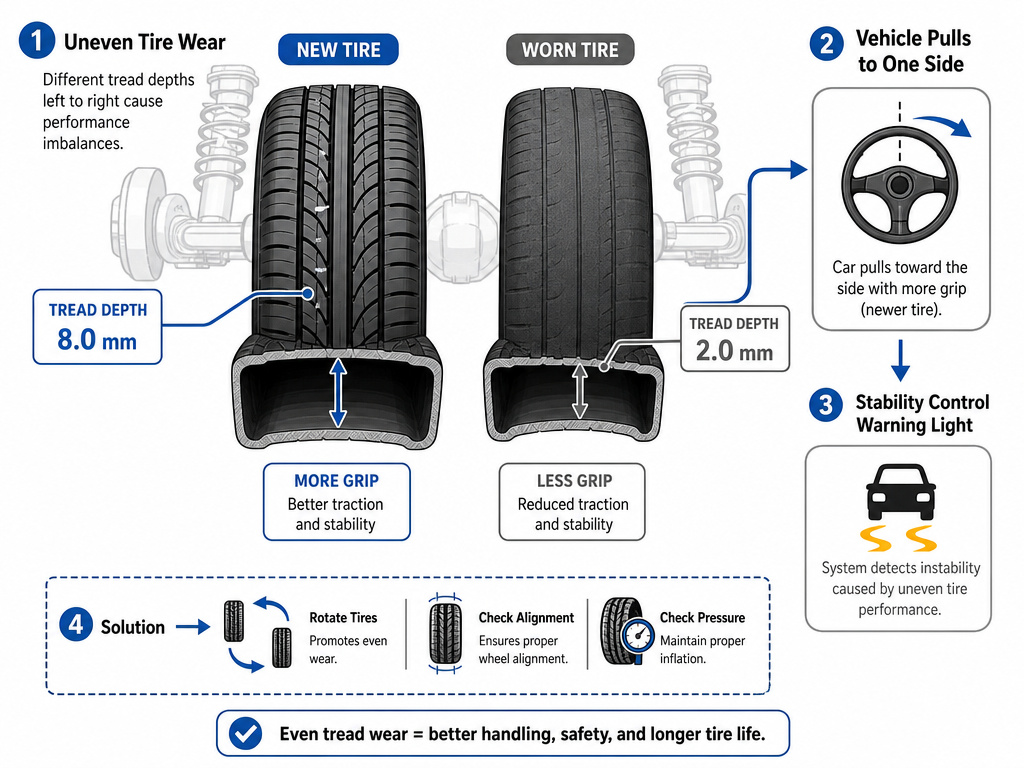
The manufacturer’s replacement rules are blunt for a reason. Honda’s manual lays them out clearly: replace all four tires at the same time is best. If not, replace the two front or two rear tires as a pair. Replacing just one tire can seriously affect handling.
This is because even minor differences in tread depth and wear patterns between tires can cause the vehicle to pull or the stability control to engage erratically. The same logic applies to mixing tire types. Honda states mixing radial and bias-ply tires reduces braking ability, traction, and steering accuracy. Never mix and match.
Also, if you replace a wheel, its specifications, diameter, width, offset, and bolt pattern, must match the original. An incorrect wheel can cause a tire to sit improperly, leading to premature wear or clearance issues. Our guide on matching tire to rim details this fit.
When the Standard Advice Doesn’t Apply: Staggered, Spares, and Low-Speed Vehicles
Some scenarios break the standard “all four the same” rule. High-performance cars often have a staggered fitment: wider tires in the rear. In this case, you replace axle pairs with the correct, different sizes. The door placard or manual will list both front and rear sizes.
Temporary spares are another exception. The safety standards explicitly allow for temporary spare tire assemblies that don’t match the regular tires. Their purpose is short-term, low-speed use only to get you to a repair shop.
Finally, the regulations themselves have an edge case. The DOT tire selection regulations exclude vehicles that can’t exceed 80 km/h (about 50 mph) from certain requirements. This covers some low-speed neighborhood electric vehicles and industrial equipment.
What does the P or LT in my tire size mean?
The letter at the start of your tire size indicates its type and intended use. A ‘P’ stands for P-metric and means the tire is intended for passenger vehicles or light trucks. The letter that follows the width and aspect ratio numbers indicates the tire’s construction. An ‘R’ means radial ply construction, which is the standard for modern vehicles. Other letters you might see are ‘D’ for diagonal or bias ply construction and ‘B’ for belted-bias ply construction. It is critical to use the same construction type as your original tires. Mixing radial and bias-ply tires on your vehicle can reduce braking ability, traction, and steering accuracy. Always use the size and type of tires recommended in your vehicle’s owner’s manual.
Frequently Asked Questions
How do I figure out what size tire I have on my car?
Look at the sidewall of the tire for the largest string of letters and numbers, like P215/65R17 108T. That’s your current tire’s size and specification. To find the size your car should have, check the tire placard on the driver’s side door jamb.
What is the 3% rule for tires?
It’s a guideline that says the overall diameter of a new tire should be no more than 3% larger or smaller than the original factory tire’s diameter. Staying within this limit minimizes speedometer error and avoids interfering with anti-lock brake and stability control systems.
Is 275 considered a wide tire?
For most passenger cars and SUVs, yes, 275 millimeters is considered a wide tire. It’s common on performance sedans, sports cars, and larger SUVs. Width must be paired with the correct wheel width and checked for clearance against the suspension and fender liner.
Can I use 235 tires instead of 225?
Maybe, but you can’t just swap the width. A 235 tire is 10mm wider. To keep the overall diameter roughly the same and stay within the 3% rule, you would typically need to reduce the aspect ratio. You must also verify the load index is sufficient and that the wider tire fits your wheel and doesn’t rub. Use a tool for converting metric tire sizes to inches to check.
The Bottom Line
Read the sidewall, but trust the door jamb. The numbers stamped on your tire tell you what’s there now; the placard tells you what needs to be there for the car to work as designed. The load index and speed rating are the two specs you never compromise on, everything else about a tire is secondary to its ability to carry the weight and handle the speed.
If your tires are over six years old, start planning their replacement regardless of tread. The chemistry inside is breaking down. And if you’re considering a different size, run the math through a calculator first. A change that looks right on paper can rub at full lock or confuse your ABS. The details decide it.
